Welsh Apples by Carwyn Graves

Carwyn has been involved with the history and growing of apples for many years now, and has written books on the subject, firstly “Afalau Cymru”, also published in English as
“Apples of Wales”. This was in parallel with a book which records the first National collection of Welsh apple varieties, and both books were best sellers within the first 3 months. He then published a book on Welsh food stories and the more recent story of the Welsh landscape. This begins with the fortunes of orchards here and the fact that so muchof the environment has been lost to industrialisation.

We started with a quiz about the names of varieties of apple that have been and, to some extent, are still grown in Wales. Not sure how well we did here with our answers, but some of the names made the audience laugh and we found that some of the unlikely sounding ones actually were apples!

There are apparently over 7000 known varieties of apple in the world, but the currently commercially available apples were all bred originally from the Golden Delicious, Red Delicious and Cox, and unfortunately most on the supermarket shelves were picked around 6 months ago. The most prolific apple producers in the world are USA, Poland and China. Historically and even recently, Wales has not been very closely associated with apple production – Lynne Yates mentioned in her cookbook (2010) that “Wales has never produced much fruit as the soil conditions are not suitable”.

However, in the Mabinogion (combining Celtic mythology and Arthurian romance, written 12th-13th century), Queen Rhiannon at her wedding feast orders her husband’s men to “wait outside in the orchard”. There are many Welsh names which can be linked with the word apple, for instance Afallon (or Avalon) meaning place of fruit/apples. The Bishop of St Davids in 1326 had gardens and orchards and many ordinary people had fruit trees and bushes. There is a record of 2 women in 1390 in St Asaph who had 2 orchards.

After 1536, following the Act of Union then the dissolution of monasteries, it seems the rich became richer and nobles of the land were able to invest in fruit production; there is a record from 1618 documenting the growth of lemons, oranges, figs, nectarines etc which had not been grown in Britain previously. Apple trees by this time were being distinguished between sweet and sour apples and it is recorded that a quantity of sweet apple trees in fruit were worth 15 pigs!

In the 1700s small plots were often available to cottagers for growing veg, flowers, herbs and 5 or 6 apple trees, and gardens were beginning to be seen as places of pleasure and gentle recreation. A land use survey around this time recorded that, of 850 acres in Brecknockshire, 350 acres were used for apples. Around this time, apples were embedded within Welsh culture via place names and many allusions were being made to fruit in folk songs and poetry.

The First and Second World Wars obviously had a great effect on fruit production and many trees were grubbed out to provide land for the most necessary vegetables – if you had a couple of apple trees in your garden they must have been highly prized.

It is not true that apple trees will not survive in very wet areas, neither is it true that the trees must be correctly and frequently pruned. The Bishop’s Palace near Carmarthen has a very old orchard, still flourishing and producing, and yet when the River Towy floods, the waters can often be seen half way up the confines of the walled garden.

To conclude the talk, a discussion was held around the loss of skills within horticulture and fruit growing. The Welsh government is taking small steps to address this and there are some subsidies for orchards plus encouragement of the use of apples for their nutritional value, but some joined up thinking is required around production and subsidies and how to use the food being produced. The government does need to facilitate and not lead because there are people outside of government who have the knowledge required.

Several questions were put to Carwyn about pruning and he encouraged not to overprune and certainly not to prune in the first year. Also, when did the idea of pruning begin? – apparently the Romans knew about it..

We really enjoyed the talk; Dawn thanked Carwyn and a raffle was held for one of Carwyn’s books.

Ten Ways to Use Willow in the Garden (and Beyond) by Justine Burgess


Justine began working with willows as a basket weaver ten years ago; she had always been interested in gardening and then eight years ago she and her husband Alan founded West Wales Willows on ten acres of land in Gwernogle (two acres of which are devoted to willow). They hold the National Collection of Salix for Plant Heritage, currently the only one in the country. The nursery was visited by Frances Tophill for  one of the Gardener’s World Winter Special programmes at the end of 2023, and has also featured on ITV’s Coast and Country series.

The nursery will be open for the NGS on 22 June from 10am to 4pm, and will be open as part of the Tywi Valley Open Studios from 27 July to 4 August, running taster willow weaving workshops on 29 July. An Open Weekend 4-6 October, when the winter colours are already starting to show through, will focus on growing willow.

On to the ten ways to use willow:

No. 1 – Plant Willow for Pollinators. Willow is very early flowering, some varieties as early as late January and early February in a ‘normal’ year (this winter it was considerably earlier). Five years ago, the National Botanic Garden of Wales analysed the pollen content of spring honey, and found that it was made up of 80-85% willow pollen, showing just how important it is for bees. This would probably mostly have been the wild growing willow such as the goat willow – Salix caprea – and the crack willow – S. fragilis. Of the more decorative varieties, S. udensis ‘Sekka’ is a magnet for all sorts of insects including bees, wasps and even bluebottles! S. gracilistyla ‘Melanostachys’ has black catkins, and makes a very good-shaped shrub in the garden, reaching only 7ft after a number of years. S. gracilistyla ‘Mount Aso’ has bright pink catkins, and is also not huge.

No. 2 – Plant for Winter Colour. The winter colour of willow stems ranges from pale white through yellow and orange, green and brown, to purple and black. The purple-barked willow is Salix daphnoides, the black-barked willow is S. nigricans, and the orange-barked willow is often a form of S. alba ‘Britzensis’. It is also worth remembering that there are alpine willows, growing no more than 2 ft tall. Frost intensifies the stem colour of all willows.

No. 3 – Plant a Fedge. What’s a fedge? It’s a cross between a fence and a hedge. It is a decorative barrier, rather than a stock-proof one, created by planting willow stems in the shape of a lattice. To keep the fedge at a reasonable size, it is best to cut off all the current year’s growth once the leaves have fallen. S. nigricans, the black-barked willow, is stunning when planted in this way. 

No. 4 – Plant Something Bigger. This could be something like a willow dome, or a willow tunnel. To create stability, you need to plant the willow rods 12 inches into the ground. Willow doesn’t like competition, so in order to get it to grow strongly you need to use membrane; Justine has recently been experimenting with cardboard and wood chip to see how they will perform in place of membrane. Some people have used willow to create mini-domes to provide shelter from the sun in summer for chickens and for dogs. In Germany a willow cathedral has even been created. 

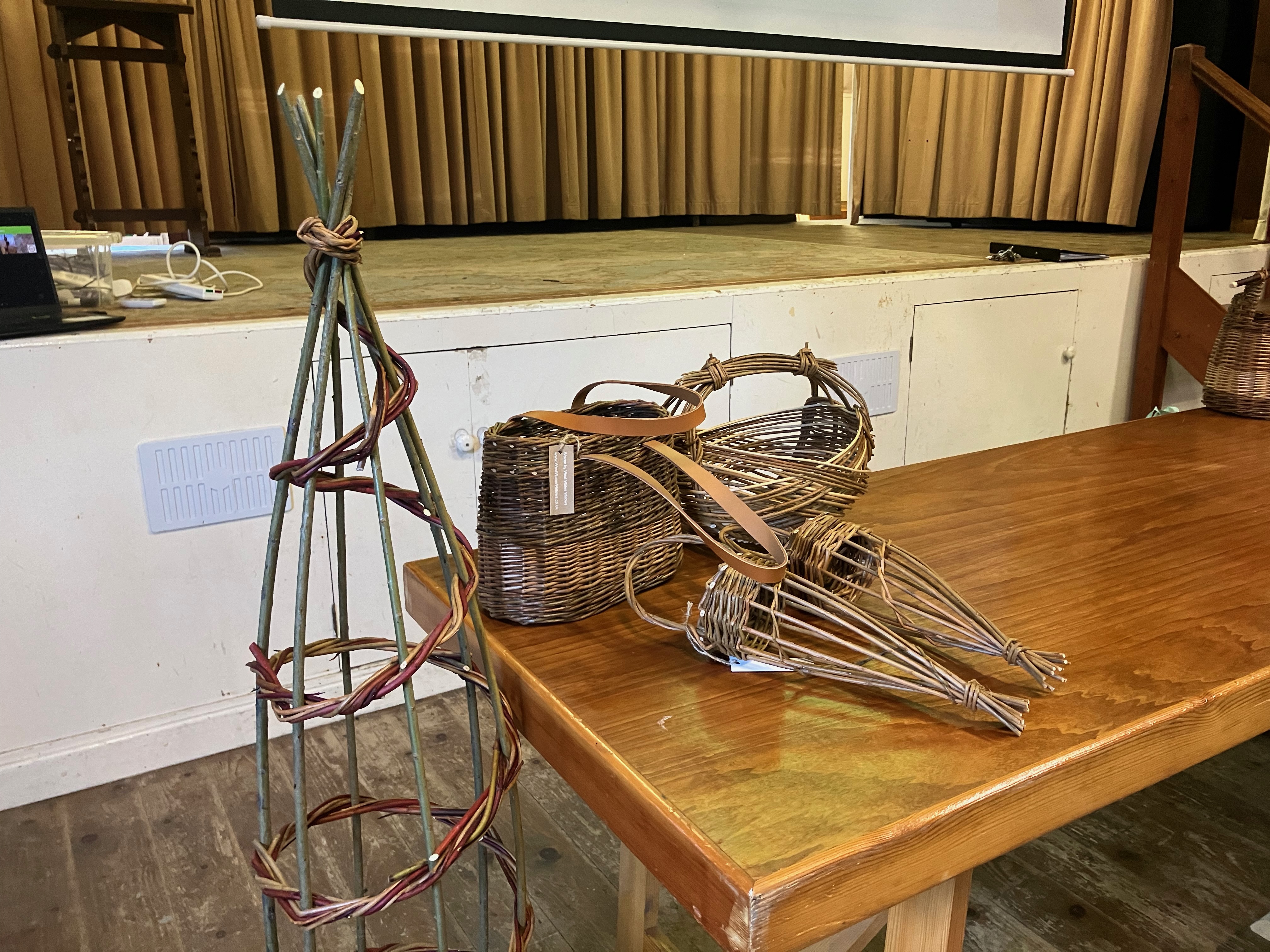
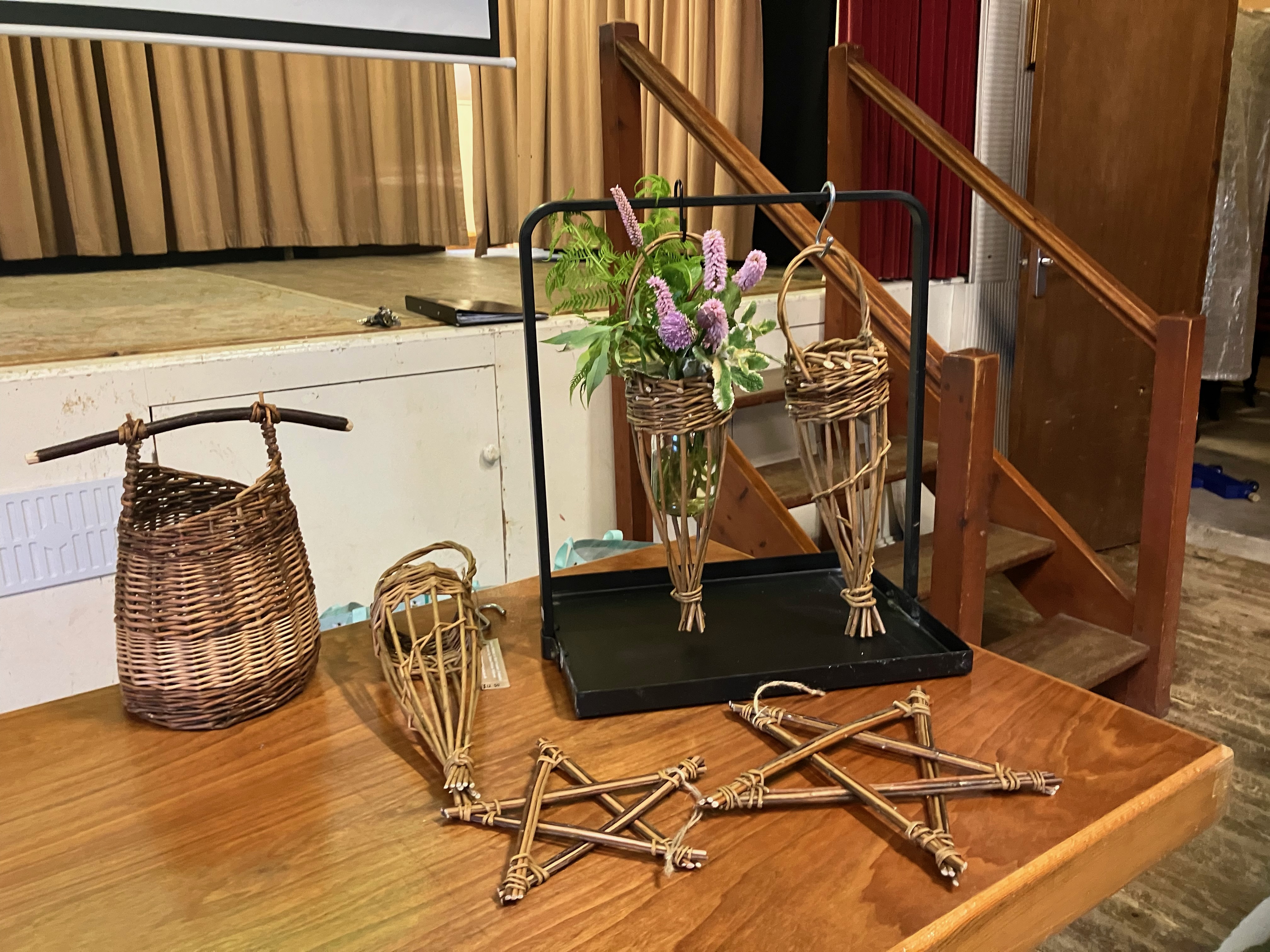
No. 5 – Use Willow Baskets. Willow stems , of course, are perfect for weaving baskets – and what could be better than collecting your own fruit and vegetables in baskets and trugs woven from your own willow!

No. 6 – Incorporate Willow Garden Structures. In the vegetable garden you can use willow to create supports for runner beans and sweet peas as well as mini-pumpkins. Willow also makes a great base for a wedding arch decorated with flowers and greenery. The only thing is that willow structures don’t last forever – four seasons is about the limit.

No. 7 – Make Willow Water. The bark of willow is packed full of growth hormones at the base of the stem when in growth. Take one-year-old willow stems, cut them into 1.5-inch chunks and cover them with water. Use about one-third willow to two-thirds water. The water will only last for one to two weeks before you have to make another batch, but it can be used as a replacement for hormone rooting powder. 

No. 8 – Chop and Drop (Ramial Woodchip). One- or two-year old willow wood, chipped, which breaks down really fast, is amazing for feeding fruit trees. It is also brilliant for making hot beds. You can use wild willow for this. The wood should be cut no later than May, because after that you won’t get much regrowth. The leaves from the wood can be dried, chopped, and then go into the compost bin.

No. 9 – Build a Dead Hedge. Dead hedges are great homes for insects and can serve as good temporary fences.

No. 10 – Make Something Fun! Willow is great for making sculptures – for example, a stag, a hare, even just a big ball.

Justine then took questions from the audience. She recommended Salix nigricans and S. triandra ‘Blacktop’ as the best black-stemmed willows. She confirmed that willows need quite a lot of sun – about 6 to 8 hours in the summer, so you shouldn’t plant them on the north side of a hedge. They also don’t like being next to established trees. They need a lot of water, although they don’t have to be in wet ground. They don’t like chalky ground, and love clay or clay on shale. Willow stems should be cut during the dormant season. As they dry, they lose one-third of their width. They should be allowed to dry for three to four months, then rehydrated. A bundle of 5-foot long willow lengths should be submersed under water for 5 days to fully rehydrate for weaving.

West Wales Willows run a variety of different courses, at Gwernogle, at Myddfai Community Hall, at Abergwili and at Denmark Farm Conservation Centre


Remember to browse the rest of the Cothi Gardeners’ website for other upcoming events, the Surplus to Requirements section and updates to Members’ Gardens. If you have any ideas for new content or would like to contribute a piece about your own garden, please contact cothigardeners@gmail.com.