The September meeting was chaired by our Treasurer, Rob, who greeted everyone and started the conversations by saying that his gardening year had resulted in good and bad results – rust on his garlic, mildew on his onions but a bumper apple crop!
Apple diseases were discussed and some people had experienced scab on their apple trees, for which there is no cure. The leaves need to be removed and disposed of by burning or binning them but definitely not putting them in the compost as it is a fungal disease. Jo pointed out that if, for instance, a tree is transplanted, all the leaves can be removed and it will not affect the tree greatly as the roots will continue to flourish.
We discussed the pruning of apple trees and, as Rob said, if the tree is doing well and producing decent fruit, there is no need to get too excited about pruning – if it ain’t broke,don’t fix it – and don’t prune for the sake of it! Happy news in a way, as some people admitted to being nervous about doing it. If we do prune, there is a need to keep open the middle of the tree (try throwing a hat through it) and taking off water shoots which will drain energy from the tree. Rob pointed out that pruning really needs to be learnt in a practical way, i.e. when we’re in front of an actual tree with a person who has the know-how. Learning on a youngish (8 – 15 years old) tree would work best.
Pressing apples is a way to use excess; juice can be bottled and the bottles then pasteurised, or it can be heated in a large pan and then bottled. This way, it will last for months. There are apple pressing days in the grounds of Lampeter University on 27th September, at Watson & Pratts Lampeter on 28th September, or at Aberglasney Gardens on 5th October. Take your apples and containers for the juice.
We also discussed pear trees; it’s best to pick the pears before they are fully ripe, then ripen them indoors so that they don’t go mushy. The difficulty of netting cherry trees was discussed, but no-one had a real answer on that one.
Sandy told us that she successfully picks redcurrants before they are ripe and then ripens them indoors, and it seems to work. Blueberries seem to flourish in the ground mostly and are happy even in flooded areas as they like their feet being wet, as do cranberries. Tracey wanted to know if anyone has picked Leycesteria (Himalayan Honeysuckle) berries and it seems it might not be worth it, though they do make good jam.
We talked about blossom end rot in courgettes, tomatoes, peppers etc; the cause may be erratic watering. We had general chats about preserving heat in a greenhouse or polytunnel, Rob advises that, although a through-draught is necessary during the day, closing everything up at night (especially when you have in there a water container which will have warmed up during the day) is usually best.
We discussed the use of the formula called Dipel for the eradication of caterpillars on brassicas. Dipel is a natural bacterium which affects the digestive system of the caterpillars and causes them to die. It cannot be purchased in the garden centre or a shop but it is available online. It is a question as to whether the dead caterpillars might be eaten by birds and kill them.
Radish pods (produced when the radish have gone to seed) are delicious and apparently the “Rat’s tail” variety sold by a company called Real Seeds are the very best if you want to eat the pods. In a similar vein, there has apparently been a trial of parsley-style leaves grown on pea shoots which produce good yields.
General information on seeds – Woolmans have now bought up Johnsons Seeds and they also supply seeds to Sarah Raven. Since the prospect of a discount for seeds from Woolmans is possible, this might be worth organising.
Carol asked about obtaining some Yellow Rattle seeds; these can probably be obtained locally from Fiona and Julian Wormald in July or August when they cut their hay.
Tracey pointed out that the posters which had been organised to advertise the club, and hopefully entice more members, need to be distributed and any help with that would be appreciated.
We were all then quite keen to have some of the delicious food on display, which had been brought to share by those present at the meeting.
October Meeting
‘Fritillaries on Four Continents’ with Robert Wallis will be the talk at our next meeting on October 15th. Bob and Rannveig Wallis are well known for their amazing collection of bulbs and their garden, Llwyn Ifan, in Carmarthenshire.. They are seasoned travellers and plant hunters and successful exhibitors for the Alpine Society Shows.
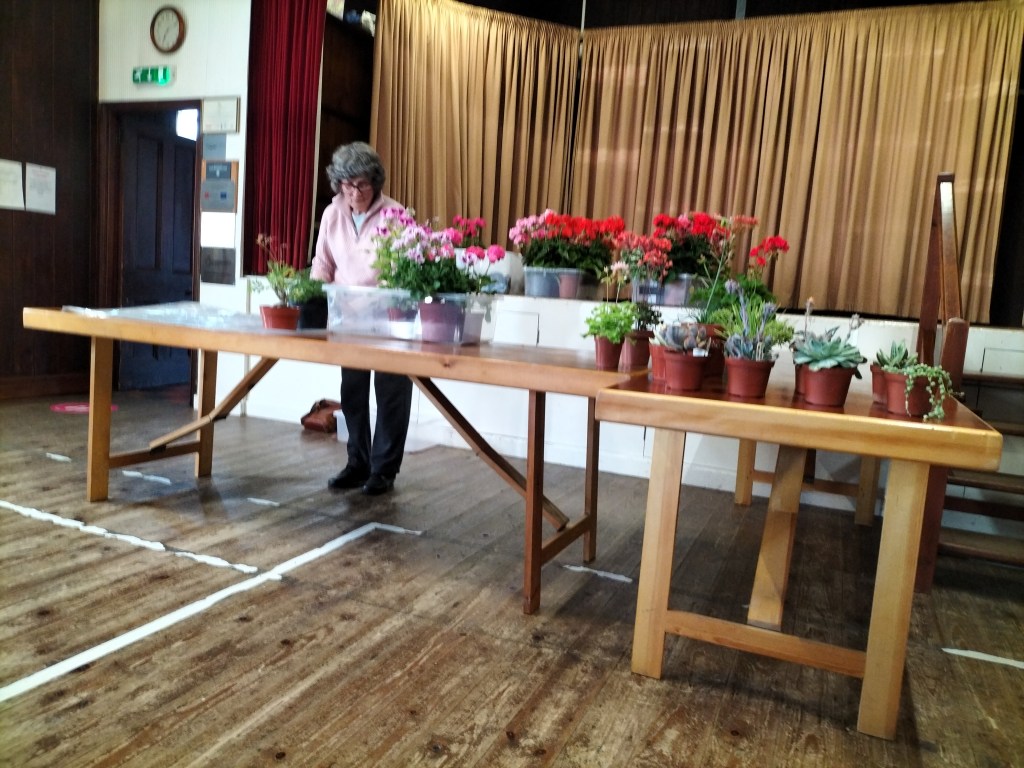
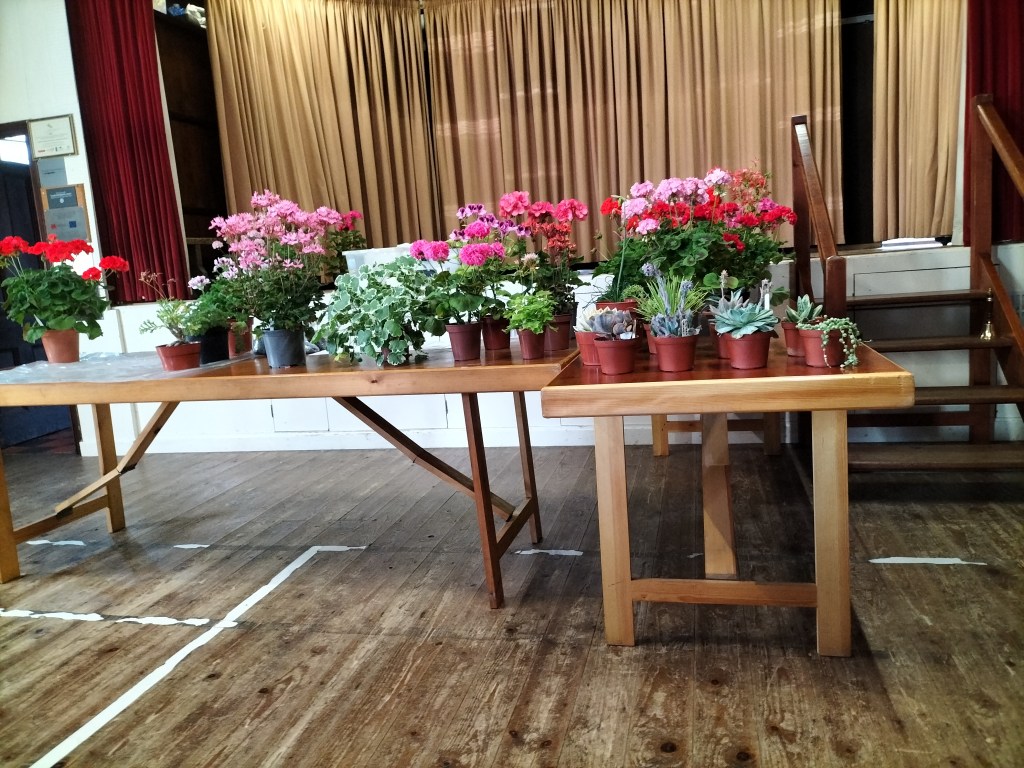
Mair firstly explained the differences between Pelargoniums and Geraniums – Pelargoniums are tender and originated in the Southern hemisphere (they are endemic to Australia and New Zealand ), whereas Geraniums are hardy and herbaceous, can be found in borders and come from the Northern hemisphere.
We had a quiz to find out who knew the difference between the two, with Mair holding up different potted plants to see if we knew whether they were Pelargoniums or Geraniums, and quite a few people did know it seems.
The name ‘Geranium’ for Pelargoniums comes from St Helena where the “Valley of Geraniums” can be found; it was given the name by Napoleon when he was exiled there, because it reminded him of the valleys of hardy geraniums in Europe. The land on St Helena was constantly shifting and the plants could be found even in the dunes which would not normally be a favoured habitat for them. They were then almost extinct there, when the trade routes were opened by the British East India and the Dutch East India shipping companies. The ships berthed in South Africa to load provisions, found the Pelargoniums and were keen to ship them back to Europe because apparently they were thought to be a cure for dysentery. In the early 18th century, they would flower in January, February and March, but were nothing like the Pelargoniums we know now and were quite scruffy with a strange scent, growing out of rocks and very tough. The Dutch particularly collected them and took them back to Holland with them.
There are now thousands of different cultivars of Pelargonium and a lot of research is carried out. Trials involving thousands of varieties, the numbers of which are whittled down to about six, are done to ensure that the required characteristics and disease resistance are present in the chosen handful.
When keeping our own Pelargoniums, the plants can get very leggy in the winter so cuttings need to be taken in late summer or early autumn and a puff of sulphur on the cut parts will really help. Mair demonstrated how to take cuttings (sharp intake of breath from the audience when she started happily chopping at the lovely plant which she had brought with her!) and explained that once the cuttings are in the compost, they should root within six weeks. She uses a mixture of coir, garden soil and compost, just fairly constantly damp, but not wet. The coir helps with drainage but obviously makes the mixture dry out quicker so they need to be checked regularly. The best time to take cuttings is September which is the ideal time to be cutting them back, and then they should put on some growth before the winter dormant phase. They can be cut back a little, usually three times between September and January. The theory goes that you need to get your cuttings in pots by the time the Malvern show comes around! Always take cuttings from the healthiest plants and, during either the growing or the dormant period, any dead leaves and flowers should be removed straight away. In the winter, the plants are happy in a cold greenhouse or porch, though if the temperature really plummets they may need to be covered.
It is possible to take cuttings and root them in water, though adding a drop of orange juice will help and the water needs to be changed weekly. The best time to feed with a good all round plant feed from June onwards and potash can be given in December and January.
There are so many different types of Pelargonium; any single variety will do very well outside and the semi-double are happy inside or out. There are also many scented varieties, with scents all through the spectrum, spicy, sweet, flowery, sharp etc. Mair has some Pelargoniums, all of which are home bred and she hand pollinates them with a paintbrush.
Mair explained that she did have a problem last year with cuttings going black at the stem end, which turned out to be the water. A drop of orange juice in the water cured the problem, so the extra acidity did the trick.
Tracey thanked Mair for her talk and for bringing her beautiful Pelargoniums for the audience to buy.
Upcoming Events
At our next meeting on Wednesday, 16 July mixed-media artist Juliet Edgar is running a printing workshop. Juliet takes nature as her inspiration when creating using macrame, eco-printing and painting. It should be a fascinating evening.
Following that, our Summer Social will be held on Wednesday, 20 August at 7pm at ‘The Plough’ in Felingwm. We’ll be sharing the most delicious pizzas, and we will also be treated to a talk by Joseph Atkin, the former head gardener at Aberglasney Gardens on Dahlias.
Richard was well-known to many of us from previous entertaining talks at our meetings and from visits to his fabulous nursery in Llandysul. So after words of welcome to members and visitors from Dawn, our Chair, without further ado the audience launched into their questions.
First up was Sandy, who asked how the changing climate was affecting Farmyard Nurseries, and how his business can help gardeners in that respect. Farmyard Nurseries is moving to peat-free compost, which is challenging. So far they are using peat-reduced compost (30% peat), although one of the issues is lack of government guidance. As much as possible is recycled, and bonfires are now banned. Generally, it would appear that the trend in the UK is for milder winters and wetter summers. Having said that, we all remember the fortnight-long cold spell in December 2022 when the temperatures dipped to -15! Richard lost many plants he wasn’t expecting to lose, including daffodils, snowdrops and Spiraeas. In the end he decided he couldn’t safeguard the Sarracenias, they would have to take their chances, and of all things they survived! So they are monitoring and adapting as they go. Richard is worried about water though. The nursery’s borehole is small; they have recently expanded to four water storage tanks, but that is really a drop in the ocean of what they need.
Talking of Sarracenias, Dawn had recently heard Richard speak on ‘On Your Farm’ on Radio 4 where he had mentioned a special feed for his pitcher plants when there are not enough flies about. Richard noted that there had been fewer flies about this summer than usual. A Sarracenia needs only about 3 flies to be viable but under normal circumstances they can consume many. One thing that some people do is to drop a fish food pellet into the pitchers. Richard uses a Floranid grass fertiliser which is very mild (2 teaspoons diluted in water in a washing-up liquid bottle) and a squirt into each pitcher.
Fiona brought up the subject of ground cover as a means of minimising bare soil and reducing weeding. What would Richard recommend? He agreed that bare soil just encourages weeds. Persicaria is a genus which has many good ground cover varieties. A less well-known form with small leaves is Persicaria vaccinifolium with a mass of pale-pink flower which goes on for months (and is also very effective in pots). For shade Chrysosplenium and also Pachysandra are very useful. Verbena corymbosa ‘Gravetye’ is good in sunny spots. There is also the tiny-leaved Gunneramagellanica for sun or light shade and damp soil. Ground-cover shrubs there are a-plenty: Potentilla, dwarf Hebes, Cotoneasters, Hydrangeas… There are over 200 Hydrangeas in the woodland garden at Farmyard Nurseries, which have really come into their own this year. You can also, depending on your soil, consider alpines as well as herbs (marjoram and oregano varieties are excellent). Richard uses mint in his wildflower meadow, as it competes with the grasses and the flowers are loved by bees.
Another question related to the depth at which new shrubs should be planted. The general advice is to plant them at the level they were at in the pot. But what about roses? We were all agreed that we no longer knew what the advice is about roses, as it seems to have changed. It always used to be that the graft point or union should be above the ground – now you sometimes see advice to plant it 4” deep. Good advice can generally be found from reputable rose growers such as David Austin and Peter Beales. Received wisdom does change over the years – delicate and very accurate rose pruning is now often replaced by using hedge cutters. A tip from Richard is never to prune your roses hard before March (before that your hard-pruned roses may be affected by winter die-back).
Ruth had grown some Echinacea plants from seed which were now a good size, and she was wondering whether to plant them out now or wait until spring. Richard warned her that generally Echinacea don’t like it in this part of the world, although you can sometimes get away with the standard E. purpurea or alba (which happily Ruth’s are). The essential thing is keep Echinacea dry through the winter as it doesn’t like the combination of wet and cold.
On the subject of seeds – there was a question about hollyhocks and whether the stems should be collected and hung up to dry inside, or whether to leave them on the plants in the garden. On clarifying that the seed was green, and therefore not yet ripe, he recommended both courses of action. It seemed to be generally agreed that for some plants such as hollyhocks and also grasses that it works to cut the stems with the seedpods still attached and lay them down directly on pots or on planting trays/guttering with perlite.
Julian asked Richard to share his two greatest successes and his worst failure during the life of the nursery. Richard replied that the very best thing to have happened was his daughter Ruth, and the worst thing that had happened was the long Covid that Ruth had suffered from, destroying her future as a potential Olympic athlete. The silver lining was that Ruth had turned turned to plants during that difficult time, in particular house plants, and now she runs that part of the nursery. The second best thing to have happened was getting to Chelsea on the first attempt! If he is honest, there had been lots of highs and Richard would do it all over again. One of his favourite things is to wander around the garden and nursery of an evening when everyone has gone home, and to see what has been achieved. Richard’s staff are a loyal and dedicated team, and he recognises that he owes them so much.
Next, a question about a damson – it’s a shrub variety, about 6’ high, from the Midlands. In six years, it has not produced a single damson! Richard said that stone fruits can be slow to get going. He asked whether it flowered well (it doesn’t), and flowers late, after the apples. Richard’s suggestion was to make the damson think that it’s dying, by chopping a circle around its roots. The other alternative is to to ring bark it, the ring being half-an-inch wide. A follow-on question involved two saplings, a wild plum and a sunset cherry, which had been given to a member in pots. Where should they be planted? Somewhere with plenty of sun and not too windy. Still on the subject of damsons, a questioner had a damson which bears very little fruit, but two seedlings have arisen nearby – would they be likely to fruit? Over seedlings you have no control, so theoretically they might. The closer to the species they are, the more reliably they are likely to fruit.
Sheena mentioned her trouble getting Japanese anemones to establish in her garden. Richard replied that it seems to be pot luck with Japanese anemones – they either like you (when they can grow very strongly) or they don’t. Erigeron karvinskianus is another.
Gordon asked about a 1’-high Eucalyptus with a single stem that he had bought for £3 – how could you resist?! The problem with Eucalyptus, particularly on a single stem, is that they have a tendency to blow over. To keep the juvenile foliage, you should cut it back hard every year, making it less likely to blow over. When cut back like that, Eucalyptus can make a great evergreen screen. Plants that generally do well in the damp soil in Wales, and can be good screens, are willows, Cornus, birch and poplar.
Carol had a question about her young ‘Bardsey Island’ apple tree, on which the lower leaves are developing brown and blotchy patches. She also has another Welsh apple, ‘Pig aderyn’, which is smaller but is doing better. The ‘Bardsey Island’ is planted close to a soakaway, and Carol wondered whether that might be affecting it. Richard thought not, unless the soakaway was making the soil very damp. He noted that smaller trees will often establish better. ‘Bardsey Island’ is a superb apple though. He added that he had quite a number of them, and they hardly fruited. The damp climate of Wales very often led to canker in apple trees. There was some debate about whether you can, or cannot, grow apples in Wales. The Club’s previous speaker in September had definitely been of the view that you can; Richard’s view is that you can’t – but sometimes you can!
Sandy asked about tall plants for a lined pond which she has recently made deeper. Options suggested were Iris, Typha minima (a miniature bulrush), plants in the Scirpus family, Pontaderia cordata, and even Equisetum. Apparently dayliles and Schisostylus also do will in water.
The final question came from Ruth, who asked about some young rhododendrons she had planted in a bed where Verbena bonariensis were becoming quite prolific. Richard was of the view that the rhododendrons wouldn’t suffer, as the Verbena are light and airy, and rhododendrons like shade, but that Ruth should just keep an eye on them. He did note that V. bonariensis will seed everywhere. Also, the young rhododendrons may well have come from Holland where they would have been forced into bud, so they may naturally pause flowering for a year or two. In fact, it would be a good thing to debud them next year, to ensure that they grow into good, strong bushes.
Farmyard Nurseries organise a Gardening Weekend every winter in Llandysul. In 2025 it will be organised for the days around 16 February. It’s a fabulous event that certainly brightens up a dreary time of year with talks, a central display and plants for sale. A date for everyone’s diary!
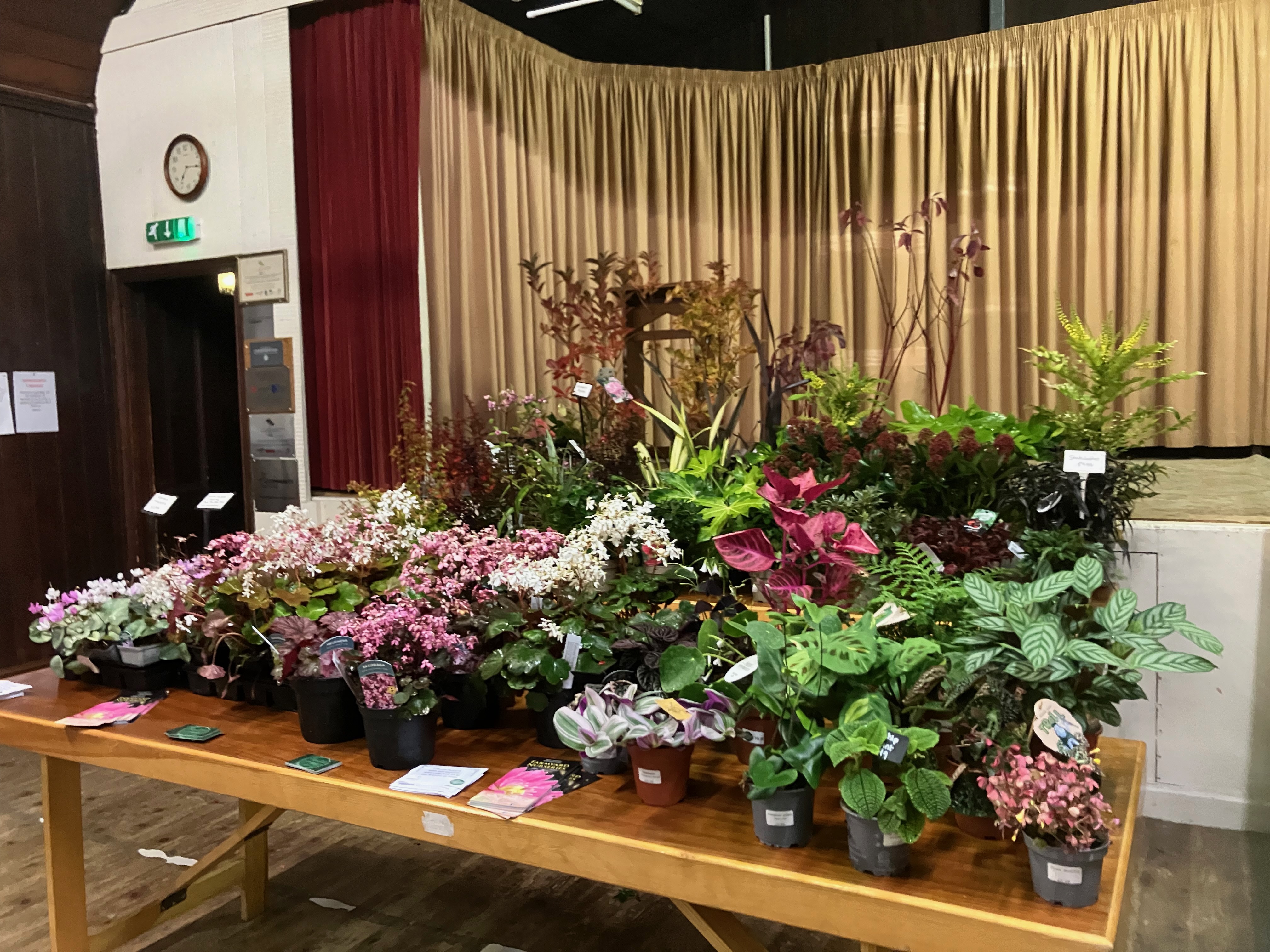
That brought to an end a very entertaining and informative hour, during which Mabel had befriended anyone in the audience she suspected of harbouring food about their person! Richard was thanked by Dawn and by an enthusiastic round of applause from the audience, and everyone made a beeline for the many beautiful plants for sale that Richard had brought to the meeting and arranged in a mouthwatering display.
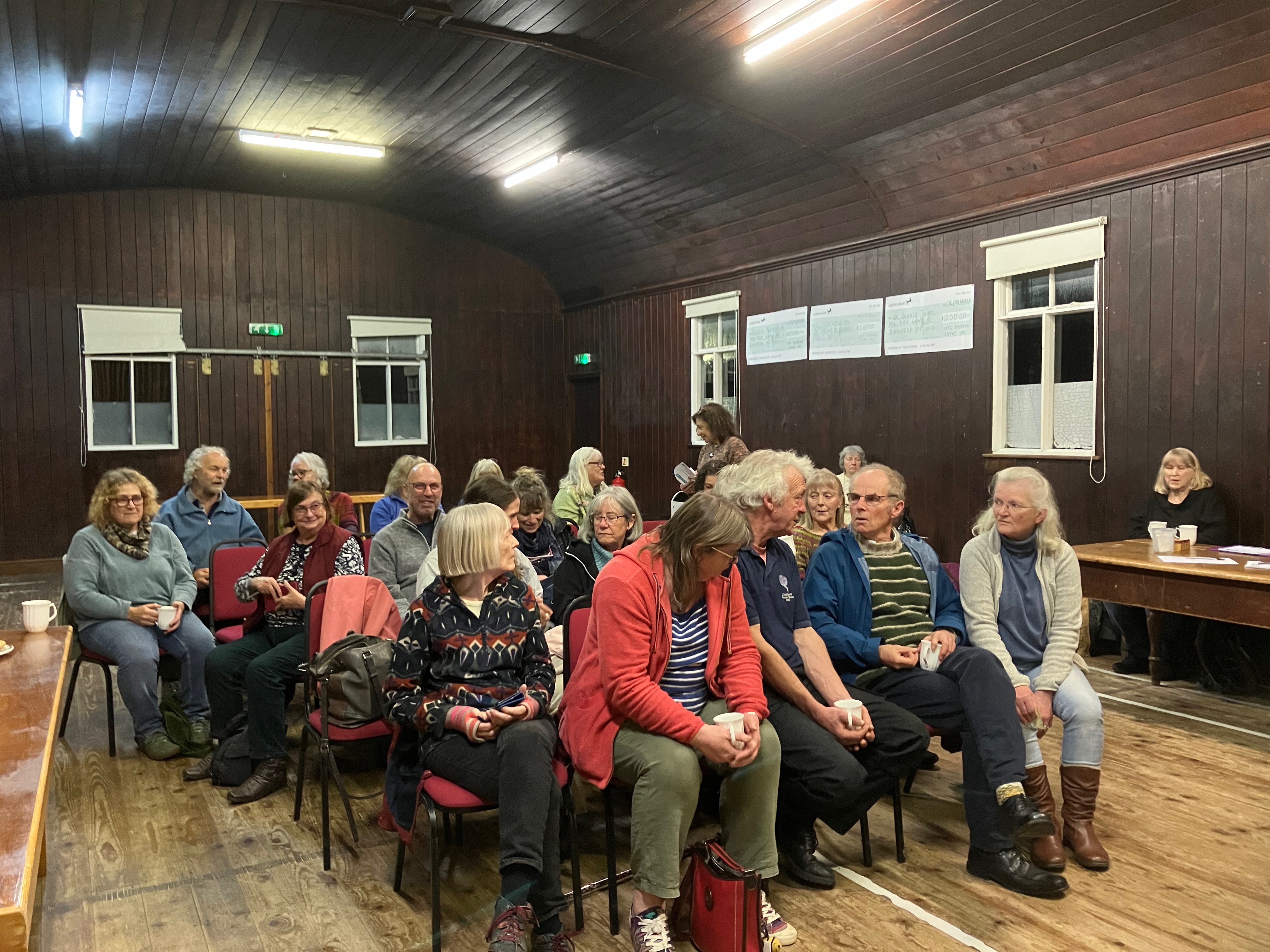
The beautiful display of pllants for saleTea and talk before the start of the meeting
Justine began working with willows as a basket weaver ten years ago; she had always been interested in gardening and then eight years ago she and her husband Alan founded West Wales Willows on ten acres of land in Gwernogle (two acres of which are devoted to willow). They hold the National Collection of Salix for Plant Heritage, currently the only one in the country. The nursery was visited by Frances Tophill for one of the Gardener’s World Winter Special programmes at the end of 2023, and has also featured on ITV’s Coast and Country series.
The nursery will be open for the NGS on 22 June from 10am to 4pm, and will be open as part of the Tywi Valley Open Studiosfrom 27 July to 4 August, running taster willow weaving workshops on 29 July. An Open Weekend 4-6 October, when the winter colours are already starting to show through, will focus on growing willow.
On to the ten ways to use willow:
No. 1 – Plant Willow for Pollinators. Willow is very early flowering, some varieties as early as late January and early February in a ‘normal’ year (this winter it was considerably earlier). Five years ago, the National Botanic Garden of Wales analysed the pollen content of spring honey, and found that it was made up of 80-85% willow pollen, showing just how important it is for bees. This would probably mostly have been the wild growing willow such as the goat willow – Salix caprea – and the crack willow – S. fragilis. Of the more decorative varieties, S. udensis ‘Sekka’ is a magnet for all sorts of insects including bees, wasps and even bluebottles! S. gracilistyla ‘Melanostachys’ has black catkins, and makes a very good-shaped shrub in the garden, reaching only 7ft after a number of years. S. gracilistyla ‘Mount Aso’ has bright pink catkins, and is also not huge.
No. 2 – Plant for Winter Colour. The winter colour of willow stems ranges from pale white through yellow and orange, green and brown, to purple and black. The purple-barked willow is Salix daphnoides, the black-barked willow is S. nigricans, and the orange-barked willow is often a form of S. alba ‘Britzensis’. It is also worth remembering that there are alpine willows, growing no more than 2 ft tall. Frost intensifies the stem colour of all willows.
No. 3 – Plant a Fedge. What’s a fedge? It’s a cross between a fence and a hedge. It is a decorative barrier, rather than a stock-proof one, created by planting willow stems in the shape of a lattice. To keep the fedge at a reasonable size, it is best to cut off all the current year’s growth once the leaves have fallen. S. nigricans, the black-barked willow, is stunning when planted in this way.
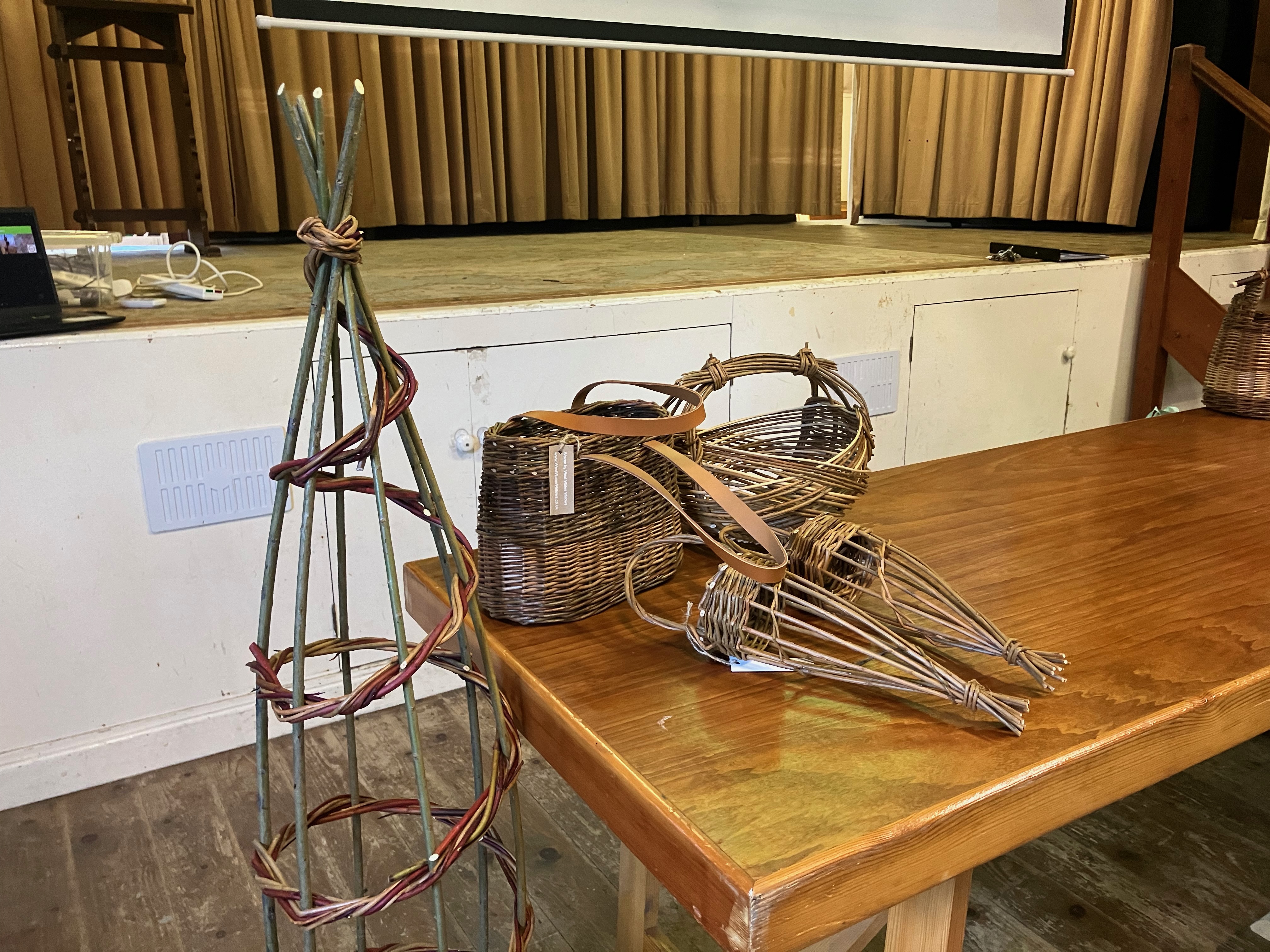
No. 4 – Plant Something Bigger. This could be something like a willow dome, or a willow tunnel. To create stability, you need to plant the willow rods 12 inches into the ground. Willow doesn’t like competition, so in order to get it to grow strongly you need to use membrane; Justine has recently been experimenting with cardboard and wood chip to see how they will perform in place of membrane. Some people have used willow to create mini-domes to provide shelter from the sun in summer for chickens and for dogs. In Germany a willow cathedral has even been created.
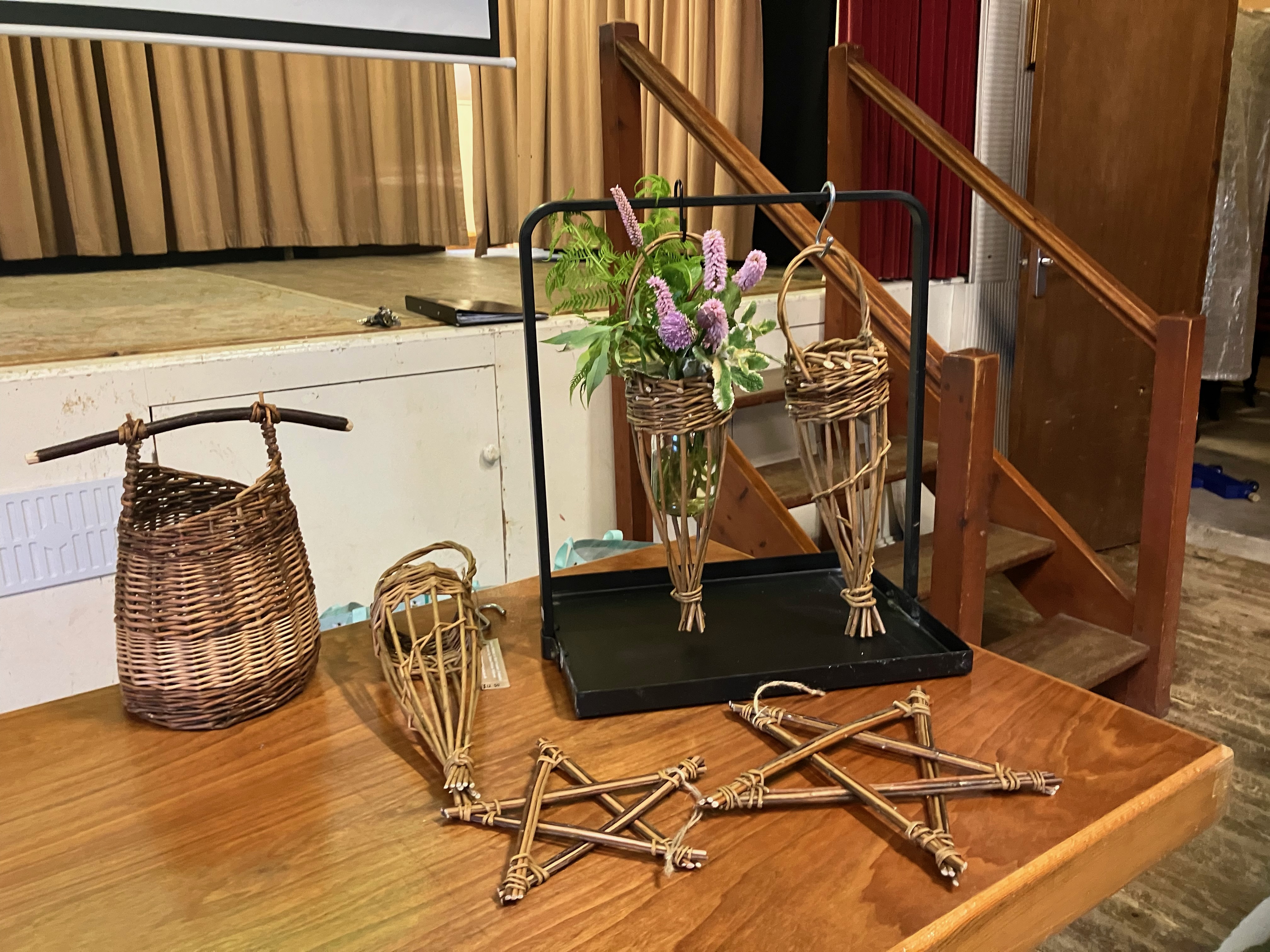
No. 5 – Use Willow Baskets. Willow stems , of course, are perfect for weaving baskets – and what could be better than collecting your own fruit and vegetables in baskets and trugs woven from your own willow!
No. 6 – Incorporate Willow Garden Structures. In the vegetable garden you can use willow to create supports for runner beans and sweet peas as well as mini-pumpkins. Willow also makes a great base for a wedding arch decorated with flowers and greenery. The only thing is that willow structures don’t last forever – four seasons is about the limit.
No. 7 – Make Willow Water. The bark of willow is packed full of growth hormones at the base of the stem when in growth. Take one-year-old willow stems, cut them into 1.5-inch chunks and cover them with water. Use about one-third willow to two-thirds water. The water will only last for one to two weeks before you have to make another batch, but it can be used as a replacement for hormone rooting powder.
No. 8 – Chop and Drop (Ramial Woodchip). One- or two-year old willow wood, chipped, which breaks down really fast, is amazing for feeding fruit trees. It is also brilliant for making hot beds. You can use wild willow for this. The wood should be cut no later than May, because after that you won’t get much regrowth. The leaves from the wood can be dried, chopped, and then go into the compost bin.
No. 9 – Build a Dead Hedge. Dead hedges are great homes for insects and can serve as good temporary fences.
No. 10 – Make Something Fun! Willow is great for making sculptures – for example, a stag, a hare, even just a big ball.
Justine then took questions from the audience. She recommended Salix nigricans and S. triandra ‘Blacktop’ as the best black-stemmed willows. She confirmed that willows need quite a lot of sun – about 6 to 8 hours in the summer, so you shouldn’t plant them on the north side of a hedge. They also don’t like being next to established trees. They need a lot of water, although they don’t have to be in wet ground. They don’t like chalky ground, and love clay or clay on shale. Willow stems should be cut during the dormant season. As they dry, they lose one-third of their width. They should be allowed to dry for three to four months, then rehydrated. A bundle of 5-foot long willow lengths should be submersed under water for 5 days to fully rehydrate for weaving.




 Cothi Gardeners