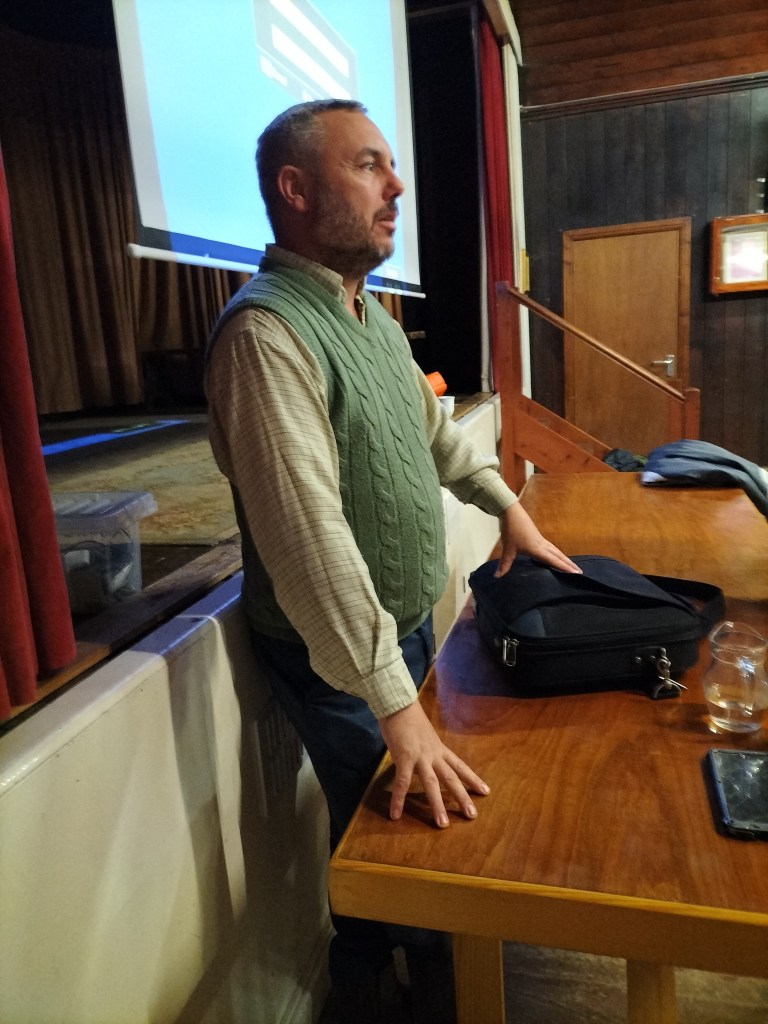
Kim Stoddart is a gardener, journalist, author and gardening teacher. She writes for The Guardian, specifically regarding gardening in the current climate change environment, and is editor of “Amateur Gardening” magazine. She has co-written the book “The Climate Change Garden” which has recently been updated and has just published “The Climate Change Resilient Vegetable Garden”.
She also runs the very popular Green Rocket courses where she teaches techniques which she has taught for many years, and has a smallholding in the Synod Inn area of 2.3 acres, of which a third of an acre is used for growing produce. She keenly boosts biodiversity there and doesn’t use pesticides or chemicals. In general, apart from growing in containers, she does not use fertilisers but concentrates on improving soil health which brings its own challenges, since the property is 750 ft above sea level and is often subject to quite serious flooding.
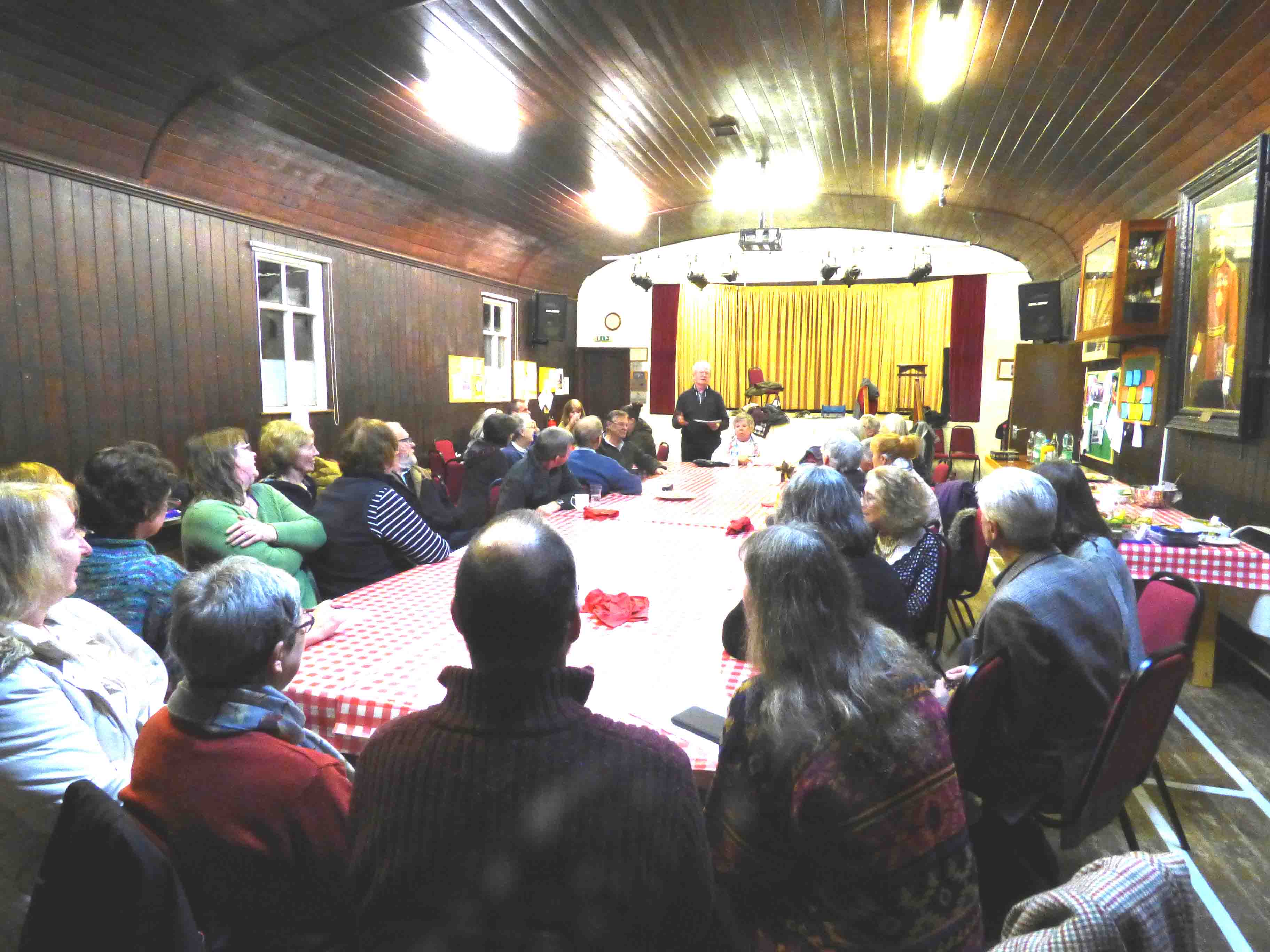
At the begining of her talk Kim encouraged us to think about how things worked in the past, how people had to have productive gardening plots which were not costly and could be maintained as easily as possible. Some of the solutions found in the past have been forgotten or discarded in favour of a quick fix, off-the-shelf solution.
She encourages us all to make time to sit and be kind to ourselves, enjoy our surroundings, including the wildlife, and not to feel we have to make everything neat – weeds are not the enemy! Examples of extreme weather have been studied by Kim in order to understand weather unpredictability and how to discourage pests and diseases that come with it, and what we can do to effectively and cheaply negotiate problems.
Recycling and upcycling, inventing ways of making making a cost effective, productive and beautiful garden need to be seriously considered and will give lots of satisfaction. Think creatively when problem solving, it does not need to be stressful! Do not pamper plants, overprune, or spend hours weeding, sometimes it works to make plants work harder to survive and flourish. If you have a gap in the flower garden, stick a vegetable in there, they often look great and you can (hopefully) eat them. The “no dig” method is proven to be effective and works well, or the German Hugelkultur method which in addition pretty much eliminates the necessity for watering. It helps to use mycorrhizal fungi which will encourage root growth and improve health – only effective when growing organically, as the fungi and fertilisers/pesticides tend to fight and restrict plant growth.
Kim had brought copies of her book for sale, and answered questions from the audience. The link for Kim’s courses is www.greenrocketcourses.com. Dawn thanked Kim for her very enjoyable talk.
John and Helen’s Plant Sale for NGS Charities on 12 May
We were reminded about John & Helens’ plant sale at Ty’r Maes, Ffarmers, SA19 8JP on Sunday 12th May from 1 pm. Donations are encouraged as payment – the proceeds are for the National Garden Scheme charities. Plants can be ordered in advance – emails will be sent to club members at the end of April with a list of available plants to order.
For our October meeting, three members of the Club volunteered to give short talks about their gardens ranging from borderline hardy shrubs and perennials to ponds.
Sheena’s Borderline Hardy Trees and Shrubs
Sheena’s garden is situated at 700’ with a northwest aspect; it has evolved over the years from a field to a garden where shrubs and trees are the main focus. There have been successes and failures with plants that might be considered to be borderline hardy in this area. The soil in the garden is acidic, and most of the plants featured, with the exception of the first, are ericaceous; they are all more-or-less evergreen.
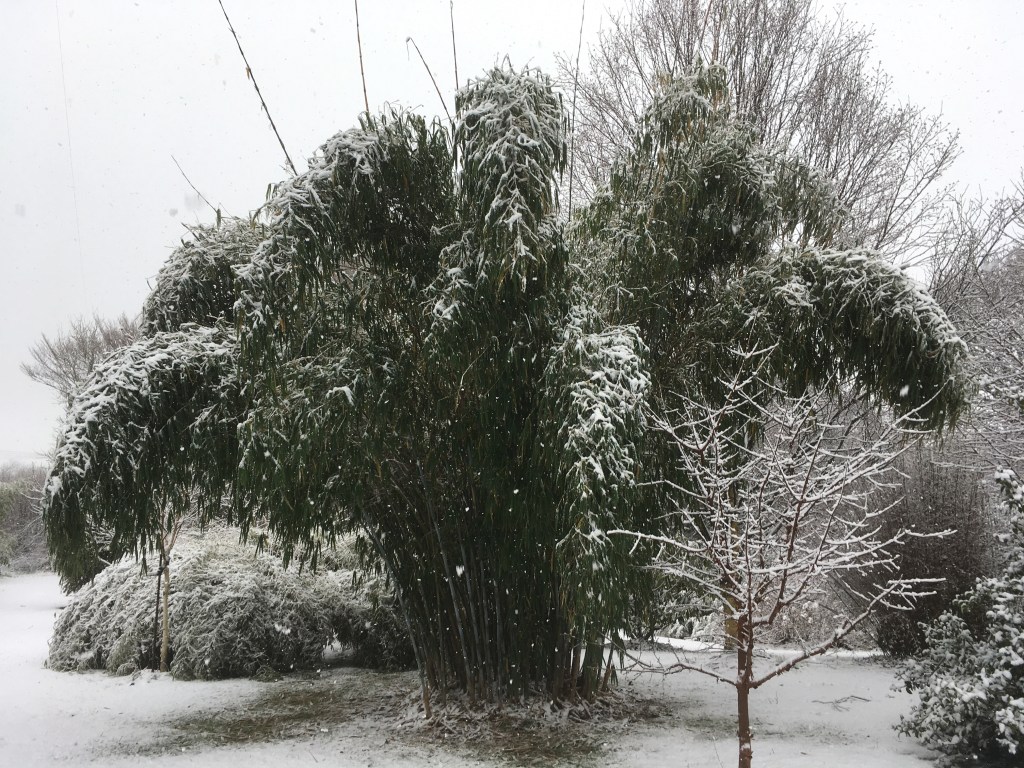
Borinda papyrifera is one of the bamboos from Yunnan that has survived (just!). Borinda lushuianensis (originally known as Yunnan 4, much simpler to pronounce) did not survive any quite mild winters here, but B. papyrifera has proved to be tougher.
Said to be hardy to -14°C to -16°C, as a small plant it did not come through the very hard winter of 2010-11. We decided to give it one more chance, and by 2020 (above) it had made an impressive specimen in the garden.
December 2022 saw some fairly low temperatures in our area, certainly into double figures below freezing. It became clear that B. papyrifera had suffered badly, and initially Sheena wasn’t sure it would survive – but it has, and developed a number of new shoots this year, although it may be a few years before it recovers to the size that it was. The young canes are a powdery blue-grey initially, maturing to olive green, with large silvery-buff sheaths, and develop up to a height of 7m. If you have the space, it is definitely a ‘statement’ plant.
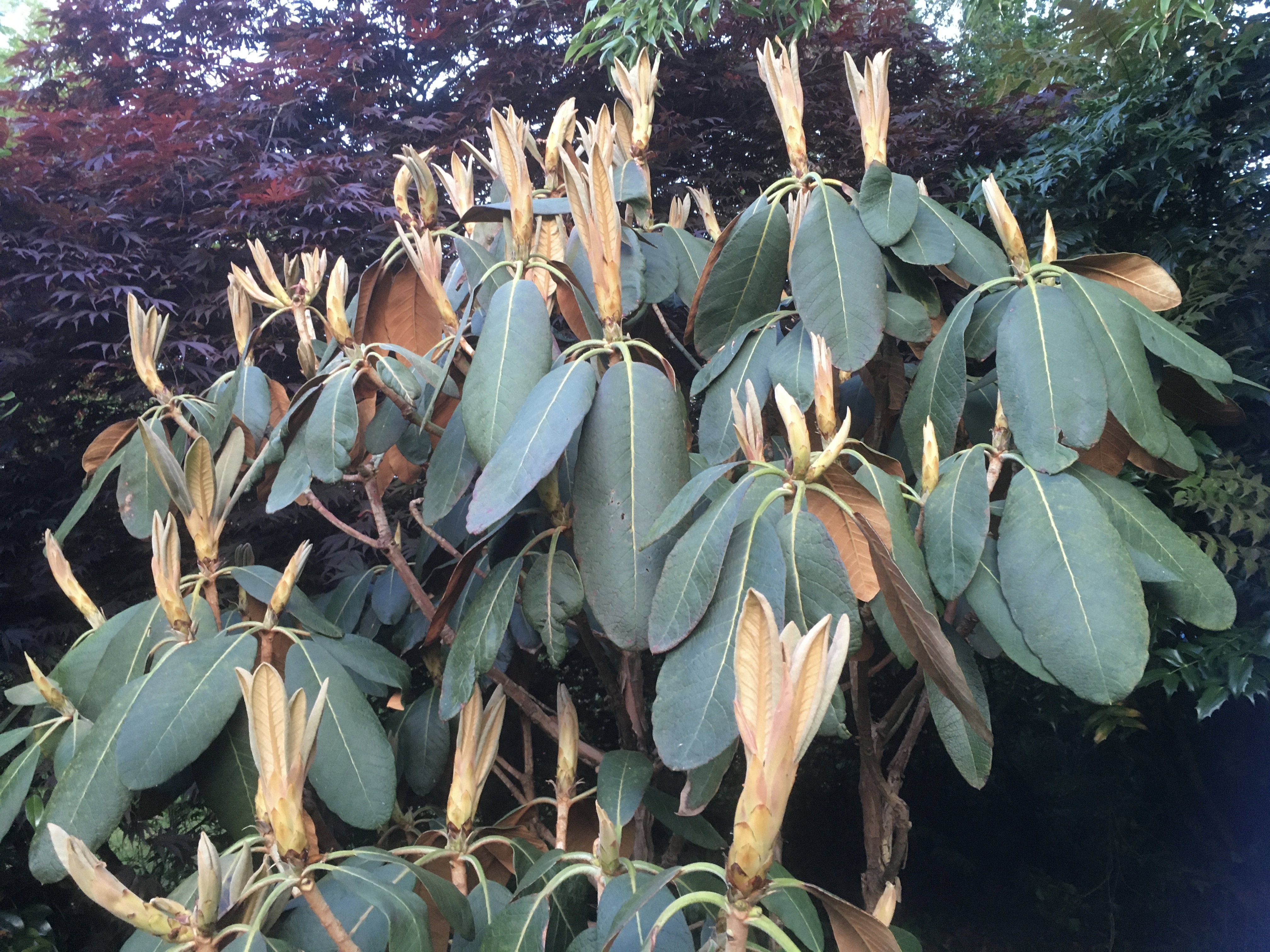
Of the large-leaved rhododendrons, R. falconeri has proved to be the hardiest (it has not suffered in even the coldest temperatures while others, such as R. sinogrande, have). It is a striking plant, with leathery dark green leaves, fawn indumentum when the leaves emerge, deepening to a rusty colour on the underside of the leaves, peeling pinky-brown stems and pale yellow flowers with a maroon blotch. It has not been extremely floriferous here, but the young leaves make up for that as they emerge.
The west wall of the house is the only place where Crinodendron hookerianum has proved happy, and it is now a very large plant. It has elongated dark green leaves and lantern-shaped crimson flowers are suspended from its branches in May, giving the shrub its name of the lantern tree. In our part of the country, it definitely requires a sheltered position.
Another red-flowered plant, this time with bright scarlet flowers, is Embothrium coccineum, which takes over from the Crinodendron flowering in late May and June. It is an evergreen or semi-evergreen small tree with clusters of bright scarlet tubular flowers (hence its name of the Chilean firebush). It has not proved to be very long-lived in the garden (Sheena thinks that late frosts in May were the culprit).
A replacement, a sucker from her parents’ garden, even though still quite small, came through last winter unscathed, even though it is said to be hardy to -5°C to -10°C.
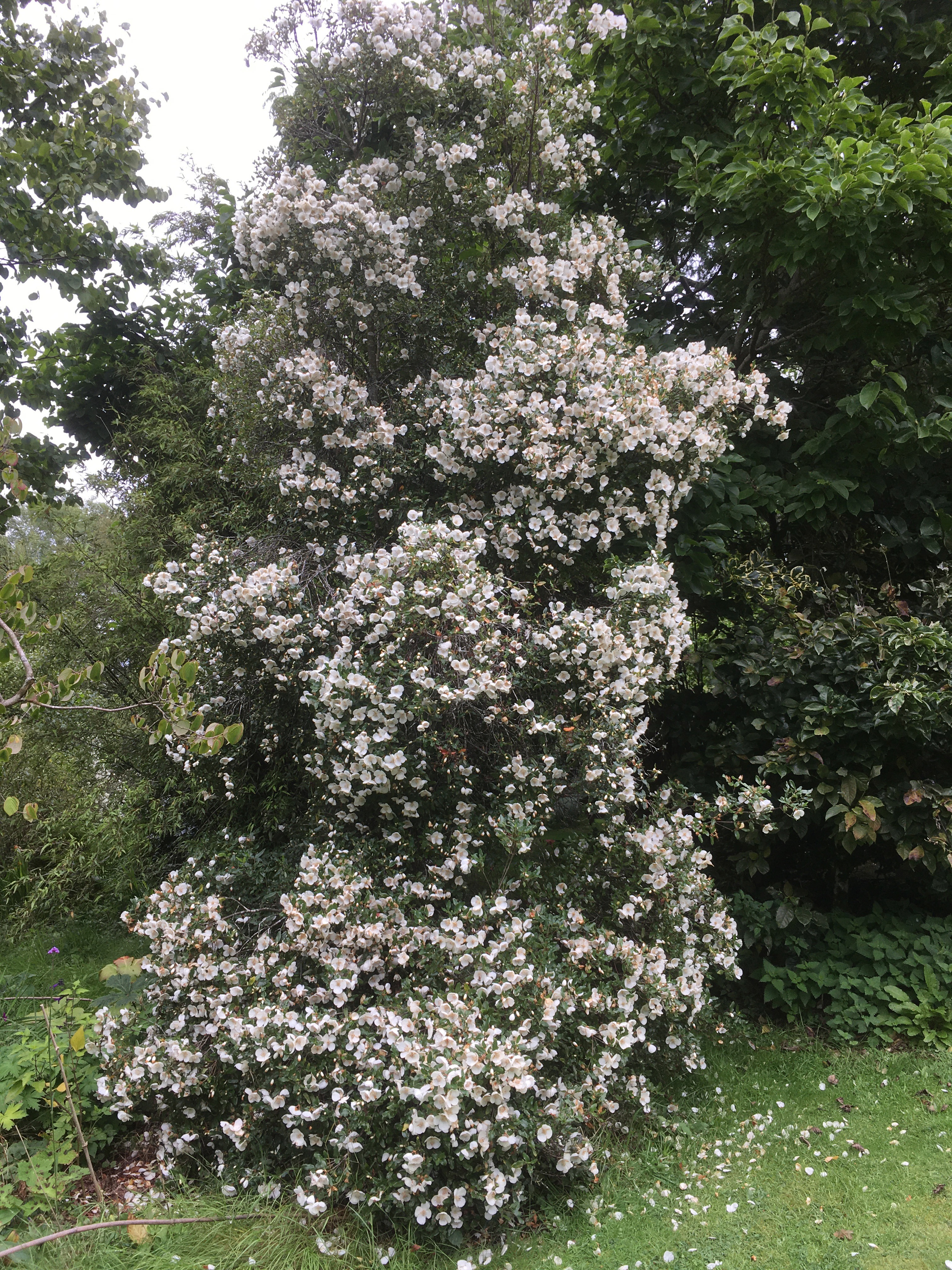
Finally, Eucryphia x intermedia ‘Rostrevor’ is a hybrid between E. glutinosa and E. lucida, which originated in Co. Down. It forms a columnar, evergreen small tree which bearing masses of scented white flowers abuzz with insects; its flowering period of late summer makes it particularly valuable in the garden, and this variety has proved to be very hardy.
Sally’s New Garden with Hardy Perennials and Grasses
After studying painting Sally at college, Sally practised as an artist for 10 years. She was influenced by medieval depictions of the flowery mead in her later work. Gardening became Sally’s main interest after moving to a house with a big garden in Oxfordshire. For ten years she ran a specialist plant nursery, with most of the plants grown from cuttings or seeds, selling out at Rare Plant Fairs, Specialist Plant Fairs and Yellow Book Gardens among others. A few years ago she moved to the Cothi Gardeners area and began to develop her new garden from scratch, focussing on hardy perennials. She has a greenhouse where she propagates perennials from seed and cuttings. To the south of the house is a border 15m long and 5m deep. Huge stumps of C. leylandii had to be removed by a tree surgeon to be able to make best use of this space. The soil is deep and rich, quite a contrast to the heavy clay in Oxfordshire.
The garden to the rear is north-facing and exposed, backing onto set-aside land with plenty of wild flowers. In this area in 2021 Sally decided to try a no-dig flowerbed which she planted up exclusively from seeds and cuttings she had raised herself.
The no-dig bed was created by laying down cardboard, adding compost and cut material on top. It has been a great success and become a varied tapestry of perennials.
In her gardening style, Sally has been very inspired by Piet Oudolf and his use of perennials and grasses, and plants particularly to attract pollinators. She gardens exclusively organically, and uses only peat-free compost. She doesn’t water plants after two weeks have passed since planting, unless a plant dehydrates completely.
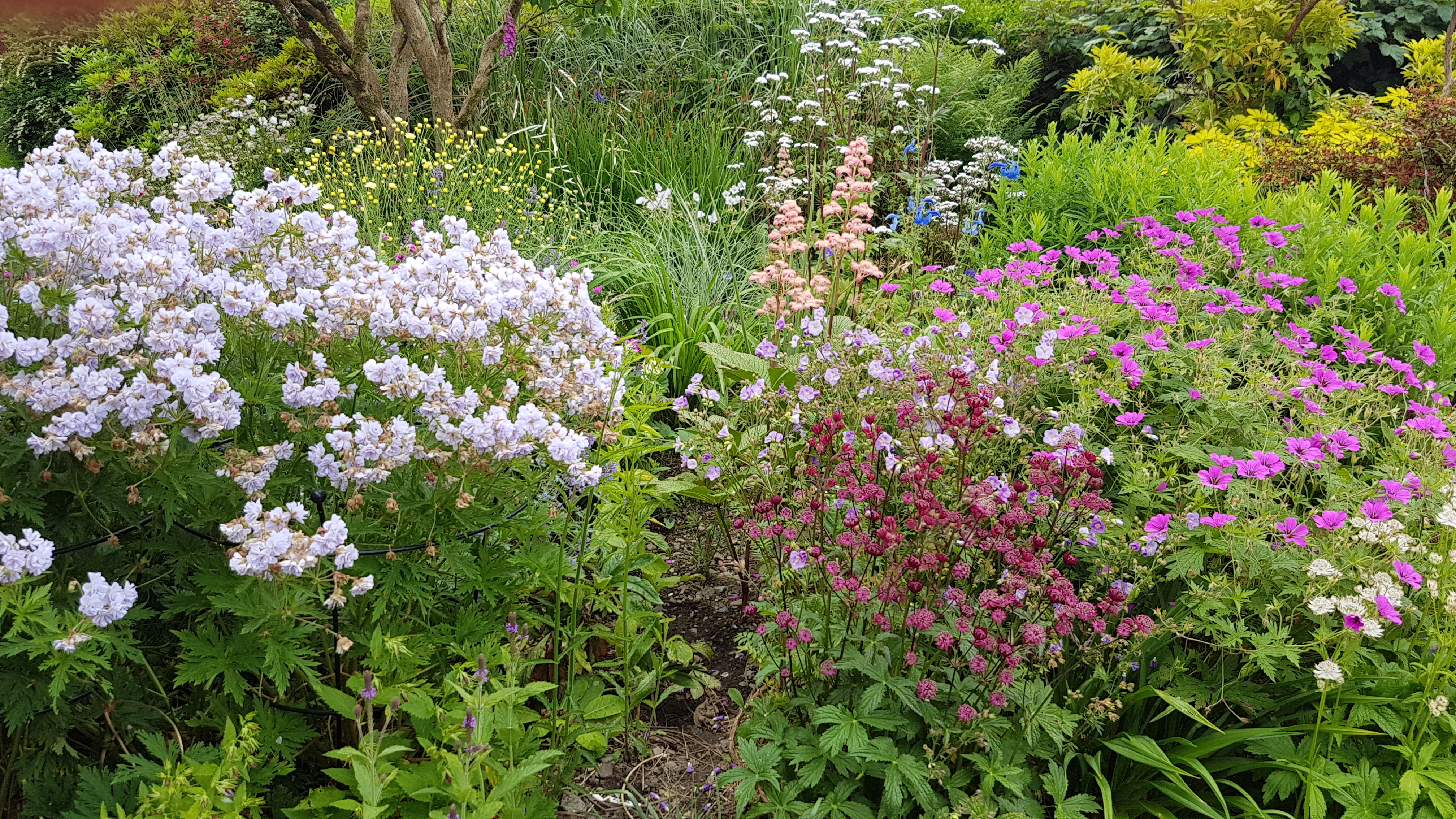
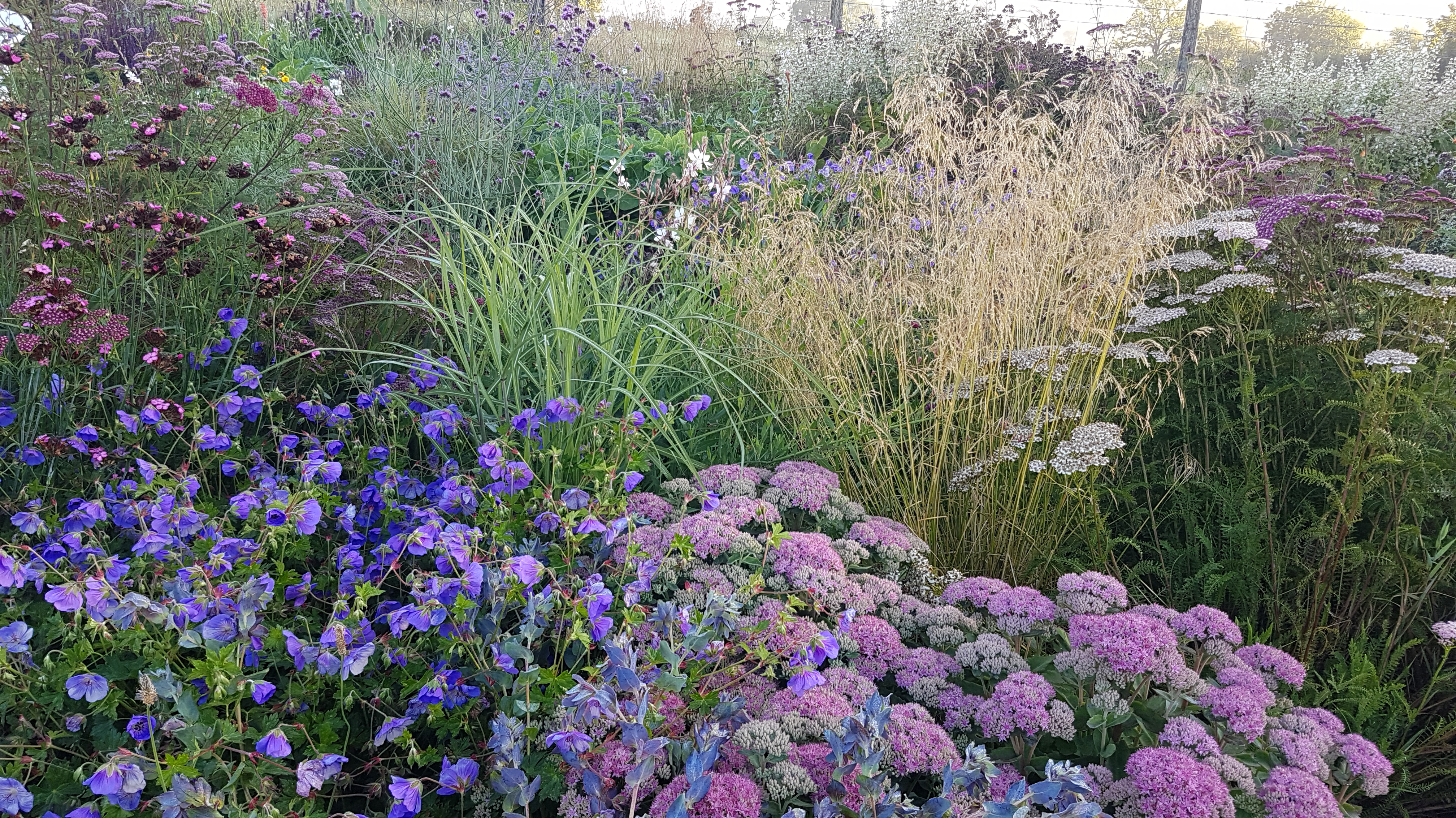
Sally showed us many pictures from her garden of beautiful combinations of hardy perennials and grasses. A group of plants Sally uses widely are the hardy geraniums – including G. ‘Patricia’, G. pratense, G renardii, G. ‘Rozanne’ (which flowers from May to October), and G. ‘Cloud Nine’ raised by Helen Warrington of local Ty Cwm Nursery. The latter is extremely floriferous over a long period, and the bees have an unusual trick to get at the pollen, by making a hole on the underside of the first petal layer.
G. ‘Cloud Nine’ with G. ‘Patricia’ and Astrantia ‘Buckland’
Among the grasses are Miscanthus ‘Morning Light’, which as the name suggests catches the light beautifully, and Miscanthus malepartum, which is extremely tough. Molinia caerulea ‘Transparent’ is another favourite, as it stays small in the border until mid-summer, but then shoots up with stems as much as 8 feet tall, making a real statement without taking up too much space.
Deschampsia cespitosa with Geranium ‘Rozanne’
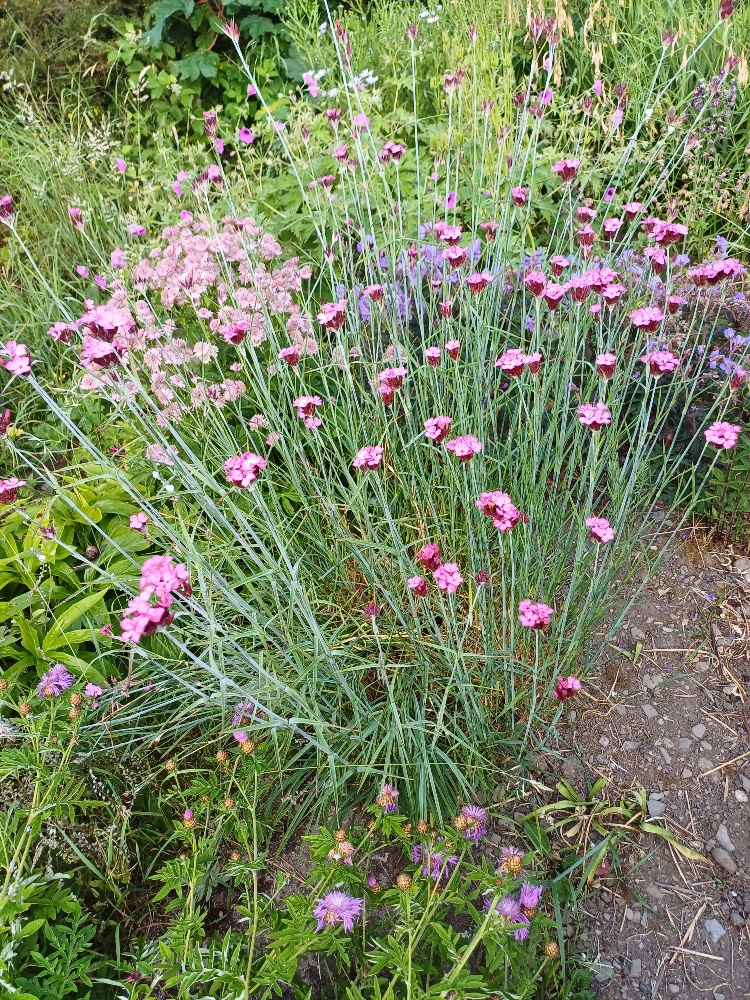
Sally has particular praise for Dianthus carthusianorum, with its single pink flowers held on tall stems above narrow, grassy, grey-green leaves; it flowers all summer long.
Other perennials that Sally uses include Salvia ‘Purple Rain’, Papaver ‘Royal Chocolate Distinction’, Asphodeline luteum, Phlox ‘Hesperis’ (with violet flowers that become almost luminous at night), Salvia uliginosa, Salvia turkestanica, Knautia macedonica, Morina longifolia (hailing from Tibet), Centaurea ‘Pulchra Major’ and Selenium wallichianum.
A beautiful grouping of plants from Sally’s garden
Elena’s Tropical Pond in Wales
Twelve years ago Elena moved from Trinidad to the Cothi Gardeners area – where the climate and vegetation couldn’t be more different! There was an unused patch of grass in her garden, with just 4 daffodils and half-a-dozen bluebells, which she had been considering turning into a ‘tropical pond’. The site is exposed to the north and the east, and on top of a rubble heap – not promising! Then along came lockdown in 2020, creating an opportunity, and providing a much-needed focus for activity.
The first step was to lay the outline of the pond with twigs on the grass. Then Elena dug up from her garden and divided any plants with tropical-looking foliage. She also scavenged what she could from friends.
But, in lockdown, where to get the materials? James, Elena’s next-door neighbour, came to the rescue. He supplied both the butyl liner, and the soft cushioning layer. He also borrowed a mini-digger to dig the pond.
Even with the mini-digger, the spoil heap proved to be a tough proposition – the pond became shallower, and shallower… Elena collected the stones for the pond, to hide the butyl liner, from the small stream which runs along the boundary of the garden. More of the butyl liner was used to create a bog garden to one side of the pond. Lifting the canopy on the sycamore trees has been effective, giving the stems a tropical appearance.
Then Elena spent hours placing pots in and around the pond, and the next thing the pond needed was a waterfall. Lockdown again turned out to be the provider, as Farmyard Nurseries had been clearing out their sheds and discovered a water fountain – just what was needed!
What of the plants? They include a Banana (which stays out all year, wrapped in the winter), Gunnera, Persicaria (which was gifted as a bunch and distributed about under the stones), watercress (also from a friend), Macleaya and even a carnivorous plant (which also overwinters!). Gingers (Hedychium) also are surprising and beautiful plants in this environment. Houseplants are brought out for a summer holiday, including Hibiscus and Bougainvillea.
Gravel has been put down around the pond, joining to the existing path, which has been lined with trellis screens bought online. At the base are ferns, which have proved to be very hardy. Hostas have been hung in pots from the tree adjoining the path, and stumps have filled with thyme and evergreen ferns.
It is just a tiny pond, but it attracted so much wildlife, almost immediately: birds, snails, dragon- and damsel-flies, frogs, toads, newts and lots of hedgehogs. The frogs come in huge numbers, as Elena and her grandchildren discovered in the spring when they went down to the pond at night to explore!
Around the pond the hedges have really thickened up, and the planting has become lusher and lusher. Many plants have died, but lots have survived. Making the pond has been an enjoyable journey; the tropical feel of the pond reminds Elena of Trinidad and the plants of gardening friends old and new.
Neighbour James, who came to the rescue with materials, with his daughters by what is now a very tropical-looking pondBench with bling
John’s October Plant Sale
John and Helen held a very well-attended plant sale for NGS charities in early October, which has so far raised a sum of over £1000 for the charities. This figure will rise as there are plants still to be delivered and collected. John and Helen would like to thank all those who contributed plants, bought plants and helped out on the day. The autumn plant sale has been so successful they may well hold another sale in the spring of next year – so watch this space…
Joseph was the Head Gardener at Aberglasney Gardens from 2011 until 2022, when he left to run The Plough in Felingwm, where he grows as much produce as possible for use in the pub, and is keen to obtain sustainable and local produce from nearby.
In gardening, he has always been keen to use and promote succession of planting in order to provide constant, all year round interest and make less work into the bargain. Hurrah!
His first early flower which works so well, particularly valuable if short of space, is the snowdrop. There are so many varieties which will flower at different times and will happily sit around other early bulbs in order to provide early spring succession.
The two types of cyclamen (Cyclamen hederofolium and Cyclamen africanum) are particularly valued because of the length of their flowering period and because the tubers will happily regrow for decades. If they can be planted in mounds or banks, their full effect and beauty can be easily seen.
Following snowdrops, Crocus appear (he’s particularly keen on the variety ‘Vanguard’), so interplanting with these two and also dwarf Dutch Iris will provide lots of interest. Iris lazica are also fairly bombproof, with the advantage that the leaves can be cut after flowering without detriment – they are winter flowering but will last until March/April.
Obviously tulips and narcissi (he particularly recommends Narcissus ‘W. P. Milner’) are good for interplanting and in Aberglasney Gardens it was known for some daffodils still to be flowering into July. Hellebores also always do well, starting in February and continuing into May; they will give very good value, coming up year after year. The different types of Camassia and Allium will provide interest for the Spring gap, and Iris (he recommends the dark Iris chrysographes) are good for the June gap.
Kniphofia (red-hot pokers), (particularly K. rooperi which will flower all through the season) also provide height and texture and they do not need cutting back in autumn. Geranium varieties are long flowering and, if cut back during the season, will flower again. Crocosmia provide fantastic pops of colour and, once established, can be split to provide more plantings. The variety ‘Hellfire’, an extremely vivid red, is recommended.
Shrubs are such good value and, once established, will provide lots of interest with very little attention. There has been a lot of work invested in what is now a huge selection of Hydrangea varieties with many different types and colours of flowers. For a smaller, later flowering Hydrangea, H. paniculatum ‘Brussels Lace’ will flower from July until the first frosts. The evergreen shrub Coronilla ‘Citrina’, which is compact and rounded, will grow in a sheltered position providing lemon yellow flower umbels in late winter and early spring.
Don’t be afraid of dahlias! They are long flowering and the answer is to stick to 5 different types; the tubers are well-suited to filling in gaps in the late summer garden. Joseph particularly likes the smaller ‘Downham Royal’ which is a darker variety and very long flowering.
Calendula and Verbena are both long flowering but do prefer drier conditions. Cerinthe major ‘Purpurascens’ has a silvery leaf, is self-seeding and will virtually grow anywhere, so is very good value.
For autumn colour, the trick is to plant trees where they catch the light and they will really shine. Acers of different types are always stunning and worth the expense if planted well. We shouldn’t forget foliage for autumn/winter planting, it will provide lots of variation in colour and texture.
Joseph then answered questions from the audience:
The science of planting – it’s concentrating on what gives pleasure to the eye.
Flowering time of different plants – try not to think too hard. What works best is to plant different types of one plant.
Keep a diary! It’s invaluable.
Problems with creeping buttercup – if it’s a problem in a lawn, scarify with a rake to remove it. Under a hedge – mulch or put down membrane and then plant as soon as possible.
Mound planting of shrubs – don’t dig a hole, just put a dish in the top of the mound, place the shrub into the hollow on the mound and heap up soil around it. Look after it well in the 1st year, half as well in the 2nd year and then leave it alone!
Rhododendron – bear in mind that they have very shallow roots, but they will work well in most conditions. They will grow in a shady border or at the edge of woodland but need watering well, particularly when first planted.
Elena thanked Joseph for an entertaining and useful talk with helpful slides.
John’s End-of-Season Plant Sale – 8 October – in Aid of NGS Charities
Start time 1.00pm Sunday 8 October at Ty’r Maes Ffarmers SA19 8DP
On the A482 look for the yellow NGS sign 7m SE of Lampeter. 8m NW of Llanwrda. 1½m N of Pumsaint opposite the turn to Ffarmers.
There will be loads of plants for sale – at least twice as many as last year. People are also encouraged to bring plants to swap. Donations are welcome, as the aim is to raise money for NGS charities.
FREE entry; tea, coffee and biscuits are provided – if you would like to donate a cake, they are always most welcome!
Parking is on the field opposite the turn to Ffarmers (weather permitting!), although the area near the house will be available for loading and unloading plants .
Committee Vacancies
Early in 2024 two of Cothi Gardeners Club committee members (the Chair and Deputy Chair/Marketing) come to the end of their term on the committee and are retiring from their roles, having served for a number of years including during the very difficult time of Covid. It is a rewarding experience to be part of the committee of such a vibrant and friendly club, so members are asked to give this serious consideration. If you are interested or if you have questions, please contact Elena.
We were lucky to once again hear an entertaining talk from Bob Brown, founder of the Cotswold Garden Flowers nursery. He started by encouraging us to put the right plant in the right place – something we all know but need constantly reminding of!
The initial list of headings was to outline the bullet points of his talk i.e. Acclimatised & Easy, Invasive, Garden Worthy etc. Bob went on to describe the different types of plants within the headings and started with the Welsh poppy (hurrah!) and we had conversations about the habits of the plant. He continued to describe many different types of plants which come into the native plant varieties including Achillea, seakale, viper’s bugloss, Mullein, Veronica spicata and many more.
Woodland plants were described next and include Aquilegia vulgaris, Allium sphaerocephalon, wood anemone amongst many others.
Woodland Edge plants & bulbs came next, such as the lawn daisies, hen & chicks, single Campanula, Colchicum autumnale, Pulmonaria, celandine varieties etc.
Grasses were the next category, including woodland grasses and Bob is keen on using plants needing structural support being grown within grasses, using the grasses as the support. Dogwoods, which look good with grasses, (Cornus sanguinea ‘Midwinter Fire’ in particular) are a favourite – he advises to cut them right down in winter.
Ferns of different types were next and his particular favourite, Polypodium vulgare, because it is evergreen in the winter but has died down by June and so makes way for other plants.
Iris types and the different areas in which they flourish came next and we discussed the very smelly Iris foetedissima (roast beef plant) & had a chat then about what the smell actually is like!
Primula varieties, which have been grown here since Eizabethan times, are a good bombproof plant for many areas.
Roses, particularly varieties of the small Rosa pimpinellifolia ,were discussed, and then many more of the different native plants including the shrubs Salix purpurea (purple willow) and the different varieties of Sambucus nigra (elder), both of which are fast growing and invasive.
We thanked Bob for his informative and entertaining presentation and took full advantage of the beautiful plants which he had brought for sale from the nursery.
Some of the beautiful plants from Cotswold Plants for saleBob Brown advising on the choice of plants
Invitation to Local Gardening Clubs
Drefach Felindre Gardening Club and Llechryd and District Gardening Club have each kindly invited all Cothi Gardeners to attend any of their meetings, which are listed below. We hope that their members will also choose to attend our meetings this year and beyond.
All meetings are held at 7.30 pm in the Red Dragon Hall. Guests simply pay £2 per meeting which includes refreshments.
Open eveningOctober 5th
The speaker is Stuart Akkermans, ‘Cae Hir’: A Welsh Garden with a Dutch History. Light refreshments to follow. This event is free to Cothi Gardeners Club members.
Wednesday, 2nd November 2022 ‘The Gardens at Winchester Cathedral’, Emma Sharpe
Wednesday, 30th November 2022 ‘Biodynamic Gardening’, Louise Cartwright
Wednesday 12 October at 7.30pm ‘The Treasures of Tadjikistan and Uzbekistan’ with Bob & Rannveig Wallis Bob and Rannveig Wallis were plant hunting in Central Asia before the pandemic and this illustrated talk starts on the border with Afghanistan and goes via Samarkand and Tashkent to the Chatkai Range. This is the centre of Tulip and bulbous Iris development and also features Fritillaria and Corydalis. Superb photographs and an excellent speaker. Last club plant table of 2022.
Wednesday 9 November at 7.30pm ‘Costa Rica’ with Julian Cremona Julian Cremona’s brilliant photography brings this small country’s amazing wildlife and flora to life. Dense broadleaf evergreen forest, palm trees, mangroves, mosses, orchids and tropical plants as well as monkeys, sloths, anteaters, snakes and iguanas. Annual Club Seed Swap.
Plant Swap and Sale for the NGS 9 October 2022
John and Helen of Cothi Gardeners are holding their annual plant swap and sale to raise funds for the NGS on 9 October at 1pm at Ty’r Maes,Ffarmers SA19 8JP.
There will be loads of plants for sale, a lot more than last year, when just about everything went! There will also be a table of plants that are available for a small donation. These are generally perfectly garden worthy plants that for presentational reasons are not quite up to selling standard.
People are encouraged to bring in plants to swap. Last year some wonderful plants arrived and were seized on immediately.
Tea, coffee, biscuits and cakes will be provided. If you bring extra cakes, that would be great too. There is nocharge for refreshments, but as funds are being raised for NGS charities – donations are always welcome.
A word about parking. We will be using our bottom field, opposite the turn to Ffarmers, for parking and there will be NGS signs up. The area in front of the house will be available for loading and unloading plants.
Malcolm Berry – The Dreaded Gardener: ‘Weaving the Web:Towards a Natural Garden’
Malcolm’s talk about how he tries to garden in a way to create ‘dynamic stability’ where flora and fauna exist in harmony struck a chord with many of us. The State of Nature reports indicate that in Wales 1 in 14 species are heading for extinction, in a large part due to loss of habitat. To try and offset this even those with small gardens can help. Biodiversity was at the root of his message: diversity creates diversity, the greater the diversity in flora the greater the diversity in fauna.
Ideas he has implemented in his own garden:
Varied habitats such as a pond, mini meadow, deciduous and evergreen hedges, mature trees and shrubs, dry stone walls, log piles, stone piles.
Flower counts throughout the year to assess where/when there is a lack. Self seeding annuals to increase flower numbers
Polyculture rather than monoculture: mixing veg in with shrubs and perennials. More naturalistic and gives better protection against pests and disease.
Clear areas for veg planting in Spring, weed through growing season, stopping in August. By winter the mix of weeds and crops cover and protect the soil which is better for both soil and habitats. Weeds are also a good winter flower source.
Compost: use comfrey in layers when turning compost as it is a good activator
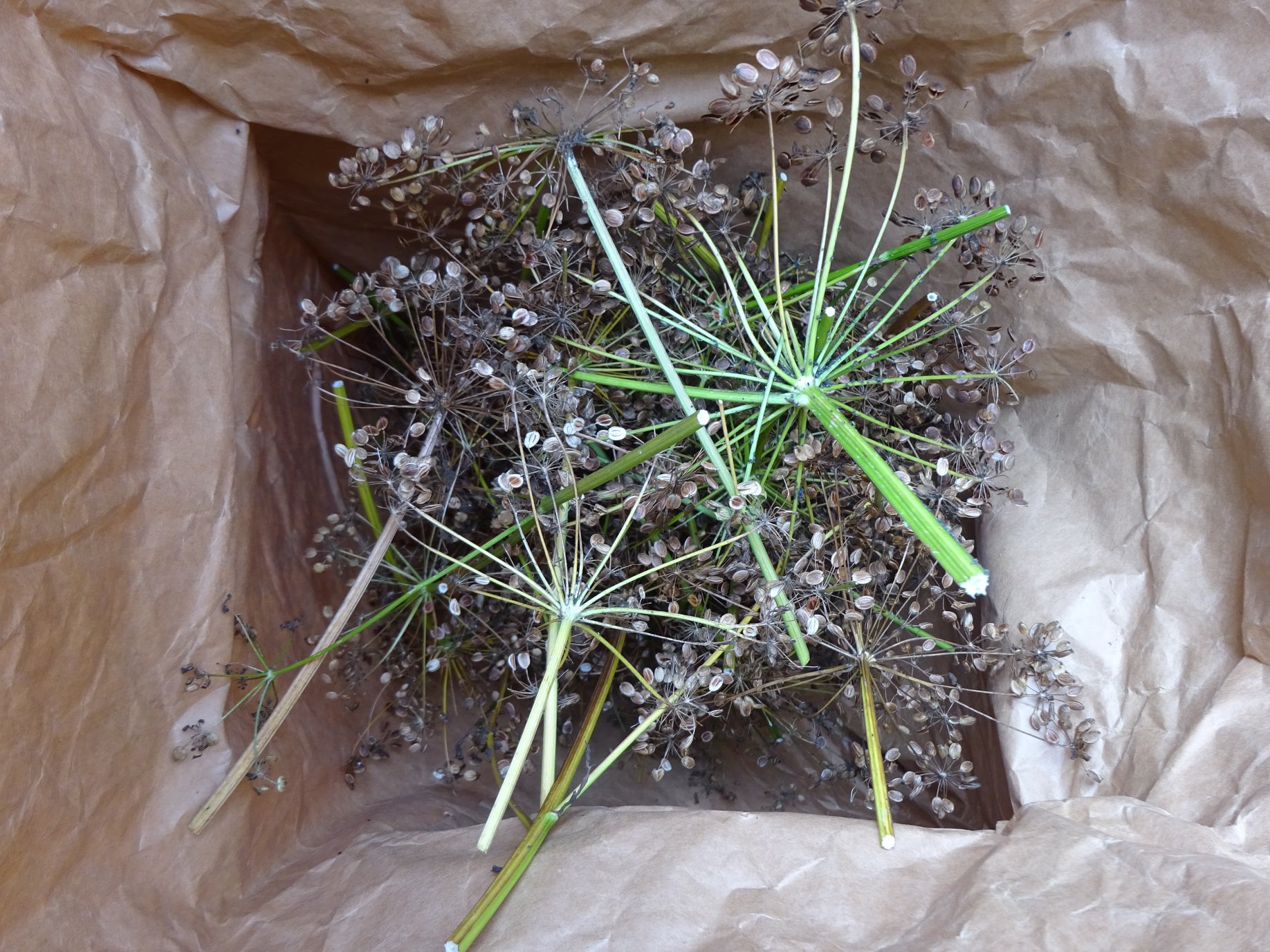
Seed saving: from most veg. Some such as parsnips, runner beans and leeks require a minimum of 16 plants to save seed from in order to retain diversity. Only save seed from the best plants/fruit. Store seeds in an air-tight tub in fridge with silicon gel packets as this significantly reduces conditions required for germination.
The Moon: He uses the Maria Thun Biodynamic Calendar which shows the optimum days for sowing, pruning and harvesting various plants and crops.
Non-interventionist approach, no pesticides or herbicides, nature will balance things out. He grows sacrificial plants to avoid significant predation on veg.
Minimum tillage, he does not turn the soil, practices good crop rotation and uses green manures to maintain condition and fertility.
It was a very interesting talk and generated many questions from the audience.
Members Social and Growing Challenge 7.30pm Coronation Hall, Pumsaint
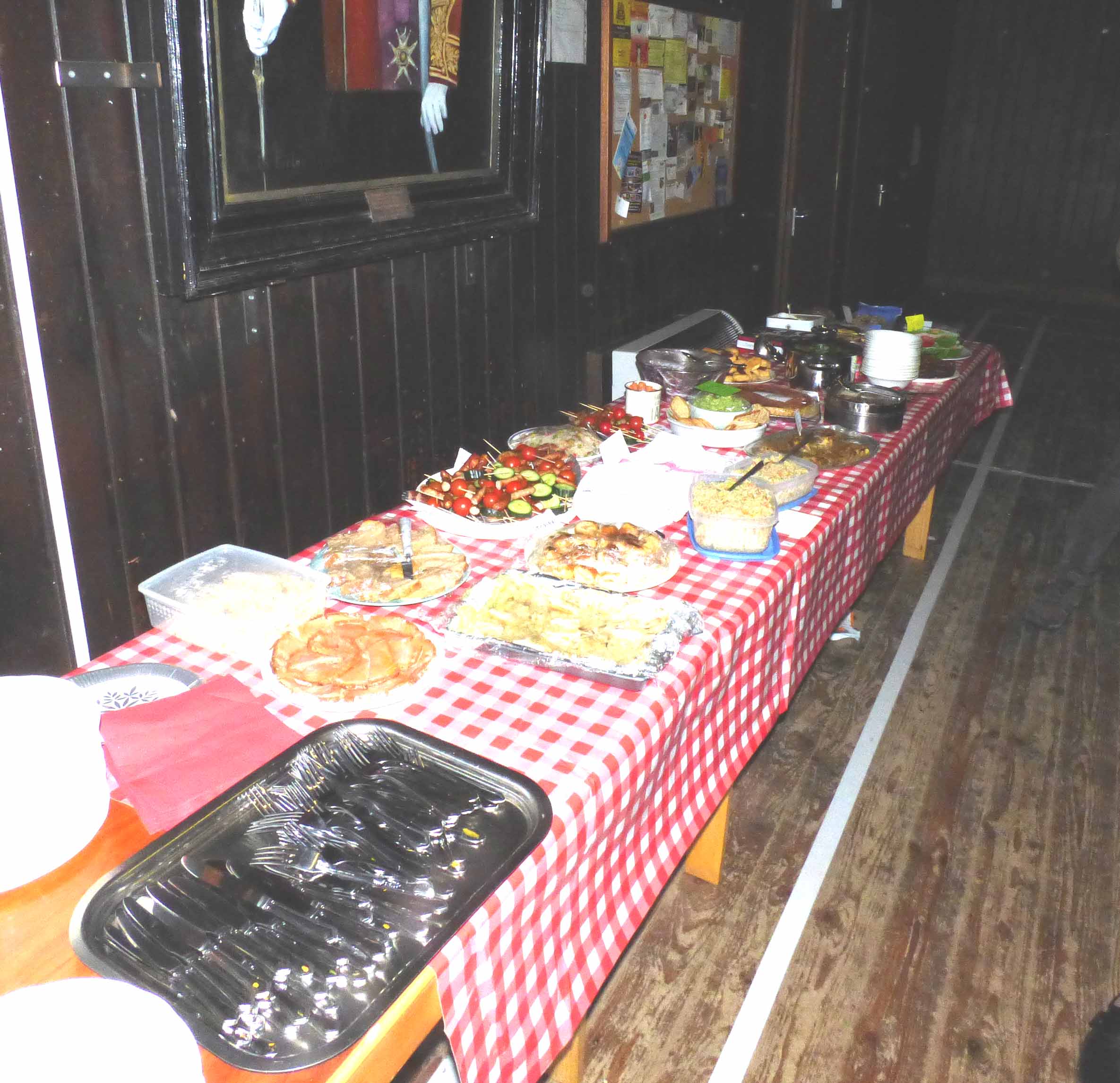
Our August meeting is our members’ social evening when we meet for a relaxed get together bringing a plate of food to share. This year due to our increasing numbers, it is being held in the hall rather than a member’s home.
Pots planted for pollinators – with varying degrees of success!
The evening is also when we share the results of this year’s growing challenge. We were asked to plant up a pot with plants for pollinators. Do bring along your pots even if they haven’t turned out quite as expected – it has been a very challenging year weather-wise, but we can all learn from our successes and failures! If you can’t manage to bring the pot itself do try and get some photos of it and bring them along instead.
The evening will also be when we will be handing over our donation from the proceeds from the plant fair, a cheque for £500, to Wales Air Ambulance.
Garden Safari
The garden safari is a club event in which we get to visit the gardens of those club members who wish to participate. The number of gardens taking part varies year to year, this year there will be just 2, Yvonne’s and Tina’s. The date on which it will take place is Friday September 7th. More details will be given at the summer social.
Drought Busters
A tip from Elena for watering…
Place a large tub in a wheelbarrow.
Fill with old washing up water – You can also add feed to the tub
Dunk hanging baskets in the tub holding underwater till all the bubbles stop
Lift out and rest on the rim of the tub to drain, some will also drop into barrow and can be re-used!
Rehang you well-watered basket. Works well with small pots too
And from Julian: we’re now having to use my huge number of water filled polycarbonate drinks bottles as a valuable water resource with our spring running low, but I also found that if you drill a tiny hole in the top of the bottle cap, upend it, and ram it into the soil beside squash, courgettes or tomatoes, it’ll deliver variable, but fairly slow water release over a few days – good if you have to go away for a weekend in hot weather.
From the white board: water Camellias and other Spring flowering shrubs now to encourage flowers next Spring.
Some plants which seem to be coping well with the lack of rain, and don’t need watering:
Jenny says….
Rudbeckia, Antirrhinum, Sweet William and Californian poppy.
Yellow Loosestrife, hostas and several unknown varieties of alliums have all flowered really well with minimal watering.
Sandy says…..
her 3 foot high unknown Phlox are doing well, and her Gunnera! She does live by a river which might help explain it.
Plants John and Helen have found are drought resistant are:
Erodium manescavii, Platycodon grandiflora and Scutellaria albida
Erodium manescavii with Geranium sanguinium
Julian and Fiona have found
Sea campion, Knapweed and Bird’sfoot Trefoil are all tough native plants to try, plus roses and clematis all seem to be thriving.
Ty’r Maes NGS Open Day
John and Helen had their NGS open day on Sunday. All John’s hard work watering to try and keep the garden looking good along with a little bit of help from the storms of the previous week certainly paid off. The garden was looking beautiful. The sun shone and the visitors flocked in – John said it was their best day for several years. As always, thanks from them to all their helpers and cake bakers and to John and Helen for their donation to Cothi Gardeners funds.
Upcoming Events
Gardener’s World: Keith Brown whom many of us know for his lovely garden and talks he has given to Cothi Gardeners in the past, has been filmed for Gardener’s World. The piece is due to be aired THIS FRIDAY 10th August at 9pm
Llandeilo Permaculture Group: Llandeilo Permaculture Group have scored a coup, booking Permaculture designer Geoff Lawton for a talk in the Civic Hall on August 24th, 7pm. He’s done TED talks and lots more. This is his only date in Wales. Tickets are £10, includes a light buffet.
September Meeting
Paul Green from Green’s Leaves Nursery will be paying us another visit after his very enjoyable talk last year….. and he will be bringing plants again! Put the date in your diaries: Wednesday September 19th at 7.30pm
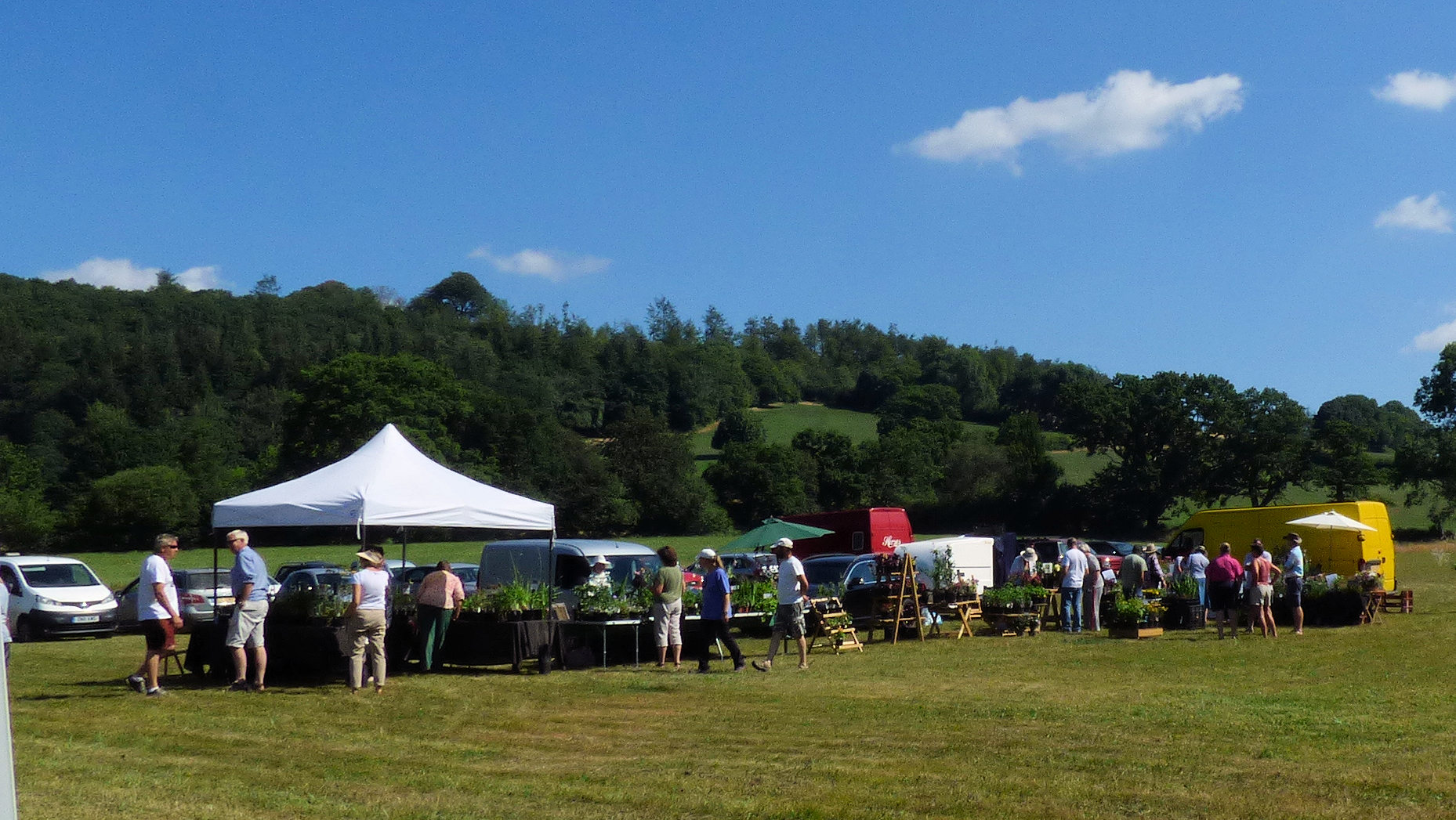
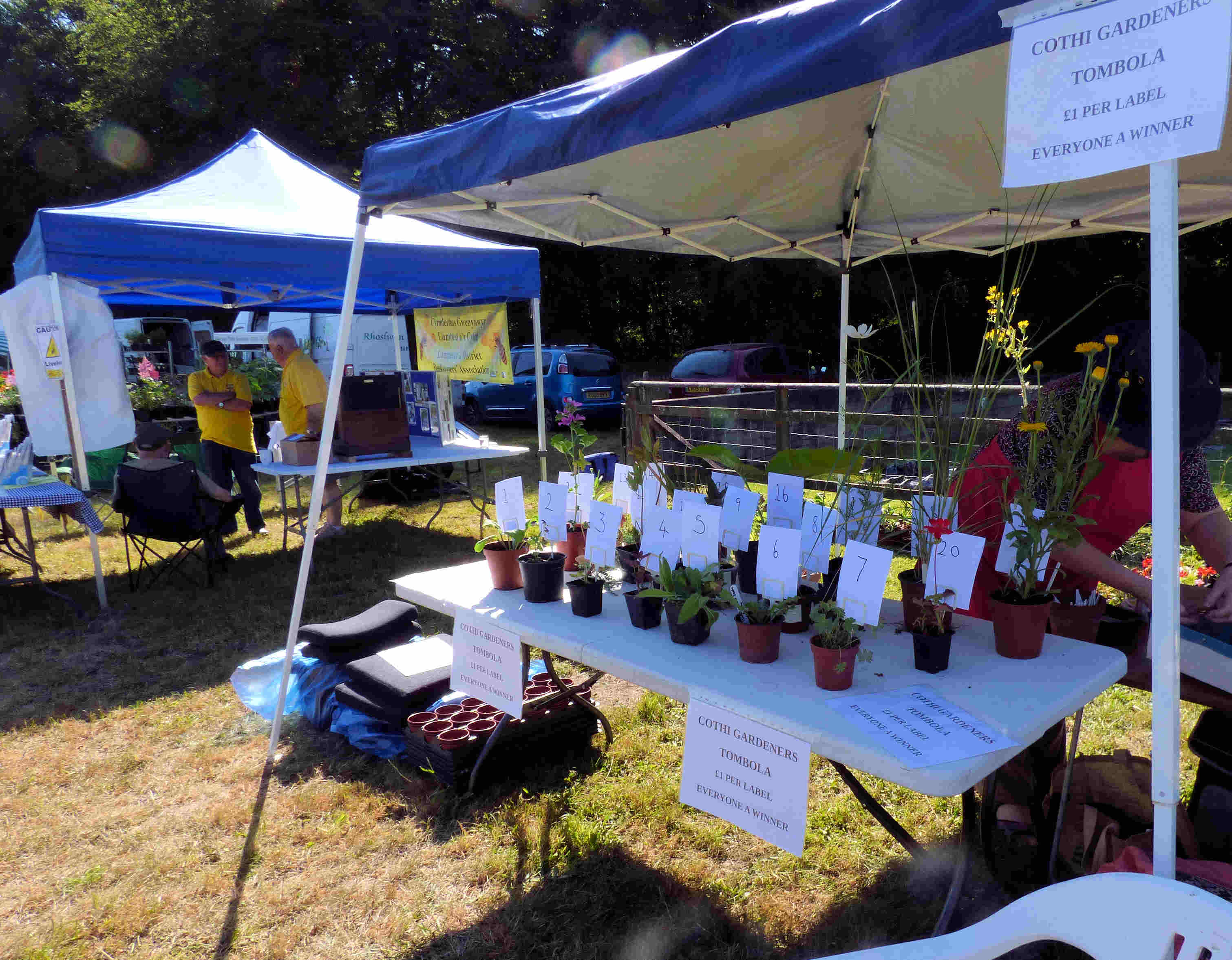
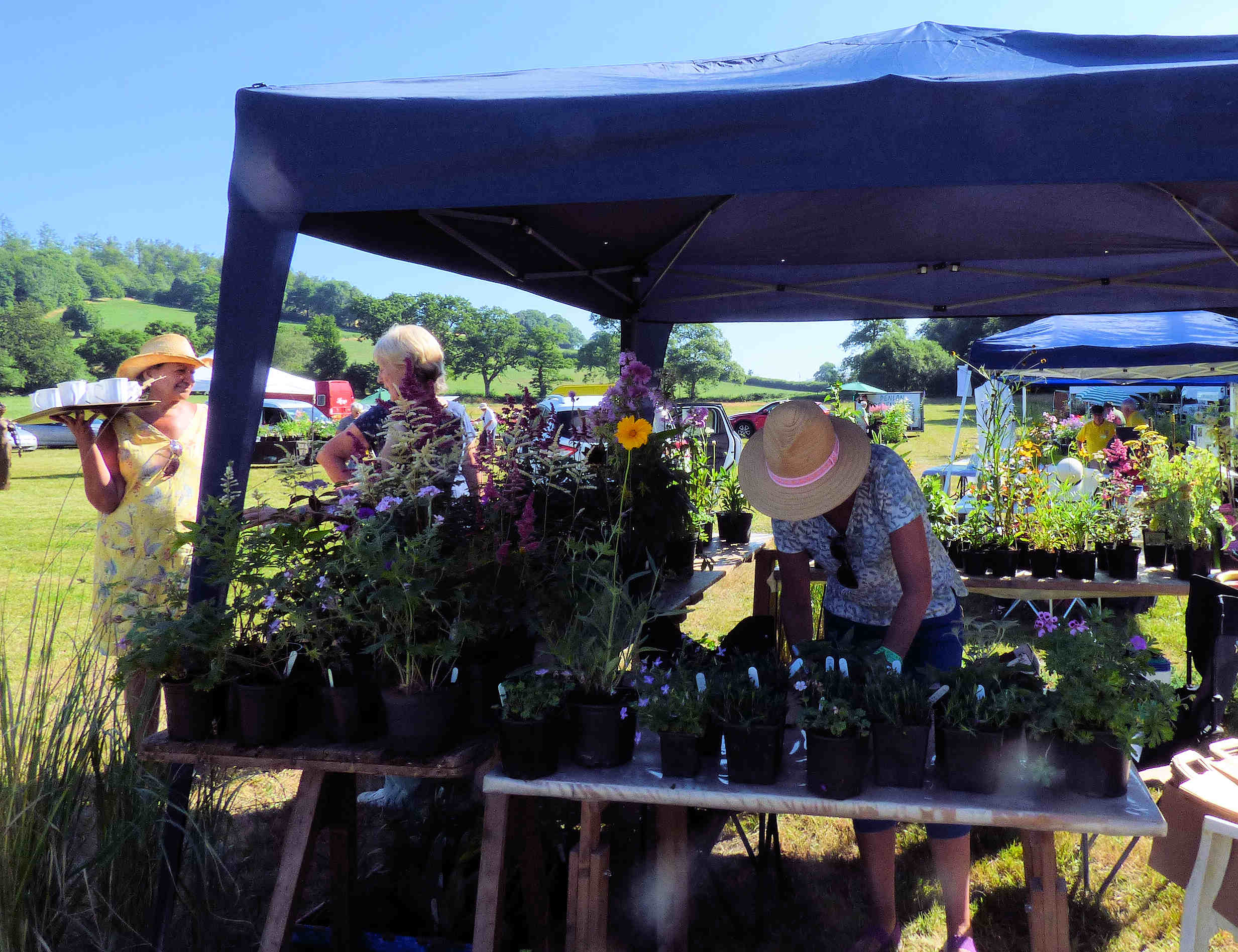
Sunday 8th July dawned clear and sunny and turned out to be one of the hottest days of the year, perhaps not ideal weather for anyone organising a plant fair! Fears that the heat would deter visitors and stallholders alike proved unfounded and the day was a resounding success with over 300 visitors.
The site was enjoyed by all with easy access for nurseries and stall holders, good parking for visitors and wonderful refreshments in the hall. Huge congratulations and thanks to John Brooks and his team for masterminding the day and putting so much time and effort into all the planning. Also thanks are due to all members of Cothi Gardeners who pulled out the stops to help in one way or another, cake baking, supplying plants, manning stalls, setting up, taking down, car parking supervision and much more. It was a real team effort and one of which we can be justifiably proud.
The nurseries and other stallholders seemed unanimous in giving it a ‘thumbs up’ and hope to join us again next year. A big thank you to all the nurseries and stall holders who supported us.
Next Meeting Wednesday, July 18th
Malcolm Berry – The Dreaded Gardener on Facebook will be giving a talk entitled “Weaving The Web: Towards A Natural Garden”
His website is dedicated to helping educate people about how to produce their own healthy food, and encourage biodiversity, using a mix of approaches combined under the banner of ‘Natural Gardening’. This includes aspects of permaculture, organic and biodynamic practice, and what comes naturally to him.
All welcome, starts at 7.30pm, £3 for non-members (includes refreshments).
Following the last minute cancellation of Terry Walton’s talk to us last month due to family circumstances, we brought forward the film which was to be our November entertainment. The good news is that we won’t miss out on Terry’s talk as he has now confirmed that he will be able to come in November instead.
Hidcote Manor Garden
The film we watched, ‘The Quiet American Gardener’, was about the history and development of Hidcote Manor Garden by Major Lawrence Johnston. He was born into a wealthy American family of stockbrokers, which gave him the necessary funds to create this now revered English garden, once his mother had bought the Cotswold estate in the early twentieth century. It was passed to the National Trust in 1948 on his retirement to his estate, Serre de la Madone, on the French Riviera.
The film was a fascinating insight into how the garden evolved and the influences that played a part: Italian garden design, architectural perspectives and their manipulation to create a particular effect are some that come to mind. The love of the place was apparent in the way the more recent gardeners talked about it and how they were trying to restore the garden to how Lawrence Johnston envisaged it. Click here for a trailer and transcript of the film.
Richard Bramley talking about Primulas – Wednesday May 16th at 7.30pm.
Primula sieboldii at Farmyard Nurseries
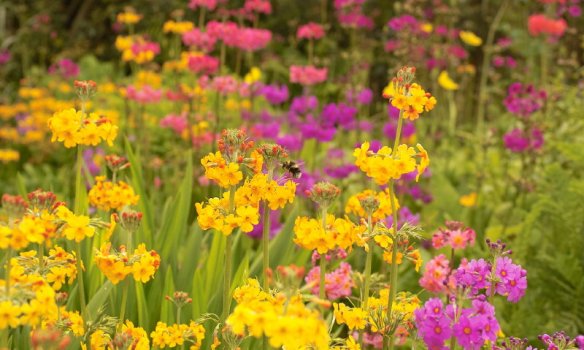
Another speaker cancellation occurred for May. Fortunately Richard Bramley, a popular and entertaining regular for Cothi Gardeners, was able to step into the breach and will give us a talk on Primulas. Richard has developed a fabulous collection of Primula sieboldii for which he is in the process of applying for National Collection status, and will no doubt tell us much about these beautiful Spring plants along with others in the primula family. He will of course be bringing plants for sale. More info on his website for Farmyard Nurseries (click here).
Primula sieboldii at Farmyard Nurseries
Candelabra primula in a garden setting
Mad Hatter’s Tea Party at Aberglasney
There is a club outing to Aberglasney on Wednesday 6th June. Entry to the garden is at a reduced rate of £7.25 (free to members of Aberglasney) and the special afternoon tea (£12 per person) has been booked for 3.30pm. Come early and enjoy this fabulous garden before sitting down to a ‘proper tea’ with sandwiches, cakes and pretty china on the terrace overlooking the pool garden. Mad Hats to be worn (but not obligatory) to add to the entertainment! If you would like to join us but haven’t put your name down yet, there will be a list at the next meeting, or let Julian know directly. We need to give Aberglasney names so that those attending can get the discounted rate.
Club Plant Stall
Now that we have had a welcome change in the weather (at last!) things have started to recover from the dreadful winter and spring. Do try and bring any surplus plants you may have to the next meeting for the club plant stall. The proceeds from the stall give a significant boost to club finances and all help both with supplying the plants and buying them is much appreciated.
The club AGM was held on January 17th and was very well attended with an excellent turnout of current members plus some new ones joining on the night. The chairman and treasurer’s reports indicated that the club is thriving but the point was made that we shouldn’t rest on our laurels but should actively encourage others to join. Thanks were given to retiring committee members, Avril and Jenny, for their hard work over the last 3 years.
Snowdrop Auction and Quiz
Once the business part of the meeting was finished Julian took up his meat tenderizer, sorry, ‘Gavel’, to conduct an auction of snowdrops. This proved to be a highly amusing event and raised over £60 for club funds. Grateful thanks to Julian and Fiona for donating the snowdrops.
Food was next on our minds and we all enjoyed the varied offerings brought for our sharing supper.
With appetites satisfied we girded our loins and attempted to get our brains in gear for Derek’s quiz. He assured us it was easy this year with all answers some kind of plant. We were deceived! Plants ? Certainly. Easy ? ?? Nonetheless it was great fun and enjoyed by all.
Stumped?
Cothi Gardeners Plant Fair Sunday, July 8th 2018
The planning for our inaugural plant fair is progressing well. The date is confirmed, excellent nurseries, growers and other participants are booked. Detailed organisation for the day itself will need the active participation of all members to make it run smoothly and successfully so PLEASE PUT IT IN YOUR DIARIES NOW and be prepared to be involved! More on what this will entail at our next meeting in February.
“The Plight of the Bumble Bee” , Wednesday, February 21st.
“The Plight of the Bumble Bee” will be presented by Clare Flynn from the Bumble Bee Conservation Trust. This is a charity doing excellent work and research across Britain. Click here for more info.
Cut-your-own willow – January 2018 – available for approx. 6 weeks.
Donna has basket makers’ willow ready for cutting. Varieties include: Fantail, Continental Purple and Golden. No charge, but I’d happily swap for a small basket! Please phone Donna, 01558 685717
Fantail: A vigorous ornamental willow known for its curiously flattened, recurved stems used in floral arrangements. Click here for more info.
Continental Purple: Tall, with dark purple to mahogany stems, and a beautiful but very delicate pale purple bloom on the bark. Click here for more info.
Golden: A spreading medium-sized deciduous tree with bright deep yellow shoots bearing narrowly-lanceolate mid-green leaves and insignificant, slender yellowish catkins in early spring. Click here for more info.
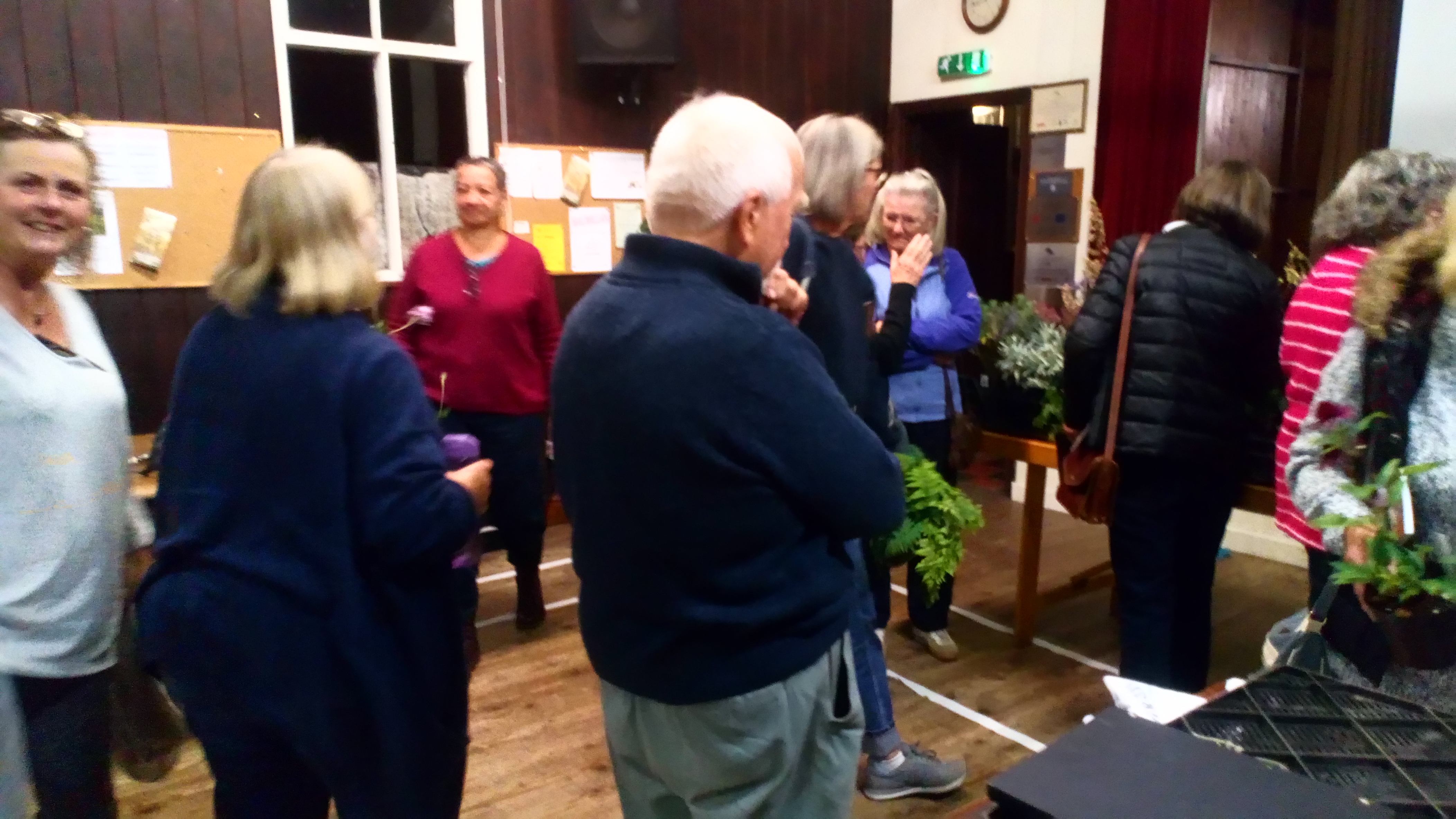
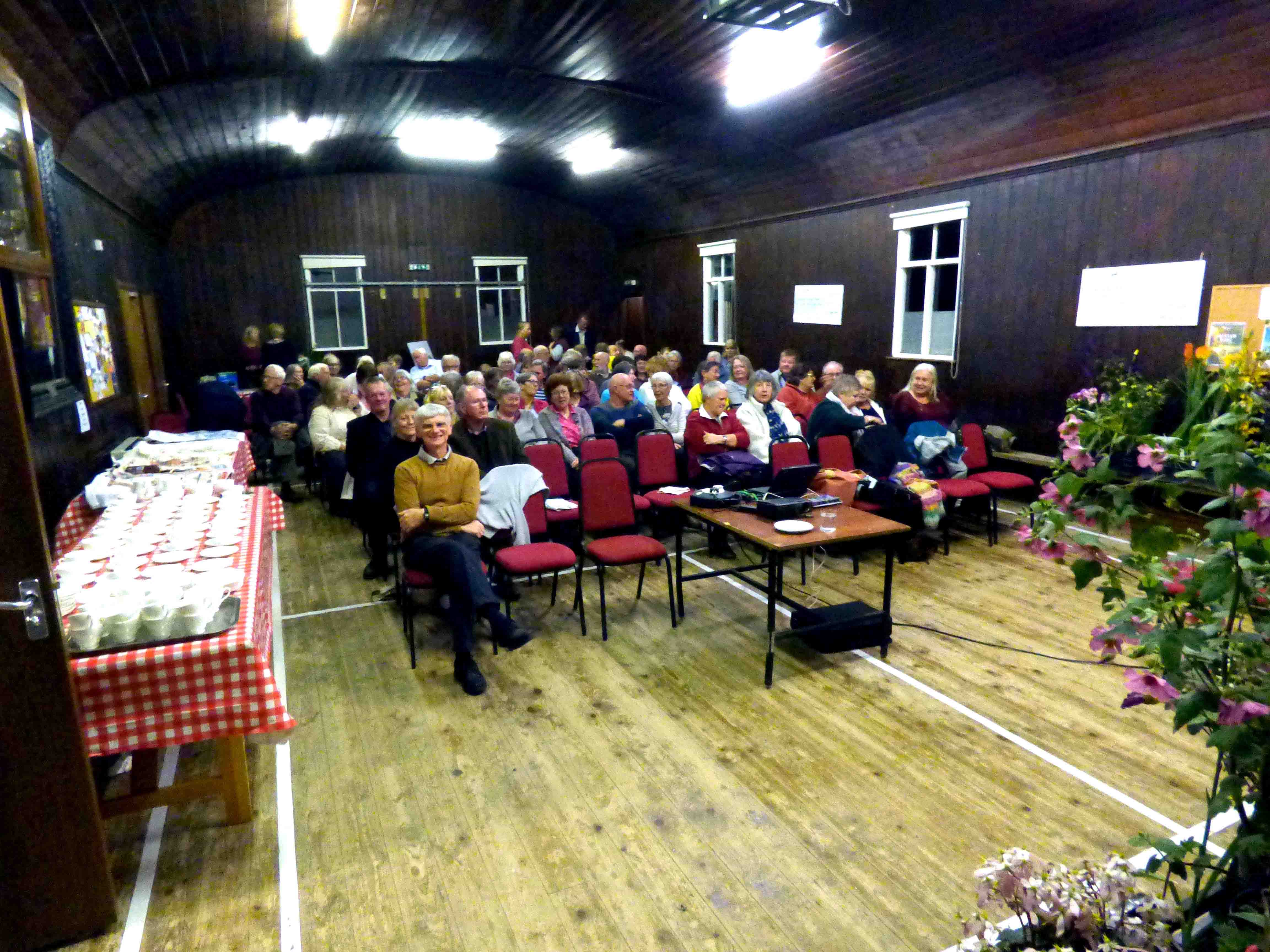
Preceded by another successful Pie Night at the Dolaucothi Arms, our October meeting saw us entertained by our ‘big name’ speaker for this year, Bob Brown from Cotswold Garden Flowers. The hall was packed with 40 visitors swelling our club numbers to over 80. There were some excellent raffle prizes to be won and members did us proud with their cake baking for the refreshments
Bob lived up to his reputation and gave us a highly informative and amusing talk on the subject ‘Too many plants, too little space’. Below is a brief summary of the main points he made.
“Too many plants, too little space”
Cut down size of garden
Make every plant earn it’s keep, opt for plants with multi-seasonal interest.
Multi-layer planting to extend growing season – as one plant goes over another is coming up to take it’s place – in the same space.
Throw out non optimal performers – be ruthless!
Go for AGM varieties as these are proven to be garden worthy.
Avoid ‘rare’ and difficult to get hold of plants – they are so described for a reason!
Bob also brought some of his lovely plants to sell, many of which were mentioned in the talk.
Many thanks to all those involved with the smooth running of the evening, and especially our programme organisers, Brenda and Yvonne, whose brainchild it was.
Quatre Vents – Wednesday November 15th
November’s meeting will be a quieter affair but non-the-less very interesting. We are showing the film made and narrated by Frank Cabot about the development of his family’s garden ‘Quatre Vents’ near Quebec in Canada. Frank and Anne Cabot were the primary benefactors of the Aberglasney Restoration Trust. He set up the Garden Conservancy in the States to help save and restore special gardens around the world. Click here to read more. Sadly Frank died in 2011 aged 86.
The following is a quote about Frank Cabot from Alexander Reford, director of the renowned family-owned Jardins du Métis, also in Quebec.
“He was a formidable character and an inspiration to gardeners, both amateur and professional who work to emulate his horticultural prowess. His wit and wisdom were a welcome addition to our lives, his erudition encouraged many to take up gardening seriously, and his irony made sure that we did not do so excessively. He inherited the land, but he made the garden; it was his from start to finish. Whenever I saw him he was in jeans, his rubber boots, knee pads, dirt under his fingernails. He had an encyclopedic knowledge of plants.”
Even though the property has been open to the general public for only four days each summer, the gardens are world renowned. Hilary Weston and Nicole Eaton featured them in their book In a Canadian Garden, and Reader’s Digest once referred to them as “Canada’s best kept secret.”
In the year 2000 Frank Cabot was awarded the Veitch medal by the Royal Horticultural Society. He also received the Garden Club of America’s 2006 Achievement Award for “the greatest horticultural accomplishment in America in the last half-century” and numerous other awards.
“His book, The Greater Perfection, received the Council of Botanical and Horticultural Libraries’ 2003 Literature Award, and was described as “one of the best books ever written about the making of a garden by its creator”
Perhaps Gardens Illustrated described him best: “part eccentric, part scholar; a thinker, a gatherer of ideas, a plantsman, and a patron… above all, as is essential to all great gardeners, he is a visionary.”
The film shows gardening on a grand scale, but is still very stimulating, and you may well not get a chance to see it anywhere else, so it’s well worth coming along.
Christmas Buffet
Our Christmas meal this year is a buffet and will be held on the evening of Wednesday December 13th at the Dolaucothi Arms, meeting at about 6.30 pm for a 6.45 to 7 pm start. Final details will be circulated nearer the time but members should be aware that places are limited, so if you do want to come you need to let Julian or Stephen know as soon as possible to secure your place. Payment needs to be made by the November meeting at the latest. The menu is below.
The DOLAUCOTHI Arms – Cothi Gardeners Christmas Buffet 2017
£15 per person
Hot
Dinefwr Venison sausages with red onion, apples and sage
Mushroom, chestnut & red wine bourguignon (gf, ve)
Buttery mashed potato (v)
Root vegetables roasted with thyme (gf, ve)
Cold
Home cooked glazed ham with cranberry and orange stuffing (gf)
Vicki Weston of Big Sky Plants talking about ‘Penstemons and Salvias’ – 20th September at 7.30pm
Flower Border – Photo courtesy of Big Sky Plants
Vicki runs a nursery and smallholding located on the top of a mountain in Ceredigion. (click here for her website) She specialises in perennials, especially Penstemons and shrubby Salvias. She grows most of her plants from seed, division or cuttings so they should all be well adapted to the west Wales climate. Plants will be available for sale.
Summer Social and Growing Challenge
This year our summer social was held at Gelli Uchaf, the home of Julian and Fiona Wormald. Although the weather did not smile – in fact it tipped down – the atmosphere inside was warm, comfortable and friendly and the evening went with a swing.
The growing challenge this year was for members to bring to the social some food they had cooked/ made from something they had grown in their garden. Many rose to the occasion and we were spoilt with a wonderful array of savouries and desserts – home-grown and made sausages, pizzas and salads, peach muffins, cheesecake and rhubarb crumble to name but a few.
Bob Brown Meeting
As most of you will be aware, our October meeting is the ‘big one’ of the year with speaker Bob Brown coming to talk on ‘Too many plants, too little space’. Posters will be available at the September meeting for anyone to take who can find somewhere to put one.
Offers of help for the night will also be gratefully received – tea/coffee serving, putting out chairs, clearing up, etc. More details at the next meeting.
Ty’r Maes NGS Open Day, 6 August 2017
Despite experiencing our first wet Open Day in 9 years, visitor numbers held up very well, and a good time was had by all. Very many thanks to everyone who made it such a great event and helped us to raise over £700 for the NGS – too many to name individually, but we certainly couldn’t have done it without your help and fantastic cakes. As usual, a donation goes to Cothi Gardeners with heartfelt thanks to all. John and Helen.
Forthcoming Events
GREAT CHARITY PLANT SALE
For National Garden Scheme and Cothi Gardeners
Sunday 22 October, form 1.00pm
Ty’r Maes, Ffarmers SA19 8JP (on A482 opposite turn to Ffarmers)
Tea and coffee provided
Drefach Felindre Gardening Club (DFGC) Open Meeting 2017
DFGC would like to invite members of Cothi Gardeners to their Open Meeting on Wednesday 4th October at 7.30pm in the Red Dragon Hall.
John Shipton of Shipton Bulbs will give a talk on “Plants of Western China”. Refreshments will be provided at the end of the meeting.



























 Cothi Gardeners