Paul and Liz O’Neill have been gardening at Llwyngarreg for 24 years, when they originally turned a field into a garden open to the public for the NGS with a variety of different environments: peat beds, azaleas and rhododendrons, a tropical bed with Tetrapanax and ginger lilies, a fritillary meadow, gravel beds creating a dry garden (see right), to mention just a few.

A soil map of Wales shows that generally the pH is about 6-6.5, so on the acidic side. Some plants are calciphile (lime-lovers), and others are calcifuge (lime-haters), and there are plenty in-between. But even then things are not so simple. Buddleja, honeysuckle, and ash are defined as being calciphile, but generally do well in Wales. This talk focuses on plants that must have or don’t mind a low pH soil, starting with trees and shrubs, and moving on to plants that grow beside or under them.
To start with – Rhododendrons, the plant that first triggered Paul’s interest in gardening. First come the species, considered to have ‘snob value’, compared to the ‘commoner’ hybrids. A lot of species rhododendrons originate from the Himalayas, but also from North America, and Europe, including Portugal (R. ponticum) and the Caucasus.

They generally come true from seed, which is how Paul has grown many of the species that he has, including R. calophytum (left), which over the years has made a huge plant. Species can take up to 20 years to flower if grown from seed – meriting a glass of champagne when one flowers for the first time! R. cinnabarinum is another favourite, this time grown from cuttings.
Hybrid rhododendrons come from crossing different species. They are generally tougher, easier to grow, and flower earlier in life. They are propagated by cuttings or layers. Paul’s favourite is R. ‘Pink Walloper’, while Liz’s is R. ‘Sappho’ (right) , a lovely old hybrid from Waterer’s Nursery in Surrey – the plant’s only fault is that it is a bit straggly.

Both species and hybrid rhododendrons hate having wet feet – so if you garden on clay soil, plant them on a bit of a mound.

Finally there are what we call the Azaleas (although they are of course Rhododendrons). They can be evergreen, such as R. ‘Hinomayo’ which forms a dense bush (so much so it can be pruned to shape with a hedge trimmer). They are also deciduous – R. luteum (left), from the Caucasus, with its scented yellow flowers and gorgeous autumn colour. The latter can tolerate really sticky grey clay, and Paul and Liz plant them on what they call the ‘killing grounds’ where many other plants won’t survive. R. occidentale, again scented, is from America.
Next come the Camellias. Over time, even in our environment, they can get large (in Cornwall they have been known to take the chainsaw to them!). Some examples Paul gave are C. ‘Donation’, C. ‘Debbie’, and C. ‘Jury’s Yellow’ (right).

Most magnolias want acid conditions – and they vary from huge trees to shrubs such as M. stellata. At Llwyngarreg one of the stars of the show is M. ‘Caerhays Surprise’, a magnificent hybrid bred at Caerhays Garden in Cornwall.
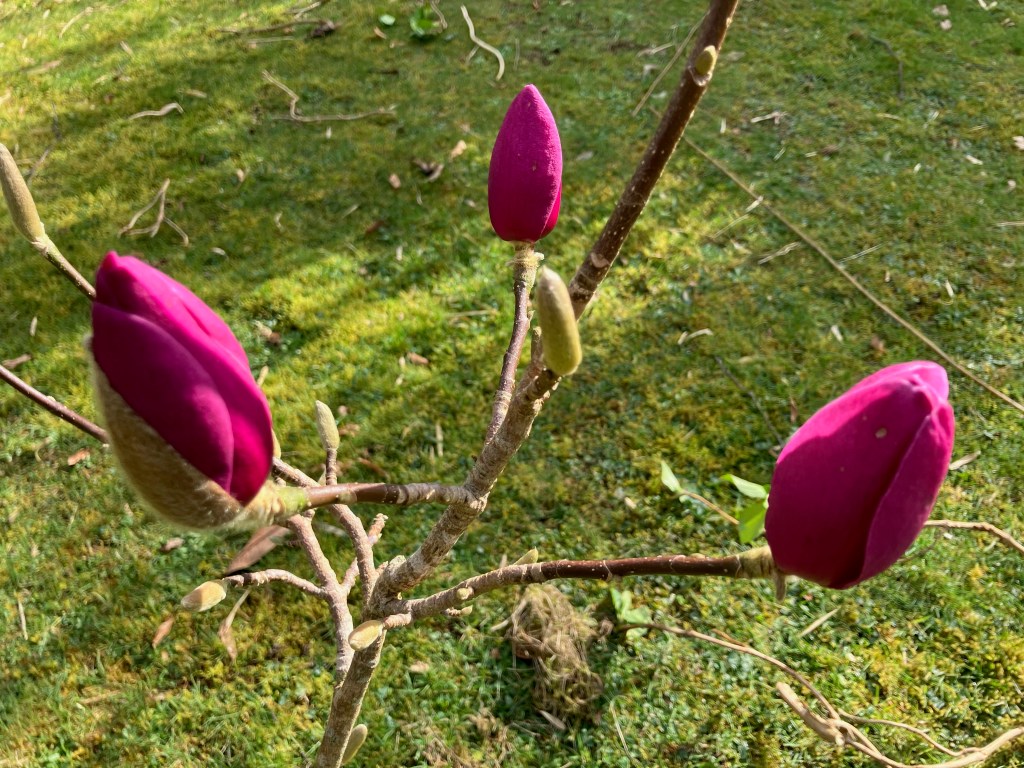
Another is M. ‘Black Tulip’ (left, in bud), a Mark Jury hybrid from New Zealand (which in addition to flowering in the spring can also flower again in September). M. loebneri ‘Merrill’ is pure white with a delicious coconut fragrance in the sun.
Another of the magnolias that Paul and Liz grow is M. ‘Yellow River’ (right), a lovely yellow flower, but as it is late the flowers can sometimes get lost among the emerging foliage. M. ‘Daphne’ is probably the yellowest of the Magnolias, but late, with the flowers coming out with the leaves. Paul recommends the Arboretum Wespelaar in Belgium as a place to see the many species and varieties of Magnolia.

Moving on to other shrubs, a hydrangea that not so many people are aware of is H. aspera subsp sargentiana, with large velvety leaves and lacy flowers which tolerates deep shade underneath beech trees. On the other side of the path from the Hydrangea is a mass of the ginger lily Cauttleya spicata ‘Robusta’, rather surprisingly also enjoying the shade.
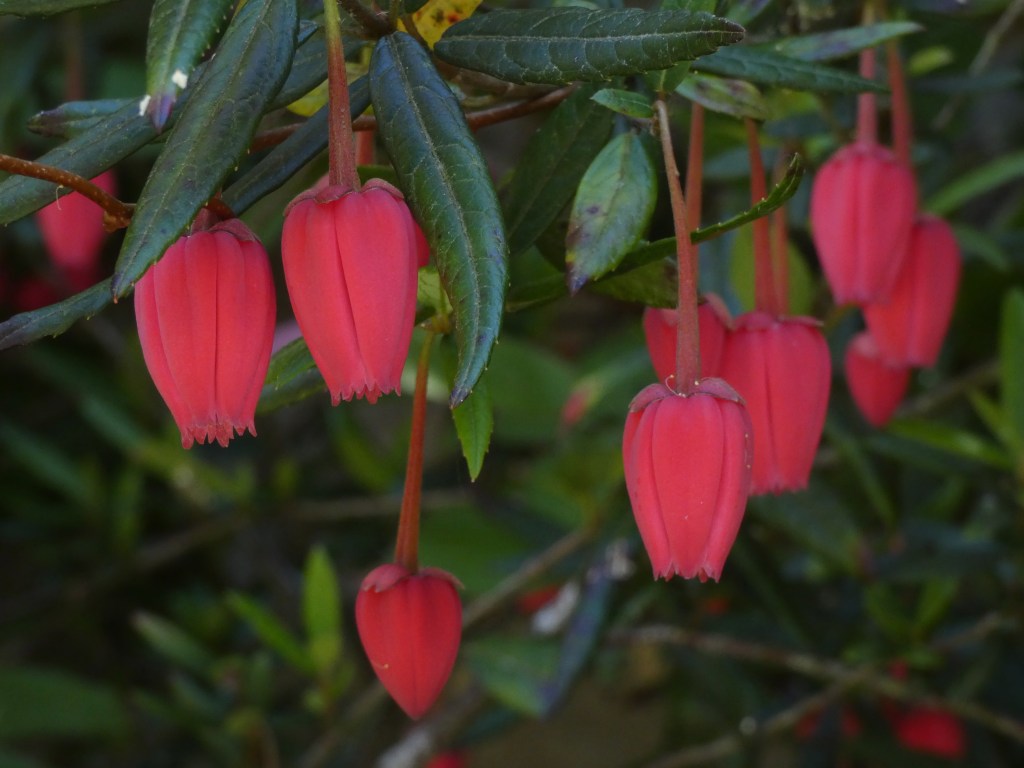
Crinodendron hookerianum has magnificent red bells in spring, and like many other acid-loving plants hails from Chile. There are also now other white and pink-flowered varieties, although they have not yet been tried at Llwyngarreg.
Paul and Liz started by planting trees at Llwyngarreg, including Parrotia persica (with tiny red flowers in late winter) and Nyssa sylvatica (the tupelo), both with fiery autumnal foliage.
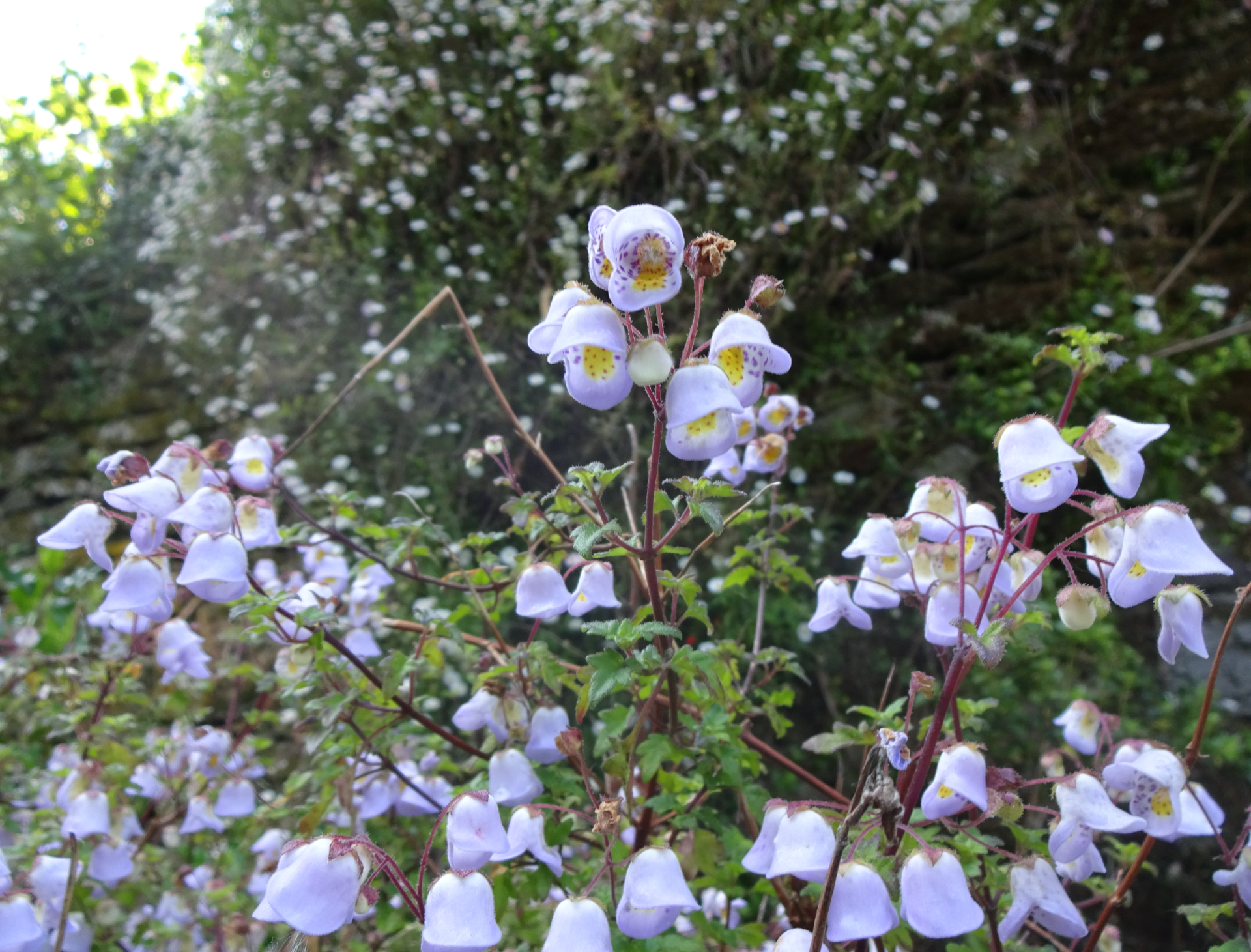
Eucryphia lucida ‘Ballerina’ is a small evergreen tree with lovely pink flowers in late summer, although here in west Wales we cannot grow the huge eucryphias (trunks like trees!) you see in Northern Ireland. Enkianthus campanulatus has small pink-tinged bells in the spring, with fantastic autumn colour. Jovellana violacea, a sub-shrub, has pale purple bell-shaped flowers with a yellow throat; also from Chile, Desfontainea spinosa has holly-like leaves and tubular red and yellow flowers, a lovely shrub, which in west Scotland can be a tree up to twenty feet tall. The latter is a true acid-lover and will die if it comes anywhere near an alkaline soil.

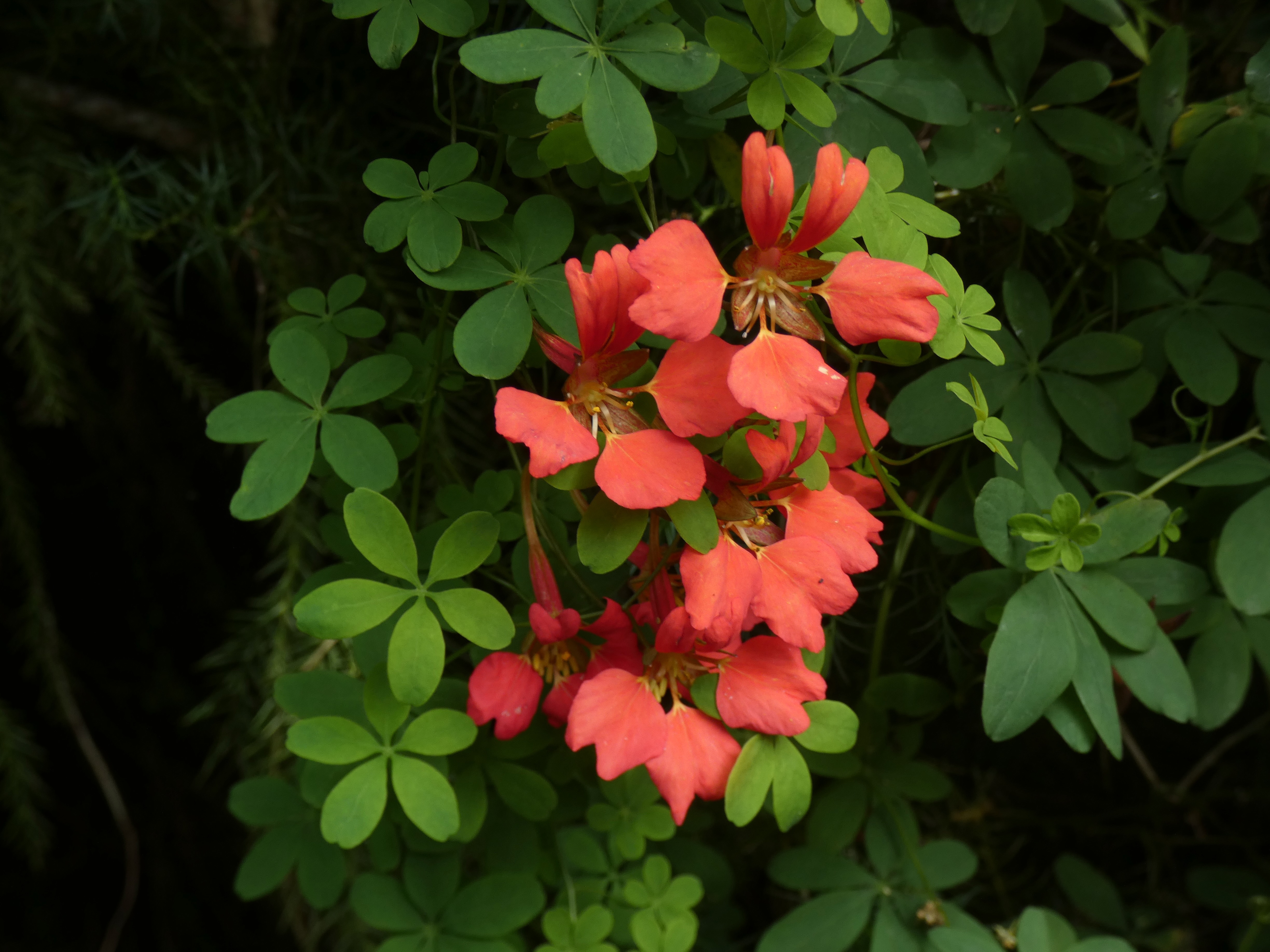
Moving on to climbers – the star of the show is Tropaeolum speciosum, a perennial nasturtium with red flowers and blue berries, renowned for growing very well in Scotland. It is often lost in gardens when first planted, because slugs graze it off.


Amongst perennials, Meconopsis, the Himalayan poppy, are perhaps the ultimate acid-lovers. They are definitely challenging to grow, and need a shady, damp bed with no sun. M. ‘Lingholm’ – the one to grow if you are only going to grow one type – used to seed around in the peat beds, but not so much any more as summers have become hotter and drier.
M. horridula, being monocarpic, takes three years to reach flowering size and then dies after flowering. So too does M. x complexa (it used to be called napaulensis), flowering red or yellow after two to three years.
Primula capitata (right), with its striking blue flowers, is a short-lived peat-lover of moist woodlands. It comes easily from seed if you sow the seed green and don’t cover it.

Another primula for a peat bed is P. flaccida – a lovely lavender blue but it is loved by vine weevil. P. ‘Arduaine’ has ice-blue flowers in January and February. P. poissonii is a candelabra primula which likes wet feet. P. viallii will grow in any soil, but thrives in a peat bed.
Roscoea ‘Harvington Evening Star’ is a dark purple. It comes up late in the year, and slugs don’t like it, always a bonus. It has a tendency to flop over, but it has a long flowering season from mid-Summer to October. Trilliums are invariably expensive to buy, but it is hard to understand why. Trillium luteum, for example, is easy to propagate by chopping it into small pieces, each with an eye, and replanting. Cypripedium, hardy slipper orchids, are gorgeous but difficult to grow, and always expensive.

Cardiocrinum giganteum, known as the giant Himalayan lily, is a truly impressive plant at up to 4m high with gloriously scented flowers (see left, with Liz). Slugs adore them so they can be difficult to grow for that reason. They produce masses of seed after flowering, but it takes seven years from seed to a flowering plant!
Gentians need moist, peaty soil, and also full sun. A good place to buy gentians is Aberconwy Nursery near Bodnant Gardens. G. asclepiadea is a great late summer plant and will tolerate light shade. Corydalis alata (blue flowers), C. flexuosa (blue flowers) and C. solida (purple flowers) are plants that need shade and moisture.
Two favourite plants in the lily family are Nomocharis alata, which requires moist peat, and Lilium mackliniae.
Podophyllum delavayi, P. ‘Spotty Dotty’ and P. ‘Kaleidoscope’ are plants for a moist and shady spot.
Myosotidium hortensia, the Chatham Island forget-me-not, is a challenging plant for acid soil, and unfortunately completely slug-delicious. It must have no sun at all.
At the very low ground level Paul and Liz plant Saxifraga stolonoifera, which makes huge mats of leaves covered in white flowers, and two Chilean plants – Asteranthera ovata, and Philesia magellanica which requires a pure acid soil.
Ginger lilies do surprising well – they prefer an acid soil but don’t have to have it. Hedychium edgeworthii (yellow) and H. ‘Tara’ (orange), produce some of the most exotic-looking flowers you can grow in the UK.

Other plants not requiring acid soilthat grow well at Llwyngarreg include Epimedium, lovely for its new foliage, and Aquilegia. Primula pulverulenta prefers a woodland environment rather than wet feet. Primula bulleyana (orange-yellow) and beesiana also do well. So too do Rodgersia podophyllum, which is easy to propagate, and Matteucia struthiopteris (the Ostrich fern).
At the time of this talk, the second half of March, some of the highlight plants in the garden at Llywngarreg are listed below:
Snakeshead fritillaries, which love wet grassland. Paul and Liz started with ten pots, over the years religiously collected the seed and sowed it – and now they have a whole fritillary meadow; sadly, Mr Badger has developed a taste for the fritillaries.
Ground cover in the form of Eomecon chionantha with poppy like white flowers from China, which can be quite a thug; also Maianthemum racemosum.
Rhododendron arboreum ‘Album’ is now starting to flower properly. So too is R. calophytum, which this year is much pinker in flower than it has been previously.

Magnolia ‘Caerhays Surprise’ (left), M. ‘Merrill’ and a large M. stellata, along with M. ‘Black Tulip’, which is a very reliable flowerer.
The talk concluded with a video of a dramatic burning of the Monocot bed, largely populated with Miscanthus but also Dierama. Paul and Liz have discovered that the simplest way to tidy up the grass beds is to cut down all the old foliage, and then set fire to the bed!!
In response to a question about tropical-looking plants that he would recommend, Paul suggested Tetrapanax papyrifera. It can be a little bit tender, and even though it was cut back by the hard frosts of December 2022, it has come back strongly. You need to be careful when handling it, as it has little brown hairs which make you cough badly. Paul also recommends cannas and hedychiums.
The talk was fast-paced, very informative, and delivered with lots of humour. The web editor, for one, came away with a long list of plants new to her to try in the garden. All those present were very appreciative and made a beeline for the plant sales table afterwards.
Llwyngarreg Garden is open for the NGS (which supports seven main and other guest charities) every day by appointment, but please check the website and ring beforehand.
Plant Sale for NGS Charities 12 May
John and Helen Brooks will be holding a plant sale for NGS Charities on Saturday, 12 May from 1pm at their garden Ty’r Maes, Ffarmers, Carmarthenshire, SA19 8JP. As usual there will be lots of plants for sale, to swap and to order online, all proceeds going to NGS Charities.
Remember to browse the website for other upcoming events, the Surplus to Requirements section and updates to Members’ Gardens. If you have any ideas for new content or would like to contribute a piece about your own garden, please contact cothigardeners@gmail.com.






 Cothi Gardeners