Summer Social at Y Plough and Dahlias with Joseph Atkin; Updated Autumn Programme; Ty-r Maes Charity Plant Sale

This year’s Summer Social – Pizzas and Plants – was held at Y Plough in Felingwm, a pub now owned by Joseph Atkin, previously Head Gardener at Aberglasney Gardens and Rachael Garside.

The social was very well attended by members and guests, and judging by the photographs a fine time was had by all! There was an imaginative choice of large and delicious pizzas cooked in an outdoor wood-fired pizza oven.

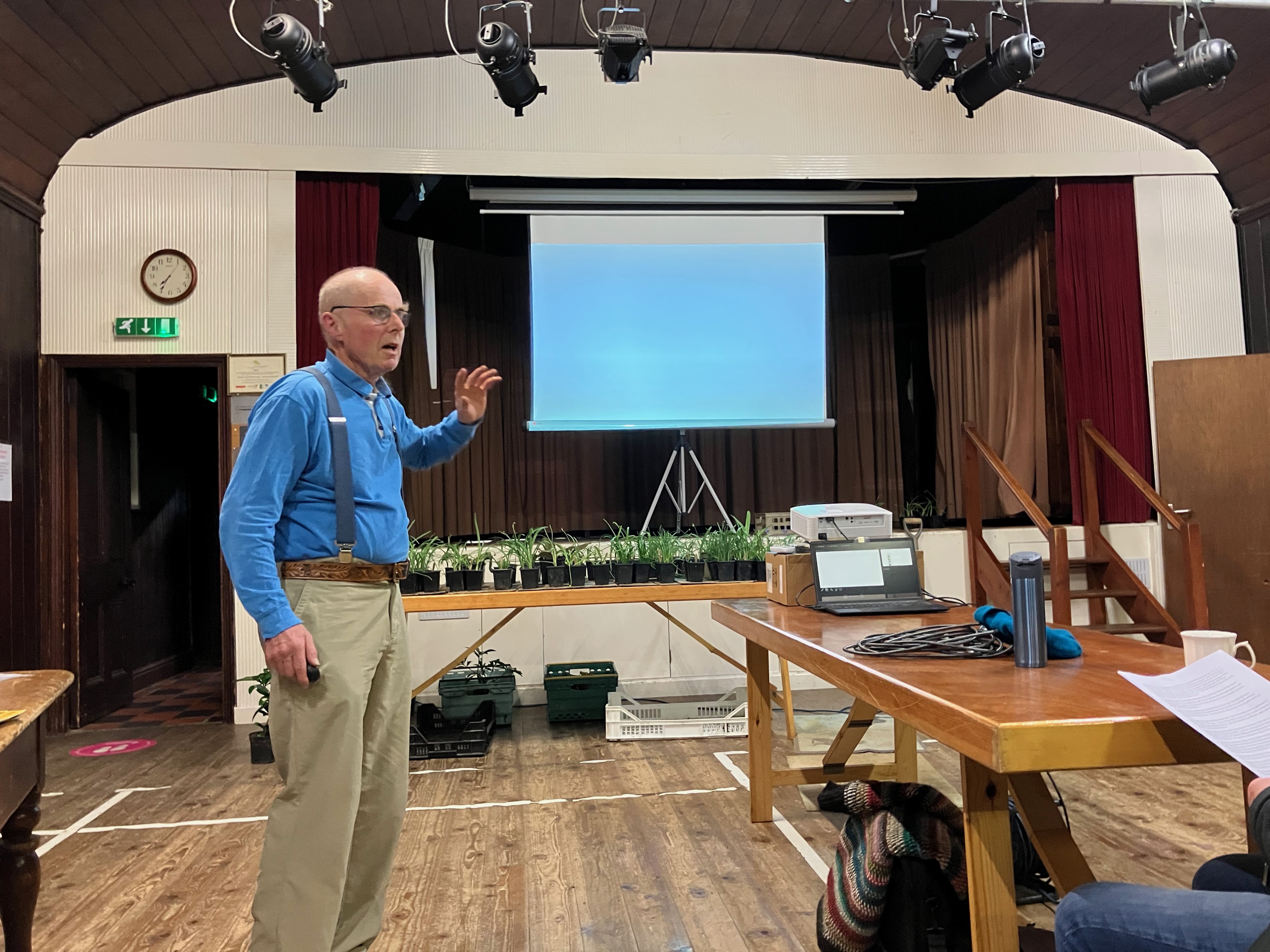
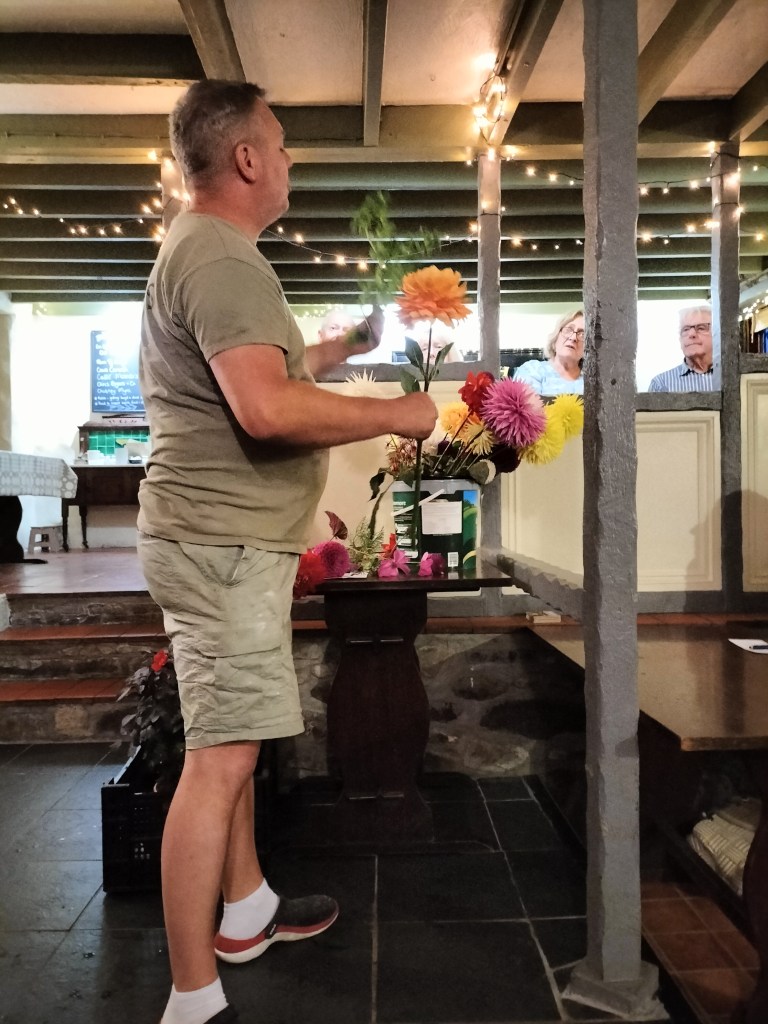
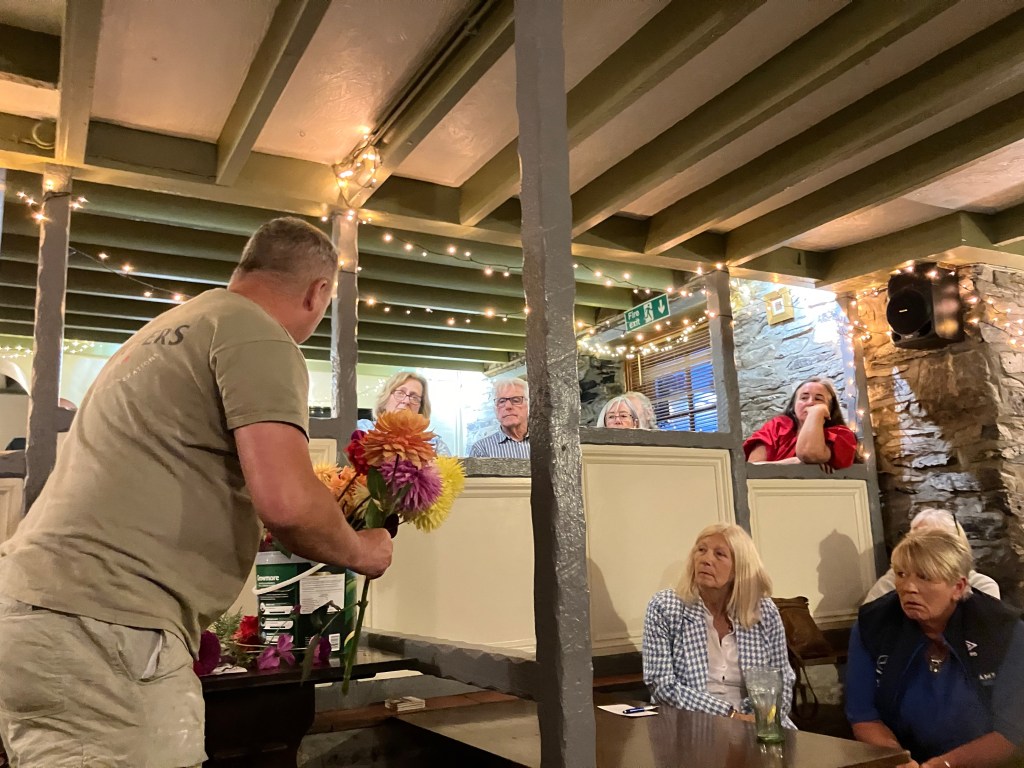
Feeling very full, it was time to listen to Joseph tell us about one of his favourite plants – dahlias, very topical for the time of year. Joseph stressed that he was giving us a gardener’s view of what he thinks is one of the very best plants for the huge selection (4,500 varieties), the range of colours (everything except blue) and their flowering season (from June until the first frosts). The only downside is that they are quite a lot of work! Joseph had two pieces of advice for us – spend some time doing your research to choose ones you really like, and don’t grow too many!

You can grow dahlias in pots, put them in troughs, or grow directly in the ground. They need super-rich, really good soil. Joseph has even grown them in pure manure! A sunny aspect is best, with a bit of shelter. Joseph thinks that the tall types of dahlia are best – as then the flowers are at the right height to be enjoyed – but they will need staking.

Fergus Garrett from Great Dixter plants his dahlias six inches deep, and leaves them in the soil over winter with frost protection. In Wales it is best to either bring the pots in or lift the tubers for the winter, because of the wet we experience and the slugs – although if you want to try leaving them outside then the tubers should be mound-planted.At Aberglasney, they overwinter the tubers inside, and then get them going early in the spring in the greenhouse. In autumn, when you dig up the tubers, cut off the foliage and leave upside down in a dark shed for two weeks. Then shake off the old soil, and plant into compost in crates, pots or hessian sacks (anything with good drainage). Cover with cardboard and they can be left for the whole winter, until late February or early March, but remember to keep the compost slightly moist.

The spring, when they start shooting, is the time to take cuttings. You will find that one shoot, as a cutting, will make a much bigger, better plant than an old tuber. The reason is that there is only so much energy in a tuber, and so that limits the size of the plant; whereas a new cutting will just grow and grow, and only start to make a tuber later. Cuttings are very fast to root (48 hours is the fastest that Joseph has rooted a dahlia cutting!). He uses a fungicidal spray, and puts the cutting into a pot of compost covered with a plastic bag on a window sill (rather than a greenhouse). Once rooted, keep watering the plants steadily in spring until there is a reasonable amount of growth. Cuttings and tubers can be planted out in May, but should be covered if frosty weather is forecast. Add organic matter when planting out, and put three stakes in a triangle around the plant ready to support it later. Slugs are the biggest enemy, so Joseph likes to make sure his plants are as big as possible before planting out, about one to two feet tall. Then just keep them watered, and deadhead them for a fantastic, long-lasting display.

Joseph noted that the popularity of dahlias has grown tremendously since 2008 and that as a consequence dahlia production has become very commercialised, which can lead to inferior plants becoming available, particularly if raised from seed. His strong recommendation is that, as dahlias are so much work, we should only buy really good ones with an Award of Garden Merit from the Royal Horticultural Society. Make sure to buy named varieties; exhibition dahlias will always give you height, but there are also plenty of good garden dahlias as well. In short, choose any AGM dahlia varieties with shapes and colours that you like, and remember that you don’t need many to fill a reasonable-sized bed or border.

Dahlias are great for combining with other plants. The leaves with dark or bronze foliage are particularly useful in colour schemes, and you can have great fun combining the colours and shapes of the flowers with other plants. The pompom or cactus shapes contrast really well with the spire shapes of other plants.

At Aberglasney, dahlias are grown in with the vegetables to really tighten up the look of the kitchen garden. In the autumn Dahlia ‘Downham Royal’ makes a stunning contrast in a border against a fiery background of Boston ivy. Basically, there is a dahlia for every colour scheme! In a border, they need to be in the middle, or further back, not in the front of a border. They also look good in pots – but it should be a really big pot with rich soil/compost. Raised beds are also good.

Asked about dividing tubers, Joseph explained that trying to ensure you get a growing shoot with part of the tuber is a bit of a nightmare. In his view, it is much easier and better to take cuttings in the spring.

Joseph was thanked appreciatively for both the delicious pizzas and his entertaining and informative talk.


Updated Autumn Programme

The Club’s autumn 2025 programme has now been updated on the website. Our next meeting on Wednesday, 17 September at 7.30pm will be an opportunity for members to reflect on our gardening year so far – what’s worked and what hasn’t in our gardens, which  garden club talks and activities have we enjoyed the most, and what would we like to see in the Club’s programmes going forward? The usual tea, coffee and biscuits will be provided, along with some extra non-alcoholic drink choices. Please bring nibbles to share as well.

The Events page on the website has also been updated and your attention is drawn to the West Wales Country Gardeners’ Autumn Plant Fair on 13 September.


Ty’r Maes Charity Plant Sale

Our very own John and Helen Brooks are holding their annual plant sale for charity on Sunday, 28 September from 1pm at Ty-r Maes, Ffarmers, Carmarthenshire SA19 8JP (but please use SA19 8DP to locate the property with SatNav). Entry to the plant sale is free, there will be tea and biscuits, as well as loads of plants for sale. All proceeds from the plant sale go to NGS charities.


Pelargoniums and Geraniums by Mair Evans; Upcoming Events

Mair firstly explained the differences between Pelargoniums and Geraniums –  Pelargoniums are tender and originated in the Southern hemisphere (they are endemic to Australia and New Zealand ),  whereas Geraniums are hardy and herbaceous, can be found in borders and come from the Northern hemisphere.

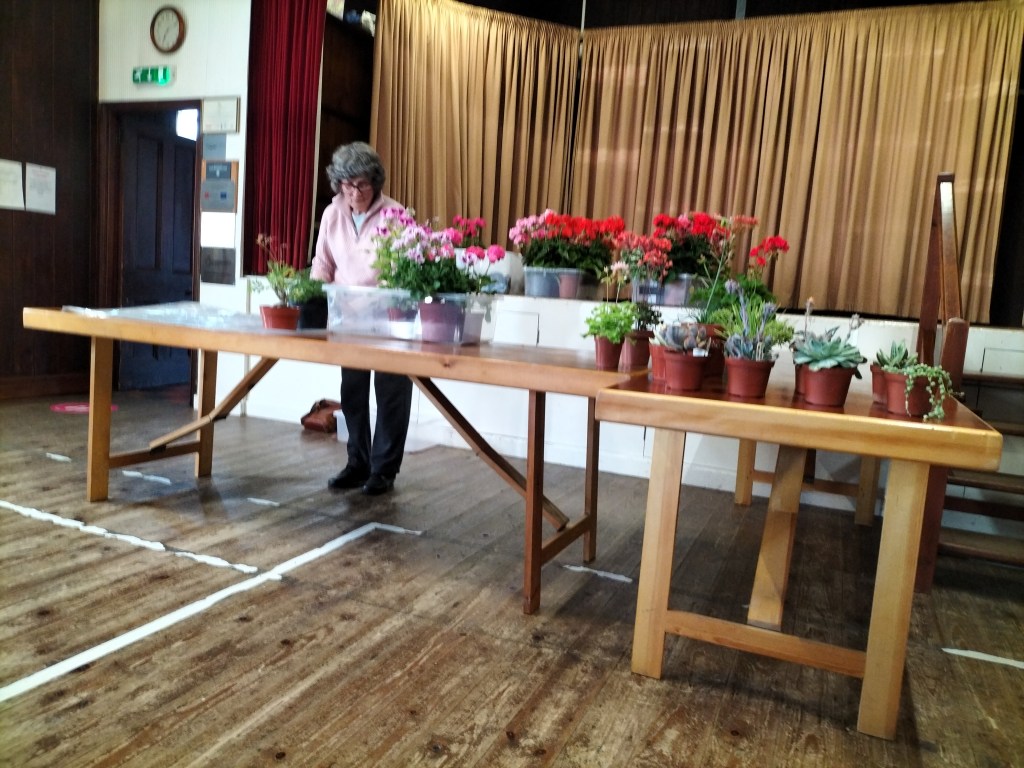
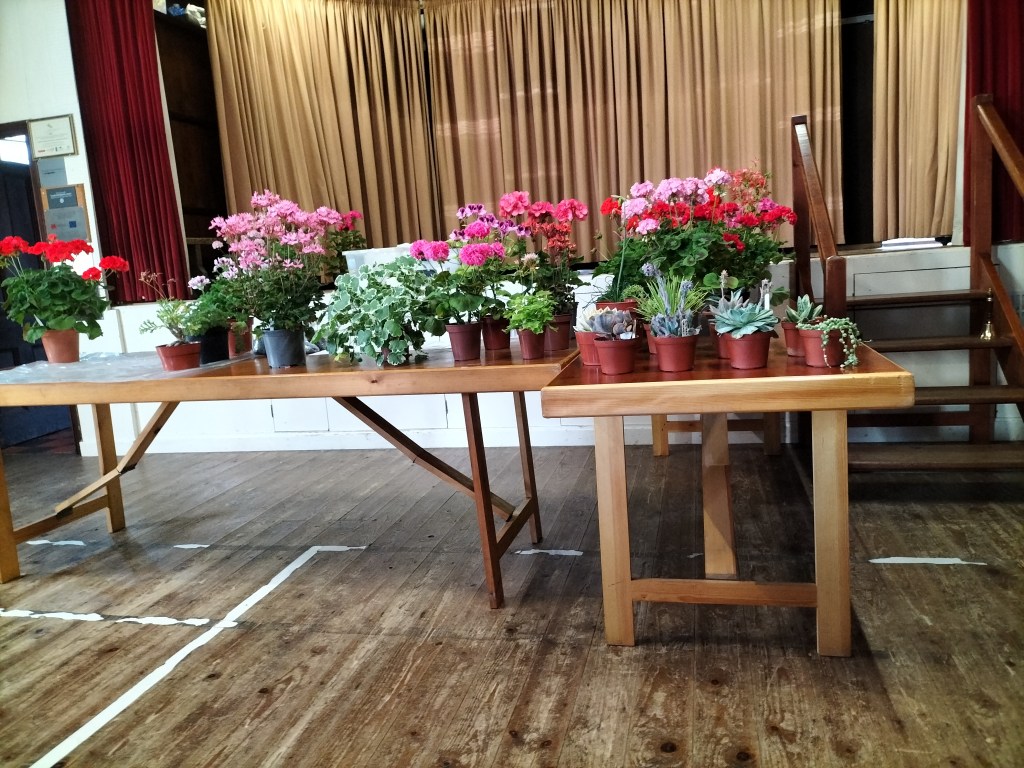
We had a quiz to find out who knew the difference between the two, with Mair holding up different potted plants to see if we knew whether they were Pelargoniums or Geraniums, and quite a few people did know it seems.

The name ‘Geranium’ for Pelargoniums comes from St Helena where the “Valley of Geraniums” can be found; it was given the name by Napoleon when he was exiled there, because it reminded him of the valleys of hardy geraniums in Europe. The land on St Helena was constantly shifting and the plants could be found even in the dunes which would not normally be a favoured habitat for them. They were then almost extinct there, when the trade routes were opened by the British East India and the Dutch East India shipping companies. The ships berthed in South Africa to load provisions, found the Pelargoniums and were keen to ship them back to Europe because apparently they were thought to be a cure for dysentery.  In the early 18th century, they would flower in January, February and March, but were nothing like the Pelargoniums we know now and were quite scruffy with a strange scent, growing out of rocks and very tough. The Dutch particularly collected them and took them back to Holland with them.

There are now thousands of different cultivars of Pelargonium and a lot of research is carried out. Trials involving thousands of varieties, the numbers of which are whittled down to about six, are done to ensure that the required characteristics and disease resistance are present in the chosen handful.

When keeping our own Pelargoniums, the plants can get very leggy in the winter so cuttings need to be taken in late summer or early autumn and a puff of sulphur on the cut parts will really help. Mair demonstrated how to take cuttings (sharp intake of breath from the audience when she started happily chopping at the lovely plant which she had brought with her!) and explained that once the cuttings are in the compost, they should root within six weeks. She uses a mixture of coir, garden soil and compost, just fairly constantly damp, but not wet. The coir helps with drainage but obviously makes the mixture dry out quicker so they need to be checked regularly. The best time to take cuttings is September which is the ideal time to be cutting them back, and then they should put on some growth before the winter dormant phase.  They can be cut back a little, usually three times between September and January. The theory goes that you need to get your cuttings in pots by the time the Malvern show comes around! Always take cuttings from the healthiest plants and, during either the growing or the dormant period, any dead leaves and flowers should be removed straight away. In the winter, the plants are happy in a cold greenhouse or porch, though if the temperature really plummets they may need to be covered. 

It is possible to take cuttings and root them in water, though adding a drop of orange juice will help and the water needs to be changed weekly. The best time to feed with a good all round plant feed from June onwards and potash can be given in December and January.

There are so many different types of Pelargonium; any single variety will do very well outside and the semi-double are happy inside or out. There are also many scented varieties, with scents all through the spectrum, spicy, sweet, flowery, sharp etc. Mair has some Pelargoniums, all of which are home bred and she hand pollinates them with a paintbrush.

Mair explained that she did have a problem last year with cuttings going black at the stem end, which turned out to be the water. A drop of orange juice in the water cured the problem, so the extra acidity did the trick.

Tracey thanked Mair for her talk and for bringing her beautiful Pelargoniums for the audience to buy.


Upcoming Events

At our next meeting on Wednesday, 16 July mixed-media artist Juliet Edgar is running a printing workshop. Juliet takes nature as her inspiration when creating using macrame, eco-printing and painting. It should be a fascinating evening.

Following that, our Summer Social will be held on Wednesday, 20 August at 7pm at ‘The Plough’ in Felingwm. We’ll be sharing the most delicious pizzas, and we will also be treated to a talk by Joseph Atkin, the former head gardener at Aberglasney Gardens on Dahlias.


‘The House on Stilts’ by Paula Davies; Next Meeting; Summer Social; ‘A Gardener’s Dream Itinerary’

Paula Davies (aka Head Gardener) came to Pumsaint, along with her husband Iain (aka Assistant Gardener), to talk to us about the garden she has created in Ferryside, Carmarthensire, on the edge of the river Towy estuary.

In purely factual terms, the garden is a third of an acre in size, eight metres above sea level (when the tide is out!). It faces west, being exposed to south-westerly winds and considerable precipitation. The soil is sandy clay over Old Red Sandstone, neutral to slightly acid (pH 6.5). To Paula, however, the garden is much more about people, places and time; it’s about the past, the present and the future.

Turning first to the past, Paula told us that her maternal grandfather had been a professional gardener, and as a child, along with her three sisters, her weekends were spent helping in her parents’ new garden or being dragged around other gardens or nurseries. Paula’s passion was drawing and painting and, influenced by books such as ‘The Country Diary of an Edwardian Lady’, she wanted to become an illustrator, perhaps of botanical or children’s books.

Once at art college, Paula discovered textiles and surface pattern, and went on to become a very successful international designer first for interior products and then fashion, always focussing on floral design. Thinking about colour, texture, shape and scale, and using these to create rhythm, repetition, focal points and balance, is a similar process to creating a garden – which came later!

The part-time lecturing which Paul did alongside her design work brought her to Carmarthen School of Art. Here, without any career plan but with a lot of hard work, she rose to become Faculty Manager and met Iain her husband, a handsome photography lecturer. Together in 1998 they bought a run-down modernist house in Ferryside, which at that time came with only a tiny plot. Paula had pots of architectural plants she had moved around various rented accommodation until then. The plants were finally put in the ground, which was then covered in 20 tons of gravel. As far as the garden was concerned, job done – or so they thought.

Then along came their son, and as he started to grow, gravel no longer seemed like the best idea. In 2013 it became possible to extend the plot as the neighbouring farm was up for sale, so that it is now one-third of an acre. And this is the land as it was when they bought it – an overgrown pond, goat willow, reeds, flag iris, brambles, nettles, hogweed, dock.

Paula’s inspiration was a book called ‘The Lost Words’ by Robert Macfarlane and illustrated by Jackie Morris, itself a response to words associated with nature being dropped from the Oxford Children’s Dictionary to make room for words from the world of technology. Paula and Iain wanted their son to grow up knowing and experiencing acorns, conkers, dandelions, frogspawn, herons and kingfishers.

The first stage, after Paula’s father had helped clear the land with his chainsaw, was to bring in a digger to excavate the pond which was clogged with couch grass, and then use the spoil to create different topographies and habitats – the pond, damp meadow, wooded shade, dry slopes. There were all the practicalities to consider, such as light, circulation, viewpoints, usage; then where the sun and shade naturally fall, where to put places to sit, paths, steps and so on. Their son got involved as well, creating drawings for what he wanted from the garden – his drawing of a tree-house perhaps the start of his interest in architecture.

This was to be a garden providing food, water and shelter for wildlife. They planted a mixed native hedge (560 plants!) including species such as beech, blackthorn and guelder rose. They left some goat willow and added more trees for height – six oaks, a golden weeping willow and birch – ‘Snow Queen’ and ‘Trinity College’. The rest of the land was sowed to meadow – with different mixes for different areas. Again, job done – or so they thought. The first year, 2014, the annual wildflowers were pretty as a postcard; the next year it was largely perennials – oxeye daisies with some red campion, knapweed, self-heal etc., but a couple of years later it was mostly grass, despite all the yellow rattle seeds sown annually.

By 2017, it was time for a rethink, aiming for dense planting with variety and succession, and value for wildlife. This time the land was cleared slowly by hand (it took weeks!). In the first section under the oaks a liner was used, and the planting (woodland edge/dry shade) was done through that. Now liner is only used for the paths, and other areas , such as the bog garden, have been cleared section by section, using cardboard to cover the ground over winter before planting. Job done – or so they thought.

The pond is a natural clay-lined pond fed by a spring at the rear and rain water from the roof. It was planted up with marginal plants, floaters and oxygenators, but it was not without its problems – nutrient levels, algae and duckweed. Norfolk Reeds were planted to help filter the nutrients – but they are the bamboo of the water world! After they began invading the land, in 2019 work had to begin to dig them out. This work is still on-going – so job not done!

Then along came the pandemic and lockdown. The garden provided wonderful views while working from home, and technology offered online opportunities for connections with other gardeners – for example @myrealgarden with Ann-Marie Powell – and for learning such as garden design courses with Adam Frost. Meanwhile the battle with the Norfolk Reeds continued, now from within the pond, and the bog garden was planned and replanted, and pond marginals chosen for succession. Lockdown was also a time for reflection, and after 32 years working in education, the tables turned and the lecturer became the student.

In autumn 2021 Paula enrolled on an RHS course at Aberglasney Gardens – the RHS Level 2 Certificate in Practical Horticulture. This was harder than any other course she had done at a much higher level, but very rewarding. At the same time more areas in the garden were cleared with the help of a friend, also a student on the course. After the areas had been left over winter, they were planted up for dry shade and woodland edge habitats. The work continued in 2022 with clearing the steepest area, the upper bank, in the autumn and planting up for a sunny well-drained position in the spring with shrubs, perennials (including fruit bushes and other edibles) and bulbs.

Every section of the garden includes wild flowers, which are either a legacy from the meadow seedbank or sown by the birds. These include red campion, ribwort plantain, and ox-eye daisies, with the addition of native ferns (which were always there) and Epimedium x versicolor ‘Sulphureum’. You have to be selective and choose plants which will work well together.

After finishing the RHS exams, Paula enrolled in autumn 2022 on an online Garden Design Course with KLC School of Design, covering how to build a garden design portfolio – storyboards, moodboards, customer profiles, masterplans, elevations and perspective drawings. All this learning was also being applied at a practical level by creating planting plans for a specific situation or purpose – in this case a wetter slope out of sight of the house to be planted colourfully for the birds and the bees. The course also gives access to CPD with the Society of Garden & Landscape Designers covering the latest thinking in design and sustainable gardening. Through this, inspired by visits to Derek Jarman’s Prospect Cottage at Dungeness, and the Walled Garden at Knepp designed by Tom Stuart-Smith and Professor John Hitchmough, as well as Beth Chatto’s Dry Garden, Paula began to rethink the front garden.

This was designed to be drought tolerant, with sand and grit layered above the topsoil, and mulched with local cockle shells. Then, after the summer of 2022, the driest since 1976, came the wettest winter since 1766! Despite this, the drought-tolerant planting survived the floods. Paula realised that we need to learn to garden in a time of climate change with more resilient plants, more species and more natives; we need to think about the soil and the substrates.

So in the following autumn (2023), she began to rethink the areas under the oaks, and the woodland edge plant communities that she wanted to create. The process involves drawing up plant longlists for these areas, taking into consideration growth type, longevity and competitiveness, in order to create successful plant communities that include natives and well-behaved or controllable weeds. The lists are then refined to reach more considered plant combinations which take into account colour, texture, form etc, and which ensure interest throughout the year as well as good ground coverage to retain moisture and avoid weeds or unwanted self-seeders.

Paula and Iain got involved with garden opening through the Ferryside Garden Crawl starting from 2018. From there connections were made with the National Garden Scheme, for whom the garden has opened since 2024 with 186 visitors raising £1100 for NGS charities, and 272 visitors in 2025. Through the NGS Yellow Book, the BBC Gardener’s World programme got in touch, and came to film the garden in May 2024, which was a wonderful experience, and provided great exposure for the garden when aired.

For a number of years Iain had been encouraging Paula to enter the B&Q Gardener of the Year competition, and in 2024 she finally did so in the ‘Most Sustainable Garden’ category – which she won!

In June 2024 photographer Sarah Cuttle had visited the garden to take photographs which were then used by Gardens Illustrated Magazine in an article written by Alys Fowler. That was when Paula realised how much she and Iain had achieved by attracting so much wildlife and creating a magical place for their son to grow up, knowing all the ‘Lost Words’ and having seen them in the garden.

For the future, Paula plans to continue to work with wildlife at the heart of the garden, completing the Garden Design course and implementing the learning. As she now knows, a garden is never finished – and the job is never ‘done’!

Members would be invited to visit ‘The House on Stilts’ on 31 May at 2pm, details to follow by email.


Next Meeting

Cothi Gardeners’ next meeting will be held on Wednesday, 18 June at 7.30 pm. Our very own Mair Evans will be giving a talk on ‘Pelargoniums and Geraniums’, which is bound to be fascinating, and as a bonus she will be bringing along plants for sale!


Summer Social

Members, save the date! On Wednesday, 20 August Cothi Gardeners’ summer social will take place at The Plough Inn, Felingwm. We will be able to order delicious pizzas of our choosing, and hear a talk on dahlias by Joseph Atkin, owner of The Plough Inn and former Head Gardener at Aberglasney Gardens. A real treat in store!


‘A Gardener’s Dream Itinerary’

A recent article in The Guardian newspaper has highlighted how lucky we are to live where we do. It is entitled ‘A Gardener’s Dream Itinerary: a Tour of Carmarthenshire, the Garden of Wales‘ and is a very nice write-up of gardens and a nursery we know and love, and you may just spot a reference to our Summer Social venue!


‘A Year in Aberglasney Gardens’ by Nigel McCall

Nigel was originally a landscape and wildlife photographer, then about 11 years ago, looking for a local project, he realised that there was one on his doorstep in the form of Aberglasney Gardens. An agreement was made that if he could go into the gardens at any time of the day to take photos, he would share them for publicity purposes. The result is also his book ‘Aberglasney Gardens – A Calendar Year’.

Aberglasney is within the parish of Llangathen and was derelict and unloved until 1995 when a charity (the Aberglasney Restoration Trust) was set up especially to save the property. Fast forward to today and with the help of volunteers it is utterly fabulous – the gardens are constantly changing with new and exciting planting schemes, which makes them a photographer’s delight.

The first photographs we saw showed how the house sits within the land and then an early map describing the gardens without the buildings. We then began the year in photographs and saw the gardens in snow in December, with Viburnum giving colour and scent, three different varieties of Witch Hazel, and Christmas Box.

Nigel constantly looks to find the best version possible of each subject by adding small but necessary additions such as a flower with a spider web or a bit of moss attached. He takes many photos of a subject from all different angles and in changing light before being satisfied with the result. He initially looks for a suitable background before starting and mostly will take the photos from ground level, as low as possible, with a telephoto lens. The gardeners are very useful and will happily point out things of interest.

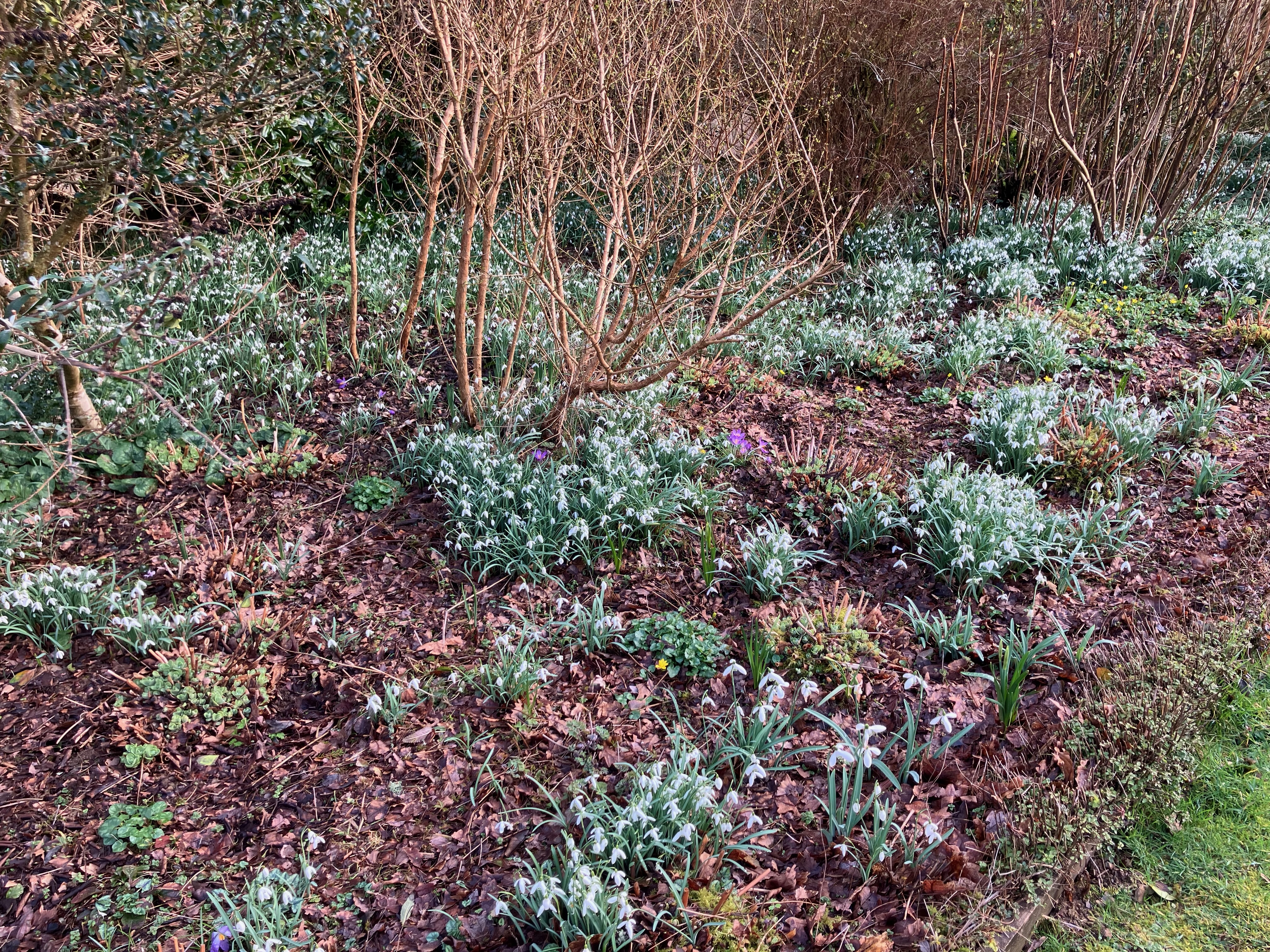
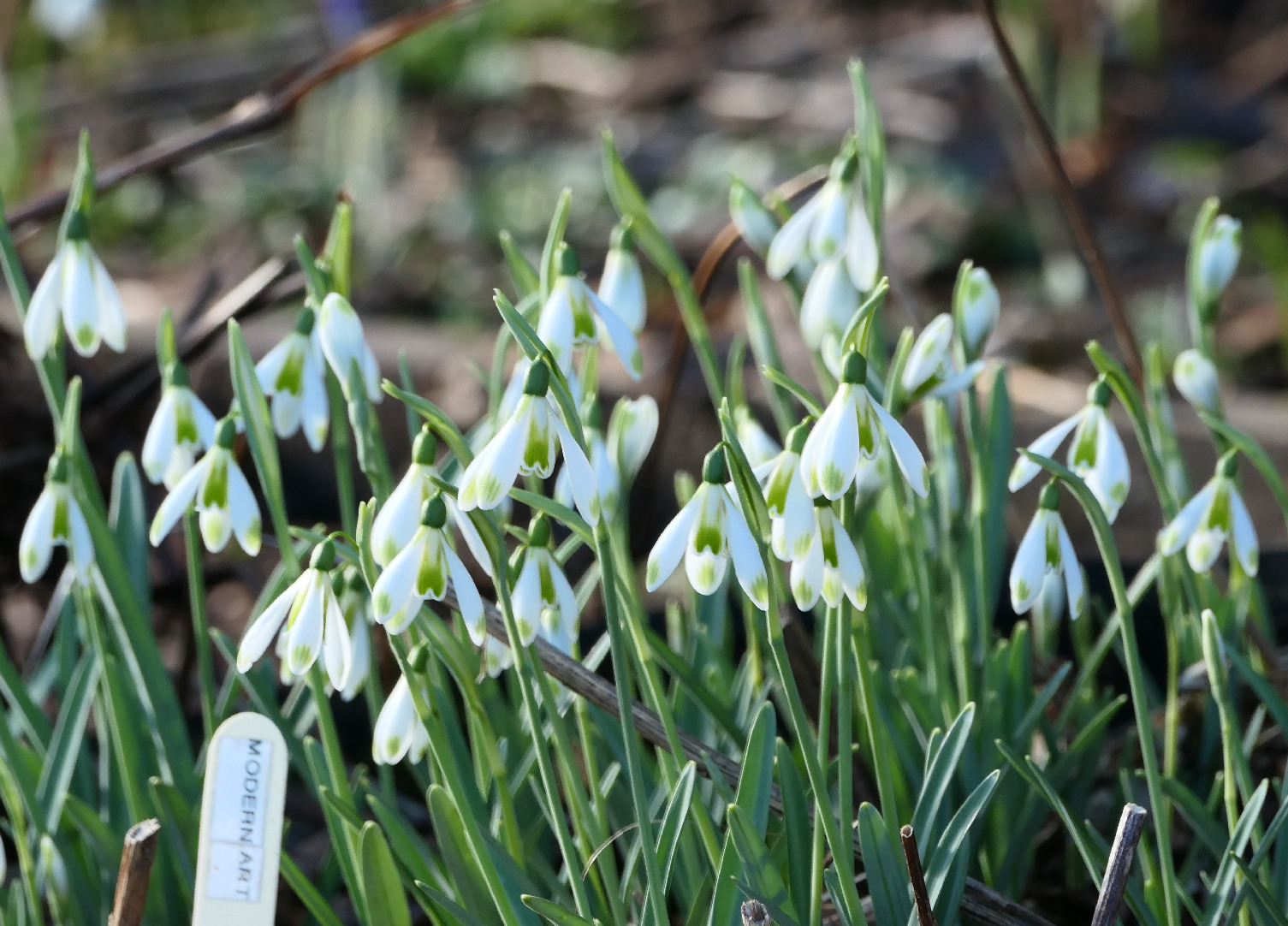
The first flowers (Crocus and Iris) to appear will be in the Alpinum area which gets sun throughout the day. Pictured opposite are a beautiful Hellebore with snowdrops captured in the Alpinum in February this year.

Nigel uses a process called focus stacking where he programmes the camera to take a number of shots at different focus points through the image to result in control both over the plant and the background. The background will be blurred so that there will be nothing distracting behind the image, it will take 15 to 30 photos rapidly to result in a good depth of focus of the image with a blurred background. By February there will be Pulmonaria and Willow coming to life, though this year the Camellias did not flower until February.

In March, there is more happening in the garden with Cuckoo flowers, Primula, Scilla, Cornus, different varieties of Narcissus and Crocus, Camellia, many types of Hellebore and more, and the woodland area is beginning to come alive.

This is a new look for the spring Cloister Garden in 2025. A lovely mixed Tulip border on the mansion terrace with Tulipa acuminata amongst the daisies & dandelions in the formal grass areas.

At the end of March and into April, there will be more Camillias, Prunus and Magnolia joining the displays along with Tulips and Fritillaries. It is unfortunate that the Magnolias will often be at the mercy of the weather and some varieties will not be seen every year (and some very rarely!). In April the butterflies will begin to appear to make the flowers even more beautiful and enhance any photographs. 

Nigel explained another photography technique called high dynamic range which accounts for the fact that the camera sees the world very literally and deals with the tones of colours (i.e. dark through to light) very differently.  A high dynamic range shot will take five shots starting with the area which is darkest then  through to the lightest and the five shots will merge on the inbuilt computer to result in the best version of the image. 

A wide angle lens is not used very often because it will lack definition and push the image away, but if you can get as close to the subject as possible it will improve the shot. Nigel tries to get combination photographs where possible and will have to spend quite a long time to get the shot just right, and again the background  has to be correct when considering colours and light. The Ninfarium at the back of the mansion provides cover and a different atmosphere for plants of a more exotic nature and different types of Orchids can be found. 

During several sections of the talk we were shown pictures of the gardens with musical accompaniment. We saw photos of  the latest work in the garden including the Aviaries which are in use for growing Squash and other vegetables. 

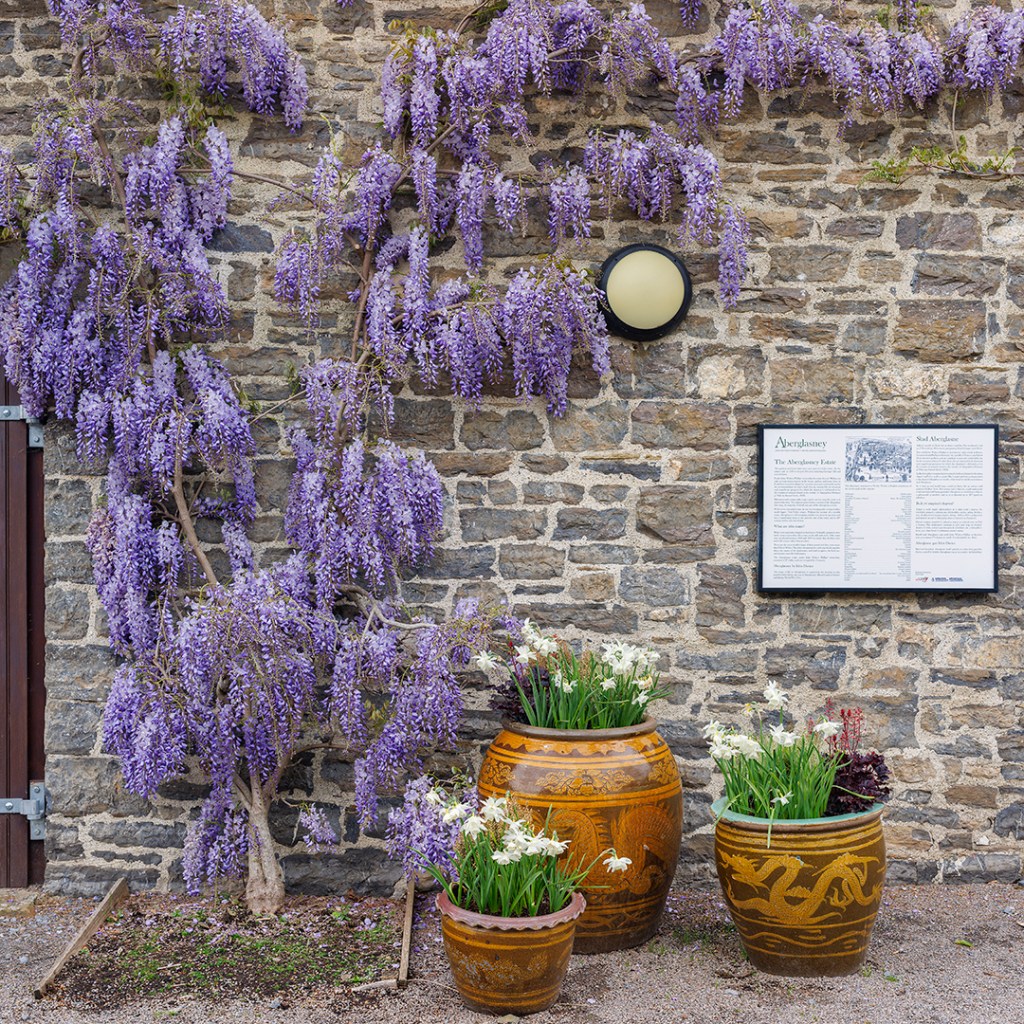
This is the display of Wisteria on the wall of the old cowshed with planters of daffodils. The photograph was taken on 17 April this year, when the wisteria arch would soon be coming into bloom.

Into June & July – roses are of course popular and can be found throughout the garden. Some varieties will continue until quite late in the year and there is a definitive rose garden which includes a beautiful rose arbour. The wildflower meadow no longer exists unfortunately, largely because they can be such a lot of work to get them at their best. 

Flowers of the Bromeliad, which is an epiphyte, will hopefully appear by September. This is a favourite month for Nigel when leaves will change colour, and Japanese anemones, vines  (particularly Vitis coignetiae ‘Crimson Glory’) and Hydrangea can be seen. September and October are excellent months for photography when the light can have a warmer hue and reflected light will be a useful addition to the photos. 

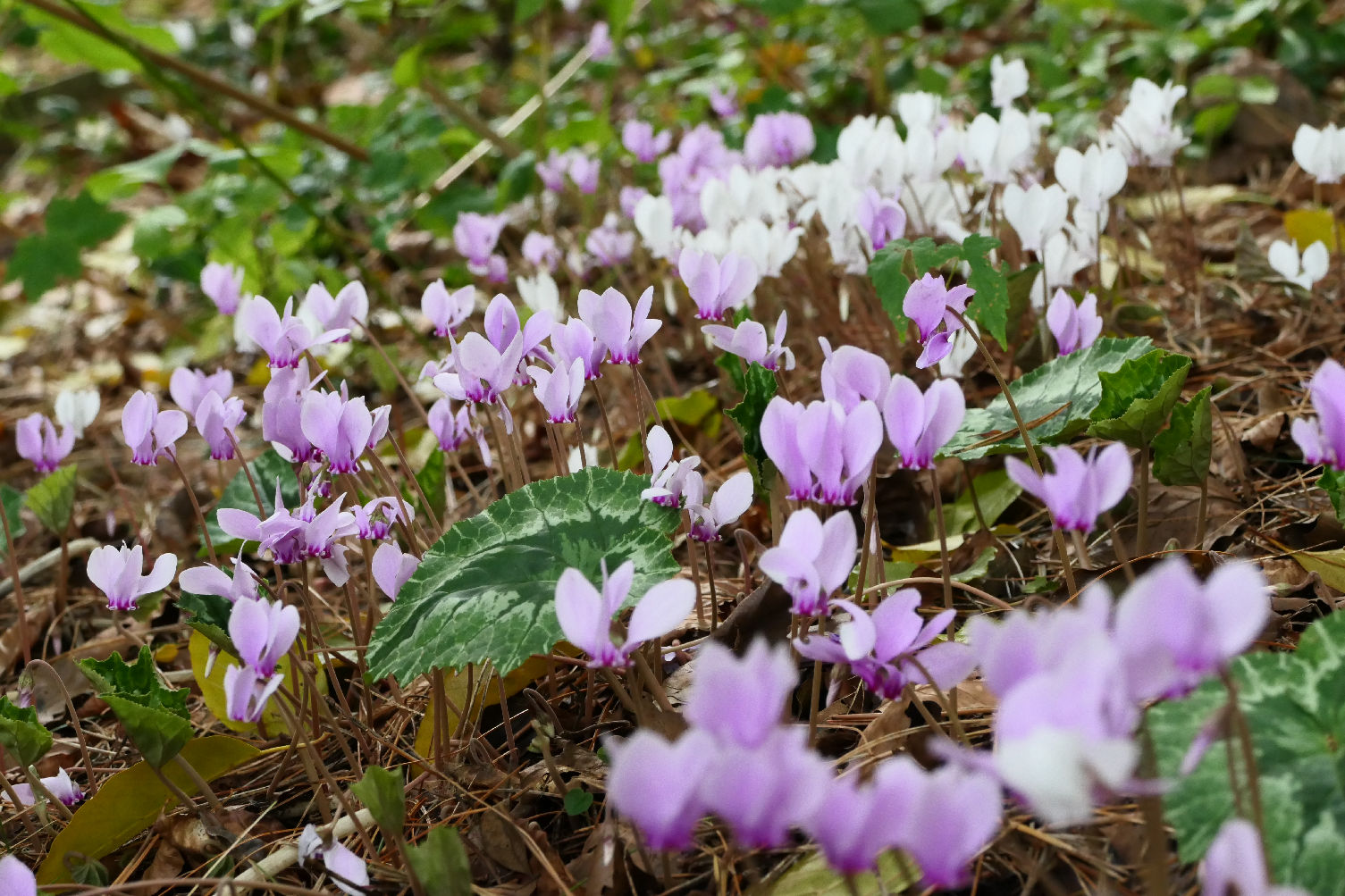
By October, Cyclamen and Cornus kousa (with their crimson fruits) are coming through and plants in the Alpinum also. One of the last flowers to be seen, which is actually a fruit, is Clerodendrum trichotomum or Harlequin glorybower. After the talk, Nigel answered any questions from the audience. He had also brought along for sale copies of his book ‘Aberglasney Gardens – A Calendar Year’, full of his stunning photographs.

Carol thanked Nigel for giving his very interesting talk and sharing the beautiful photographs which will hopefully inspire us to get into the garden with the usual tools plus a camera! 


Gardeners’ Question Time with Richard Brambly and Mabel of Farmyard Nurseries


Richard was well-known to many of us from previous entertaining talks at our meetings and from visits to his fabulous nursery in Llandysul. So after words of welcome to members and visitors from Dawn, our Chair, without further ado the audience launched into their questions. 


First up was Sandy, who asked how the changing climate was affecting Farmyard Nurseries, and how his business can help gardeners in that respect. Farmyard Nurseries is moving to peat-free compost, which is challenging. So far they are using peat-reduced compost (30% peat), although one of the issues is lack of government guidance. As much as possible is recycled, and bonfires are now banned. Generally, it would appear that the trend in the UK is for milder winters and wetter summers. Having said that, we all remember the fortnight-long cold spell in December 2022 when the temperatures dipped to -15! Richard lost many plants he wasn’t expecting to lose, including daffodils, snowdrops and Spiraeas. In the end he decided he couldn’t safeguard the Sarracenias, they would have to take their chances, and of all things they survived! So they are monitoring and adapting as they go. Richard is worried about water though. The nursery’s borehole is small; they have recently expanded to four water storage tanks, but that is really a drop in the ocean of what they need.

Talking of Sarracenias, Dawn had recently heard Richard speak on ‘On Your Farm’ on Radio 4 where he had mentioned a special feed for his pitcher plants when there are not enough flies about. Richard noted that there had been fewer flies about this summer than usual. A Sarracenia needs only about 3 flies to be viable but under normal circumstances they can consume many. One thing that some people do is to drop a fish food pellet into the pitchers. Richard uses a Floranid grass fertiliser which is very mild (2 teaspoons diluted in water in a washing-up liquid bottle) and a squirt into each pitcher.

Fiona brought up the subject of ground cover as a means of minimising bare soil and reducing weeding. What would Richard recommend? He agreed that bare soil just encourages weeds. Persicaria is a genus which has many good ground cover varieties. A less well-known form with small leaves is Persicaria vaccinifolium with a mass of pale-pink flower which goes on for months (and is also very effective in pots). For shade Chrysosplenium and also Pachysandra are very useful. Verbena corymbosa ‘Gravetye’ is good in sunny spots. There is also the tiny-leaved Gunnera magellanica for sun or light shade and damp soil. Ground-cover shrubs there are a-plenty: Potentilla, dwarf Hebes, Cotoneasters, Hydrangeas… There are over 200 Hydrangeas in the woodland garden at Farmyard Nurseries, which have really come into their own this year. You can also, depending on your soil,  consider alpines as well as herbs (marjoram and oregano varieties are excellent). Richard uses mint in his wildflower meadow, as it competes with the grasses and the flowers are loved by bees.

Another question related to the depth at which new shrubs should be planted. The general advice is to plant them at the level they were at in the pot. But what about roses? We were all agreed that we no longer knew what the advice is about roses, as it seems to have changed. It always used to be that the graft point or union should be above the ground – now you sometimes see advice to plant it 4” deep. Good advice can generally be found from reputable rose growers such as David Austin and Peter Beales. Received wisdom does change over the years – delicate and very accurate rose pruning is now often replaced by using hedge cutters. A tip from Richard is never to prune your roses hard before March (before that your hard-pruned roses may be affected by winter die-back).

Ruth had grown some Echinacea plants from seed which were now a good size, and she was wondering whether to plant them out now or wait until spring. Richard warned her that generally Echinacea don’t like it in this part of the world, although you can sometimes get away with the standard E. purpurea or alba (which happily Ruth’s are). The essential thing is keep Echinacea dry through the winter as it doesn’t like the combination of wet and cold.

On the subject of seeds – there was a question about hollyhocks and whether the stems should be collected and hung up to dry inside, or whether to leave them on the plants in the garden. On clarifying that the seed was green, and therefore not yet ripe, he recommended both courses of action. It seemed to be generally agreed that for some plants such as hollyhocks and also grasses that it works to cut the stems with the seedpods still attached and lay them down directly on pots or on planting trays/guttering with perlite.

Julian asked Richard to share his two greatest successes and his worst failure during the life of the nursery. Richard replied that the very best thing to have happened was his daughter Ruth, and the worst thing that had happened was the long Covid that Ruth had suffered from, destroying her future as a potential Olympic athlete. The silver lining was that Ruth had turned turned to plants during that difficult time, in particular house plants, and now she runs that part of the nursery. The second best thing to have happened was getting to Chelsea on the first attempt! If he is honest, there had been lots of highs and Richard would do it all over again. One of his favourite things is to wander around the garden and nursery of an evening when everyone has gone home, and to see what has been achieved. Richard’s staff are a loyal and dedicated team, and he recognises that he owes them so much.

Next, a question about a damson – it’s a shrub variety, about 6’ high, from the Midlands. In six years, it has not produced a single damson! Richard said that stone fruits can be slow to get going. He asked whether it flowered well (it doesn’t), and flowers late, after the apples. Richard’s suggestion was to make the damson think that it’s dying, by chopping a circle around its roots. The other alternative is to to ring bark it, the ring being half-an-inch wide. A follow-on question involved two saplings, a wild plum and a sunset cherry, which had been given to a member in pots. Where should they be planted? Somewhere with plenty of sun and not too windy. Still on the subject of damsons, a questioner had a damson which bears very little fruit, but two seedlings have arisen nearby – would they be likely to fruit? Over seedlings you have no control, so theoretically they might. The closer to the species they are, the more reliably they are likely to fruit.

Sheena mentioned her trouble getting Japanese anemones to establish in her garden. Richard replied that it seems to be pot luck with Japanese anemones – they either like you (when they can grow very strongly) or they don’t. Erigeron karvinskianus is another. 

Gordon asked about a 1’-high Eucalyptus with a single stem that he had bought for £3 – how could you resist?! The problem with Eucalyptus, particularly on a single stem, is that they have a tendency to blow over. To keep the juvenile foliage, you should cut it back hard every year, making it less likely to blow over. When cut back like that, Eucalyptus can make a great evergreen screen. Plants that generally do well in the damp soil in Wales, and can be good screens, are willows, Cornus, birch and poplar. 

Carol had a question about her young ‘Bardsey Island’ apple tree, on which the lower leaves are developing brown and blotchy patches. She also has another Welsh apple, ‘Pig aderyn’, which is smaller but is doing better. The ‘Bardsey Island’ is planted close to a soakaway, and Carol wondered whether that might be affecting it. Richard thought not, unless the soakaway was making the soil very damp. He noted that smaller trees will often establish better. ‘Bardsey Island’ is a superb apple though. He added that he had quite a number of them, and they hardly fruited. The damp climate of Wales very often led to canker in apple trees. There was some debate about whether you can, or cannot, grow apples in Wales. The Club’s previous speaker in September had definitely been of the view that you can; Richard’s view is that you can’t – but sometimes you can!

Sandy asked about tall plants for a lined pond which she has recently made deeper.  Options suggested were Iris, Typha minima (a miniature bulrush), plants in the Scirpus family, Pontaderia cordata, and even Equisetum. Apparently dayliles and Schisostylus also do will in water.

The final question came from Ruth, who asked about some young rhododendrons she had planted in a bed where Verbena bonariensis were becoming quite prolific. Richard was of the view that the rhododendrons wouldn’t suffer, as the Verbena are light and airy, and rhododendrons like shade, but that Ruth should just keep an eye on them. He did note that V. bonariensis will seed everywhere. Also, the young rhododendrons may well have come from Holland where they would have been forced into bud, so they may naturally pause flowering for a year or two. In fact, it would be a good thing to debud them next year, to ensure that they grow into good, strong bushes.

Farmyard Nurseries organise a Gardening Weekend every winter in Llandysul. In 2025 it will be organised for the days around 16 February. It’s a fabulous event that certainly brightens up a dreary time of year with talks, a central display and plants for sale. A date for everyone’s diary!

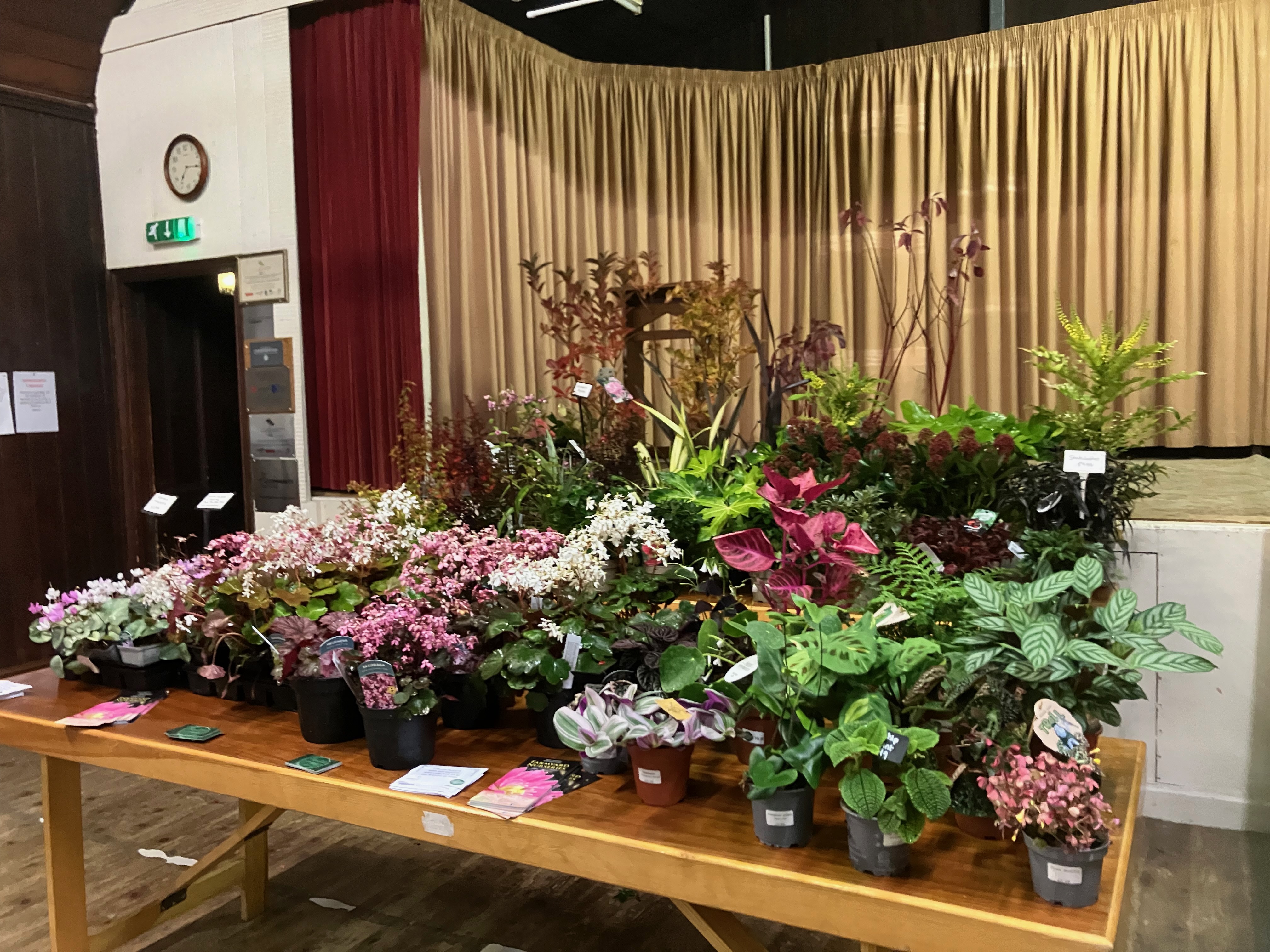
That brought to an end a very entertaining and informative hour, during which Mabel had befriended anyone in the audience she suspected of harbouring food about their person! Richard was thanked by Dawn and by an enthusiastic round of applause from the audience, and everyone made a beeline for the many beautiful plants for sale that Richard had brought to the meeting and arranged in a mouthwatering display.

Ten Ways to Use Willow in the Garden (and Beyond) by Justine Burgess


Justine began working with willows as a basket weaver ten years ago; she had always been interested in gardening and then eight years ago she and her husband Alan founded West Wales Willows on ten acres of land in Gwernogle (two acres of which are devoted to willow). They hold the National Collection of Salix for Plant Heritage, currently the only one in the country. The nursery was visited by Frances Tophill for  one of the Gardener’s World Winter Special programmes at the end of 2023, and has also featured on ITV’s Coast and Country series.

The nursery will be open for the NGS on 22 June from 10am to 4pm, and will be open as part of the Tywi Valley Open Studios from 27 July to 4 August, running taster willow weaving workshops on 29 July. An Open Weekend 4-6 October, when the winter colours are already starting to show through, will focus on growing willow.

On to the ten ways to use willow:

No. 1 – Plant Willow for Pollinators. Willow is very early flowering, some varieties as early as late January and early February in a ‘normal’ year (this winter it was considerably earlier). Five years ago, the National Botanic Garden of Wales analysed the pollen content of spring honey, and found that it was made up of 80-85% willow pollen, showing just how important it is for bees. This would probably mostly have been the wild growing willow such as the goat willow – Salix caprea – and the crack willow – S. fragilis. Of the more decorative varieties, S. udensis ‘Sekka’ is a magnet for all sorts of insects including bees, wasps and even bluebottles! S. gracilistyla ‘Melanostachys’ has black catkins, and makes a very good-shaped shrub in the garden, reaching only 7ft after a number of years. S. gracilistyla ‘Mount Aso’ has bright pink catkins, and is also not huge.

No. 2 – Plant for Winter Colour. The winter colour of willow stems ranges from pale white through yellow and orange, green and brown, to purple and black. The purple-barked willow is Salix daphnoides, the black-barked willow is S. nigricans, and the orange-barked willow is often a form of S. alba ‘Britzensis’. It is also worth remembering that there are alpine willows, growing no more than 2 ft tall. Frost intensifies the stem colour of all willows.

No. 3 – Plant a Fedge. What’s a fedge? It’s a cross between a fence and a hedge. It is a decorative barrier, rather than a stock-proof one, created by planting willow stems in the shape of a lattice. To keep the fedge at a reasonable size, it is best to cut off all the current year’s growth once the leaves have fallen. S. nigricans, the black-barked willow, is stunning when planted in this way. 

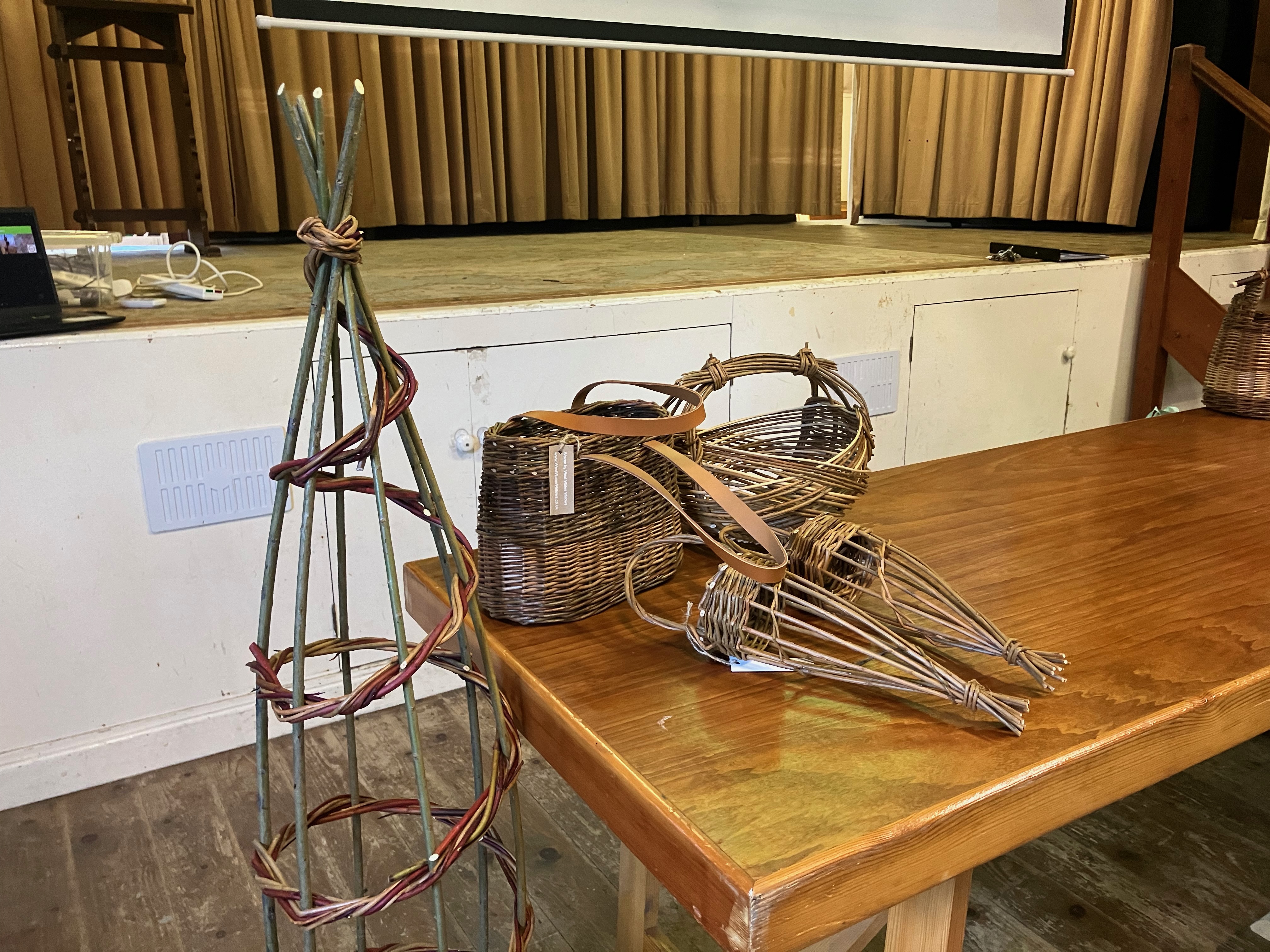
No. 4 – Plant Something Bigger. This could be something like a willow dome, or a willow tunnel. To create stability, you need to plant the willow rods 12 inches into the ground. Willow doesn’t like competition, so in order to get it to grow strongly you need to use membrane; Justine has recently been experimenting with cardboard and wood chip to see how they will perform in place of membrane. Some people have used willow to create mini-domes to provide shelter from the sun in summer for chickens and for dogs. In Germany a willow cathedral has even been created. 

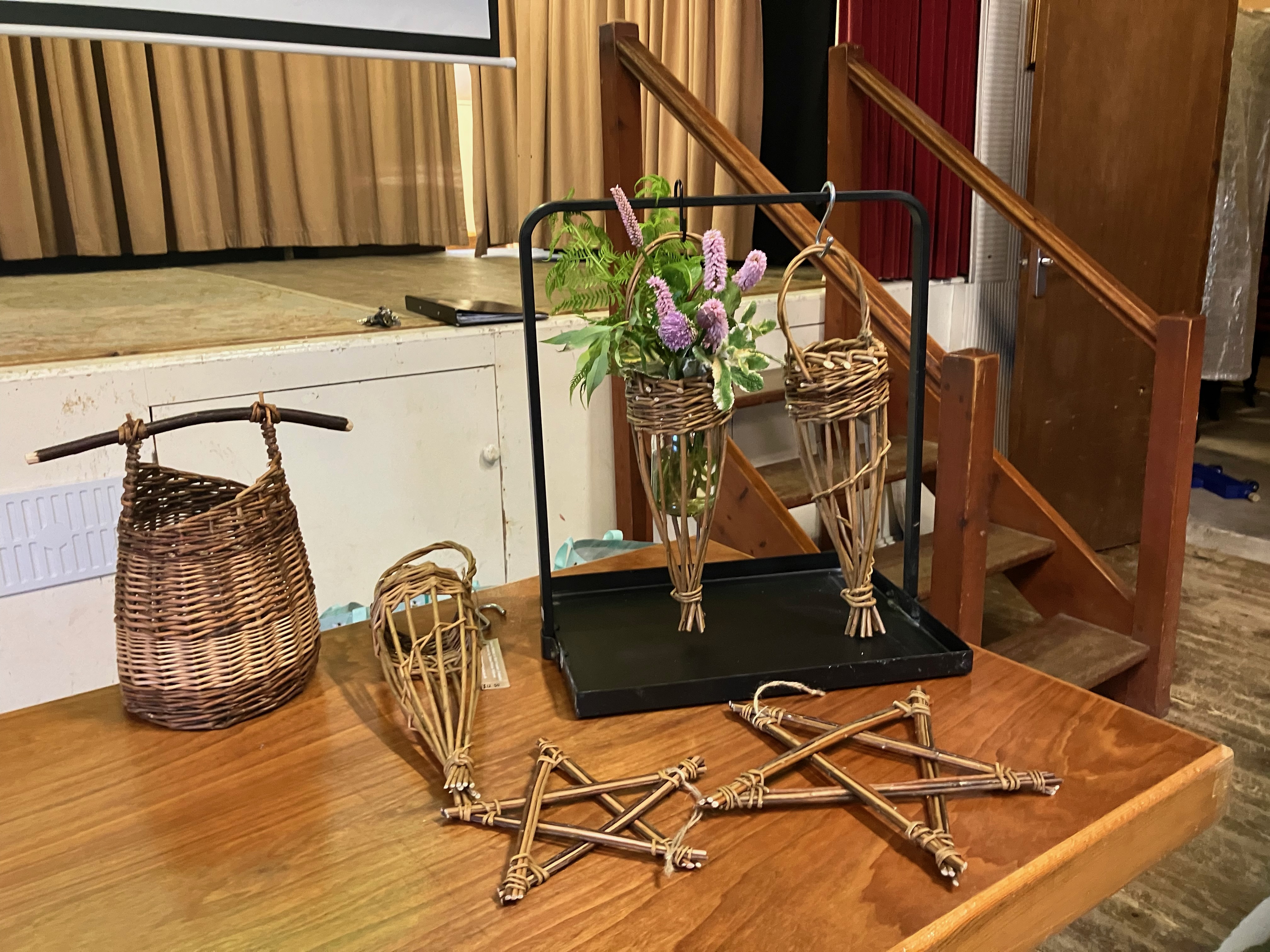
No. 5 – Use Willow Baskets. Willow stems , of course, are perfect for weaving baskets – and what could be better than collecting your own fruit and vegetables in baskets and trugs woven from your own willow!

No. 6 – Incorporate Willow Garden Structures. In the vegetable garden you can use willow to create supports for runner beans and sweet peas as well as mini-pumpkins. Willow also makes a great base for a wedding arch decorated with flowers and greenery. The only thing is that willow structures don’t last forever – four seasons is about the limit.

No. 7 – Make Willow Water. The bark of willow is packed full of growth hormones at the base of the stem when in growth. Take one-year-old willow stems, cut them into 1.5-inch chunks and cover them with water. Use about one-third willow to two-thirds water. The water will only last for one to two weeks before you have to make another batch, but it can be used as a replacement for hormone rooting powder. 

No. 8 – Chop and Drop (Ramial Woodchip). One- or two-year old willow wood, chipped, which breaks down really fast, is amazing for feeding fruit trees. It is also brilliant for making hot beds. You can use wild willow for this. The wood should be cut no later than May, because after that you won’t get much regrowth. The leaves from the wood can be dried, chopped, and then go into the compost bin.

No. 9 – Build a Dead Hedge. Dead hedges are great homes for insects and can serve as good temporary fences.

No. 10 – Make Something Fun! Willow is great for making sculptures – for example, a stag, a hare, even just a big ball.

Justine then took questions from the audience. She recommended Salix nigricans and S. triandra ‘Blacktop’ as the best black-stemmed willows. She confirmed that willows need quite a lot of sun – about 6 to 8 hours in the summer, so you shouldn’t plant them on the north side of a hedge. They also don’t like being next to established trees. They need a lot of water, although they don’t have to be in wet ground. They don’t like chalky ground, and love clay or clay on shale. Willow stems should be cut during the dormant season. As they dry, they lose one-third of their width. They should be allowed to dry for three to four months, then rehydrated. A bundle of 5-foot long willow lengths should be submersed under water for 5 days to fully rehydrate for weaving.

West Wales Willows run a variety of different courses, at Gwernogle, at Myddfai Community Hall, at Abergwili and at Denmark Farm Conservation Centre


Remember to browse the rest of the Cothi Gardeners’ website for other upcoming events, the Surplus to Requirements section and updates to Members’ Gardens. If you have any ideas for new content or would like to contribute a piece about your own garden, please contact cothigardeners@gmail.com.


Christmas Social; NGS Donations for 2023

This year’s Cothi Gardeners Christmas Social was held at Ystrad Nurseries near Llandovery. It was, for a change, a sunny afternoon, the alpacas greeting us as our cars pulled in. We all arrived in time to have a good browse around the nursery before the demonstration 

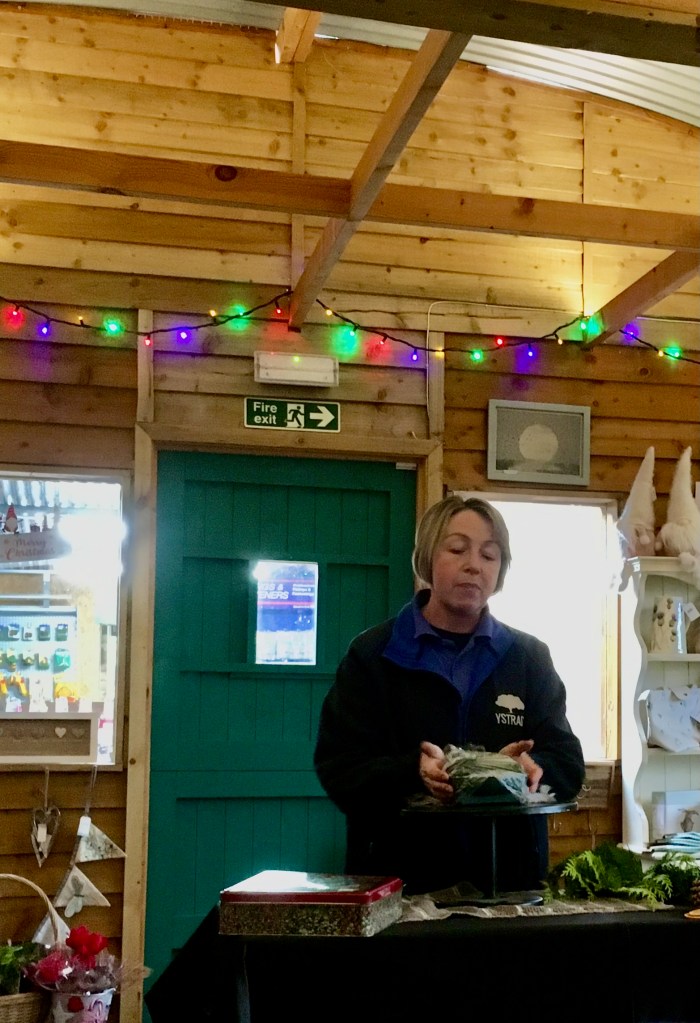
Julie began the demonstration by telling us a bit about the history of the nursery and timber yard, particularly since 2016, when John and Laura Morgan bought Ystrad, having seen the potential to bring together her background in running a nursery and John’s expertise in the timber business. Since then they have grown the business significantly, and from an original staff of three at Ystrad in 2016, there are now over 30. Ystrad Nurseries itself now also has florist Sian on site, and has embarked on phased improvements, beginning with the car park and entrance. Julie herself has worked here since 2020, having previously been a primary school teacher.

First we saw how to build up an arrangement that could be adapted either for the table, or for placing on graves, using a square block of oasis in a circular base,  Starting at the bottom, it is best to avoid prickly holly and to create a base layer with fronds from spruce or cypress. The holly can go in as the next layer. Julie recommends pieris for the centre of the arrangement, which at this time of year has flower buds. To add berries and ensure they show up well, take off any surrounding leaves. When adding skimmia do the same and strip the leaves to highlight the purple flower. For a table arrangement, you can then place a candle-holder with candle in the centre.

Julie then explained how to wire items onto an arrangement, such as dried orange slices, and also demonstrated bow-making.

After that, we turned to wreaths. Nowadays moss is less favoured, and people are choosing straw-based rings for the base as a more sustainable option. The straw rings, once purchased, can be re-used the following year if allowed to dry out and stored safely. The greenery can be fixed in place with either wire or twine, using small clusters of foliage as you go, again starting with spruce, but incorporating a range of foliage such as osmanthus, choisya, skimmia, leucothoe and pieris. From this you can then adapt the decoration depending on whether the wreath is for a grave, a door or table arrangement.

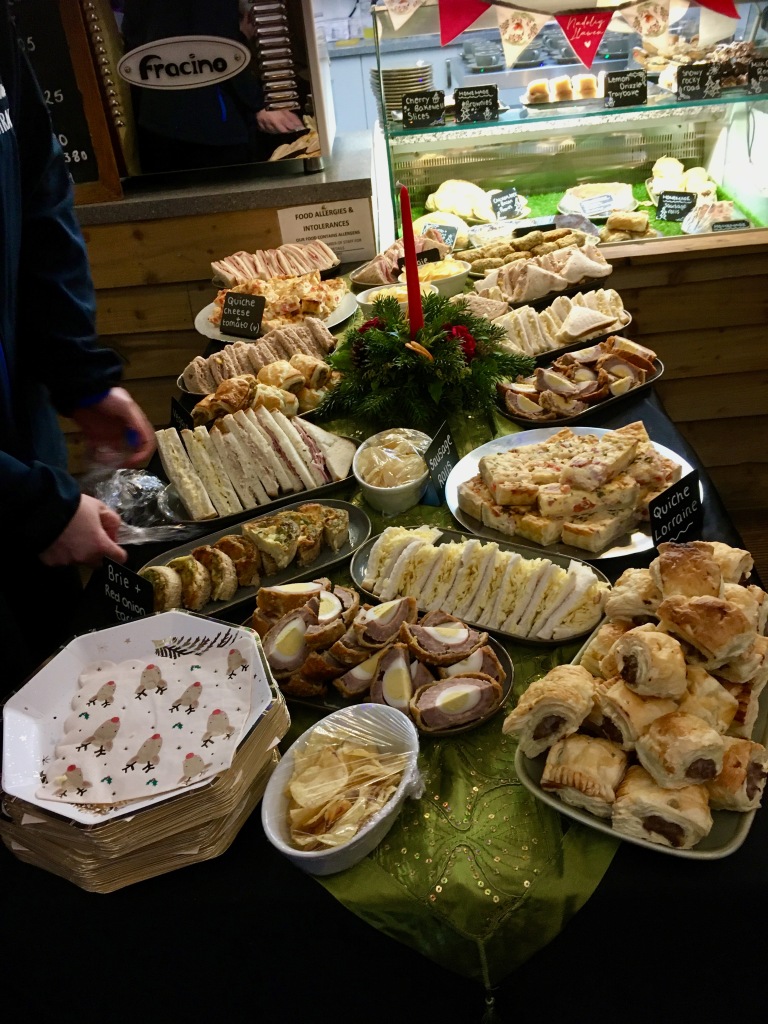
After thanking Julie for her interesting and informative presentation, everyone had an appetite for the delicious and plentiful tea that Ystrad Nurseries had provided. We weren’t going to need supper after that, and a grand time was had by all!


NGS Donations in 2023

Cothi Gardeners Club are fortunate to have among our members John and Helen from Ty’r Maes and Julian and Fiona from Gelli Uchaf who open their gardens for the National Garden Scheme in Carmarthenshire and Pembrokeshire. Across the two counties as a whole there were 3,514 visitors, of which 2,130 were from Open Days and 1,384 from By Appointment visits. That is a return to the visitor numbers seen in 2019 and previously. In 2023 the total raised for charity was £26,638 (up from £20,300 in 2022) – a fantastic increase! 

In total the National Garden Scheme has been able to donate £3,403,960 to beneficiaries in 2023. This record amount is testament to the hard work and dedication of all those who open their gardens to the public and all the volunteers who contribute.