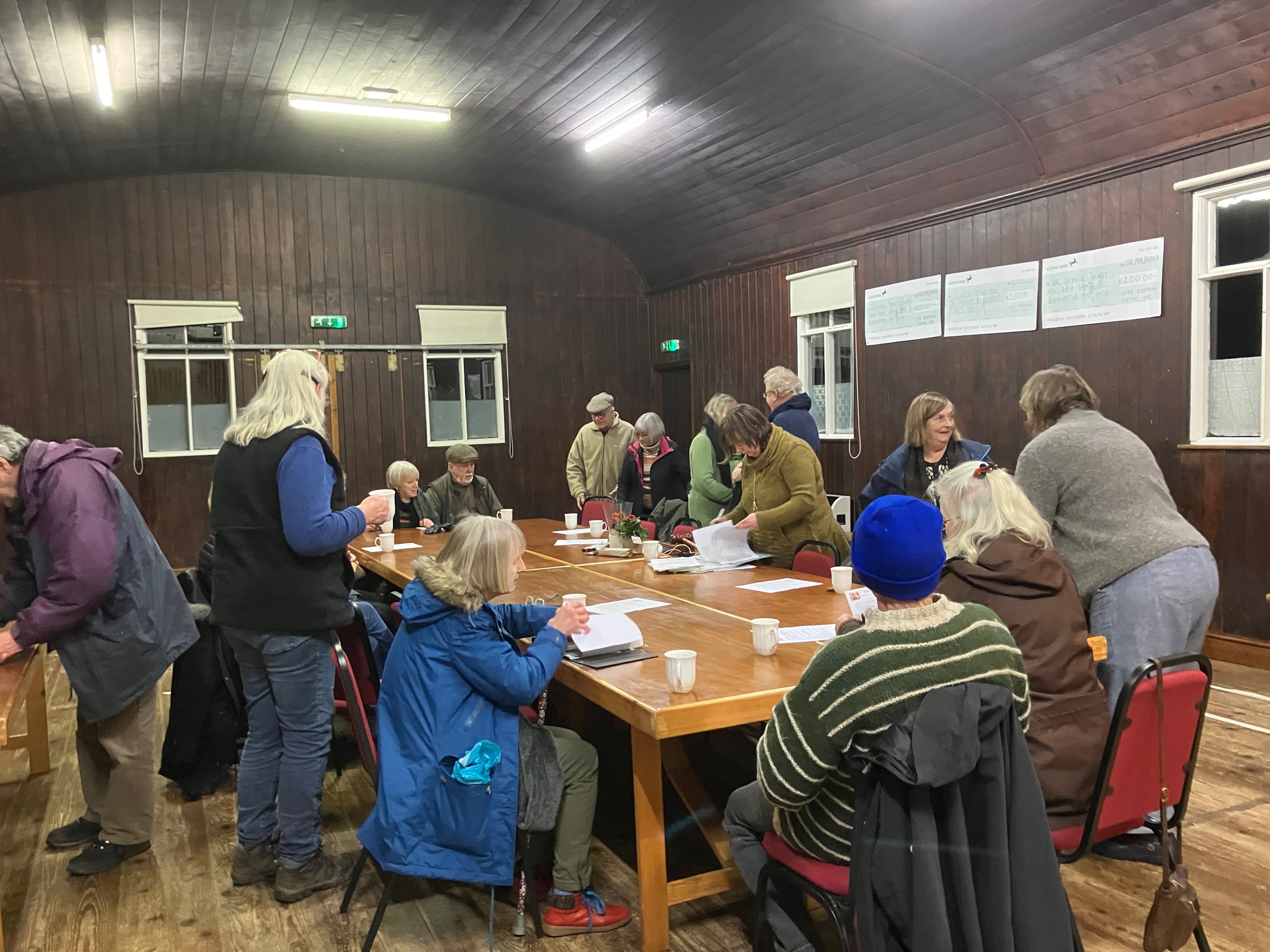
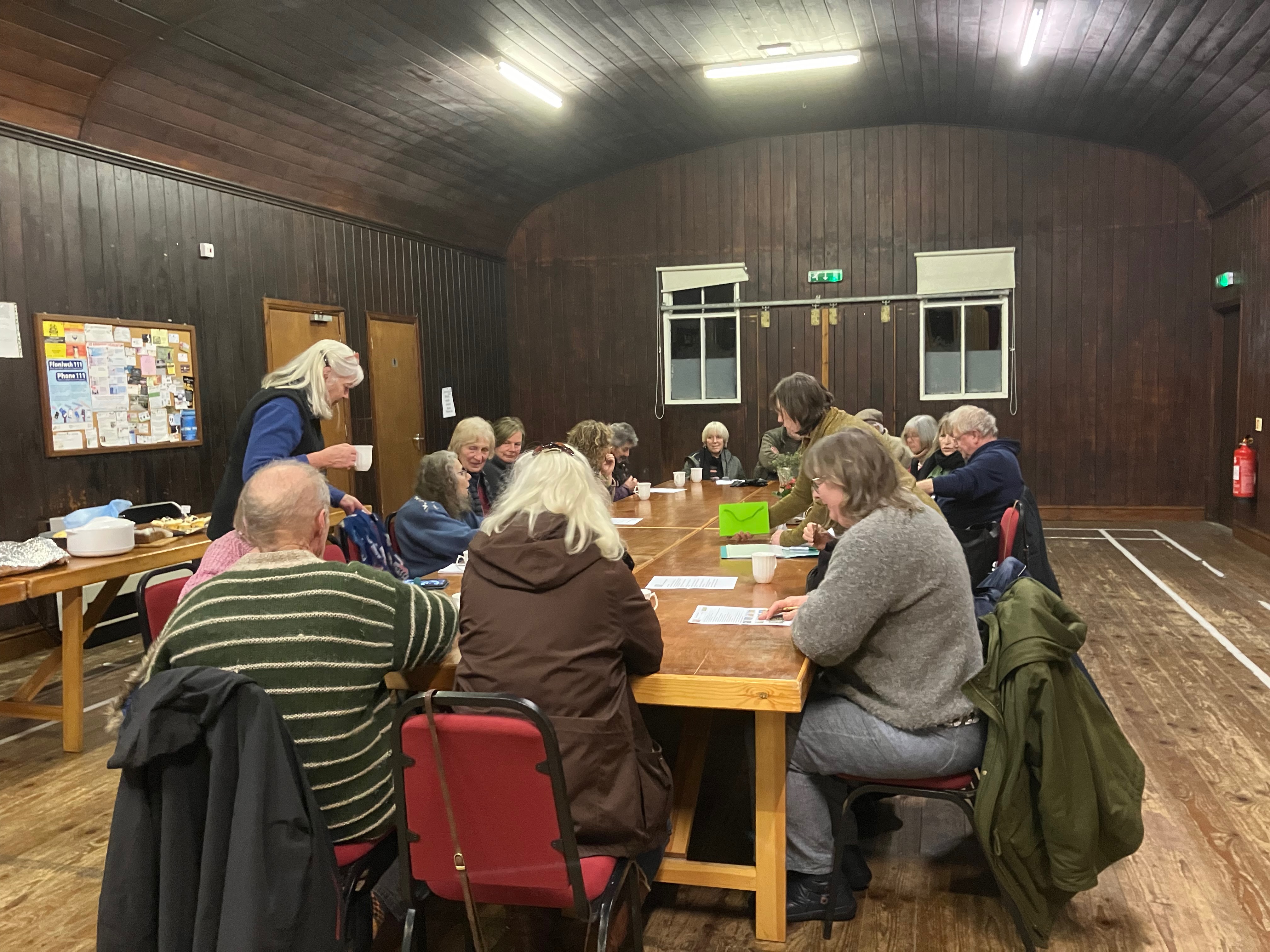
As usual, the Cothi Gardeners’ Annual General Meeting was held in February. The last year seemed to go by very fast, with an enjoyable and interesting programme. Members enjoyed five talks and one workshop, and we held two social events with one garden visit to ‘The House on Stilts’. All were well attended and received positive feedback. John and Helen’s plant sale at Ty’r Maes had generated funds for the NGS charities.
Reports were received from the Chair and the Treasurer. The accounts for the year were approved. Membership of the Club currently stands at 37. Votes of thanks were extended to the Treasurer, Secretary and Web Editor, as well as the Chair all of whom are continuing in post for the coming year. Particular thanks was reserved for Carol Carpenter, our outgoing Programme Co-ordinator, for her sterling work over the last three years in delivering such varied and interesting programmes, and putting together the current year’s programme.
No volunteers came forward at the meeting to take over the role of Programme Co-ordinator (which in the past has sometimes been a role successfully shared between two members). If any member(s) would like to volunteer, Carol can provide a handover and also give you a folder packed with useful information and contacts to get you started. The first task will be to finalise talks for the autumn and the Christmas social, and from there to move on to the programme for 2027. Ideally the role would be filled quite soon because speakers have to be booked a reasonable time in advance. The Club is nothing without its members – thank you all – but it needs the talks, workshops and social events to bring us together. We won’t have those unless someone is willing to take on organising them! If you are at all interested and would like to discuss, please contact Tracey, Cothi Gardeners Chair, or email cothigardeners@gmail.com.
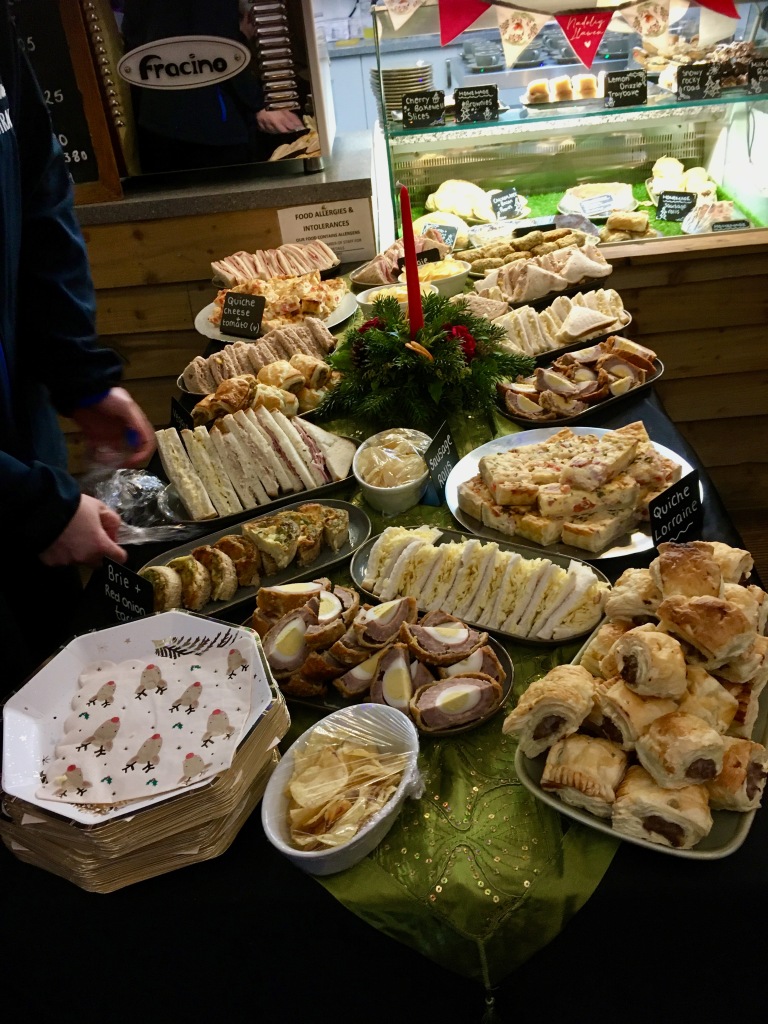
The AGM was followed by an inventive and challenging quiz created for us by guest Roger; the quiz in turn was followed by a delicious assortment of savoury and sweet dishes brought along by members for all to share – chilli, pizza, quiche, vegetarian empanadas, sausage rolls, frittata, rye and almond biscuits, chocolate brownies and marmalade cake to mention just a few!
March Talk – Not To Be Missed
On Wednesday, 18 March our next talk goes by the intriguing title: ‘The Underclass: a Gardeners’ Best Friends. Geophytes (bulbs, corms and tubers) to lift the spirits from October to March‘. It will be given by one of our members, Julian Wormald. Julian and Fiona are well-known not just to members of the club but to gardeners far and wide who have visited their garden Gelli Uchaf in Rhydcymerau through the National Garden Scheme, seen it featured on television or read about it in books, periodicals or on The Garden Impressionists blog.
Gelli Uchaf garden is renowned for its tapestry of flowers planted under trees and shrubs and also in the open. Much of that tapestry is down to thousands of bulbs, corms and tubers. This is a new talk by Julian, created for this meeting of the Cothi Gardeners Club, and is bound to be both informative and inspiring. Julian and Fiona hope to bring some plants for sale.
The September meeting was chaired by our Treasurer, Rob, who greeted everyone and started the conversations by saying that his gardening year had resulted in good and bad results – rust on his garlic, mildew on his onions but a bumper apple crop!
Apple diseases were discussed and some people had experienced scab on their apple trees, for which there is no cure. The leaves need to be removed and disposed of by burning or binning them but definitely not putting them in the compost as it is a fungal disease. Jo pointed out that if, for instance, a tree is transplanted, all the leaves can be removed and it will not affect the tree greatly as the roots will continue to flourish.
We discussed the pruning of apple trees and, as Rob said, if the tree is doing well and producing decent fruit, there is no need to get too excited about pruning – if it ain’t broke,don’t fix it – and don’t prune for the sake of it! Happy news in a way, as some people admitted to being nervous about doing it. If we do prune, there is a need to keep open the middle of the tree (try throwing a hat through it) and taking off water shoots which will drain energy from the tree. Rob pointed out that pruning really needs to be learnt in a practical way, i.e. when we’re in front of an actual tree with a person who has the know-how. Learning on a youngish (8 – 15 years old) tree would work best.
Pressing apples is a way to use excess; juice can be bottled and the bottles then pasteurised, or it can be heated in a large pan and then bottled. This way, it will last for months. There are apple pressing days in the grounds of Lampeter University on 27th September, at Watson & Pratts Lampeter on 28th September, or at Aberglasney Gardens on 5th October. Take your apples and containers for the juice.
We also discussed pear trees; it’s best to pick the pears before they are fully ripe, then ripen them indoors so that they don’t go mushy. The difficulty of netting cherry trees was discussed, but no-one had a real answer on that one.
Sandy told us that she successfully picks redcurrants before they are ripe and then ripens them indoors, and it seems to work. Blueberries seem to flourish in the ground mostly and are happy even in flooded areas as they like their feet being wet, as do cranberries. Tracey wanted to know if anyone has picked Leycesteria (Himalayan Honeysuckle) berries and it seems it might not be worth it, though they do make good jam.
We talked about blossom end rot in courgettes, tomatoes, peppers etc; the cause may be erratic watering. We had general chats about preserving heat in a greenhouse or polytunnel, Rob advises that, although a through-draught is necessary during the day, closing everything up at night (especially when you have in there a water container which will have warmed up during the day) is usually best.
We discussed the use of the formula called Dipel for the eradication of caterpillars on brassicas. Dipel is a natural bacterium which affects the digestive system of the caterpillars and causes them to die. It cannot be purchased in the garden centre or a shop but it is available online. It is a question as to whether the dead caterpillars might be eaten by birds and kill them.
Radish pods (produced when the radish have gone to seed) are delicious and apparently the “Rat’s tail” variety sold by a company called Real Seeds are the very best if you want to eat the pods. In a similar vein, there has apparently been a trial of parsley-style leaves grown on pea shoots which produce good yields.
General information on seeds – Woolmans have now bought up Johnsons Seeds and they also supply seeds to Sarah Raven. Since the prospect of a discount for seeds from Woolmans is possible, this might be worth organising.
Carol asked about obtaining some Yellow Rattle seeds; these can probably be obtained locally from Fiona and Julian Wormald in July or August when they cut their hay.
Tracey pointed out that the posters which had been organised to advertise the club, and hopefully entice more members, need to be distributed and any help with that would be appreciated.
We were all then quite keen to have some of the delicious food on display, which had been brought to share by those present at the meeting.
October Meeting
‘Fritillaries on Four Continents’ with Robert Wallis will be the talk at our next meeting on October 15th. Bob and Rannveig Wallis are well known for their amazing collection of bulbs and their garden, Llwyn Ifan, in Carmarthenshire.. They are seasoned travellers and plant hunters and successful exhibitors for the Alpine Society Shows.
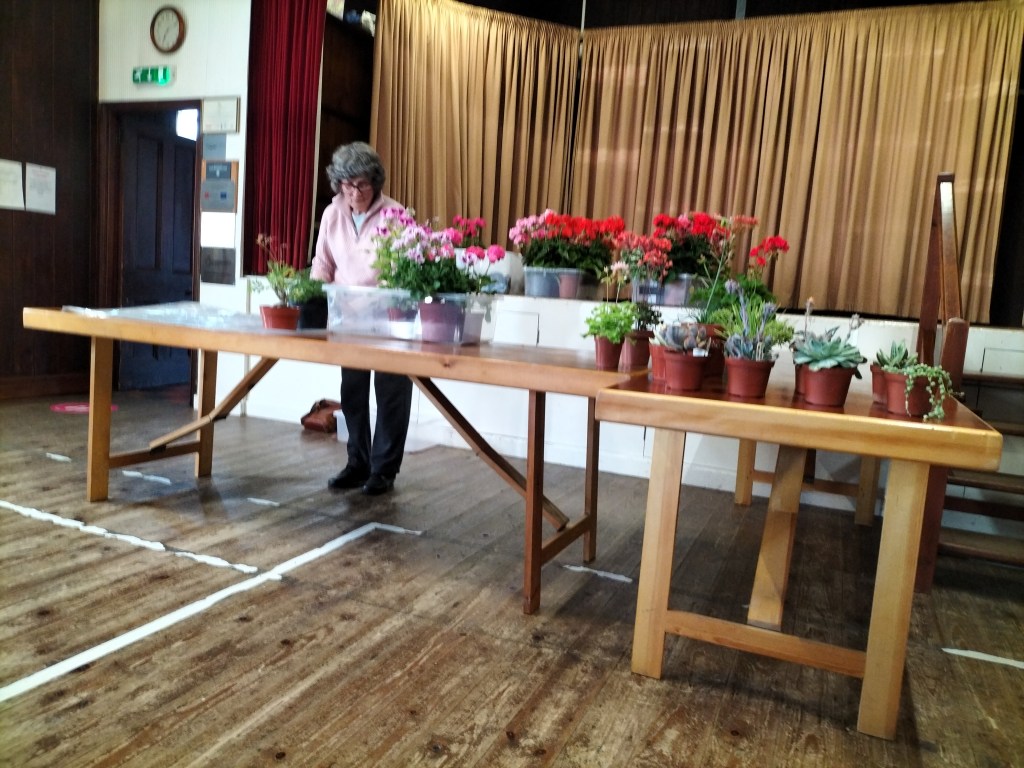
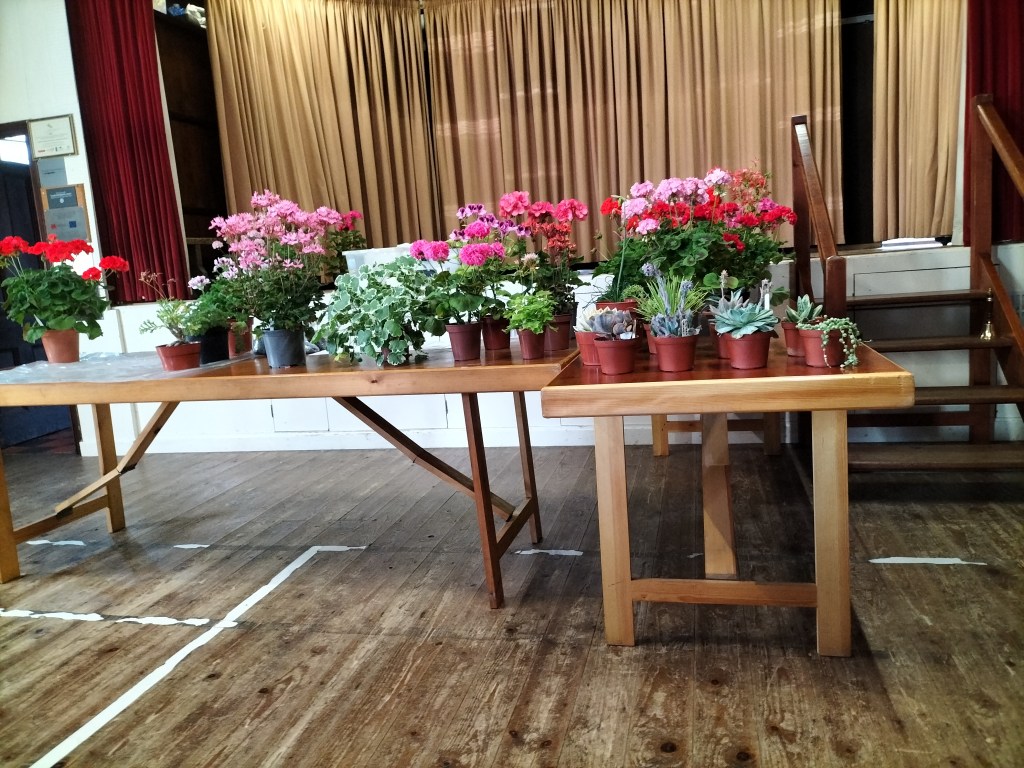
Mair firstly explained the differences between Pelargoniums and Geraniums – Pelargoniums are tender and originated in the Southern hemisphere (they are endemic to Australia and New Zealand ), whereas Geraniums are hardy and herbaceous, can be found in borders and come from the Northern hemisphere.
We had a quiz to find out who knew the difference between the two, with Mair holding up different potted plants to see if we knew whether they were Pelargoniums or Geraniums, and quite a few people did know it seems.
The name ‘Geranium’ for Pelargoniums comes from St Helena where the “Valley of Geraniums” can be found; it was given the name by Napoleon when he was exiled there, because it reminded him of the valleys of hardy geraniums in Europe. The land on St Helena was constantly shifting and the plants could be found even in the dunes which would not normally be a favoured habitat for them. They were then almost extinct there, when the trade routes were opened by the British East India and the Dutch East India shipping companies. The ships berthed in South Africa to load provisions, found the Pelargoniums and were keen to ship them back to Europe because apparently they were thought to be a cure for dysentery. In the early 18th century, they would flower in January, February and March, but were nothing like the Pelargoniums we know now and were quite scruffy with a strange scent, growing out of rocks and very tough. The Dutch particularly collected them and took them back to Holland with them.
There are now thousands of different cultivars of Pelargonium and a lot of research is carried out. Trials involving thousands of varieties, the numbers of which are whittled down to about six, are done to ensure that the required characteristics and disease resistance are present in the chosen handful.
When keeping our own Pelargoniums, the plants can get very leggy in the winter so cuttings need to be taken in late summer or early autumn and a puff of sulphur on the cut parts will really help. Mair demonstrated how to take cuttings (sharp intake of breath from the audience when she started happily chopping at the lovely plant which she had brought with her!) and explained that once the cuttings are in the compost, they should root within six weeks. She uses a mixture of coir, garden soil and compost, just fairly constantly damp, but not wet. The coir helps with drainage but obviously makes the mixture dry out quicker so they need to be checked regularly. The best time to take cuttings is September which is the ideal time to be cutting them back, and then they should put on some growth before the winter dormant phase. They can be cut back a little, usually three times between September and January. The theory goes that you need to get your cuttings in pots by the time the Malvern show comes around! Always take cuttings from the healthiest plants and, during either the growing or the dormant period, any dead leaves and flowers should be removed straight away. In the winter, the plants are happy in a cold greenhouse or porch, though if the temperature really plummets they may need to be covered.
It is possible to take cuttings and root them in water, though adding a drop of orange juice will help and the water needs to be changed weekly. The best time to feed with a good all round plant feed from June onwards and potash can be given in December and January.
There are so many different types of Pelargonium; any single variety will do very well outside and the semi-double are happy inside or out. There are also many scented varieties, with scents all through the spectrum, spicy, sweet, flowery, sharp etc. Mair has some Pelargoniums, all of which are home bred and she hand pollinates them with a paintbrush.
Mair explained that she did have a problem last year with cuttings going black at the stem end, which turned out to be the water. A drop of orange juice in the water cured the problem, so the extra acidity did the trick.
Tracey thanked Mair for her talk and for bringing her beautiful Pelargoniums for the audience to buy.
Upcoming Events
At our next meeting on Wednesday, 16 July mixed-media artist Juliet Edgar is running a printing workshop. Juliet takes nature as her inspiration when creating using macrame, eco-printing and painting. It should be a fascinating evening.
Following that, our Summer Social will be held on Wednesday, 20 August at 7pm at ‘The Plough’ in Felingwm. We’ll be sharing the most delicious pizzas, and we will also be treated to a talk by Joseph Atkin, the former head gardener at Aberglasney Gardens on Dahlias.
Paula Davies (aka Head Gardener) came to Pumsaint, along with her husband Iain (aka Assistant Gardener), to talk to us about the garden she has created in Ferryside, Carmarthensire, on the edge of the river Towy estuary.
In purely factual terms, the garden is a third of an acre in size, eight metres above sea level (when the tide is out!). It faces west, being exposed to south-westerly winds and considerable precipitation. The soil is sandy clay over Old Red Sandstone, neutral to slightly acid (pH 6.5). To Paula, however, the garden is much more about people, places and time; it’s about the past, the present and the future.
Turning first to the past, Paula told us that her maternal grandfather had been a professional gardener, and as a child, along with her three sisters, her weekends were spent helping in her parents’ new garden or being dragged around other gardens or nurseries. Paula’s passion was drawing and painting and, influenced by books such as ‘The Country Diary of an Edwardian Lady’, she wanted to become an illustrator, perhaps of botanical or children’s books.
Once at art college, Paula discovered textiles and surface pattern, and went on to become a very successful international designer first for interior products and then fashion, always focussing on floral design. Thinking about colour, texture, shape and scale, and using these to create rhythm, repetition, focal points and balance, is a similar process to creating a garden – which came later!
The part-time lecturing which Paul did alongside her design work brought her to Carmarthen School of Art. Here, without any career plan but with a lot of hard work, she rose to become Faculty Manager and met Iain her husband, a handsome photography lecturer. Together in 1998 they bought a run-down modernist house in Ferryside, which at that time came with only a tiny plot. Paula had pots of architectural plants she had moved around various rented accommodation until then. The plants were finally put in the ground, which was then covered in 20 tons of gravel. As far as the garden was concerned, job done – or so they thought.
Then along came their son, and as he started to grow, gravel no longer seemed like the best idea. In 2013 it became possible to extend the plot as the neighbouring farm was up for sale, so that it is now one-third of an acre. And this is the land as it was when they bought it – an overgrown pond, goat willow, reeds, flag iris, brambles, nettles, hogweed, dock.
Paula’s inspiration was a book called ‘The Lost Words’ by Robert Macfarlane and illustrated by Jackie Morris, itself a response to words associated with nature being dropped from the Oxford Children’s Dictionary to make room for words from the world of technology. Paula and Iain wanted their son to grow up knowing and experiencing acorns, conkers, dandelions, frogspawn, herons and kingfishers.
The first stage, after Paula’s father had helped clear the land with his chainsaw, was to bring in a digger to excavate the pond which was clogged with couch grass, and then use the spoil to create different topographies and habitats – the pond, damp meadow, wooded shade, dry slopes. There were all the practicalities to consider, such as light, circulation, viewpoints, usage; then where the sun and shade naturally fall, where to put places to sit, paths, steps and so on. Their son got involved as well, creating drawings for what he wanted from the garden – his drawing of a tree-house perhaps the start of his interest in architecture.
This was to be a garden providing food, water and shelter for wildlife. They planted a mixed native hedge (560 plants!) including species such as beech, blackthorn and guelder rose. They left some goat willow and added more trees for height – six oaks, a golden weeping willow and birch – ‘Snow Queen’ and ‘Trinity College’. The rest of the land was sowed to meadow – with different mixes for different areas. Again, job done – or so they thought. The first year, 2014, the annual wildflowers were pretty as a postcard; the next year it was largely perennials – oxeye daisies with some red campion, knapweed, self-heal etc., but a couple of years later it was mostly grass, despite all the yellow rattle seeds sown annually.
By 2017, it was time for a rethink, aiming for dense planting with variety and succession, and value for wildlife. This time the land was cleared slowly by hand (it took weeks!). In the first section under the oaks a liner was used, and the planting (woodland edge/dry shade) was done through that. Now liner is only used for the paths, and other areas , such as the bog garden, have been cleared section by section, using cardboard to cover the ground over winter before planting. Job done – or so they thought.
The pond is a natural clay-lined pond fed by a spring at the rear and rain water from the roof. It was planted up with marginal plants, floaters and oxygenators, but it was not without its problems – nutrient levels, algae and duckweed. Norfolk Reeds were planted to help filter the nutrients – but they are the bamboo of the water world! After they began invading the land, in 2019 work had to begin to dig them out. This work is still on-going – so job not done!
Then along came the pandemic and lockdown. The garden provided wonderful views while working from home, and technology offered online opportunities for connections with other gardeners – for example @myrealgarden with Ann-Marie Powell – and for learning such as garden design courses with Adam Frost. Meanwhile the battle with the Norfolk Reeds continued, now from within the pond, and the bog garden was planned and replanted, and pond marginals chosen for succession. Lockdown was also a time for reflection, and after 32 years working in education, the tables turned and the lecturer became the student.
In autumn 2021 Paula enrolled on an RHS course at Aberglasney Gardens – the RHS Level 2 Certificate in Practical Horticulture. This was harder than any other course she had done at a much higher level, but very rewarding. At the same time more areas in the garden were cleared with the help of a friend, also a student on the course. After the areas had been left over winter, they were planted up for dry shade and woodland edge habitats. The work continued in 2022 with clearing the steepest area, the upper bank, in the autumn and planting up for a sunny well-drained position in the spring with shrubs, perennials (including fruit bushes and other edibles) and bulbs.
Every section of the garden includes wild flowers, which are either a legacy from the meadow seedbank or sown by the birds. These include red campion, ribwort plantain, and ox-eye daisies, with the addition of native ferns (which were always there) and Epimedium x versicolor ‘Sulphureum’. You have to be selective and choose plants which will work well together.
After finishing the RHS exams, Paula enrolled in autumn 2022 on an online Garden Design Course with KLC School of Design, covering how to build a garden design portfolio – storyboards, moodboards, customer profiles, masterplans, elevations and perspective drawings. All this learning was also being applied at a practical level by creating planting plans for a specific situation or purpose – in this case a wetter slope out of sight of the house to be planted colourfully for the birds and the bees. The course also gives access to CPD with the Society of Garden & Landscape Designers covering the latest thinking in design and sustainable gardening. Through this, inspired by visits to Derek Jarman’s Prospect Cottage at Dungeness, and the Walled Garden at Knepp designed by Tom Stuart-Smith and Professor John Hitchmough, as well as Beth Chatto’s Dry Garden, Paula began to rethink the front garden.
This was designed to be drought tolerant, with sand and grit layered above the topsoil, and mulched with local cockle shells. Then, after the summer of 2022, the driest since 1976, came the wettest winter since 1766! Despite this, the drought-tolerant planting survived the floods. Paula realised that we need to learn to garden in a time of climate change with more resilient plants, more species and more natives; we need to think about the soil and the substrates.
So in the following autumn (2023), she began to rethink the areas under the oaks, and the woodland edge plant communities that she wanted to create. The process involves drawing up plant longlists for these areas, taking into consideration growth type, longevity and competitiveness, in order to create successful plant communities that include natives and well-behaved or controllable weeds. The lists are then refined to reach more considered plant combinations which take into account colour, texture, form etc, and which ensure interest throughout the year as well as good ground coverage to retain moisture and avoid weeds or unwanted self-seeders.
Paula and Iain got involved with garden opening through the Ferryside Garden Crawlstarting from 2018. From there connections were made with the National Garden Scheme, for whom the garden has opened since 2024 with 186 visitors raising £1100 for NGS charities, and 272 visitors in 2025. Through the NGS Yellow Book, the BBC Gardener’s World programme got in touch, and came to film the garden in May 2024, which was a wonderful experience, and provided great exposure for the garden when aired.
For a number of years Iain had been encouraging Paula to enter the B&Q Gardener of the Year competition, and in 2024 she finally did so in the ‘Most Sustainable Garden’ category – which she won!
In June 2024 photographer Sarah Cuttle had visited the garden to take photographs which were then used by Gardens Illustrated Magazine in an article written by Alys Fowler. That was when Paula realised how much she and Iain had achieved by attracting so much wildlife and creating a magical place for their son to grow up, knowing all the ‘Lost Words’ and having seen them in the garden.
For the future, Paula plans to continue to work with wildlife at the heart of the garden, completing the Garden Design course and implementing the learning. As she now knows, a garden is never finished – and the job is never ‘done’!
Members would be invited to visit ‘The House on Stilts’ on 31 May at 2pm, details to follow by email.
Next Meeting
Cothi Gardeners’ next meeting will be held on Wednesday, 18 June at 7.30 pm. Our very own Mair Evans will be giving a talk on ‘Pelargoniums and Geraniums’, which is bound to be fascinating, and as a bonus she will be bringing along plants for sale!
Summer Social
Members, save the date! On Wednesday, 20 August Cothi Gardeners’ summer social will take place at The Plough Inn, Felingwm. We will be able to order delicious pizzas of our choosing, and hear a talk on dahlias by Joseph Atkin, owner of The Plough Inn and former Head Gardener at Aberglasney Gardens. A real treat in store!
‘A Gardener’s Dream Itinerary’
A recent article in The Guardian newspaper has highlighted how lucky we are to live where we do. It is entitled ‘A Gardener’s Dream Itinerary: a Tour of Carmarthenshire, the Garden of Wales‘ and is a very nice write-up of gardens and a nursery we know and love, and you may just spot a reference to our Summer Social venue!
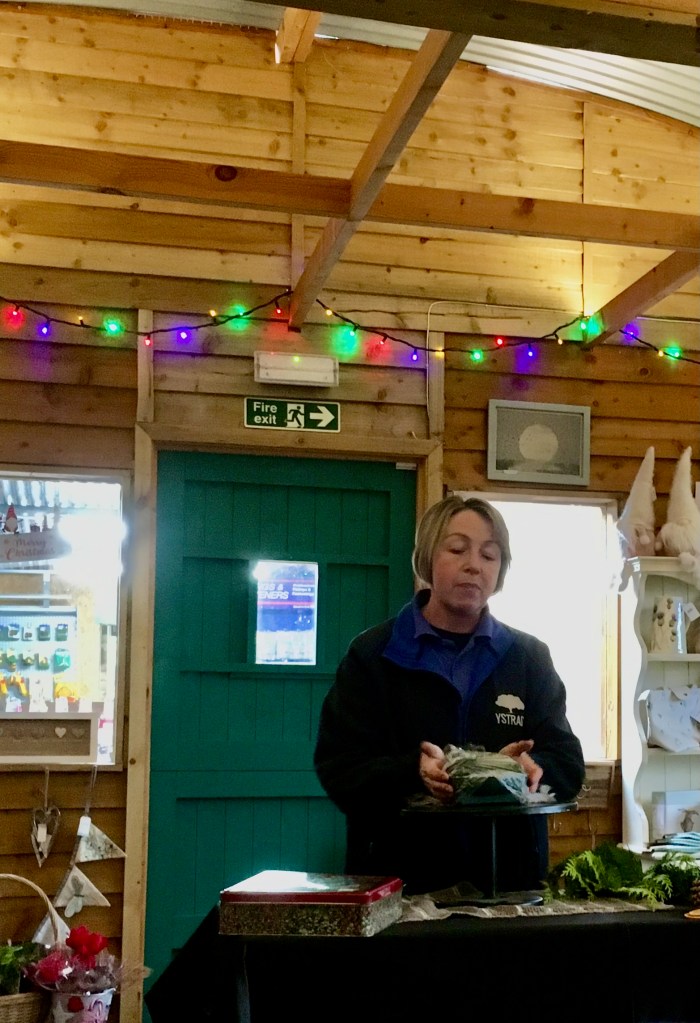
This year’s Cothi Gardeners Christmas Social was held at Ystrad Nurseries near Llandovery. It was, for a change, a sunny afternoon, the alpacas greeting us as our cars pulled in. We all arrived in time to have a good browse around the nursery before the demonstration
Julie began the demonstration by telling us a bit about the history of the nursery and timber yard, particularly since 2016, when John and Laura Morgan bought Ystrad, having seen the potential to bring together her background in running a nursery and John’s expertise in the timber business. Since then they have grown the business significantly, and from an original staff of three at Ystrad in 2016, there are now over 30. Ystrad Nurseries itself now also has florist Sian on site, and has embarked on phased improvements, beginning with the car park and entrance. Julie herself has worked here since 2020, having previously been a primary school teacher.
First we saw how to build up an arrangement that could be adapted either for the table, or for placing on graves, using a square block of oasis in a circular base, Starting at the bottom, it is best to avoid prickly holly and to create a base layer with fronds from spruce or cypress. The holly can go in as the next layer. Julie recommends pieris for the centre of the arrangement, which at this time of year has flower buds. To add berries and ensure they show up well, take off any surrounding leaves. When adding skimmia do the same and strip the leaves to highlight the purple flower. For a table arrangement, you can then place a candle-holder with candle in the centre.
Julie then explained how to wire items onto an arrangement, such as dried orange slices, and also demonstrated bow-making.
After that, we turned to wreaths. Nowadays moss is less favoured, and people are choosing straw-based rings for the base as a more sustainable option. The straw rings, once purchased, can be re-used the following year if allowed to dry out and stored safely. The greenery can be fixed in place with either wire or twine, using small clusters of foliage as you go, again starting with spruce, but incorporating a range of foliage such as osmanthus, choisya, skimmia, leucothoe and pieris. From this you can then adapt the decoration depending on whether the wreath is for a grave, a door or table arrangement.
Julie with straw base for a wreathFinished wreath for table decoration
After thanking Julie for her interesting and informative presentation, everyone had an appetite for the delicious and plentiful tea that Ystrad Nurseries had provided. We weren’t going to need supper after that, and a grand time was had by all!
NGS Donations in 2023
Cothi Gardeners Club are fortunate to have among our members John and Helen from Ty’r Maes and Julian and Fiona from Gelli Uchaf who open their gardens for the National Garden Scheme in Carmarthenshire and Pembrokeshire. Across the two counties as a whole there were 3,514 visitors, of which 2,130 were from Open Days and 1,384 from By Appointment visits. That is a return to the visitor numbers seen in 2019 and previously. In 2023 the total raised for charity was £26,638 (up from £20,300 in 2022) – a fantastic increase!
In total the National Garden Scheme has been able to donate £3,403,960 to beneficiaries in 2023. This record amount is testament to the hard work and dedication of all those who open their gardens to the public and all the volunteers who contribute.
For our October meeting, three members of the Club volunteered to give short talks about their gardens ranging from borderline hardy shrubs and perennials to ponds.
Sheena’s Borderline Hardy Trees and Shrubs
Sheena’s garden is situated at 700’ with a northwest aspect; it has evolved over the years from a field to a garden where shrubs and trees are the main focus. There have been successes and failures with plants that might be considered to be borderline hardy in this area. The soil in the garden is acidic, and most of the plants featured, with the exception of the first, are ericaceous; they are all more-or-less evergreen.
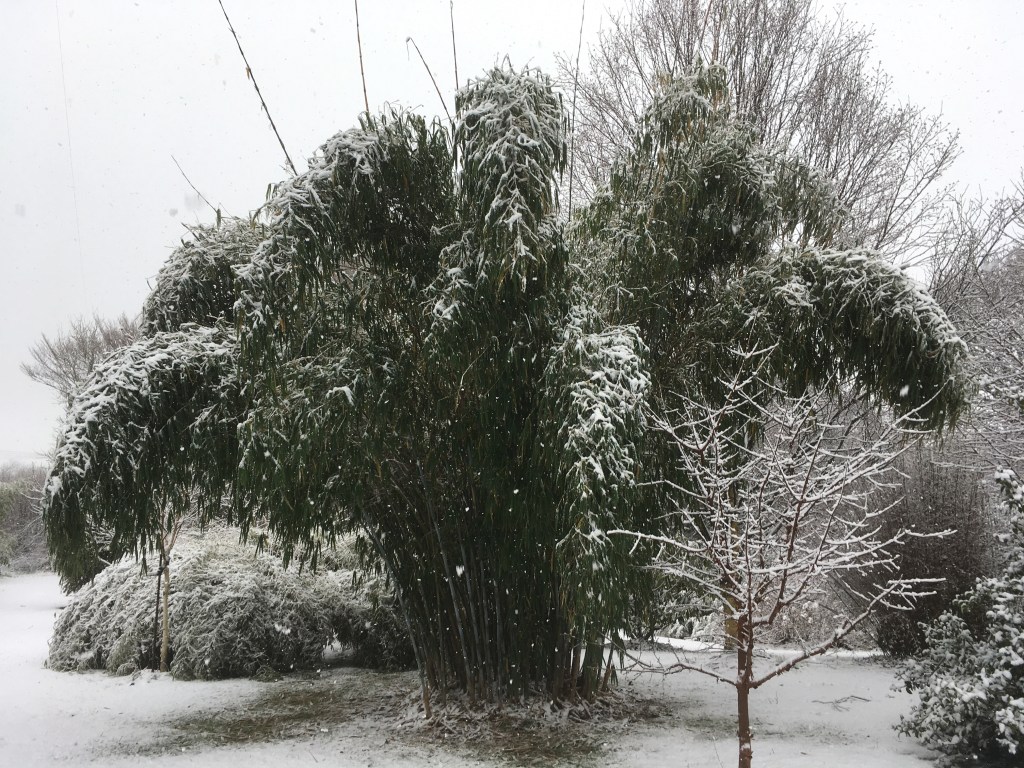
Borinda papyrifera is one of the bamboos from Yunnan that has survived (just!). Borinda lushuianensis (originally known as Yunnan 4, much simpler to pronounce) did not survive any quite mild winters here, but B. papyrifera has proved to be tougher.
Said to be hardy to -14°C to -16°C, as a small plant it did not come through the very hard winter of 2010-11. We decided to give it one more chance, and by 2020 (above) it had made an impressive specimen in the garden.
December 2022 saw some fairly low temperatures in our area, certainly into double figures below freezing. It became clear that B. papyrifera had suffered badly, and initially Sheena wasn’t sure it would survive – but it has, and developed a number of new shoots this year, although it may be a few years before it recovers to the size that it was. The young canes are a powdery blue-grey initially, maturing to olive green, with large silvery-buff sheaths, and develop up to a height of 7m. If you have the space, it is definitely a ‘statement’ plant.
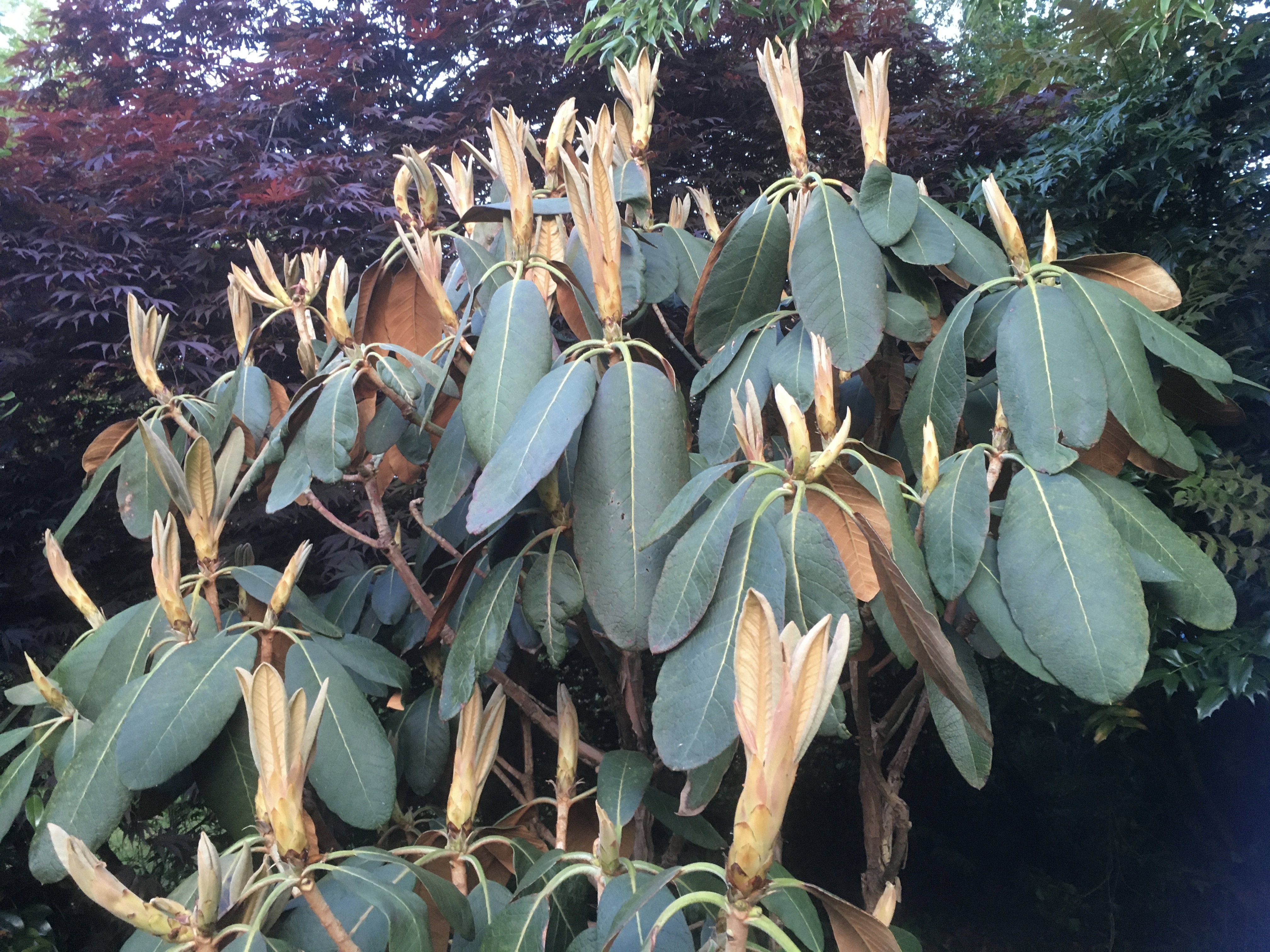
Of the large-leaved rhododendrons, R. falconeri has proved to be the hardiest (it has not suffered in even the coldest temperatures while others, such as R. sinogrande, have). It is a striking plant, with leathery dark green leaves, fawn indumentum when the leaves emerge, deepening to a rusty colour on the underside of the leaves, peeling pinky-brown stems and pale yellow flowers with a maroon blotch. It has not been extremely floriferous here, but the young leaves make up for that as they emerge.
The west wall of the house is the only place where Crinodendron hookerianum has proved happy, and it is now a very large plant. It has elongated dark green leaves and lantern-shaped crimson flowers are suspended from its branches in May, giving the shrub its name of the lantern tree. In our part of the country, it definitely requires a sheltered position.
Another red-flowered plant, this time with bright scarlet flowers, is Embothrium coccineum, which takes over from the Crinodendron flowering in late May and June. It is an evergreen or semi-evergreen small tree with clusters of bright scarlet tubular flowers (hence its name of the Chilean firebush). It has not proved to be very long-lived in the garden (Sheena thinks that late frosts in May were the culprit).
A replacement, a sucker from her parents’ garden, even though still quite small, came through last winter unscathed, even though it is said to be hardy to -5°C to -10°C.
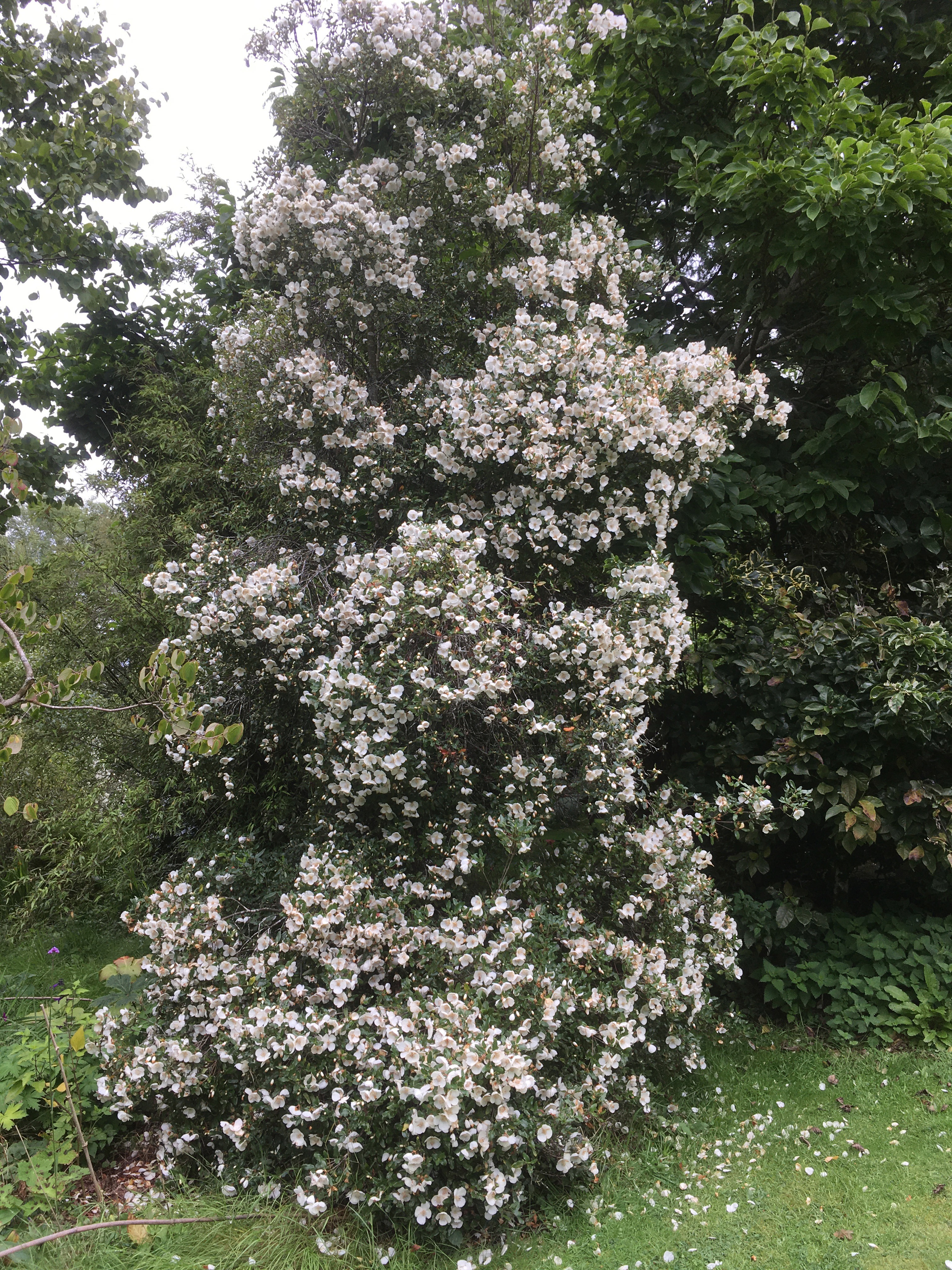
Finally, Eucryphia x intermedia ‘Rostrevor’ is a hybrid between E. glutinosa and E. lucida, which originated in Co. Down. It forms a columnar, evergreen small tree which bearing masses of scented white flowers abuzz with insects; its flowering period of late summer makes it particularly valuable in the garden, and this variety has proved to be very hardy.
Sally’s New Garden with Hardy Perennials and Grasses
After studying painting Sally at college, Sally practised as an artist for 10 years. She was influenced by medieval depictions of the flowery mead in her later work. Gardening became Sally’s main interest after moving to a house with a big garden in Oxfordshire. For ten years she ran a specialist plant nursery, with most of the plants grown from cuttings or seeds, selling out at Rare Plant Fairs, Specialist Plant Fairs and Yellow Book Gardens among others. A few years ago she moved to the Cothi Gardeners area and began to develop her new garden from scratch, focussing on hardy perennials. She has a greenhouse where she propagates perennials from seed and cuttings. To the south of the house is a border 15m long and 5m deep. Huge stumps of C. leylandii had to be removed by a tree surgeon to be able to make best use of this space. The soil is deep and rich, quite a contrast to the heavy clay in Oxfordshire.
The garden to the rear is north-facing and exposed, backing onto set-aside land with plenty of wild flowers. In this area in 2021 Sally decided to try a no-dig flowerbed which she planted up exclusively from seeds and cuttings she had raised herself.
The no-dig bed was created by laying down cardboard, adding compost and cut material on top. It has been a great success and become a varied tapestry of perennials.
In her gardening style, Sally has been very inspired by Piet Oudolf and his use of perennials and grasses, and plants particularly to attract pollinators. She gardens exclusively organically, and uses only peat-free compost. She doesn’t water plants after two weeks have passed since planting, unless a plant dehydrates completely.
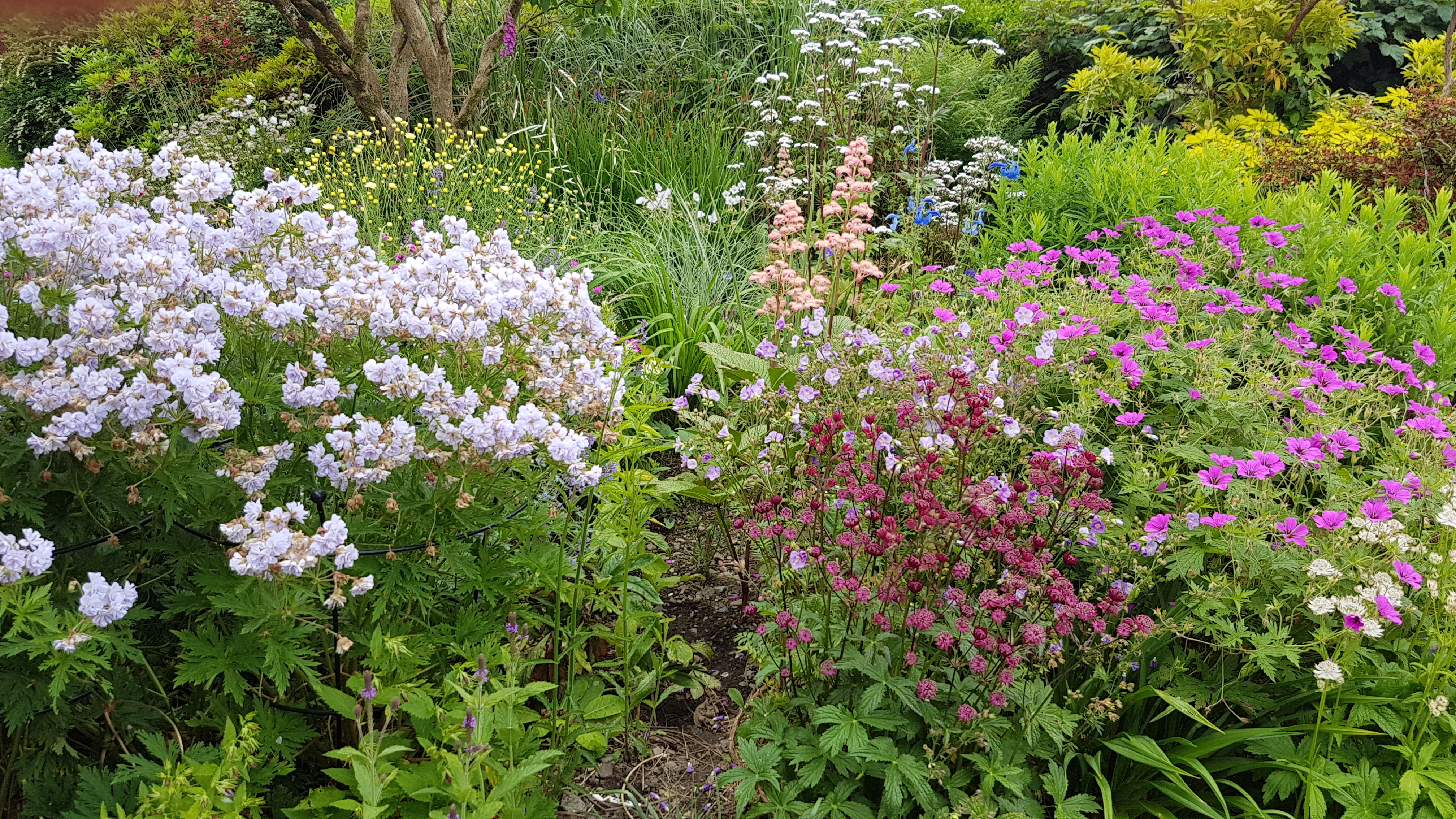
Sally showed us many pictures from her garden of beautiful combinations of hardy perennials and grasses. A group of plants Sally uses widely are the hardy geraniums – including G. ‘Patricia’, G. pratense, G renardii, G. ‘Rozanne’ (which flowers from May to October), and G. ‘Cloud Nine’ raised by Helen Warrington of local Ty Cwm Nursery. The latter is extremely floriferous over a long period, and the bees have an unusual trick to get at the pollen, by making a hole on the underside of the first petal layer.
G. ‘Cloud Nine’ with G. ‘Patricia’ and Astrantia ‘Buckland’
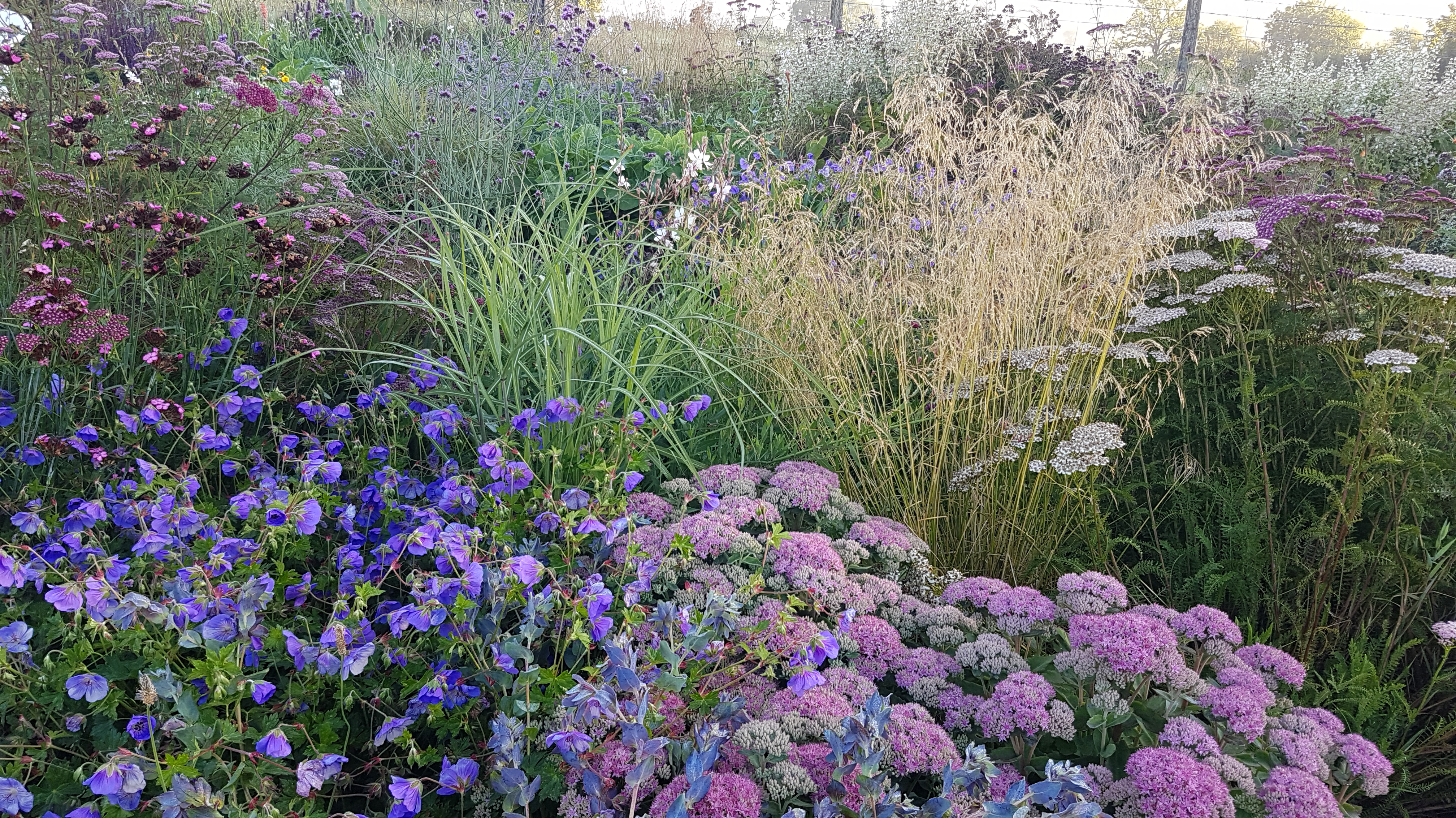
Among the grasses are Miscanthus ‘Morning Light’, which as the name suggests catches the light beautifully, and Miscanthus malepartum, which is extremely tough. Molinia caerulea ‘Transparent’ is another favourite, as it stays small in the border until mid-summer, but then shoots up with stems as much as 8 feet tall, making a real statement without taking up too much space.
Deschampsia cespitosa with Geranium ‘Rozanne’
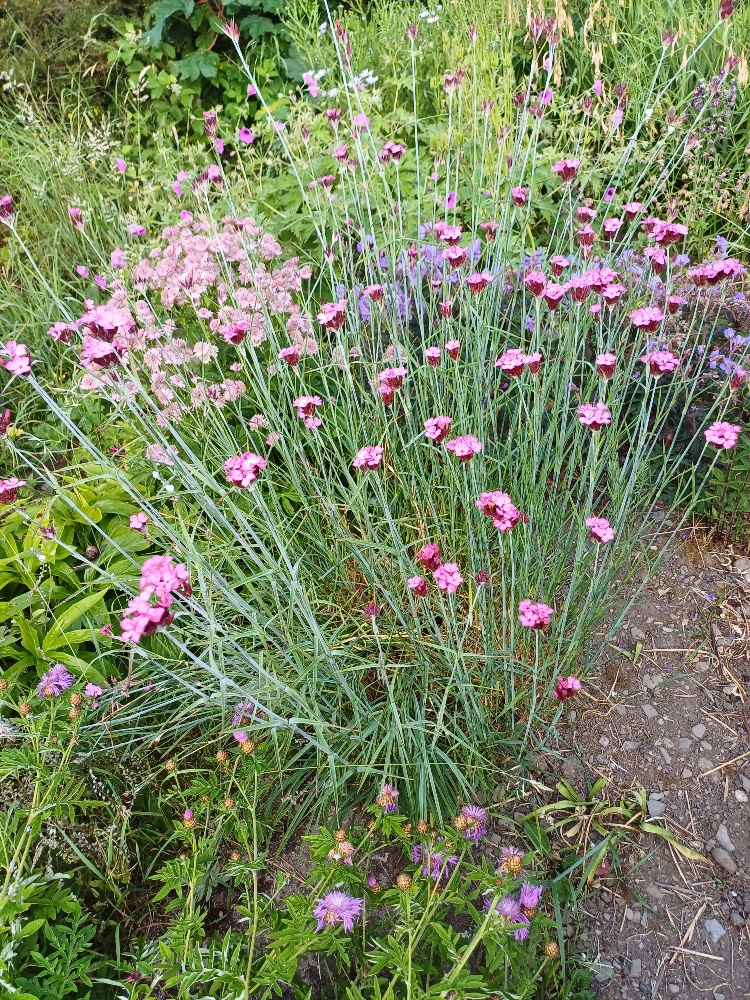
Sally has particular praise for Dianthus carthusianorum, with its single pink flowers held on tall stems above narrow, grassy, grey-green leaves; it flowers all summer long.
Other perennials that Sally uses include Salvia ‘Purple Rain’, Papaver ‘Royal Chocolate Distinction’, Asphodeline luteum, Phlox ‘Hesperis’ (with violet flowers that become almost luminous at night), Salvia uliginosa, Salvia turkestanica, Knautia macedonica, Morina longifolia (hailing from Tibet), Centaurea ‘Pulchra Major’ and Selenium wallichianum.
A beautiful grouping of plants from Sally’s garden
Elena’s Tropical Pond in Wales
Twelve years ago Elena moved from Trinidad to the Cothi Gardeners area – where the climate and vegetation couldn’t be more different! There was an unused patch of grass in her garden, with just 4 daffodils and half-a-dozen bluebells, which she had been considering turning into a ‘tropical pond’. The site is exposed to the north and the east, and on top of a rubble heap – not promising! Then along came lockdown in 2020, creating an opportunity, and providing a much-needed focus for activity.
The first step was to lay the outline of the pond with twigs on the grass. Then Elena dug up from her garden and divided any plants with tropical-looking foliage. She also scavenged what she could from friends.
But, in lockdown, where to get the materials? James, Elena’s next-door neighbour, came to the rescue. He supplied both the butyl liner, and the soft cushioning layer. He also borrowed a mini-digger to dig the pond.
Even with the mini-digger, the spoil heap proved to be a tough proposition – the pond became shallower, and shallower… Elena collected the stones for the pond, to hide the butyl liner, from the small stream which runs along the boundary of the garden. More of the butyl liner was used to create a bog garden to one side of the pond. Lifting the canopy on the sycamore trees has been effective, giving the stems a tropical appearance.
Then Elena spent hours placing pots in and around the pond, and the next thing the pond needed was a waterfall. Lockdown again turned out to be the provider, as Farmyard Nurseries had been clearing out their sheds and discovered a water fountain – just what was needed!
What of the plants? They include a Banana (which stays out all year, wrapped in the winter), Gunnera, Persicaria (which was gifted as a bunch and distributed about under the stones), watercress (also from a friend), Macleaya and even a carnivorous plant (which also overwinters!). Gingers (Hedychium) also are surprising and beautiful plants in this environment. Houseplants are brought out for a summer holiday, including Hibiscus and Bougainvillea.
Gravel has been put down around the pond, joining to the existing path, which has been lined with trellis screens bought online. At the base are ferns, which have proved to be very hardy. Hostas have been hung in pots from the tree adjoining the path, and stumps have filled with thyme and evergreen ferns.
It is just a tiny pond, but it attracted so much wildlife, almost immediately: birds, snails, dragon- and damsel-flies, frogs, toads, newts and lots of hedgehogs. The frogs come in huge numbers, as Elena and her grandchildren discovered in the spring when they went down to the pond at night to explore!
Around the pond the hedges have really thickened up, and the planting has become lusher and lusher. Many plants have died, but lots have survived. Making the pond has been an enjoyable journey; the tropical feel of the pond reminds Elena of Trinidad and the plants of gardening friends old and new.
Neighbour James, who came to the rescue with materials, with his daughters by what is now a very tropical-looking pondBench with bling
John’s October Plant Sale
John and Helen held a very well-attended plant sale for NGS charities in early October, which has so far raised a sum of over £1000 for the charities. This figure will rise as there are plants still to be delivered and collected. John and Helen would like to thank all those who contributed plants, bought plants and helped out on the day. The autumn plant sale has been so successful they may well hold another sale in the spring of next year – so watch this space…
This is a brief post to let you know that our 2022 programme starts next week. We are having the first two meetings by Zoom and then will hopefully be able to have ‘in person’ meetings from March onwards – fingers crossed!
Next weeks’ meeting is on Wednesday 19th January, 7.15pm for a 7.30pm start when Carole Whittaker will be talking to us on “The History, Medicinal Qualities and care of Monarda“
These beautiful perennials from North America have been utilised since 2,500 BC by the Native American peoples for their medicinal qualities. But the history does not stop there! The talk covers all aspects of caring for these unusual, late summer perennials.
Carole and her husband, Pete, have established a beautiful garden, Glyn Bach, in Pembrokeshire which is home to their National Collection of Monarda. The garden is open through the NGS and Plant Heritage. Click here for their website.
If you would like to join the Zoom meeting and have not received the email with the invitation please contact Fiona at cothigardeners@gmail.com so she can send it through to you.
Terry Walton made his long delayed visit to Cothi Gardeners for our November meeting. He was certainly worth the wait and gave us a highly entertaining and informative talk.
The first part of the talk was about how, after retiring from his career as MD of a precision engineering company, he came to be a media allotmenteer appearing on various radio and television programmes. Currently he is a regular Friday afternoon feature on Radio 2’s Jeremy Vine Show and on Radio Wales. Both shows are live broadcasts; for the former he manages to perform his various tasks, often one handed, while communicating via mobile phone with the studio.
He started gardening on an allotment as a child of 4, building up the number of plots he managed to 11 and growing vegetables which he put into veg boxes and then sold to local householders. It being illegal to sell produce from an allotment, he only charged for the box itself and not the veg it contained. By the time he was 17 he was able to buy his first car. He continued to garden his allotment throughout his career, as a hobby.
Terry gardens organically. His allotment is about the size of centre court at Wimbledon, water is collected from a nearby mountain stream and he has an unheated greenhouse on site. He uses a 4 crop rotation which reduces pest problems and maintains fertility, has no paths (they waste growing space!) and is self-sufficient for all his vegetables, freezing summer crops for winter consumption. Seeds that require extra warmth for germination are placed in the airing cupboard at home for 48hrs, moved to a windowsill and from there out to the greenhouse.
Parsnips:
Don’t sow in the ground
Germinate the seeds on damp kitchen towel, wait until the root shows then
Plant into fibre pots with the bases removed, 2 to a pot. This way they can be planted out without disturbance and the root will not be obstructed and so is less likely to fork.
In due course plant out in a drum for long roots, or into the ground under a fleece cloche, thinning to 1 per pot and at a distance of 9” apart.
Leeks:
He grows early, mid and late season varieties.
They are sown into seed trays, 35/tray, so a total of 105 every year.
When approx. 6” high he uses a crowbar to make a hole in the ground into which the leeks are dropped.
A piece of 6” long, 3” diameter plastic pipe is then placed over each leek which will allow them to grow long and straight, and increase the length of blanched stem.
Beans:
To germinate, place in a freezer bag half filled with semi moist compost.
Plant into recycled polystyrene cups (which keeps compost warm and so gives them a head start)
Once planted out in the ground, water twice a week with a watering can of water with a handful of lime dissolved in it. This helps prevent flower drop.
Courgettes:
To help reduce mildew early in the season, mix 1 part milk to 1 part water and water or spray over the leaves – mildew likes acid conditions to germinate.
Peas:
Germinate as for beans
Plant out in a shallow trench.
Lettuce:
To keep continuity and avoid a glut, sow into pots 6 each of Iceberg and Lollo Rosso every 2 weeks, then plant out.
Grow under cloches in March, then in open. Keep going until October
Sow cut and come again in greenhouse for the winter
Onions:
Don’t wait until the end of the season to start using them, use from when they are big enough.
When drying off make sure ventilation is good. If weather is bad dry in the greenhouse on mesh to give greater circulation
Brassicas:
To combat Cabbage White decimation spray with water in which rhubarb leaves have been soaking for 3 weeks. Repeat after rain. This deters the butterflies.
Or grow under netting/enviromesh.
To prevent Cabbage Root Fly place 2 pieces of damp proof membrane, with V shaped cuts, around base of each plant.
Carrots:
Grow in drums for longer, straighter roots
Harvest through the winter.
Sow in February in greenhouse under bubble wrap for an early crop.
Sowing into the ground: dribble in compost, then seeds and then cover with more compost for good germination.
Cover with enviromesh to avoid Carrot Root Fly
Potatoes:
Earlies – Grow in a drum in a cold greenhouse. Place a layer of manure mixed with compost in the bottom
Add the potatoes and then add layers of the manure/compost mix as they grow until the drum is full
In the ground use green manures and well rotted manure in the potato bed for a good crop
Peppers:
Alternate with Coleus carina or French Marigolds to help with White fly.
Spring Onions:
Sow in buckets every 2 weeks
Tomatoes:
Drape bananas over the tomato trusses to help ripening later in the season – the ethylene relased by the banana skins helps ripen the fruit.
Garlic:
Best varieties to grow are UK ones
Strawberries:
Plant up runners and scrap original plants after 3 years
Cover with netting to avoid bird predation
Other tips:
Keep a wormery for excellent, rich compost
Collect sheep droppings, place in a hessian sack in water for 3 weeks, use the water as a plant feed
Use green manures e.g. vetches and ryes
Use nematodes to help reduce slug populations – repeat every year once the soil warms up.
Use a pressure spray to blast aphids off plants then water well to drown them.
To grow giant pumpkins feed them 6 pints of beer a day!!
Book signing
Some topical tips from Julian:
I thought we were doing well this year with being ahead of the game in the garden and struggled to think of any topical tips for late November, but Fiona then reminded me we’ve still got to plant our tulip bulbs, still need to cut back the roses, and still need to raise pots off the ground to stop problems with freezing – so there you go, no time to put your feet up just yet. And a few suggestions for a dry day.
Cothi Gardeners Christmas Lunch at the Forest Arms, Brechfa
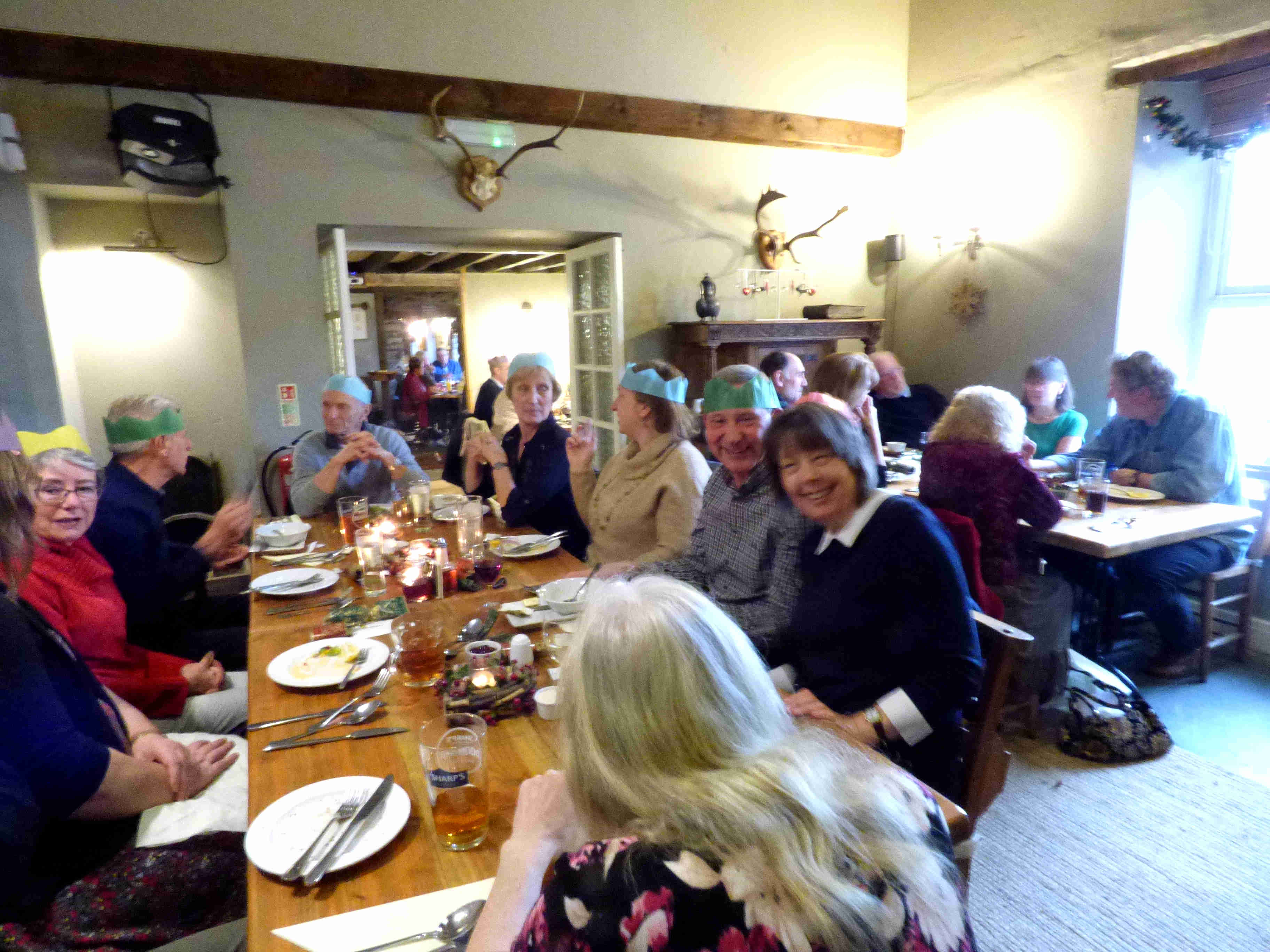
A highly successful end to the Cothi Gardener’s season. A high turnout of members contributed to a thoroughly enjoyable lunch – excellent food, festive atmosphere and great company. A big thank you to George and Louise and their staff and to all who came to make it such a success.
Apologies for the poor quality of the photos but light levels were challenging!
Committee Members Needed
As those who have attended the last few meetings will already know, we have three committee members retiring from their current committee roles in January. A huge thank you to Brenda and Yvonne, our programme secretaries and Julian our Chairman. All members should consider serving on the committee at some point to help the club to continue forward into the future. It isn’t onerous and is often great fun. Obviously it’s very important to find someone prepared to take on the role of chairman. It would be for 1 year with the option of continuing for a maximum of 3. Please give it some serious thought and if you are prepared to join us then please give your name to Julian by 9th January 2019
Finally remember to put the date for the AGM in your diary: Wednesday, January 16th at 7.30pm. Bring a plate of food to share and be prepared for Derek’s Quiz!
Membership renewals:
For existing members who renew their membership before or at the AGM in January the fee will be £10 (normally £14).
In addition, the committee decided that we should introduce a new fee for couples. This would normally be £25 but will be £18 if renewed before or at the AGM in January 2019.
All that remains is to wish you a very Happy Christmas and peaceful, healthy and productive 2019
Bruce Langridge enthralled us with his enthusiastic and informative talk on ‘Fascinating and Phenomenal Fungi’ at our October meeting. Knowing very little about fungi when he arrived at the National Botanic Garden of Wales 15 years ago where his role as Head of Interpretation was “to create interpretation that informs, entertains and fascinates all Garden visitors, whatever their age, gender or background”. Finding that the NBGW included a meadow of international importance for fungi fired his enthusiasm to find out more and raise awareness of this amazing and important form of life. His annual Wales Fungus Day, started in 2013, has been taken up by the Mycological Society in 2015 and expanded into a National Fungus Day.
Embroidered Fungi
Bruce gave us a potted history from fungi’s evolution over a billion years ago to the present day when it is thought that there could be over 100 million different types. The importance of fungi to the planet’s ecosystem is huge. 85 – 90% of plants have a symbiotic relationship with one sort of fungus or another (fungi don’t photosynthesise and plants are not always very efficient in taking up necessary nutrients from the soil). Certain fungi are indicators of old meadows which have not had modern farming practices applied to them. The pink Waxcap is on such example (coincidentally Julian had counted nearly 70 of these in one of his meadows that afternoon). Some fungi are edible but Bruce advised caution as there are often ‘lookalikes’ which are poisonous; or in one case an edible one can be infected by a poisonous one! In addition, picking wild fungi causes damage to the fungus through trampling and soil impaction. Other fungi such as Dutch Elm Disease, Ash Dieback and Honey Fungus kill plants, while others have hallucinogenic properties eg. Magic Mushrooms and Fly Agaric and many have been used in Chinese and Japanese medicine for 1000’s of years. One of the top 5 most poisonous fungi in the world, the Destroying Angel, was found by Bruce locally.
Examples of fungi brought in to the meeting
Bruce’s slides and examples demonstrated the diversity of shape and colour from the bright red Elf Cups to yellow Witches’ Butter and the Bird’s Nest Fungus, often accompanied by interesting and amusing anecdotes.
Finally, Bruce told us a little about lichens (a combination of fungi and algae and sometimes bacteria as well) and rusts and smuts. Lichens are a sign of pure air, however they do not like acid rain so many are dying out. The NBGW is the first Botanic Garden in Europe to try a conservation technique, transplanting rare lichens onto a willow tree in the gardens to try and save them. So far the results have been very encouraging. (https://botanicgarden.wales/about-the-garden/wildlife/lichens-in-the-garden/)
For anyone who is interested, Bruce runs fungi walks at the Botanic Gardens and also suggests joining the Carmarthenshire Fungi Group (http://www.carmarthenshirefungi.co.uk/)
Committee Members Needed
As those who have attended the last few meetings will already know, we have three committee members retiring from their current committee roles in January. A huge thank you to Brenda and Yvonne, our programme secretaries and Julian our Chairman. All members should consider serving on the committee at some point to help the club to continue forward into the future. It isn’t onerous and is often great fun. Obviously it’s very important to find someone prepared to take on the role of chairman. It would be for 1 year with the option of continuing for a maximum of 3. Please give it some serious thought and if you are prepared to join us then please give your name to Julian by 9th January 2019
Membership
Due to the healthy state of the club’s finances this year, the committee has decided that there will be a one off discount for membership renewals as follows:
For existing members who renew their membership before or at the AGM in January the fee will be £10 (normally £14).
In addition, the committee decided that we should introduce a new fee for couples. This would normally be £25 but will be £18 if renewed before or at the AGM in January 2019.
Terry Walton
It’s hard enough getting those fiddly seeds into compost or trimming just the right side-shoots without holding your mobile phone to your ear and providing a running commentary to thousands of Radio 2 listeners at the same time.
If you haven’t already guessed, our speaker in November will be Terry Walton. “The Life of a Media Allotmenteer” promises to give us a look behind the scenes as Terry tells us about life on his allotment in the Rhondda and how he has given growing advice on the radio each month for over twelve years.
A gardener of over 40 years’ experience, Terry has worked plots on the same site since he was a boy, learning from his father and other allotment gardeners. Many of you will be familiar with his enthusiastic style, so do come along on November 21st to meet Terry. Mobile phones not necessary!
Guests and visitors welcome, £3, to include refreshments. The talk begins at 7.30pm.
Christmas Lunch
November’s meeting is your last chance to book in for our Christmas lunch. It is to be held at the Forest Arms, Brechfa on Wednesday December 12th from 12.30pm. The form together with the menu (which is also listed in a previous post) will be out on the ‘Meet & Greet’ table. You will need to give your food choices, noting any allergies/dietary requirements, plus a £10 deposit per person. The full cost of the lunch is £20 per person.
Topical Tips
Lilium regale – A fabulous scented species lily with large funnel shaped white flowers in the summer. The seed pods have just ripened and lilies are fairly easy to grow with fresh seed. Keep it in the fridge until maybe mid March and then sow it in a pot outside. You do need to keep slugs and mice away from them, but you can get good germination rates and it’ll take about 4 years for the lilies to flower.
Autumn planting
It’s a great time of the year for new planting now, before the frosts arrive, while the soil is still warm and with all that recent ‘wonderful’ rain having soaked the ground….
Winter Squash
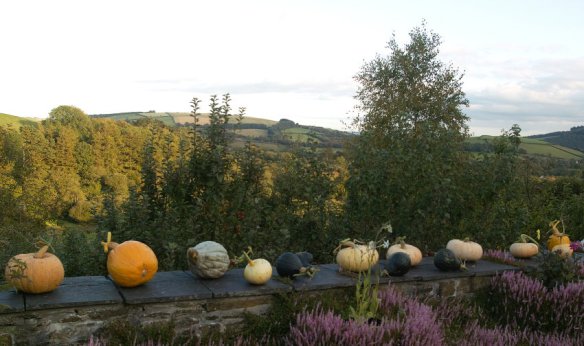
For everyone with winter squash, it’s probably a good time to ripen them off for about 10 days in a warm, dry place to toughen and dry up the skins, before moving to a cool, frost free place to allow them to store well for longer.
September’s meeting saw a very welcome return by Paul Green from Green’s Leaves Nursery. Paul once again built his talk around a fantastic and diverse selection of plants that he’d brought along, persuading us of the merits of plants which look great at this early autumn period and on into winter.
Ranging through grasses, trees and small perennials, there was something for everyone to enjoy, and the talk was laced with practical tips (remember to lift any outside pots off the ground over winter to prevent water logging and root death), to snippets of fascinating information (Alder Buckthorn is not only one of the main larval food plants for the caterpillars of the Brimstone Butterfly, but also originally the favoured wood for making high quality charcoal to incorporate into gun powder!)
An enjoyable evening all round, and great to see several new members join us.
Bruce Langridge – ‘Fantastic and Phenomenal Fungi’
Next week’s talk on ‘Fantastic and Phenomenal Fungi’ by Bruce Langridge promises to be really interesting – Bruce is responsible for establishing the Wales Fungi Day at the National Botanic Garden of Wales, taking place this Sunday 14th October and it’s been so successful that a similar event is now held at over 80 venues nationally. Click here for more information.
Terry Walton – “The Life of a Media Allotmenteer”
Advance notice for November’s meeting when our speaker will be Terry Walton on the subject “The Life of a Media Allotmenteer”. Terry promises to give us a look behind the scenes as he tells us about life on his allotment in the Rhondda and how he has given growing advice on the radio each month for over twelve years.
A gardener of over 40 years’ experience, Terry has worked plots on the same site since he was a boy, learning from his father and other allotment gardeners. Many of you will be familiar with his enthusiastic style, so do come along on November 21st to meet Terry. Click here for his facebook page.
Guests and visitors welcome, £3, to include refreshments. The talk begins at 7.30pm.
Christmas Lunch
Initial bookings for the lunchtime Christmas meal at The Forest Arms, Brechfa are coming in, so don’t forget to sign up soon – there may be a limit on numbers which we could broach this year, with the increased membership. The cost is £20 per head. Please give your menu choices (including any dietary requirements/allergies) plus a 50% deposit when you book your place. The menu is shown below. The date is Wednesday December 12th, 12.30 for 1 pm.
Monthly Tips
3 Tips from Julian……………..
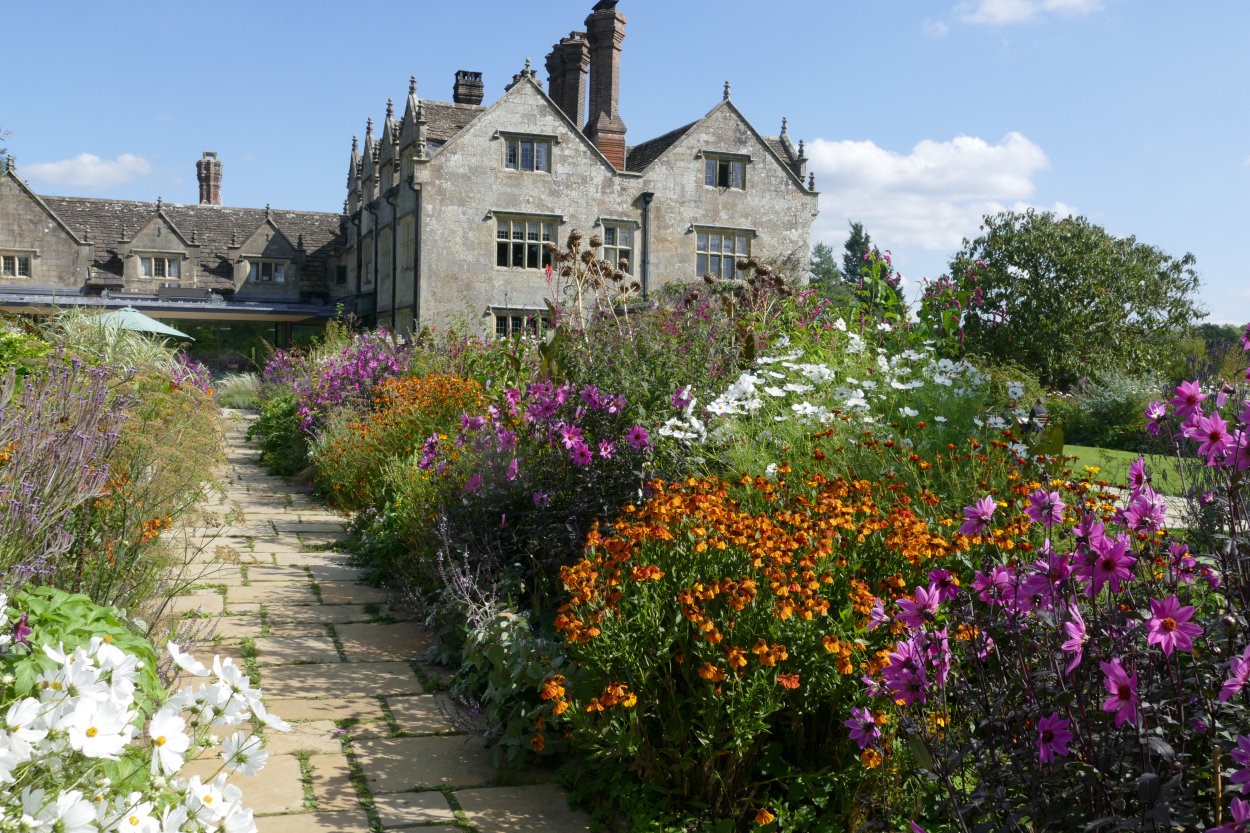
I find myself collecting seeds from quite a few plants at this time of the year. Obviously It’s a good idea to collect them on a dry day if you can manage that, but also it’s worth labelling them and quickly storing them in the fridge so that they don’t become too dry which can easily happen if they’re left on the side in a warm house. We had a few days in Sussex recently and were fortunate to visit Gravetye Manor which was the home of William Robinson at the beginning of the last century. He was perhaps the driving force in moving gardens towards a more naturalistic, less formal type of garden design. However I didn’t know until this visit that he injured himself very badly after slipping on a stile whilst walking to church, and spent the last 25 years of his life confined to a wheel chair. But apparently right up to the end of his days, he loved scattering seeds of his favourite plants around his garden and meadows and enjoying the excitement of seeing what germinated.
Gravetye Manor flower garden
I’ve also found that the 2 pronged weeding fork I mentioned earlier in the year as a great tool will work as a bulb planting implement for small bulbs like Crocus and fritillaries, which limits the extent to which you have to bend over. But I’ve also found it’s not a good idea to twist it too much, or you end up with a single pronged fork! Which is still ok for bulb planting, and for using as a strut or support but not so good for weeding!
Finally I’m guessing a lot of people will have a surfeit of apples this year. We have, so I’ve been juicing and freezing a lot. This generates quite a lot of pulp and trimmings. I did read that mice and voles love apples (certainly our rats do!) So I’ve been scattering all the apple debris around near where I’ve planted my Crocus in the hope that the rodents are distracted by the smell and taste of this. And therefore leave the corms alone. In previous years I’ve sometimes lost 80% of newly planted Crocus within a few days (in spite of dousing them in Chilli powder and vinegar) with them being systematically dug up and eaten. Fingers crossed, but so far I haven’t seen any signs of dug out, chomped Crocus this year. Also although it sounds a bit messy, actually all the bits turns brown very quickly and they have the added bonus of attracting in the few slugs we currently have left in the garden, which can then very easily be dealt with at night if you go round with a torch. In whatever way you like to do that! Of late since bending not’s so good for me, I’ve been using John’s suggested method of stamping on them, though I suppose if I sharpened the spike on my weeding fork I could try skewering…




























 Cothi Gardeners