Nigel was originally a landscape and wildlife photographer, then about 11 years ago, looking for a local project, he realised that there was one on his doorstep in the form of Aberglasney Gardens. An agreement was made that if he could go into the gardens at any time of the day to take photos, he would share them for publicity purposes. The result is also his book ‘Aberglasney Gardens – A Calendar Year’.
Aberglasney is within the parish of Llangathen and was derelict and unloved until 1995 when a charity (the Aberglasney Restoration Trust) was set up especially to save the property. Fast forward to today and with the help of volunteers it is utterly fabulous – the gardens are constantly changing with new and exciting planting schemes, which makes them a photographer’s delight.
The first photographs we saw showed how the house sits within the land and then an early map describing the gardens without the buildings. We then began the year in photographs and saw the gardens in snow in December, with Viburnum giving colour and scent, three different varieties of Witch Hazel, and Christmas Box.
Nigel constantly looks to find the best version possible of each subject by adding small but necessary additions such as a flower with a spider web or a bit of moss attached. He takes many photos of a subject from all different angles and in changing light before being satisfied with the result. He initially looks for a suitable background before starting and mostly will take the photos from ground level, as low as possible, with a telephoto lens. The gardeners are very useful and will happily point out things of interest.

The first flowers (Crocus and Iris) to appear will be in the Alpinum area which gets sun throughout the day. Pictured opposite are a beautiful Hellebore with snowdrops captured in the Alpinum in February this year.
Nigel uses a process called focus stacking where he programmes the camera to take a number of shots at different focus points through the image to result in control both over the plant and the background. The background will be blurred so that there will be nothing distracting behind the image, it will take 15 to 30 photos rapidly to result in a good depth of focus of the image with a blurred background. By February there will be Pulmonaria and Willow coming to life, though this year the Camellias did not flower until February.
In March, there is more happening in the garden with Cuckoo flowers, Primula, Scilla, Cornus, different varieties of Narcissus and Crocus, Camellia, many types of Hellebore and more, and the woodland area is beginning to come alive.
This is a new look for the spring Cloister Garden in 2025. A lovely mixed Tulip border on the mansion terrace with Tulipa acuminata amongst the daisies & dandelions in the formal grass areas.
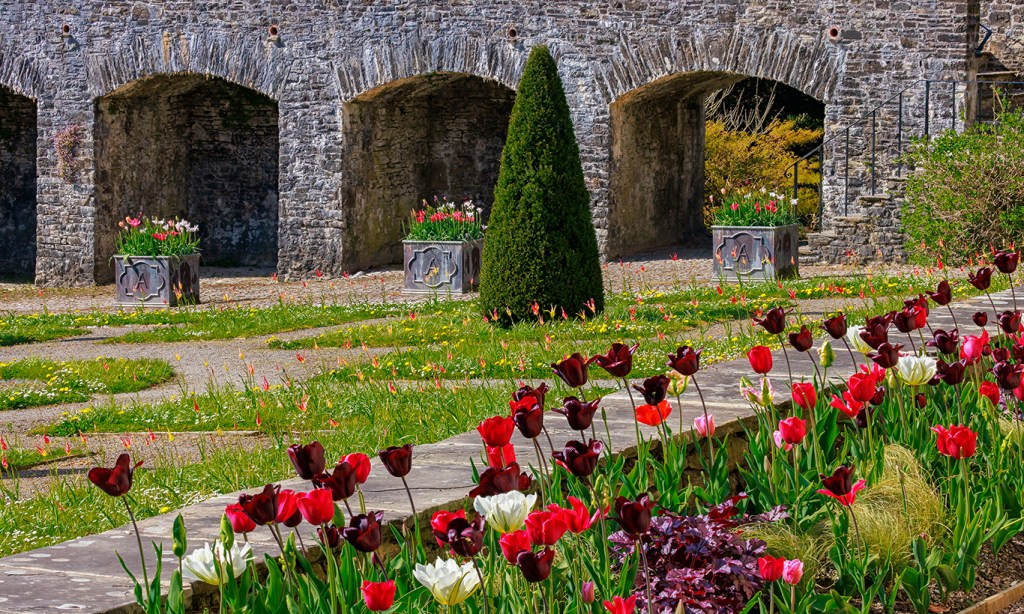
At the end of March and into April, there will be more Camillias, Prunus and Magnolia joining the displays along with Tulips and Fritillaries. It is unfortunate that the Magnolias will often be at the mercy of the weather and some varieties will not be seen every year (and some very rarely!). In April the butterflies will begin to appear to make the flowers even more beautiful and enhance any photographs.
Nigel explained another photography technique called high dynamic range which accounts for the fact that the camera sees the world very literally and deals with the tones of colours (i.e. dark through to light) very differently. A high dynamic range shot will take five shots starting with the area which is darkest then through to the lightest and the five shots will merge on the inbuilt computer to result in the best version of the image.
A wide angle lens is not used very often because it will lack definition and push the image away, but if you can get as close to the subject as possible it will improve the shot. Nigel tries to get combination photographs where possible and will have to spend quite a long time to get the shot just right, and again the background has to be correct when considering colours and light. The Ninfarium at the back of the mansion provides cover and a different atmosphere for plants of a more exotic nature and different types of Orchids can be found.
During several sections of the talk we were shown pictures of the gardens with musical accompaniment. We saw photos of the latest work in the garden including the Aviaries which are in use for growing Squash and other vegetables.
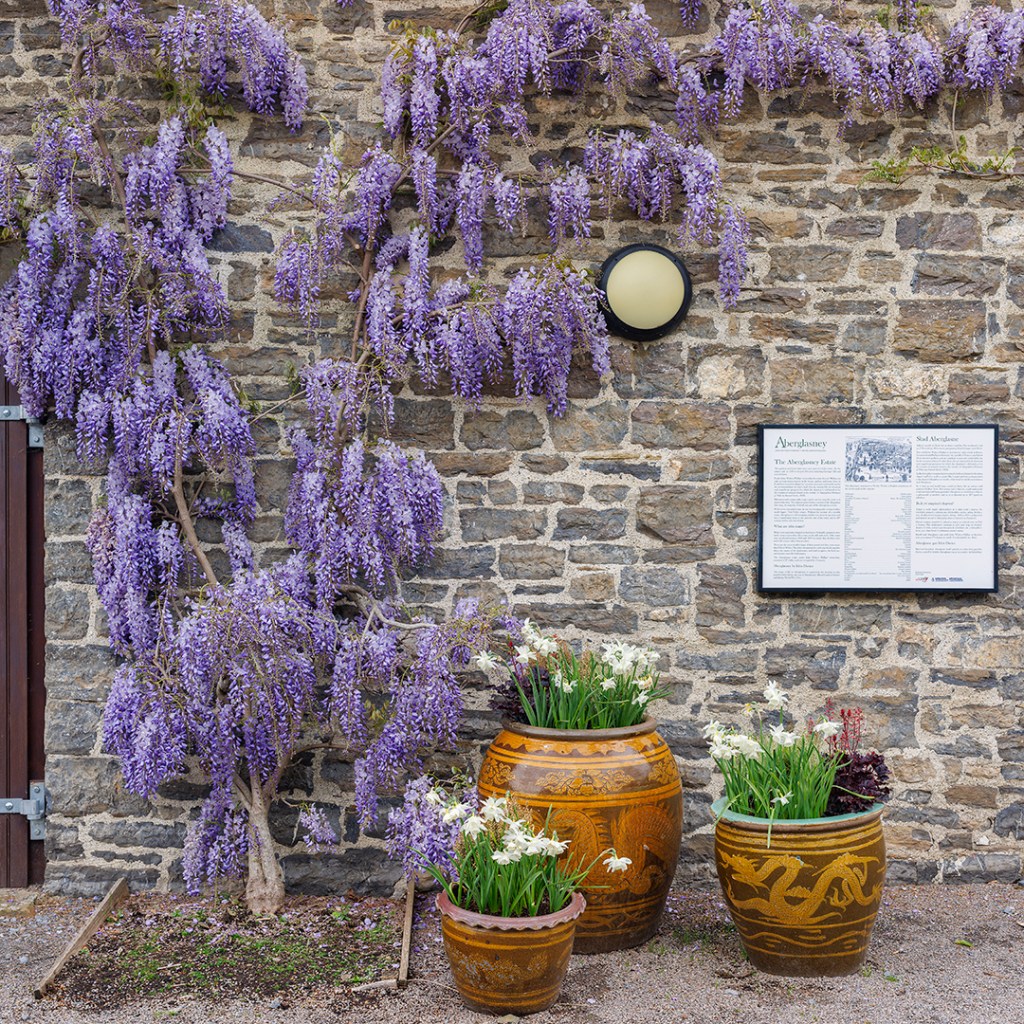
This is the display of Wisteria on the wall of the old cowshed with planters of daffodils. The photograph was taken on 17 April this year, when the wisteria arch would soon be coming into bloom.
Into June & July – roses are of course popular and can be found throughout the garden. Some varieties will continue until quite late in the year and there is a definitive rose garden which includes a beautiful rose arbour. The wildflower meadow no longer exists unfortunately, largely because they can be such a lot of work to get them at their best.
Flowers of the Bromeliad, which is an epiphyte, will hopefully appear by September. This is a favourite month for Nigel when leaves will change colour, and Japanese anemones, vines (particularly Vitis coignetiae ‘Crimson Glory’) and Hydrangea can be seen. September and October are excellent months for photography when the light can have a warmer hue and reflected light will be a useful addition to the photos.
By October, Cyclamen and Cornus kousa (with their crimson fruits) are coming through and plants in the Alpinum also. One of the last flowers to be seen, which is actually a fruit, is Clerodendrum trichotomum or Harlequin glorybower. After the talk, Nigel answered any questions from the audience. He had also brought along for sale copies of his book ‘Aberglasney Gardens – A Calendar Year’, full of his stunning photographs.
Carol thanked Nigel for giving his very interesting talk and sharing the beautiful photographs which will hopefully inspire us to get into the garden with the usual tools plus a camera!
 Cothi Gardeners