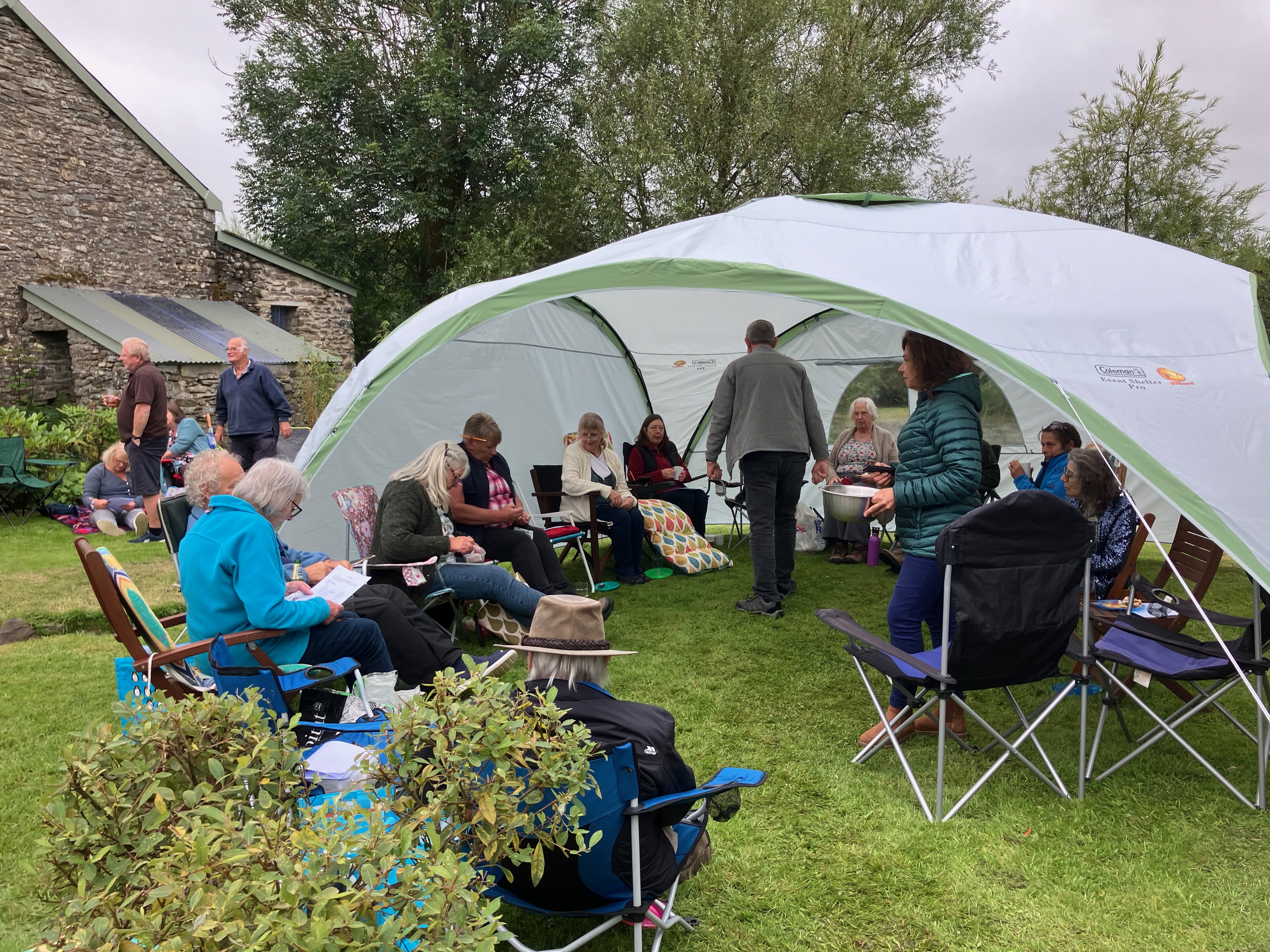
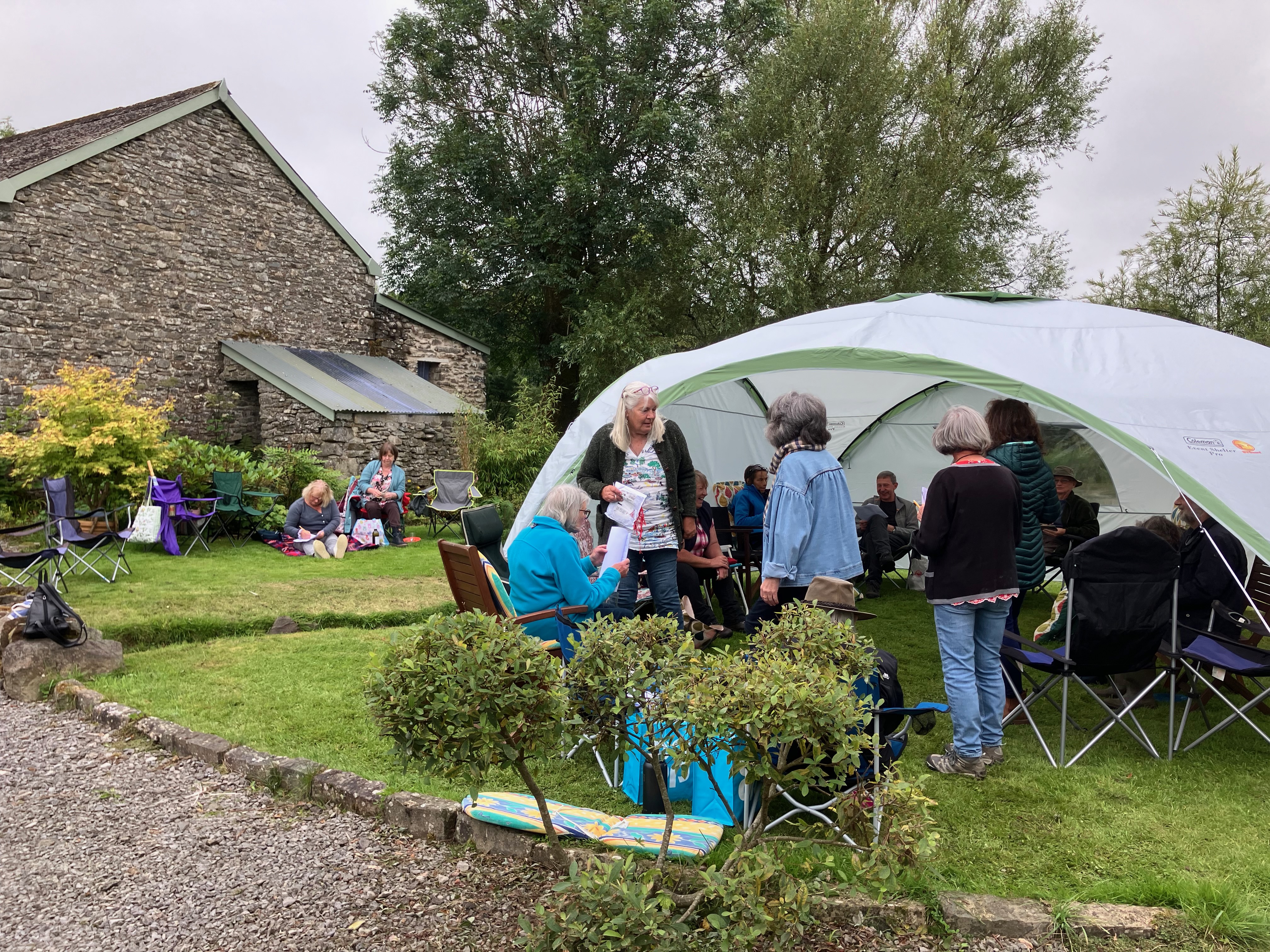
The Cothi Gardeners annual social, hosted by our Chair Dawn, was held on an overcast, but fortunately not rainy (at least not until the end, when the remains of Storm Ernesto arrived!) day, allowing us all to make the most of the wonderful garden in Ffarmers, and the activities arranged. Plenty of members brought along produce or flowers for the various competitions, and the table was laden with savoury delights and delicious cakes for us all to tuck into.
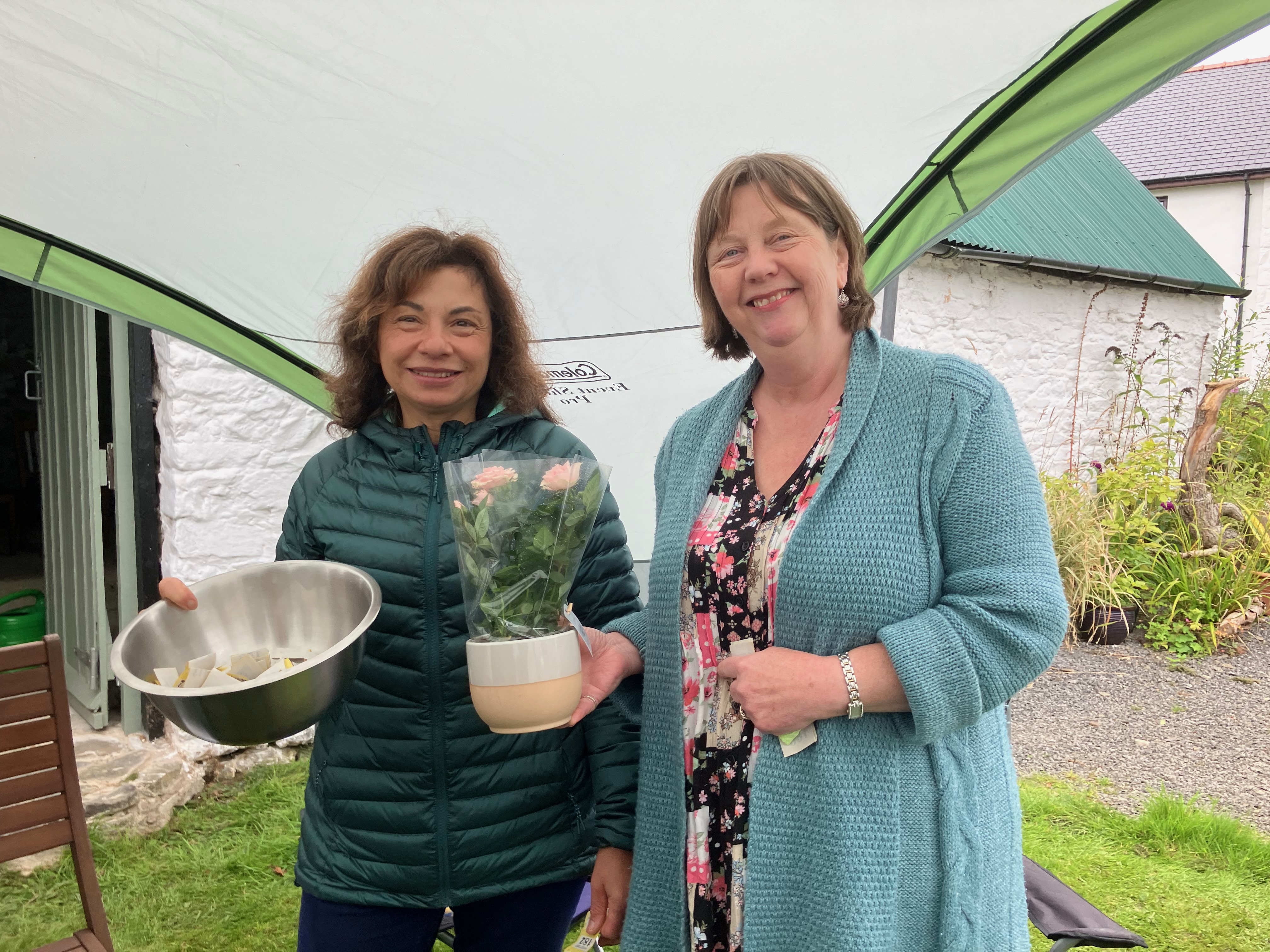
After much conversation over the food, the results of the raffle and the competition prizewinners were announced. There were a total of six prizes for the raffle, which also benefitted the Club’s funds.
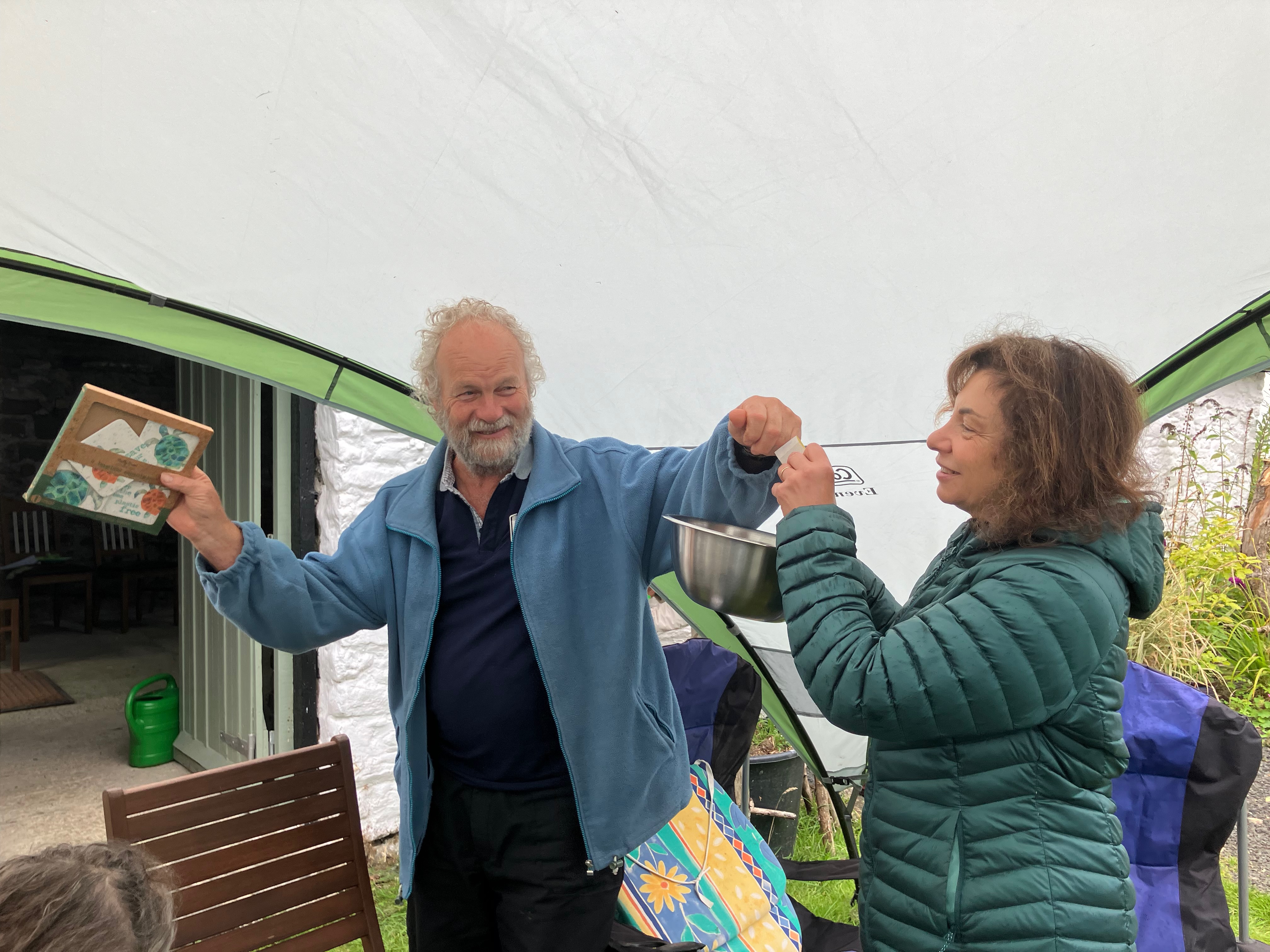
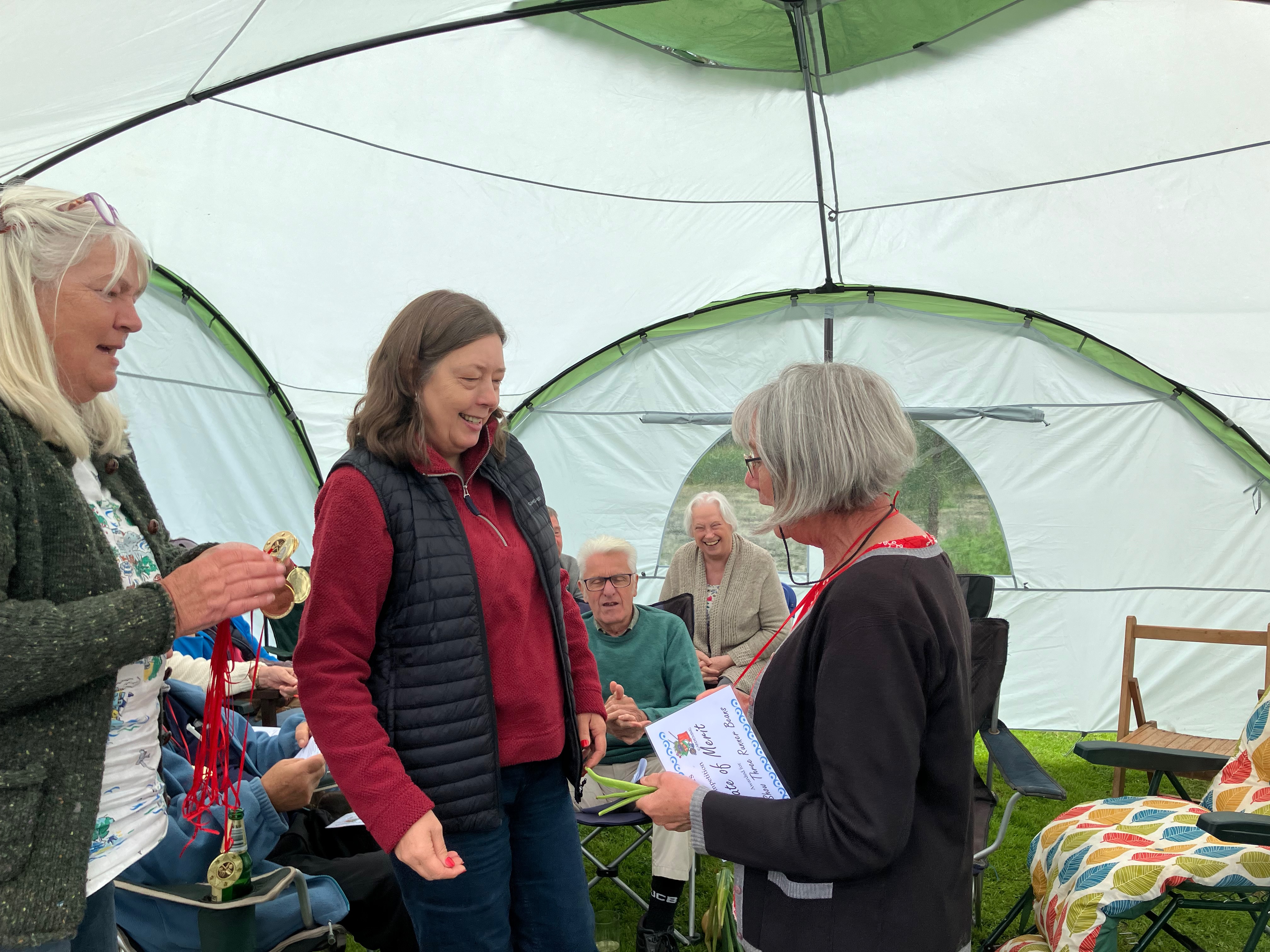
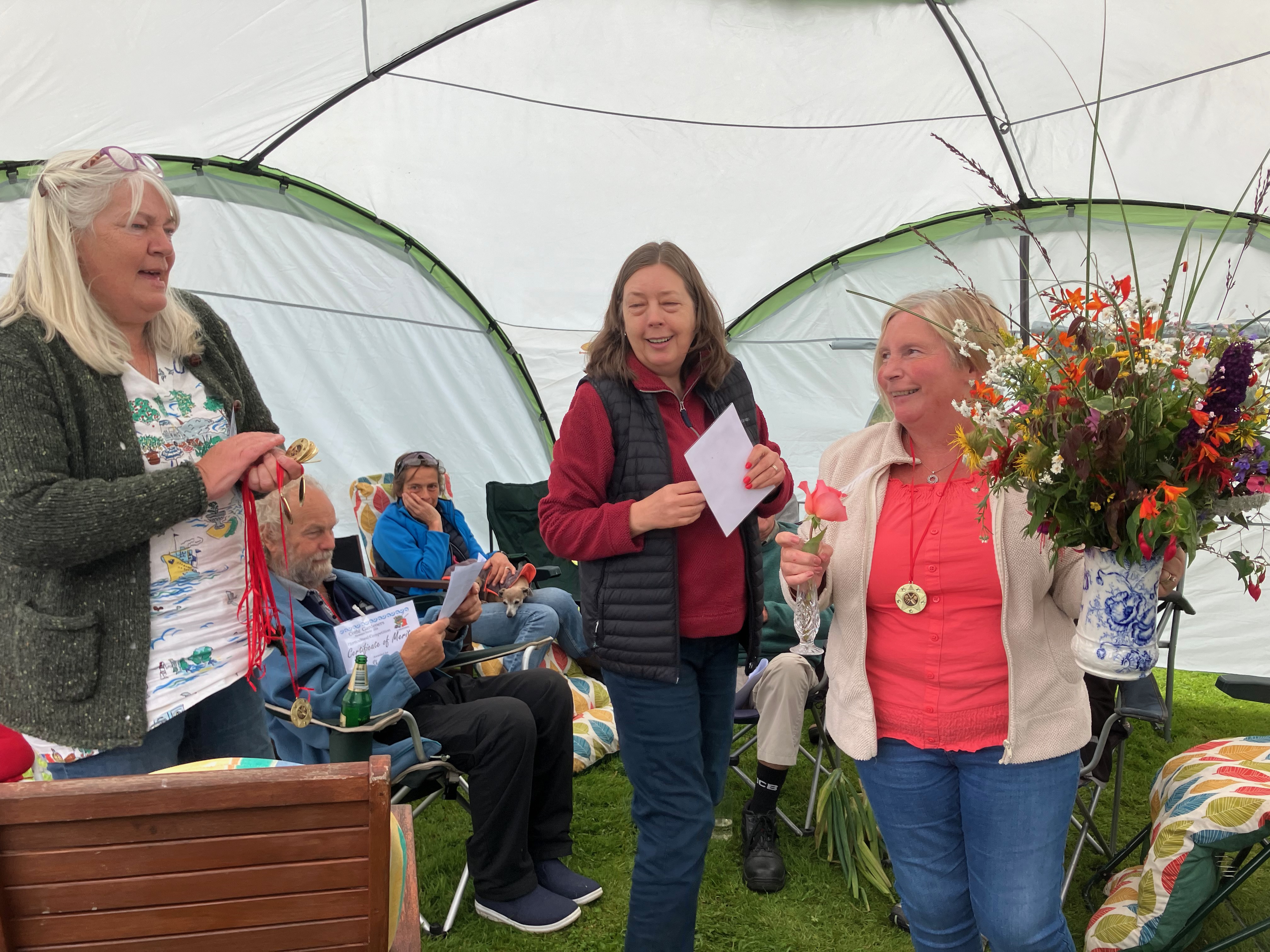
Certificates and medals were awarded for the best exhibit in each category, ably judged by guests Angela and Martin. Rob won the prize for the largest weed (by definition of being a plant in the wrong place, not an undesirable plant). Jenny claimed the prize for the best three runner beans, and Honour for the best flower arrangement and also single rose. Amanda won for best single dahlia, and the best potatoes.
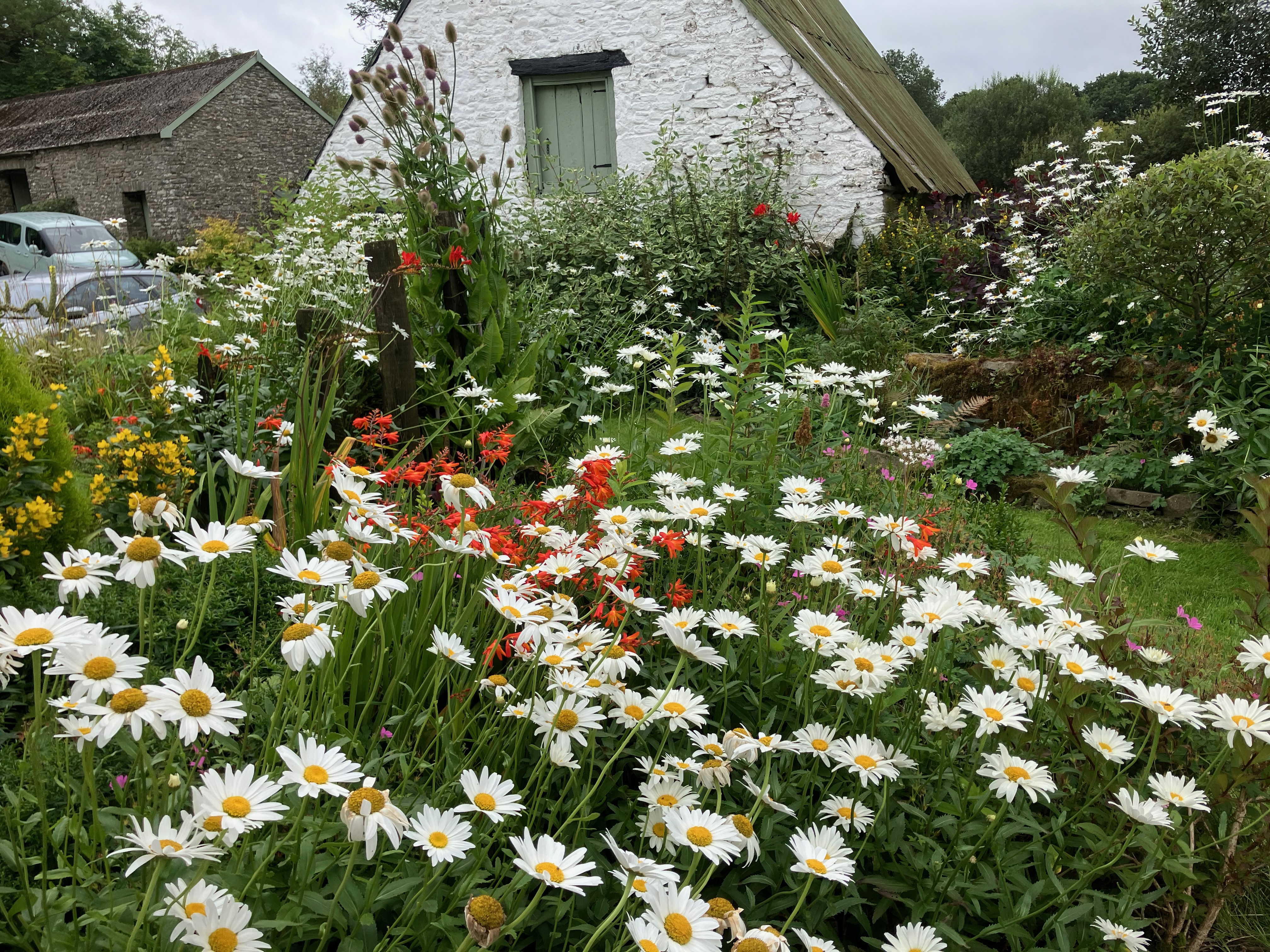
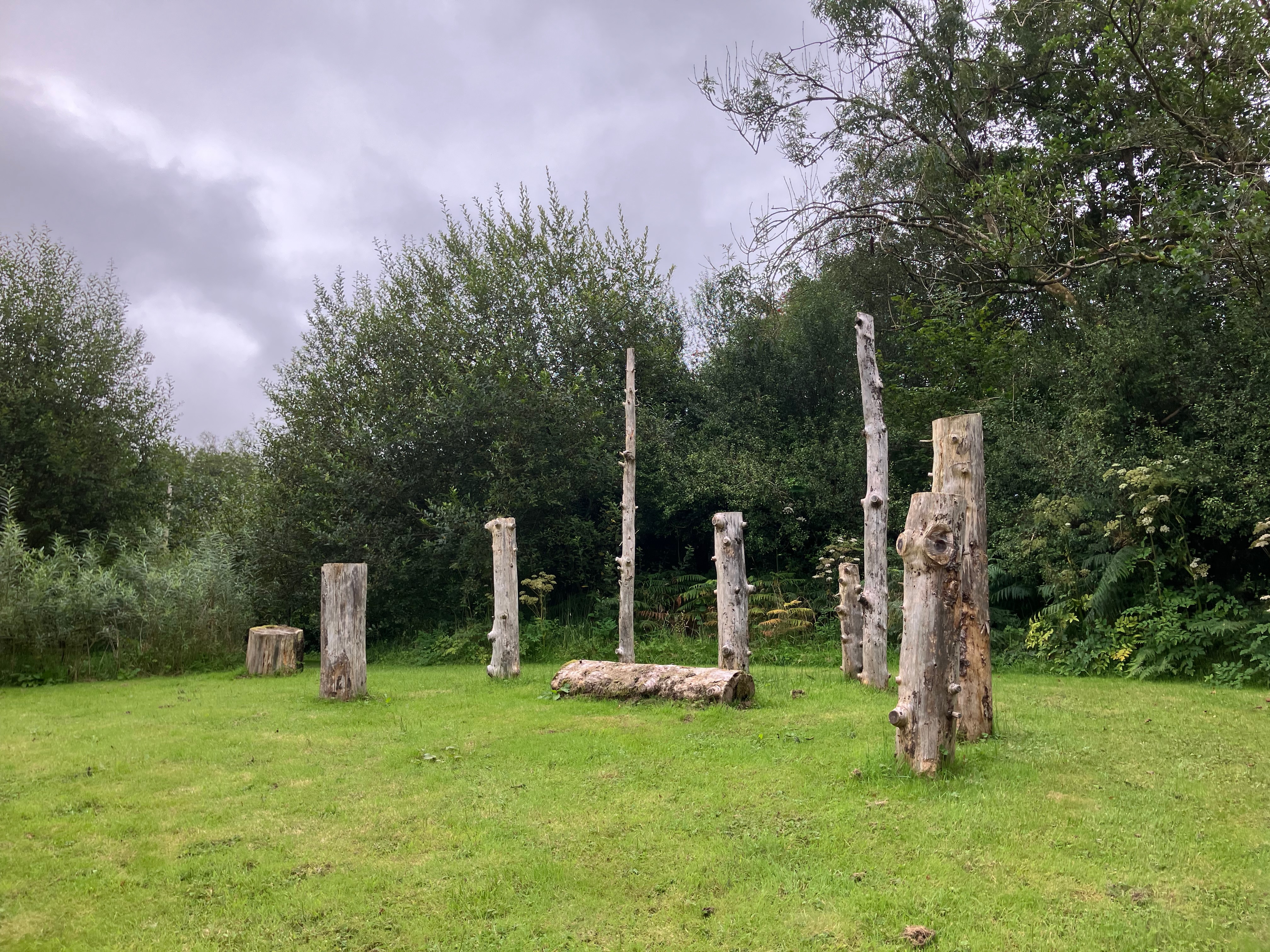
After that Dawn gave us a tour of their garden and land bordering the River Twrch and encompassing SSSI areas including swathes of Devil’s Bit Scabious, the food plant of the Marsh Fritillary butterfly, in perfect flower when we visited. I think that everyone was impressed with the natural beauty of the site and what Dawn and Nick had achieved in removing the overgrown brambles from much of the land, as well as creating a lovely more formal garden around the house and barns.
There was also an opportunity to try our hand at archery, with Nick a very friendly and able instructor. Let’s say that some of us were better than others, but everyone thoroughly enjoyed the experience.
We all enjoyed meeting Dawn and Nick’s lovely dogs, who played a full part in the proceedings and many balls were thrown during our walk. All in all it was a fabulous day out, and the raffle and plant sale (thank you Rhoslwyn Plants) raised welcome funds for the club.
This year’s Cothi Gardeners Christmas Social was held at Ystrad Nurseries near Llandovery. It was, for a change, a sunny afternoon, the alpacas greeting us as our cars pulled in. We all arrived in time to have a good browse around the nursery before the demonstration
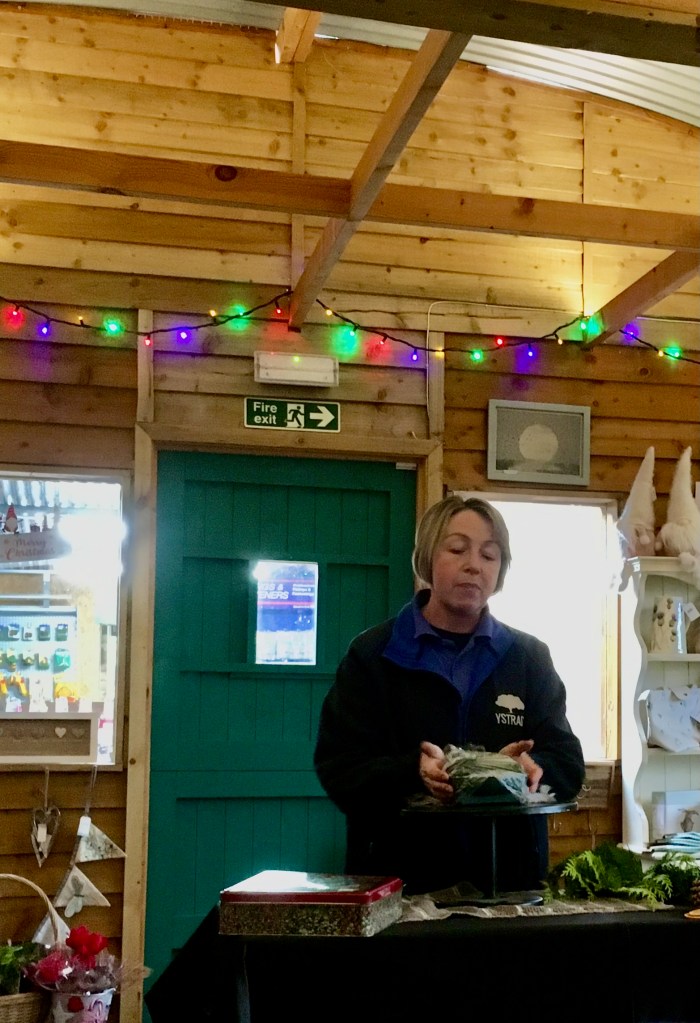
Julie began the demonstration by telling us a bit about the history of the nursery and timber yard, particularly since 2016, when John and Laura Morgan bought Ystrad, having seen the potential to bring together her background in running a nursery and John’s expertise in the timber business. Since then they have grown the business significantly, and from an original staff of three at Ystrad in 2016, there are now over 30. Ystrad Nurseries itself now also has florist Sian on site, and has embarked on phased improvements, beginning with the car park and entrance. Julie herself has worked here since 2020, having previously been a primary school teacher.
First we saw how to build up an arrangement that could be adapted either for the table, or for placing on graves, using a square block of oasis in a circular base, Starting at the bottom, it is best to avoid prickly holly and to create a base layer with fronds from spruce or cypress. The holly can go in as the next layer. Julie recommends pieris for the centre of the arrangement, which at this time of year has flower buds. To add berries and ensure they show up well, take off any surrounding leaves. When adding skimmia do the same and strip the leaves to highlight the purple flower. For a table arrangement, you can then place a candle-holder with candle in the centre.
Julie then explained how to wire items onto an arrangement, such as dried orange slices, and also demonstrated bow-making.
After that, we turned to wreaths. Nowadays moss is less favoured, and people are choosing straw-based rings for the base as a more sustainable option. The straw rings, once purchased, can be re-used the following year if allowed to dry out and stored safely. The greenery can be fixed in place with either wire or twine, using small clusters of foliage as you go, again starting with spruce, but incorporating a range of foliage such as osmanthus, choisya, skimmia, leucothoe and pieris. From this you can then adapt the decoration depending on whether the wreath is for a grave, a door or table arrangement.
Julie with straw base for a wreathFinished wreath for table decoration
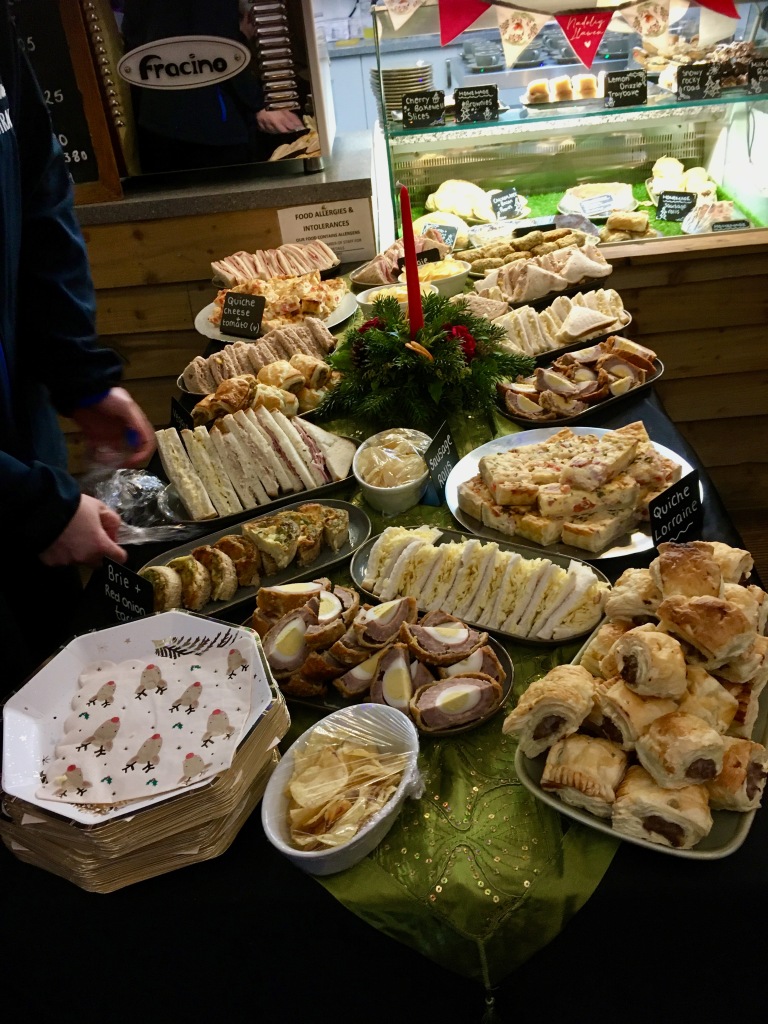
After thanking Julie for her interesting and informative presentation, everyone had an appetite for the delicious and plentiful tea that Ystrad Nurseries had provided. We weren’t going to need supper after that, and a grand time was had by all!
NGS Donations in 2023
Cothi Gardeners Club are fortunate to have among our members John and Helen from Ty’r Maes and Julian and Fiona from Gelli Uchaf who open their gardens for the National Garden Scheme in Carmarthenshire and Pembrokeshire. Across the two counties as a whole there were 3,514 visitors, of which 2,130 were from Open Days and 1,384 from By Appointment visits. That is a return to the visitor numbers seen in 2019 and previously. In 2023 the total raised for charity was £26,638 (up from £20,300 in 2022) – a fantastic increase!
In total the National Garden Scheme has been able to donate £3,403,960 to beneficiaries in 2023. This record amount is testament to the hard work and dedication of all those who open their gardens to the public and all the volunteers who contribute.
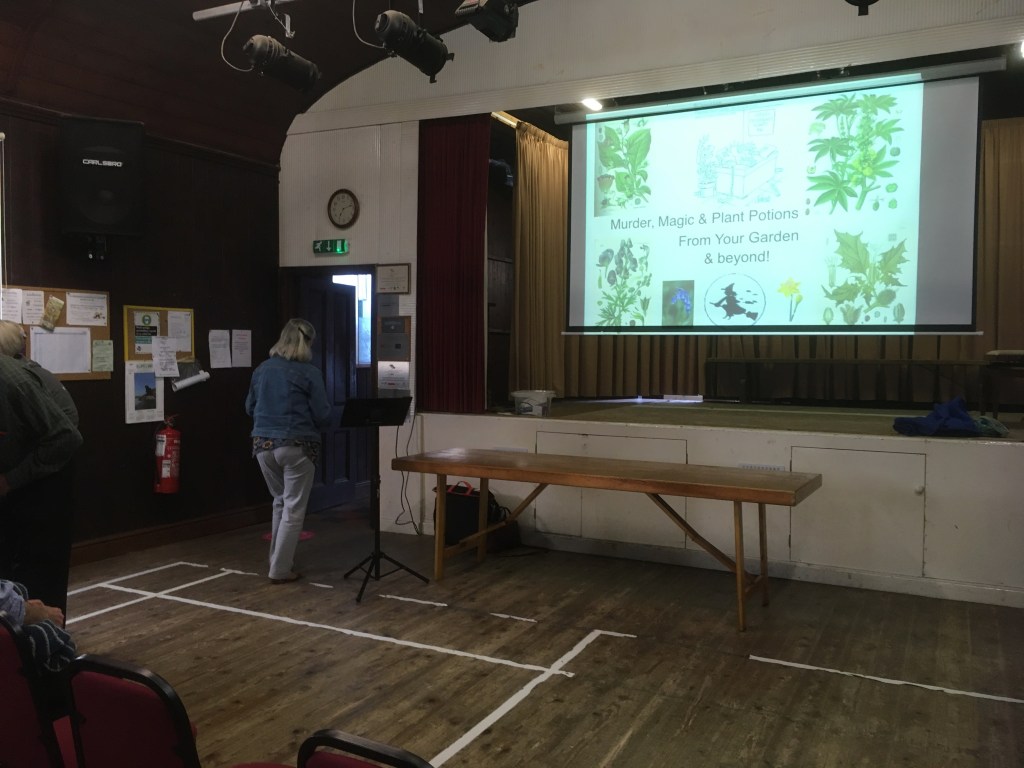
Marion opened by telling us that her talk would be about ornamental and native plants – their history, their less well-known aspects and their ability to both heal and harm. The definition of ‘poisonous’ can range from a nettle sting to causing death. The talk would cover just some of the plants that can be described as poisonous, highlighting those that can be both good and bad.
A good example is the yew tree. All parts of the tree are poisonous, apart from the red flesh of the berries. Symptoms of poisoning can range from stomach upset to heart failure. There are records of yew clippings being thrown into a field where sheep then died after eating them. Traditionally, yew trees have been grown in churchyards and in that environment there are many ancient specimens – in Perthshire there is a tree recorded as being between two and three thousand years old. It was believed that yew trees became poisonous by feeding on the dead bodies buried in the ground in the churchyards, and for that reason they also became associated with witches (another theme in this talk). On the positive side, yew has more recently become known as the source of the anti-cancer chemical taxane, which has had many benefits.
A number of gardens were sources of information for this talk – the Chelsea Physic Garden, the Alnwick Garden Poison Garden and the Welsh National Botanic Garden. The latter contains the Apothecary Hall, a recreation of an apothecary’s shop as it would have been in 1919. Many herbal plants include ‘officinalis’ in their Latin name, indicating that they were used for medicinal purposes, primarily at home. If these domestic remedies failed, people would turn to the apothecary., who would have turned plants into powders, pills and tinctures – the raw materials would be contained in labelled drawers. An example photograph from the Apothecary Hall showed us a drawer labelled with various plants we would consider poisonous, including Aconite. The latter ingredient was included in a prescription (which can be seen there) dated 23 June 1918 – but we don’t know what was wrong with the patient, nor whether they recovered!
Plants are, of course, still used in medicine; now, much more rigorous testing and isolation of the active ingredient is carried out. This ingredient is then made up or synthesised (created artificially). The World Health Organisation estimates that 80% of the world’s population rely on plant-based remedies, while 40% of the industrialised countries use medicines based on plant extracts, and 33% of new medicines developed in the last 25 years have been made from or are synthesised versions of plants. For example, the anti-malarial ingredient artemisinin was isolated in Artemisia annua (sweet wormwood) in the 1970s which was effective, but then resistance developed. However, now an American trial is using the whole plant, which contains 10 different anti-malarial properties, which is proving very effective (as it is harder for the parasite to develop resistance to 10 different components).
The poisonous ingredients found in plants fall into a number of groups:
Alkaloids: this group includes the poppy, which provides morphine.
Glycosides: this group includes foxgloves, whose active ingredient is used to treat heart problems.
Saponins: only some plants containing these are poisonous. The group includes the soapworts, but also the little corncockle, which used to be a problem in hayfields.
Essential oils (terpenes and sesquiterpenes): many of us are familiar with the great variety of essential oils available. One example is lemon balm essential oil which is now being studied for the treatment of agitation and aggression in Alzheimer’s Disease, and also for the treatment of epilepsy. Essential oils are widely available, but as they are very concentrated they can be problematic if they are not correctly diluted.
Peptides and Proteins: peptides (as found in gardenia, for example,) are widely used in skincare preparations.
Pyrethrins and Pyrethroids: deriving from plants from the Chrysanthemum family, pyrethrum is an insecticide (used against ants, for example). Care should be taken to use it in the evening to avoid damaging other insects such as bees.
There are three ways in which a person may be killed by a plant:
they may ingest it accidentally;
they may be given the plant with intent to kill them;
they may self-administer it.
There are a number of plant families which contain poisonous plants (although not all the plants in the family may be poisonous:
Solanaceae: this family contains potatoes (which is why you should cut out any parts of potatoes with green colour for the high concentration of glycoalkaloids) but also deadly nightshade; it contains Nicotiana tabacum (tobacco), as well as the lovely scented N. sylvestnis.
Apiaceae: this is the carrot family, so again it contains a vegetable that we eat as well as hemlock (Socrates was sentenced to die by drinking hemlock). Its similarity to wild carrot means great care should be exercised. Giant hogweed, in the same family, is phytotoxic, and so the juice can cause severe blistering and burns when exposed to sunlight. Dill, parsley and parsnip also have the potential to be skin irritants.
Ranunculaceae: this is the buttercup family, including Aconitum (all parts of which are extremely poisonous), Delphinium and Helleborus (which has irritant sap).
Liliaceae: cat-owners will no doubt be aware of the danger these plants pose to cats. All parts of the plant are toxic to cats, including the leaves, flowers and pollen, even in very small amounts. The autumn crocus (Colchicum autumnal) is also a toxic plant, but is used in the treatment of gout.
Papaveraceae: this is the poppy family, which is the source of the painkillers morphine and codeine with all their adverse and beneficial effects.
Euphorbiaceae: many of the spurges contain irritant sap which is phytotoxic. The castor-oil plant, Ricinus communis, is a member, giving us castor oil (used for many things including the promotion of hair growth in men, but also the deadly poison ricin). It is the coating of the bean that contains the most ricin – one bean contains enough to kill a human, and it would take four beans to kill a horse.
Amaryllidaceae: two plants in this family very familiar to us in Wales are the daffodil and the snowdrop. Both plants contain galantamine, which is used in the treatment of Alzheimer’s Disease in its early stages. Indeed, daffodils are grown commercially for this purpose, including near Talgarth in the Brecon Beacons. Bluebells are another member of this family, everywhere in the hedgerows and woods at this time of year, with a medical history going back to the thirteenth century for the treatment of leprosy. Bluebells are now being investigated as a possible control for mycobacterial infections, including tuberculosis. It is known that badgers eat bluebells, so is it possible that they are self-medicating for tuberculosis? Bluebell bulbs have been shown to contain at least 15 different compounds, some of which are similar to those used in the treatment of HIV and cancer, and others have diuretic and astringent properties. On a more mundane note, the juice from bluebell bulbs was traditionally used in place of starch.
Plantaginaceae: an important plant in this family is the foxglove, which contains digitoxin and digitalin. These are compounds which have a low therapeutic index (where there is only a narrow margin between the amount needed to be medically effective and the amount that would do harm). Despite being so well-known to us today, its use to treat heart disease is relatively recent. In 1598, Gerard in his Herbal declared that the foxglove had no place in medicine; although it would have been used by wise women to treat throat problems based on the doctrine of signatures. It was also later used as a diuretic to treat dropsy (which in retrospect makes sense as fluid build-up can be caused by congestive heart failure).
Marion went on to discuss some of the plants, whether native or introduced, which might serve as starter plants in a witch’s garden. The first four have been referenced in the context of the ‘witches’ flying brew’, supposedly used by witches before mounting their broomsticks!
The first is Aconitum, or wolfsbane. It has the reputation of being one of the most poisonous plants in the garden (although it is also a wild plant). It can be absorbed even through broken skin. It can give rise to severe stomach problems and slow the heart, sometimes fatally. Gloves should always be worn when handling the plant. It was used in warfare to poison arrow tips and to poison the water supplies of besieged castles; it was also used to administer the death penalty in some Greek cities.
Another ingredient in this brew was Atropa belladonna, or deadly nightshade, named after Atropos who in Greek mythology wields the scissors of death. Poisonous as it is, atropine is also an antidote to the nerve agent sarin, and was issued as such to US troops in the Iraq war. The ‘belladonna’ in the name comes from the Italian for ‘beautiful woman’ and refers to its use in dilating pupils to make eyes appear more attractive; atropine is still in use in optometry for specific purposes.
A second member of the nightshade family is henbane, Hyoscyamus niger, containing hyoscine causing hallucinations, as well as vision problems, forgetfulness, weakness and sleepiness. Along with the mandrake root, again of the same family and containing hyoscine, it also makes up part of the flying brew.
Datura, thornapple or jimsonweed, is another plant with a low therapeutic index. The plant has been used as an anaesthetic and asthma treatment, as well as a hallucinogenic. It is worth noting that Brugmansia, often grown in gardens, has the same properties.
Amongst other plants is Sambucus nigra , the elder. In addition to being used to create elderflower cordial and elderberry wine, both flowers and berries have anti-bacterial and anti-viral properties. However, the roots and some parts are very poisonous, so care is needed. Elder trees were often planted in graveyards, and were believed to be protective if planted by a house. In Ireland witches traditionally rode eldersticks rather than broomsticks; the most powerful wand in the Harry Potter books was the Elder Wand.
The box, or Buxus sempervirens, is a native plant commonly used for edging in gardens, but it also contains buxine and is poisonous to us (it can cause a skin rash) and animals. Boxwood extract may boost the immune system, and it was once used in place of quinine to reduce a fever.
Marion was keen to stress that the purpose of her talk had not been to make us concerned, but to bring out the hidden elements behind the history of many plants which she hoped would add to our enjoyment of plants. Members of the audience shared their experiences of contact with some of the plants she had mentioned, and the meeting closed with a big thank you to Marion for a fascinating and enjoyable talk.
Members Only – Mad Hatters Tea Party
Cothi Gardeners’ Club members are invited to a Mad Hatters Tea Party (hats obligatory, the madder the better!) on 14 June at Fiona and Julian’s wonderful garden in Rhydcymerau, when the wild flower meadow should be at its best. If you are a member, and haven’t already let Elena know that you would like to be there, please get in touch with her directly, or email Cothi Gardeners and I will forward your query on. Julian has very kindly prepared a couple of videos to introduce the garden to new members of the club and remind existing members of its delights.
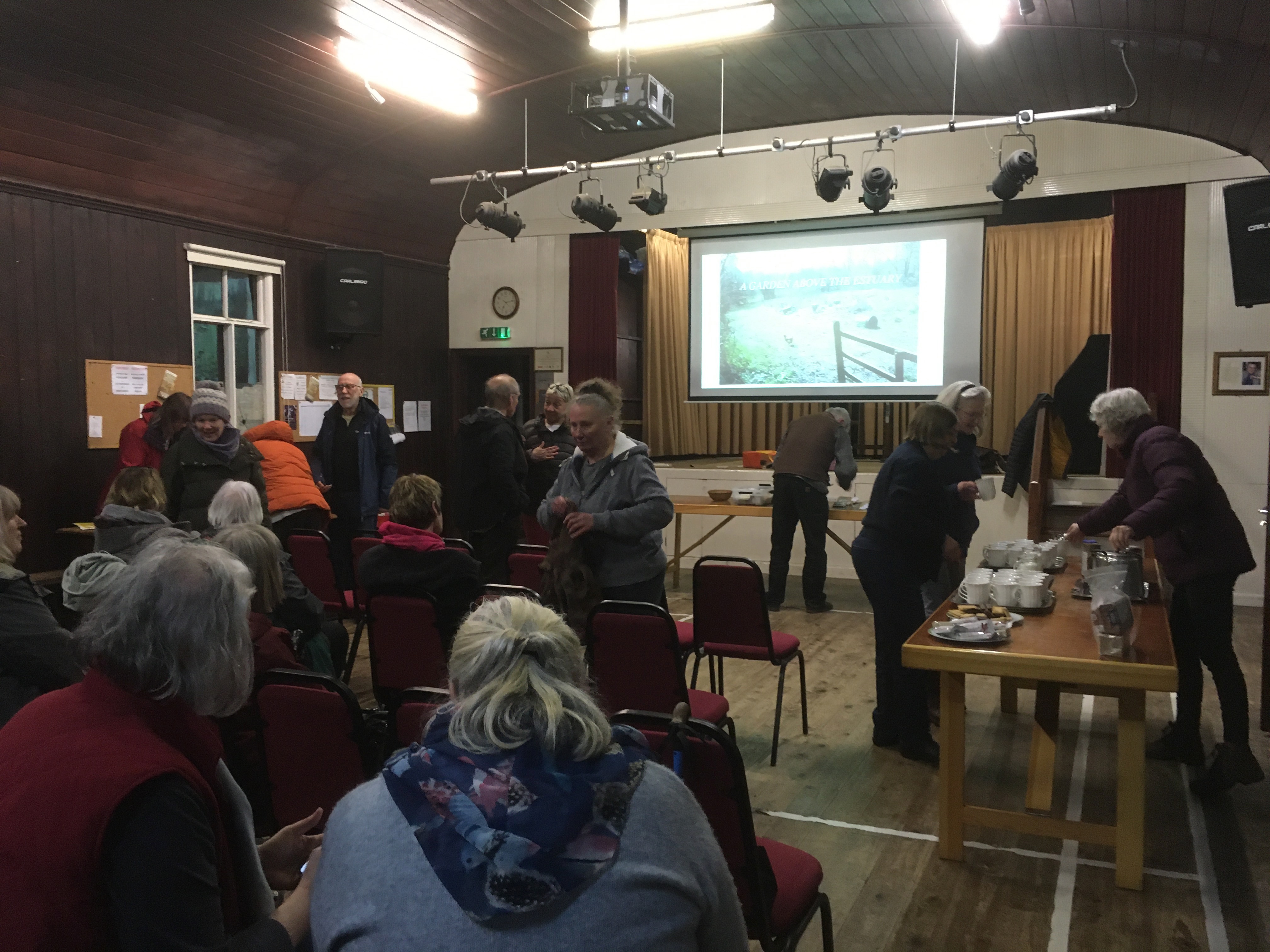
The 2023 year of talks opened with this fascinating and entertaining talk on the creation of Adam’s current garden which combined practical tips with stories of adventures tracking down vegetable seed and its links with food identity and culture, and the history of many vegetable seeds and their names. Adam’s particular interest is the conservation of the genetic diversity of edible crops.
As background, Adam told us that he has grown something every year for the table from a very young age. Despite having trained as a film-maker, Adam became a market gardener in the mid-late seventies; then that was what Adam describes as a “mug’s game”, as there was little interest in unusual vegetables such as purple-podded peas or yellow courgettes, and he returned to the film industry. That was a job that enabled him to travel widely and led directly to Adam’s interest in acquiring and protecting vegetable seeds with a history and cultural connection.
That is where this story begins – in Donetsk in 1988, where Adam had travelled as producer of a film about a Welsh industrialist who founded the steel industry in Ukraine. In the hotels of the time vegetables were not in great supply on the menu, and Adam ventured to the local market with an interpreter. There he encountered an old lady selling the surplus of vegetables she had grown, from seed she had saved herself, from seed saved previously by her mother and her grandmother. Adam bought some peppers and took them back to the hotel kitchen and was blown away by the sweetness, fruitiness and hint of heat. During his stay Adam returned to the market several times to buy more peppers (which are a very important part of the culture in parts of the former Soviet Union and eastern and central Europe, and central to the food identity of the peoples there). The taste of the pepper was unique and he wondered about saving seed to take home to propagate for conservation purposes; seed was duly dried on the window sill of the hotel and has successfully been propagated and conserved, so that it can now be distributed to displaced Ukrainians to reconnect them with their home.
Fast forward to 2013. By now, Adam was growing over 500 varieties of vegetable for the various seed libraries and gene banks. He grows at least 70 varieties each year to renew each of the seeds that he has. This takes a lot of space, which Adam found in different gardens, but he really needed to have everything in one place. So in 2013 he moved from the Forest of Dean to Monmouthshire, to a property outside Chepstow 170m above the Severn Estuary.
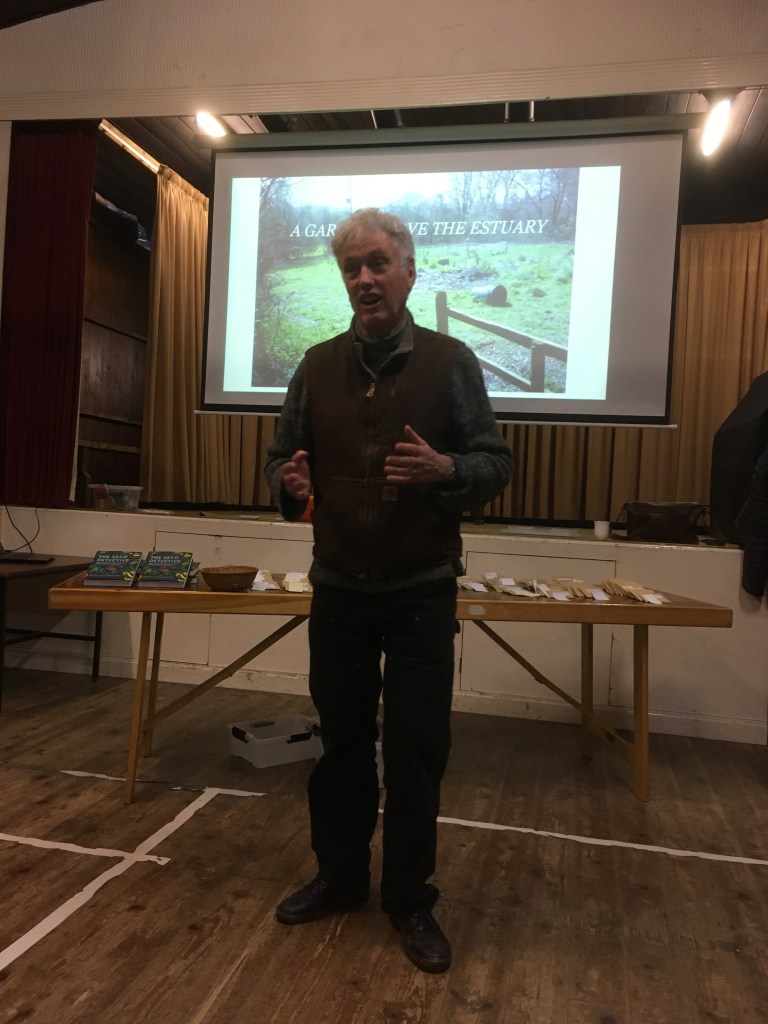
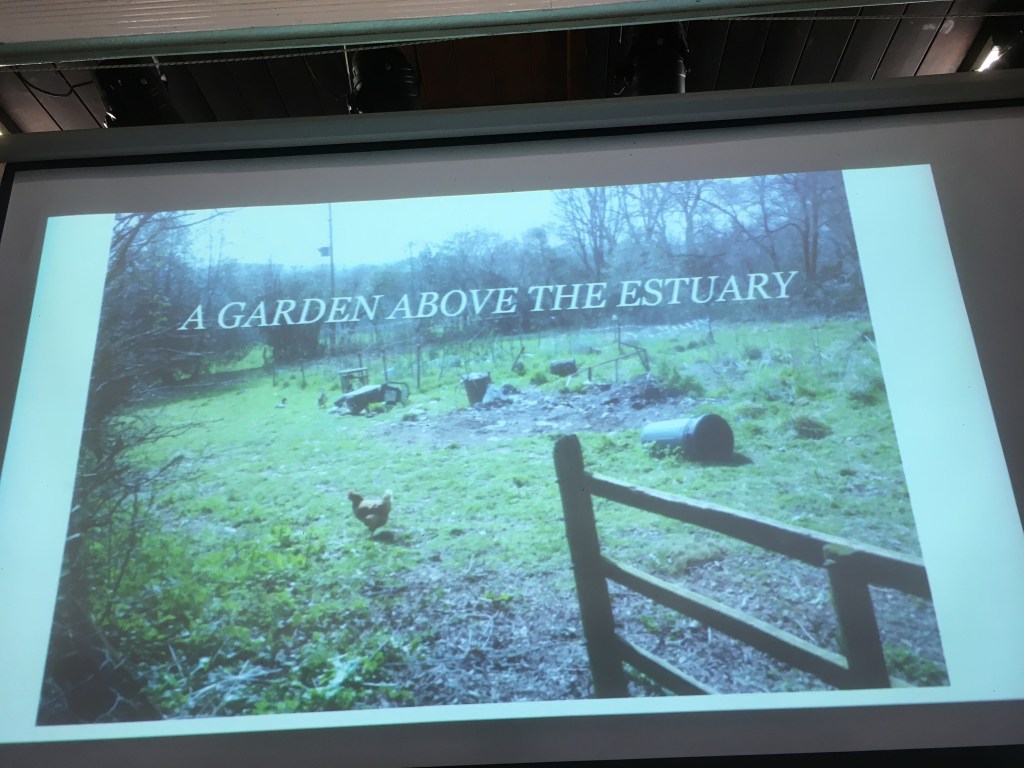
With the property came a field to transform into his garden; it was effectively an unrestored wild flower meadow, in which the previous owners had kept chicken and had a lot of bonfires (as the opening slide of the presentation illustrates).
In the spring of 2014, having covered parts of the ground with anything he could find (polythene, corrugated iron sheets etc.) for weed suppression, he planted potatoes (excellent for cleaning the ground) through black plastic. Then some raised beds were built in terraces to maximise the light in an East-West orientation. Adam had always used cedar for his raised beds, as it was readily available from plantations in the Forest of Dean. If you turn the cedar boards in your raised beds around every couple of years, they can last for up to 20 years.
Within 2 or 3 months, Adam had created the framework and the shape for the garden that he needed. There were 14 raised beds, each one-metre wide, which means you never have to walk on them. You can extend the season by using clear polythene film with metal hoops. As the beds are all the same length, these cloches can be re-used, and typically last five years. He also uses and re-uses fleece in the same way for warmth and to keep pests out.
While some digging was required to create the framework of the garden, the basic philosophy is to keep digging to a minimum and use black mulch (polythene or membrane) to grow through; it warms the soil and gives off heat at night creating a micro-climate for the plants. The aim is also to recycle and re-use materials as much as possible.
The contents of a 40-foot duck pond provided the base, spread on the ground and covered with black polythene, for two 30-foot polytunnels, the first of which was erected in October 2014. The polytunnels had been with Adam since 1976 and have moved with him to all of his different gardens ever since. In his raised beds within them, now in March, he has peas and broad beans in flower, fennel for eating, herbs, salad crops right through the winter and cauliflowers beginning to heart up. A trickle irrigation system is essential – he is lucky to have his own spring water (with a pH of 6.9) for this, one of the original attractions of this site.
One of the crops that Adam plants in his polytunnels is garlic – but not any old garlic! One of his filming assignments took him to Oman, home to damask roses and famed for its rose water. In Oman terraces tumble 100 metres down into ravines with the most amazing irrigation system. Adam saw garlic being cultivated, and got into conversation with the owner of the hotel where he was staying. It turned out that the plantation of garlic that Adam had seen belonged to the hotel owner; this was in April, and Adam asked him to send some garlic when it was ready, not really expecting that this would be possible. In June, having been away, Adam walked into his house to find a strong smell and a large plastic sweet jar covered in stamps and with the appropriate immigration certificate. In South Wales, Adam plants this garlic in a polytunnel in October through black polythene. The mountains of Oman in the winter experience a dry cold. This is replicated in the polytunnel where, even if the air temperature drops, the soil temperature is maintained. The garlic in the polytunnel can be harvested in the green in May, and then after that for storing in June/July. It is a hardneck variety, and doesn’t keep terribly well beyond October.
Adam also wanted polytunnels for broad beans; he grows three crops in a year in sequence, from autumn through to April, so that they do not cross-pollinate. A delicious broad bean is ‘Bowland Beauty’, which was originally bred for exhibition.
It has to be said that timing is key in terms of getting crops into the ground. Since 1976 Adam has kept a diary of what he sows when, the temperature, conditions etc. This is giving very direct information about climate change. Saving seed helps to build in local adaptations, which means that plants from very different environments from our own will in time thrive here. Carrot ‘Red Elephant’ from Australia is a good case in point. Adam has grown it outside in beds for a number of years. He discovered by chance, from seed spilt in the bed while collecting, that it can grow with absolute neglect when sown in October outside for early harvesting – there is no need for special forcing varieties.
None of Adam’s growing would be possible without compost. He uses all sorts of old materials to make the compost bins, including pallets and old carpet (this has to be pure wool). A lot of grass is used in the compost, which has the benefit of generating heat, but it does have to be turned regularly (once a week).
The last thing that Adam installed on his new site was a greenhouse, which he uses for tomatoes, capsicum, cucumbers, lemongrass, okra, ginger etc. A propagator is also key for starting seed off in early spring. There is only one cucumber which he now grows, for its taste, which comes from Syria. He encountered it in Aleppo, in what was known as the ‘fertile crescent’, and he now grows out a number of vegetables from the seed bank there for seed. The cucumber is unusual in that it has both male and female flowers. Seed is now being distributed to displaced Syrians, including those in camps in Jordan; later this year they will be sent to camps in Kurdistan.
Polytunnels or greenhouses allow you to create controlled environments for the production of seed; you can water when necessary during the growing period, and keep the crops dry when seed is setting.
One of the things that Adam has discovered on his travels is that growers like to mix things up together, and that plants don’t mind being crowded; polytunnels or a greenhouse allow him to do both of these things. Sweetcorn is an example: he has had good success growing 9 or 10 plants in a small block a foot apart, producing very good crops. Sweetcorn is a wind-pollinated crop, and growing them in a polytunnel gives good control (rather than the wind blowing the pollen far and wide, tapping the plants means the pollen falls where it needs to).
Moving on to the seed that Adam grows, here is a whirlwind tour through just a few of them:
Fava bean ‘Syrian Small’ – first seen in Damascus, being wheeled through the streets in barrows piled high. They are traditionally eaten whole when young, but can also be eaten shelled. The seed is now primarily being distributed to displaced Syrians.
Radish ‘Pasque’, is a French radish, which is lifted in the autumn, stored in clamps, and then eaten at Easter. It is an interesting plant in that the flowers start white, but then turn pink once they have been pollinated.
Fava Mourda Reina Mouz (‘Purple Queen’) is a purple broad bean from Catalonia (another very interesting area for endangered vegetable varieties), which Adam is growing out to make safe for the future.
Blue potatoes from Atacama in Chile – they have a shape like Pink Fir Apple, but are deep blue right through; they are now being included in an official breeding programme to establish their blight-resistance.
Pea ‘Champion of England’ is the only pea still in cultivation of the 13 listed as having any merit out of the 200 catalogued by the RHS at the end of the nineteenth century. Although held in seed libraries, it returned to commercial seed catalogues in 2016, originating in the US. Adam still held some seed from 2009, so that seed is now being grown for comparison to see whether the newly-listed variety is the true original variety.
Pea ‘Daniel O’Rourke’ was one of the most successful varieties of pea in the United States until the 1920s. Its name derives from the 1852 Derby winner, when it was introduced to the UK the following year, as a marketing strategy to encourage growers in the UK to buy it.
Pea ‘Fesol Negre del Belgarda’ is a purple-flowered, black pea from Catalonia grown for drying and storing.
Pea ‘Panther’ is a pea that the Heritage Seed Library was told grew to about two foot in height – but in fact grows to three times that!
Pea ‘Jaune de Madras’ is one of the peas used by Mendel in his work on genetics. It is a mange-tout pea, its name implies it had originated in India. However, it was being introduced to the UK at the time that yellow Madras curry, which was a British invention, was very popular, so the name was purely a marketing strategy. In the US, it was called ‘Golden Sweet’, and it is now sold here as that as well.
Blue Hopi Maize hails from very arid regions of Arizona, where three inches of rain falls in a year if they are lucky. There it is sown in very deep holes to reach the damp where it can germinate. It is sown in clumps, and the drooping leaves create shade and a particular micro-climate which enables them to grow in such a harsh climate. There is a particular culture around blue maize within the Hopi nation where it used to make blue polenta, and the ability to grow blue maize is key to winning the heart of the woman a man wants to marry.
Tomatoes – Adam grows many different tomatoes from all over the world – including ‘Burmese Sour Tomato’ from Yangon (which is recently in demand thanks to ‘Gardener’s World’), and ‘Bolivian Orange Cherry.’
Adam stressed the importance of using green manures over winter. A very important one is Caliente Mustard – its biofumigant properties attack pathogens such as onion white rot in the soil. He also grows comfrey as a feed for plants, particularly tomatoes.
Autumn in Adam’s garden is all about harvesting. Beetroot is a great crop, as you don’t need many plants to produce masses of seeds (33,000 seeds from a single plant!). Cucumbers are much tricker – the cucumbers have to be almost rotten, and even then there is no guarantee the seed will be viable.
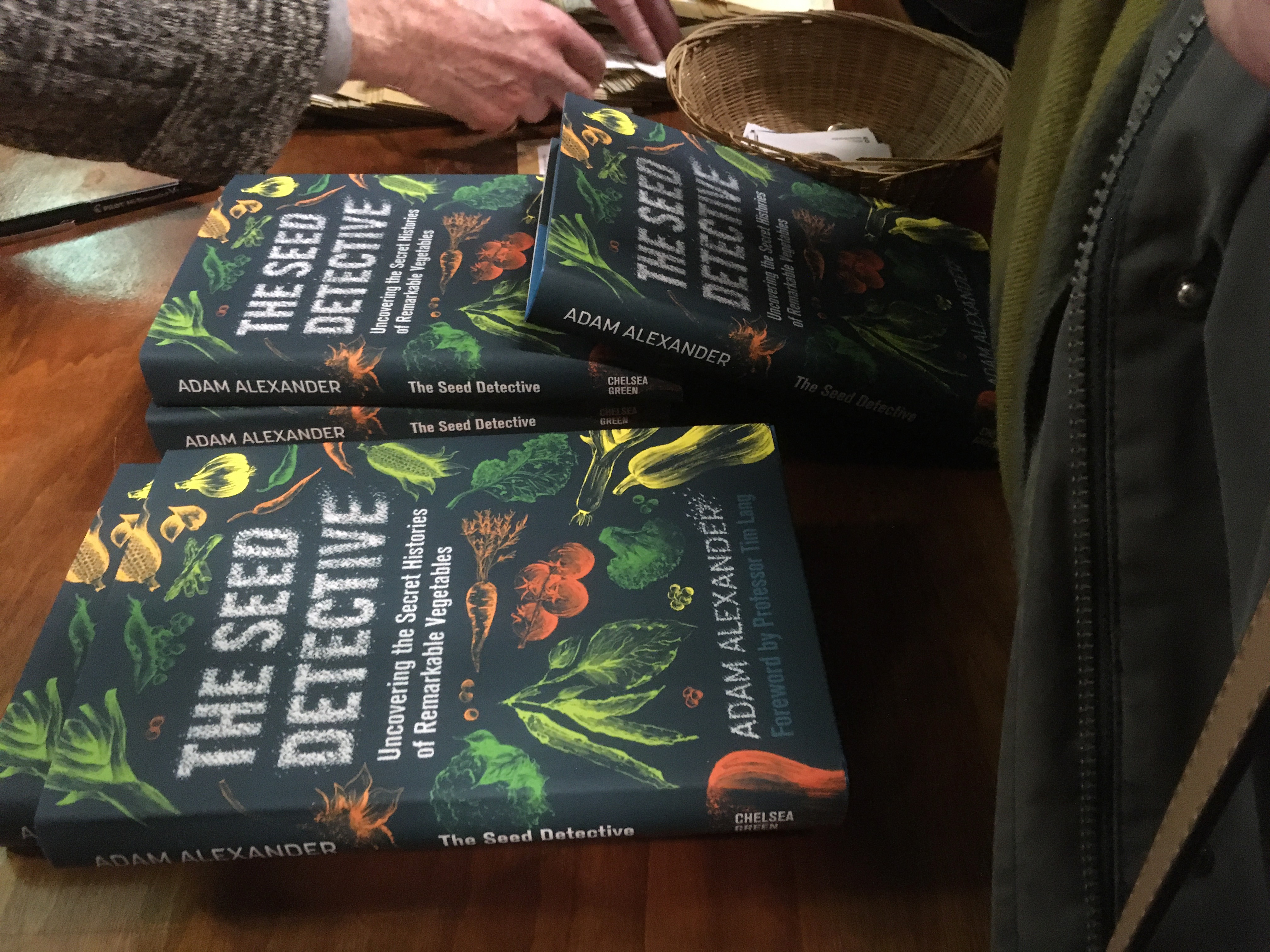
On that note of seed harvesting, Adam’s talk came to a close. Appreciative thanks were expressed for such a wide-ranging, erudite, and engrossing talk, and there was then a rush for the table where different seed varieties were laid out, along with Adam’s book ‘The Seed Detective’.
Pottiputki
At our last meeting Julian introduced us to the Finnish tree-planting tool, the Pottiputki. Although originally designed for forestry planting, Julian has discovered it is invaluable for transplanting snowdrop divisions. He has created this video to show how the tool can be used and to demonstrate the process of dividing snowdrops in the green. Thank you Julian!
Updated Cothi Gardeners Website
The Cothi Gardeners websitehas recently undergone a bit of an update, and now includes a new section for members to write about their garden as it changes through the year – highlight ‘Members’ Gardens through the Year’ from the main menu at the top of the page. The more members who would like to contribute pieces about their gardens the better! Please contact cothigardeners@gmail.com with your text and photographs (or any queries you may have), and the web editor will do the rest.
During the Covid-19 lockdowns of 2020-21, the Zoom talks organised by Fiona Wormald in lieu of our in-person meetings were a beacon of light which helped to lift the gloom of the general isolation. This repeated Zoom talk at our November meeting was shown in our meeting hall so that we could all enjoy for a second time what was a fascinating talk with the added benefit of social interaction, tea and biscuits!
Timothy Walker is a highly respected British botanist who was the Director of The Oxford Botanic Garden and Harcourt Aboretum from 1988 – 2014. He is passionate about plants, particularly regarding conservation and pollination, and is the author of several books on these subjects.
The talk began with with a quote from Charles Darwin in his ‘Origin of Species’ where he identified the relationship between the flower and the bee, and how they were perfectly adapted to each other, describing “pollination biology”. One of the many ways in which this was demonstrated was with the orchid, where a visiting hawk moth was able to reach over 12 inches into the flower in order to obtain the nectar. So, it was pointed out, not only did the moth end up with food, it also helped with pollination by dusting itself with pollen as it left which was then transferred to the next orchid it visited.
Pollen grains are different on each variety of plant, and fertilisation will generally only work when pollen of one variety is transferred from the anthers (male) to the stigma (female) of another plant of the same variety. Moving the pollen from one plant to another occurs via animals, insects, wind and (rarely) water. Even slugs can be pollinators (!), but not often. Plants have different ways of attracting pollinators, such as colour and scent, (though some use both, plus pattern); some, such as a number of trees, produce catkins where the pollen is then blown away to hopefully land on another catkin. The birch tree cleverly has a flap on the flower which protects the catkin and opens on landing, thus preventing random spillage of the seed. There are plants which actually inject pollen into the atmosphere. Grasses are almost always blown on the wind with only very few, such as the Canadian Pondweed, using water as a vehicle. Around 87% of water plant pollination is done by animal life, the majority being bees and wasps.
Night-flowering plants (such as nicotiana and night-scented stock) are hard wired to attract (mostly) moths via scent. Again, a short proboscis is catered for with a short pollen tube (or it could be the other way round!). The same theory applies to butterflies.
Birds obviously help with pollination and they particularly favour red flowers, although they also see UV colours; bats help as well, although they are quite clumsy and throw stuff around a bit.
Pollen is a highly nutritious substance and the whole organisation of fertilisation runs on a reward or bribe system benefitting both parties. The fig is a clever example of pollination where the fig flower is hidden inside what is effectively a brood chamber and a female wasp enters through a hole. She lays eggs; the male wasps hatch first and fertilise the unborn female wasps, create exit tunnels for those female wasps to move on to the next fig, and then die. Thus, if humans eat the fig they also eat the poor dead male wasps – not a reward for them but probably extra protein for the human!
Victoria amazonica is a South American water lily, which attracts a beetle of the Scarabaeidae family; it crawls into the flower, eats so much pollen that it gets drunk & is then too confused to remember its way home, eventually leaving the flower only to stagger on to the next one. Hopefully the wife (or husband) doesn’t possess a rolling pin otherwise there will be trouble!
There are, however, flowers that don’t smell good at all (to humans anyway), such as Dracunculus vulgaris, which smells like rotting meat and Helicadiceros muscivorus (or Dead horse Arum, which is probably a clue). These plants are largely pollinated by flies.
This really interesting Zoom talk by Timothy was just as entertaining the second time around, very well put together and certainly educational.
John and Helen’s October Plant Swap and Sale
John and Helen Brooks held a plant sale at their garden Ty’r Maes on a Sunday afternoon in October to raise funds for the National Garden Scheme charities. It was very well attended, with visitors coming from as far away as North Pembrokeshire.
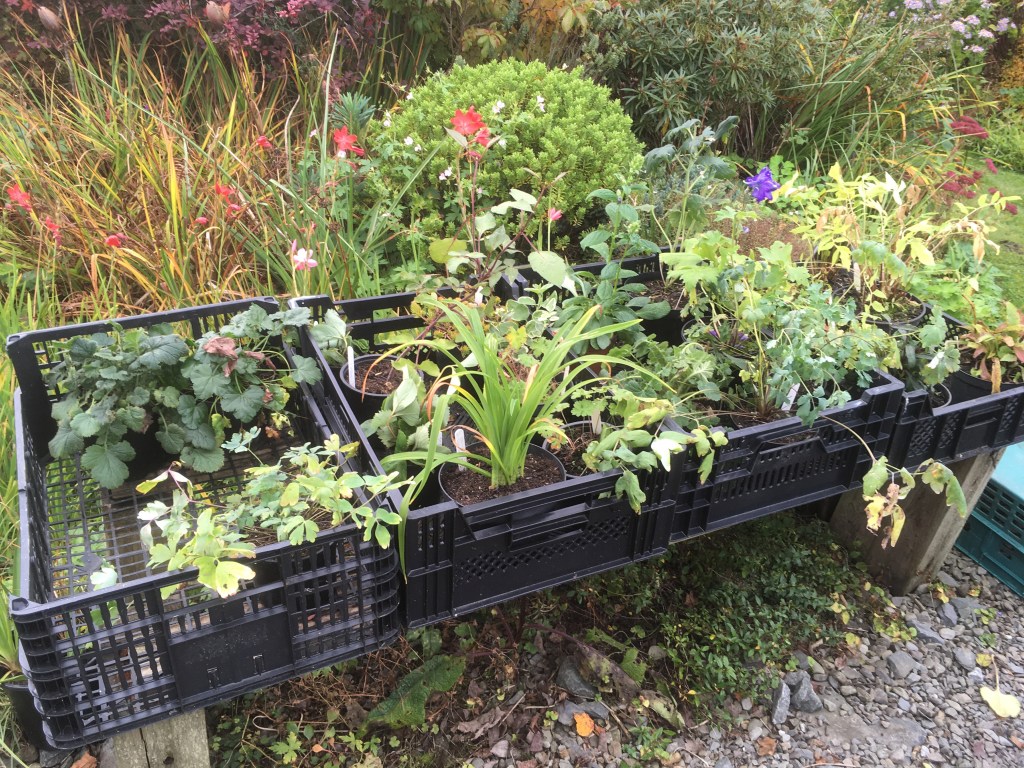
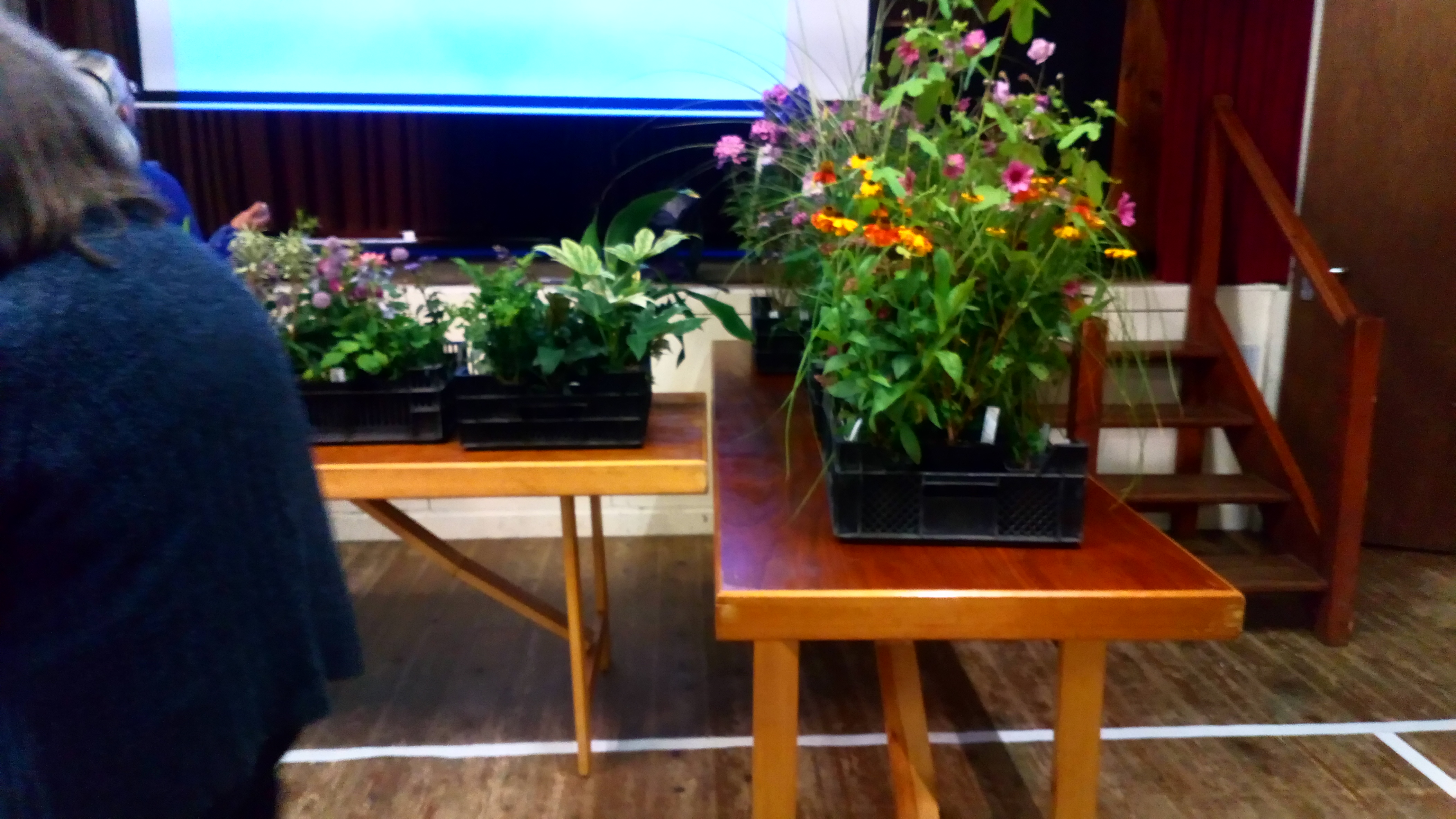
There was a great variety of plants on sale, provided by members of the Cothi Gardeners, and mostly of course by John and Helen themselves. The plants on offer ranged from trees, such as Paulownia tomentosa (the Foxglove tree) through to a great variety of perennials, including asters, geums, crocosmia, geraniums, hesperantha, persicaria, primula, rudbeckia, salvia, and many others. A great bonus of the afternoon was the enormous quantity of delicious cake provided by volunteers along with teas, and the opportunity to chat with other gardeners.
In total the amount raised for the NGS charities was a fantastic £900! This is a reflection of the tremendous generosity of the plant providers, Cothi Gardeners members and other visitors, and we should never forget the hard work that goes into organising such an event, including the refreshments.
Festive Christmas Tea on 14 December
This year the Cothi Gardeners are celebrating Christmas by holding a festive tea at Granny’s Kitchen in Lampeter at 3.30pm on 14 December. Twenty-two of us are attending, and it’s bound to be a jolly (and delicious) event, bringing to an end a year when we have finally been able to hold in-person meetings and celebratory gatherings again. Long may it continue!
We were lucky to once again hear an entertaining talk from Bob Brown, founder of the Cotswold Garden Flowers nursery. He started by encouraging us to put the right plant in the right place – something we all know but need constantly reminding of!
The initial list of headings was to outline the bullet points of his talk i.e. Acclimatised & Easy, Invasive, Garden Worthy etc. Bob went on to describe the different types of plants within the headings and started with the Welsh poppy (hurrah!) and we had conversations about the habits of the plant. He continued to describe many different types of plants which come into the native plant varieties including Achillea, seakale, viper’s bugloss, Mullein, Veronica spicata and many more.
Woodland plants were described next and include Aquilegia vulgaris, Allium sphaerocephalon, wood anemone amongst many others.
Woodland Edge plants & bulbs came next, such as the lawn daisies, hen & chicks, single Campanula, Colchicum autumnale, Pulmonaria, celandine varieties etc.
Grasses were the next category, including woodland grasses and Bob is keen on using plants needing structural support being grown within grasses, using the grasses as the support. Dogwoods, which look good with grasses, (Cornus sanguinea ‘Midwinter Fire’ in particular) are a favourite – he advises to cut them right down in winter.
Ferns of different types were next and his particular favourite, Polypodium vulgare, because it is evergreen in the winter but has died down by June and so makes way for other plants.
Iris types and the different areas in which they flourish came next and we discussed the very smelly Iris foetedissima (roast beef plant) & had a chat then about what the smell actually is like!
Primula varieties, which have been grown here since Eizabethan times, are a good bombproof plant for many areas.
Roses, particularly varieties of the small Rosa pimpinellifolia ,were discussed, and then many more of the different native plants including the shrubs Salix purpurea (purple willow) and the different varieties of Sambucus nigra (elder), both of which are fast growing and invasive.
We thanked Bob for his informative and entertaining presentation and took full advantage of the beautiful plants which he had brought for sale from the nursery.
Some of the beautiful plants from Cotswold Plants for saleBob Brown advising on the choice of plants
Invitation to Local Gardening Clubs
Drefach Felindre Gardening Club and Llechryd and District Gardening Club have each kindly invited all Cothi Gardeners to attend any of their meetings, which are listed below. We hope that their members will also choose to attend our meetings this year and beyond.
All meetings are held at 7.30 pm in the Red Dragon Hall. Guests simply pay £2 per meeting which includes refreshments.
Open eveningOctober 5th
The speaker is Stuart Akkermans, ‘Cae Hir’: A Welsh Garden with a Dutch History. Light refreshments to follow. This event is free to Cothi Gardeners Club members.
Wednesday, 2nd November 2022 ‘The Gardens at Winchester Cathedral’, Emma Sharpe
Wednesday, 30th November 2022 ‘Biodynamic Gardening’, Louise Cartwright
Wednesday 12 October at 7.30pm ‘The Treasures of Tadjikistan and Uzbekistan’ with Bob & Rannveig Wallis Bob and Rannveig Wallis were plant hunting in Central Asia before the pandemic and this illustrated talk starts on the border with Afghanistan and goes via Samarkand and Tashkent to the Chatkai Range. This is the centre of Tulip and bulbous Iris development and also features Fritillaria and Corydalis. Superb photographs and an excellent speaker. Last club plant table of 2022.
Wednesday 9 November at 7.30pm ‘Costa Rica’ with Julian Cremona Julian Cremona’s brilliant photography brings this small country’s amazing wildlife and flora to life. Dense broadleaf evergreen forest, palm trees, mangroves, mosses, orchids and tropical plants as well as monkeys, sloths, anteaters, snakes and iguanas. Annual Club Seed Swap.
Plant Swap and Sale for the NGS 9 October 2022
John and Helen of Cothi Gardeners are holding their annual plant swap and sale to raise funds for the NGS on 9 October at 1pm at Ty’r Maes,Ffarmers SA19 8JP.
There will be loads of plants for sale, a lot more than last year, when just about everything went! There will also be a table of plants that are available for a small donation. These are generally perfectly garden worthy plants that for presentational reasons are not quite up to selling standard.
People are encouraged to bring in plants to swap. Last year some wonderful plants arrived and were seized on immediately.
Tea, coffee, biscuits and cakes will be provided. If you bring extra cakes, that would be great too. There is nocharge for refreshments, but as funds are being raised for NGS charities – donations are always welcome.
A word about parking. We will be using our bottom field, opposite the turn to Ffarmers, for parking and there will be NGS signs up. The area in front of the house will be available for loading and unloading plants.
This is a brief post to let you know that our 2022 programme starts next week. We are having the first two meetings by Zoom and then will hopefully be able to have ‘in person’ meetings from March onwards – fingers crossed!
Next weeks’ meeting is on Wednesday 19th January, 7.15pm for a 7.30pm start when Carole Whittaker will be talking to us on “The History, Medicinal Qualities and care of Monarda“
These beautiful perennials from North America have been utilised since 2,500 BC by the Native American peoples for their medicinal qualities. But the history does not stop there! The talk covers all aspects of caring for these unusual, late summer perennials.
Carole and her husband, Pete, have established a beautiful garden, Glyn Bach, in Pembrokeshire which is home to their National Collection of Monarda. The garden is open through the NGS and Plant Heritage. Click here for their website.
If you would like to join the Zoom meeting and have not received the email with the invitation please contact Fiona at cothigardeners@gmail.com so she can send it through to you.
Our last Zoom meeting (at least for now) is next Wednesday, 19th May 7.15 for a 7.30pm start.
Stephen Anderton, Gardening Correspondent for The Times will be talking to us on ‘Courageous Gardening’
“A fresh approach to gardening. Stephen investigates gardeners’ techniques, ideas and inspiration, in everything, from breeding and pruning to planting and design. He shows remarkable gardens from all over the world and explains how their makers have single-mindedly planned and created exciting effects. The many unconventional ideas on offer here make this one of his most popular lectures.”
It would be great if we could have as many as possible joining us as Stephen is one of our ‘Big Name’ speakers for this our 10th Anniversary year. So if you are interested in joining us and haven’t already done so, please send an email to cothigardeners@gmail.com so we can send you the Zoom invitation.
Programme Update
We are planning on having outdoor meetings for the next 4 months, so fingers crossed that the weather improves. The following visits have now been confirmed and we will be asking for names nearer the time for anyone who wishes to join us.
Wednesday, 16th June, 2pm
Outdoor talk and demonstration of propagation techniques by Helen Warrington at Ty Cwm Nursery, (Penffordd, Llanybydder SA40 9XE).
Wednesday, 21st July
Social get together (if permitted) details to follow
Wednesday, 18th August 2pm
Outdoor visit to Wild Ginger Flower Farm ( Cwm Gwenllan, Gwynfe, nr Llangadog, SA19 9PU).
An environmentally conscious flower farm and floral design studio. Talk and tour followed by refreshments. Please let Fiona know if you wish to come no later than Tuesday 3rd August.
Outdoor visit to Vicki Weston Weston’s Salvias. Vicki gave us a talk a few years ago when she was based near Tregaron. She has now move from the to just north of Newcastle Emlyn where she is concentrating on her first love, Salvias. The visit will include a tour of her newly established display garden where she has some 70 – 80 different Salvias. She is also creating a large garden from scratch on a new and untouched site – definitely a work in progress but still plenty to see.
The cost will be £5 per person to include tea/coffee and cake.
This is a brief post to bring everyone up to date with our programme until August this year. Sadly in person indoor meetings are unlikely for the foreseeable future so we are aiming for a mix of Zoom talks and outdoor visits when the weather (hopefully) is better. The latter will be subject to change depending on when restrictions are eased to allow larger groups to meet outdoors. The Zoom talks we have had so far have proved very successful so, if anyone who hasn’t put their name down to participate would like to, please send an email to cothigardeners@gmail.com to let us know so that we can send you the invitation to join the meeting. The next one is in 2 weeks time.
WE ARE IN DESPERATE NEED OF SOMEONE TO RUN THE WEBSITE. It isn’t difficult or onerous so please do consider whether you can help out and get in touch with Elena.
Wednesday, 17th March,7.15pm for a 7.30pm start. ZOOM Meeting
‘The Answer Lies in the Soil’ – Philip Aubury
Good gardening starts here. Soil improvement, fertilisers and compost making. Philip trained at Birmingham Botanical Gardens and Pershore Horticultural College. He started his career as a nurseryman, then lecturer, followed by Parks Manager until finally, in 1987, returning full circle as Director of Birmingham Botanical Gardens. He retired in 2007.
Wednesday, 21st April 7.15 for7.30pm start ZOOM meeting Julian Wormald (from Cothigardeners!) – “Wildflowers, Meadows and Gardens – challenging ideas for more naturalistic gardens.”
This will look at various aspects of wildflower hay meadows – their biodiversity, aesthetics, creation, ecology and management; and contrast this very briefly (since this is a time reduced zoom talk) with currently trendy “pictorial” meadows. Finally, it’ll consider how we can learn from wildflower hay meadows to develop more naturalistic and diverse plant based communities in our gardens. This section mainly focuses on our grass free multicultural meadow terrace garden: how it’s developed over 20 years, is maintained and changes through the seasons.
Lots of ideas for people to think about as our gardens are springing into life.
Wednesday, 19th May 7.15 for a 7.30pm start ZOOM meeting Stephen Anderton – “Courageous Gardening” A fresh approach to gardening. Stephen investigates gardeners’ techniques, ideas and inspiration, in everything, from breeding and pruning to planting and design. He shows remarkable gardens from all over the world and explains how their makers have single-mindedly planned and created exciting effects. The many unconventional ideas on offer here make this one of his most popular lectures. Stephen is the long-standing garden writer for the Times, as well as a lecturer and author. Trained originally in Drama and then Landscape Design, he worked in historic gardens where, latterly as National Gardens Manager for English Heritage, he was responsible for several major restoration projects. Discovering Welsh Gardens was published in 2009; his official biography Christopher Lloyd, His Life at Great Dixter appeared in March 2010 and Lives of the Great Gardeners in 2018.
Wednesday, 16th June, 2pm
Outdoor talk and demonstration of propagation techniques by Helen Warrington at Ty Cwm Nursery, (Penffordd, Llanybydder SA40 9XE).
Wednesday, 21st July
Social get together (if permitted) details to follow
Wednesday, 18th August 2pm
Outdoor visit to Wild Ginger Flower Farm ( Cwm Gwenllan, Gwynfe, nr Llangadog, SA19 9PU).
An environmentally conscious flower farm and floral design studio. Talk and tour followed by refreshments. Please let Fiona know if you wish to come no later than Tuesday 3rd August.
As the Covid -19 lock down is maintained and we move into April with no clear exit strategy, I’m guessing we’re all feeling incredibly fortunate to be living in this wonderful part of the world, with our gardens to appreciate in what must be one of the best runs of dry weather we’ve had in ages. (Whisper – we could really do with some rain soon…).
In the absence of any meetings in the near future I’m very grateful for those members who’ve sent photos and information on their gardens to me or Elena recently. Having just acquired a replacement granny phone (thanks of course to Fiona for sorting this) which I need for receiving SMS messages to log in to this website (the first got trashed last Saturday when I came off my bike at speed in the forestry), I can now upload these insights below:
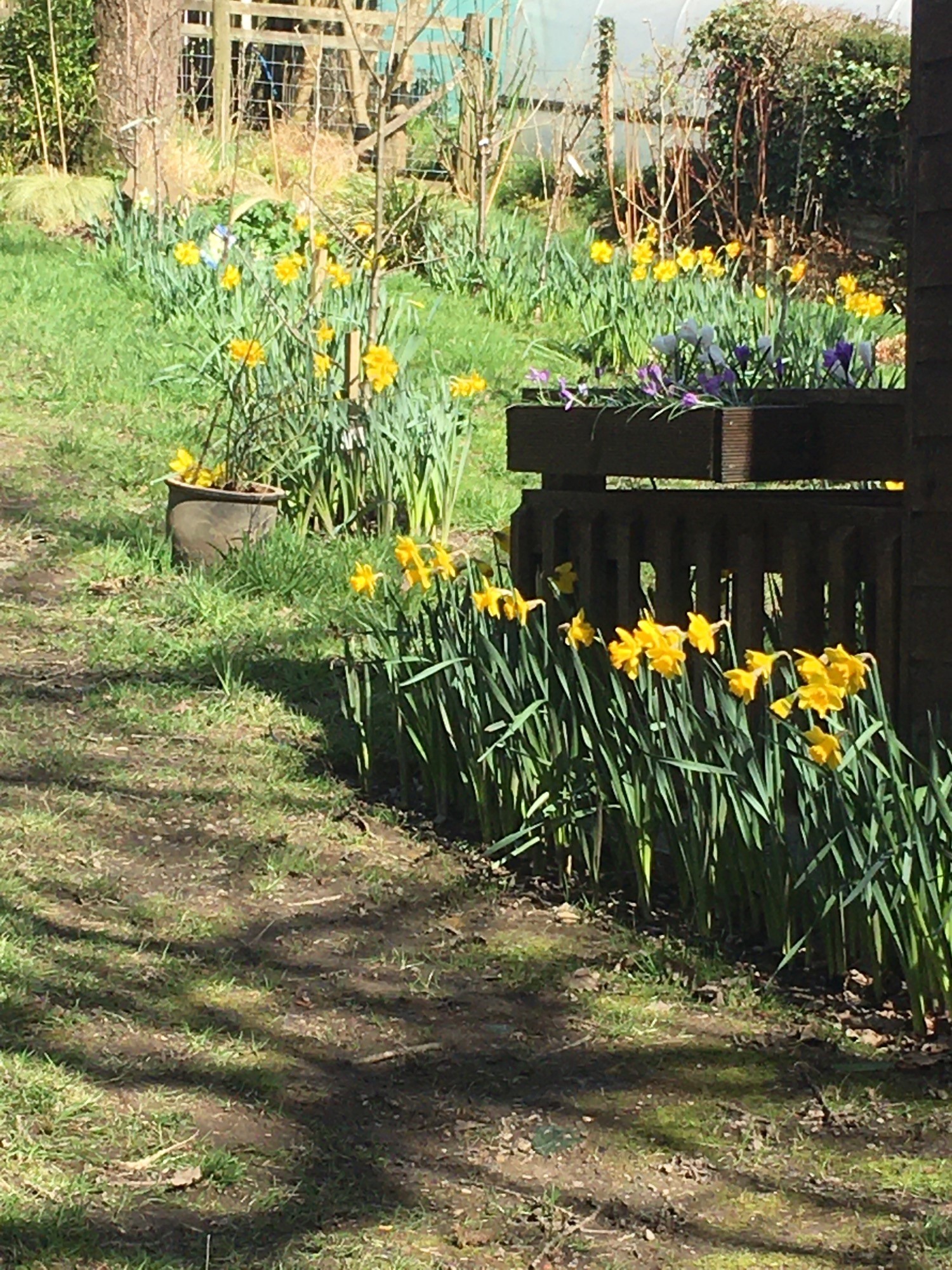
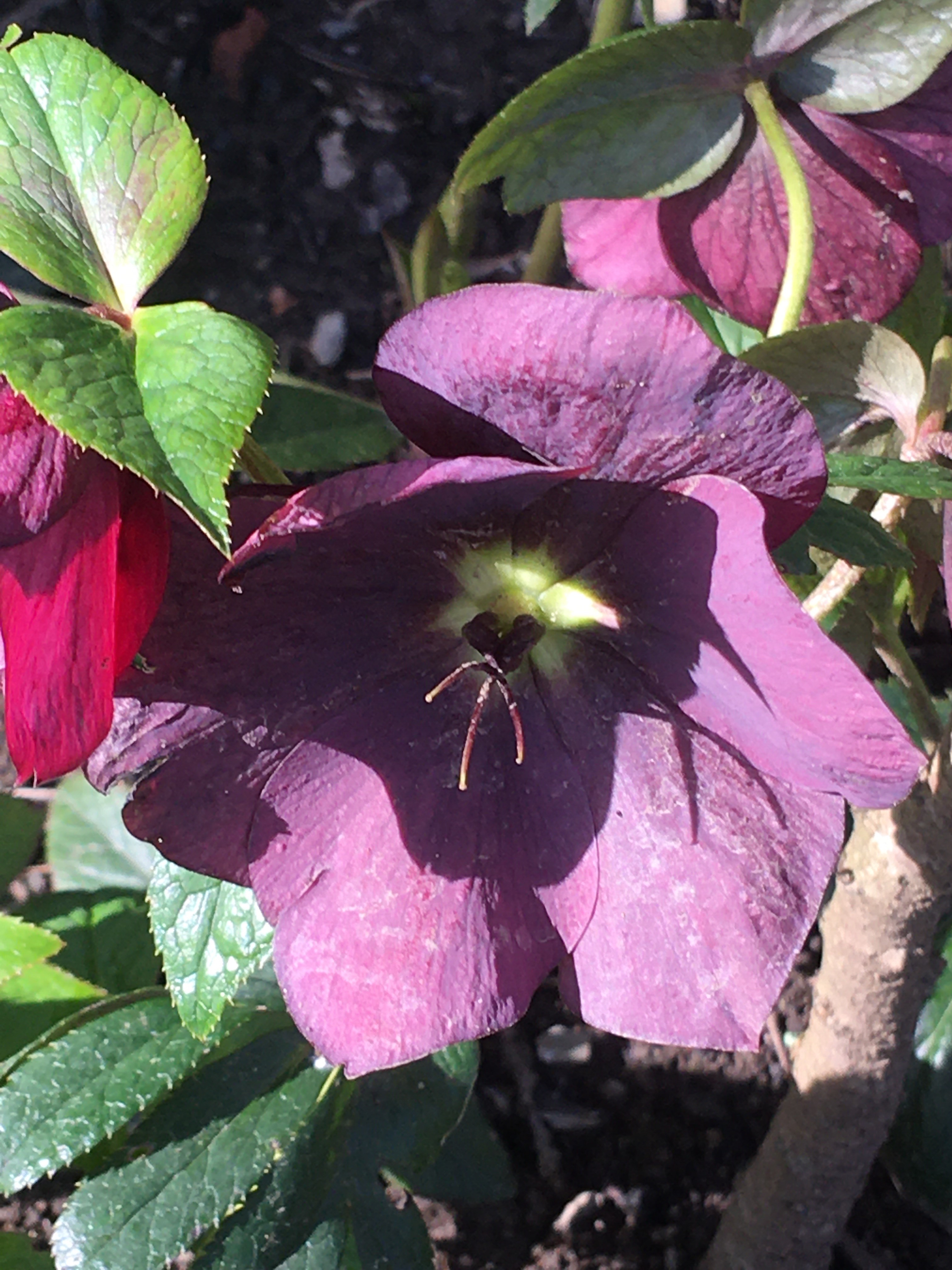
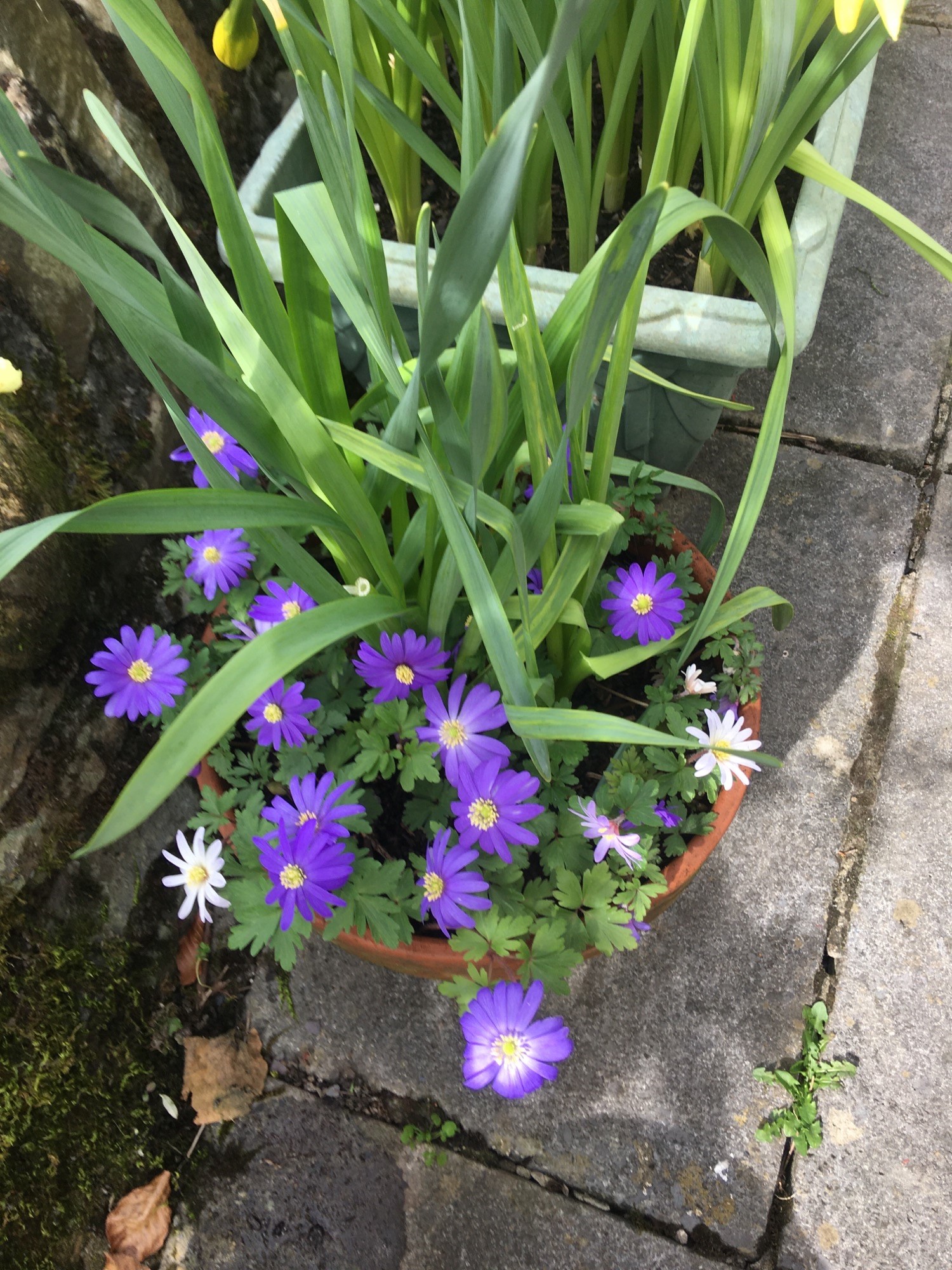
Alison Williams sent these lovely photos of spring flowers from her garden :
Anne Thomas sent me this background on what she’s been up to recently :
Well we have been creating a new raised bed in what was an untidy corner (one of many) and laying some slabs and creating a new bed in a corner that housed the oil tank until last month. Have a lot of Hellebores so have put some in the new area and a couple of Acers bought at one of the garden talks. And the good news is that online ordering still seems to be happening with plants!
New raised bed. I think I will plant some tumbling plants above stone wall (built by me when we put in the greenhouse).
Interesting daffodils ( ? Oxford gold)
I think we should feel very lucky living where we do in these difficult times. Must be awful stuck in a flat with children. We don’t need to see or speak to anyone other than the sheep!
Keep safe. I look forward to seeing other gardens. Anne Thomas
Derek Marshall sent me this:
Raised bed evolution season by season! The ground is so wet here that we needed to give some depth to the beds, hence raised beds. Originally with mole earth and compost, now supplemented with sand, grit, farmyard manure, more compost and ash from the Rayburn in combination or composition depending upon the intended planting for each bed.
The near bed has been prepared but needs to have holes burned when Tina wants to plant brassicas; the bed on the right still has Leeks; the bed on the far left is now planted with onions, and the central bed is still a bit of a hodge podge mess needing to be tidied up prior to reuse this season. The fabric is heavy duty, keeps the soil warm and moist, and in combination with the holes reduces weeds, and weeding, tremendously, and the incidence of slugs is also much reduced. I use a small kitchen blowlamp to create the holes. It has many advantages: it is more accurate, easy to use, seals the holes as they are burned so no fraying, and therefore minimises errors on an otherwise potentially expensive resource, the fabric. By this method, and secure fixing by stapling, the fabric normally lasts 3 years, so also defraying the initial cost. It is clear that Tina is the gardener in our family, but I can complement her efforts by creating structure, and I am weeder in chief, so it all helps. Aren’t we fortunate at this time to have outside space to relax in, to work in, and to grow in? Additionally I anticipate that in the near future all our efforts to grow our own food will not only be beneficial, but necessary.
I think one of the (few?) benefits of the current crisis might be getting everyone to have to slow down and think about what’s really important.
So here’s a new fable in pictures for these troubled times from our garden – the Tale of Sally the Slug and Harry the Hare….
Harry the hare spent all day racing at speed, from dawn till dusk, getting hotter and hotter, and more and more anxious.But didn’t get anywhere.And ended up exhausted and turned to rusting iron.
(Many thanks to Martin and Angela for this wonderful prop! Click here for their website for any distant readers!)
Meanwhile in the greenhouse, Sally, the slimy slug, who spent all night very slowly slithering to the very apex to graze on algae and leaves, decided as light began to tinge the Eastern sky, to take the scenic route down. So abseiled down her own strong and sticky, slimey thread. And enjoyed a wonderful view as the sun rose and warmed her slowly spiralling body as she inched towards the floor. With plenty of time to think about what she was going to do for the rest of the day, and hardly a care in the world.
( Apologies for gender inaccuracies – slugs are hermaphrodites, but it doesn’t work as well with “it”).
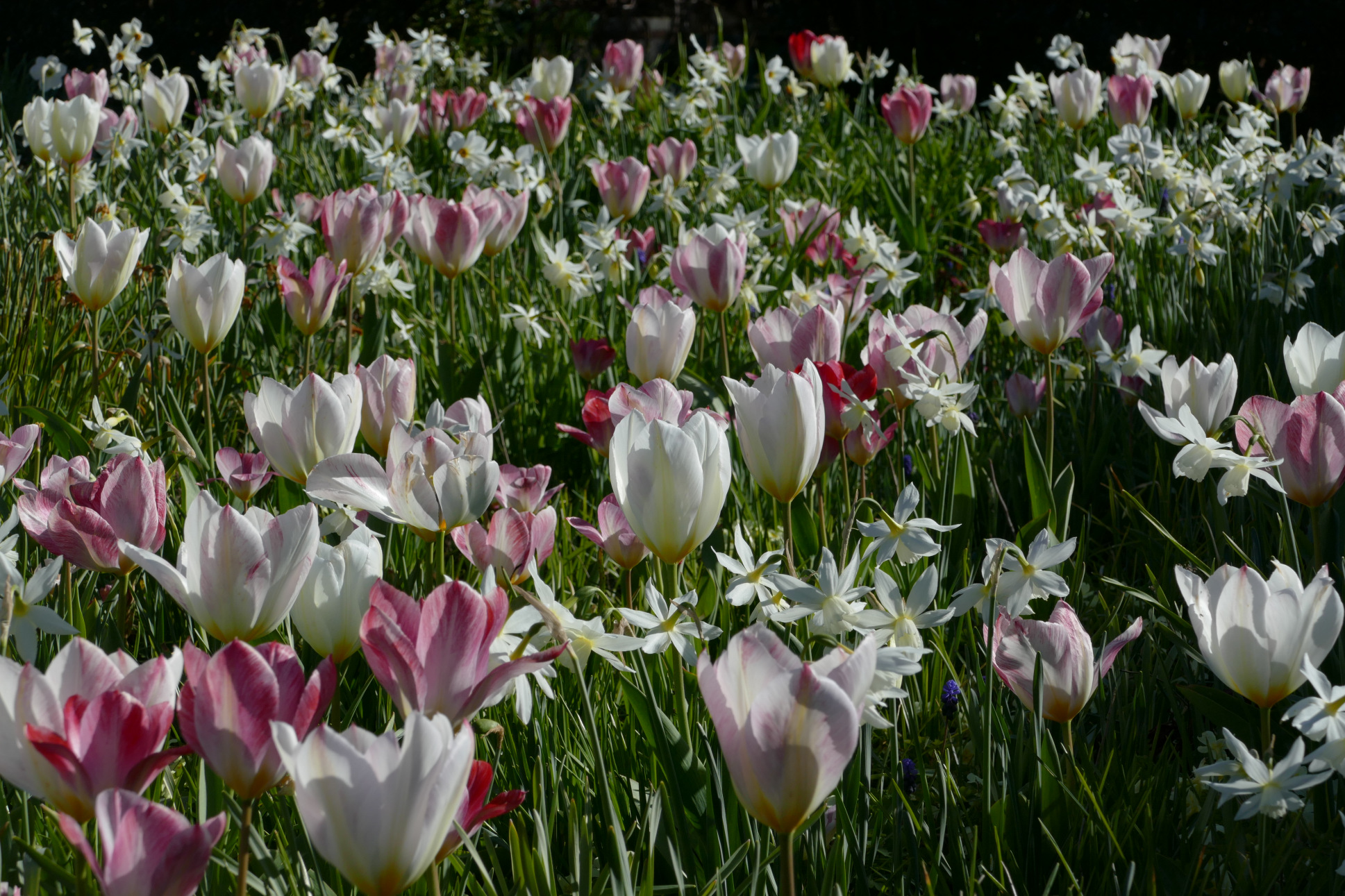
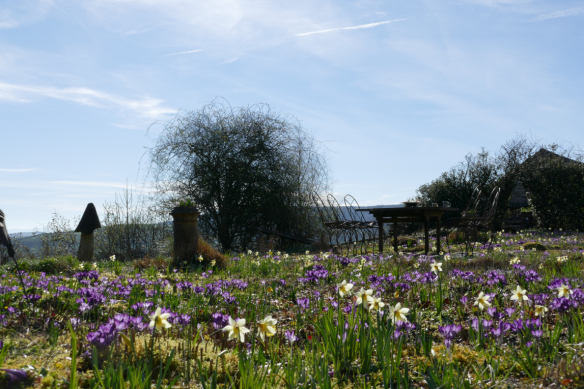
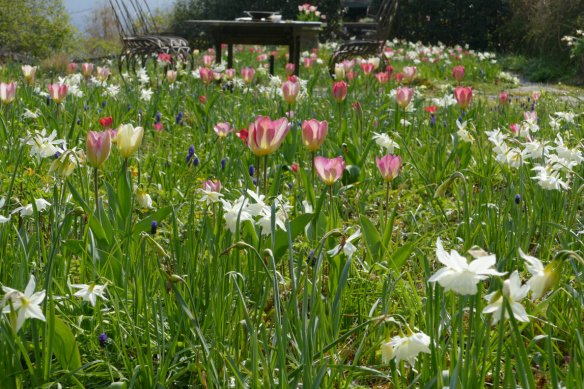
Some of our favourite spring bulbs right now which always make me forget about the hard work last autumn crow-barring them into the ground. In particular the largely white Nacissus “Thalia” and “Actaea”, and Tulip “Flaming Purissima” :
It would be lovely to hear from more members about their favourite plants, or things in their gardens as we go through the next few months. Why not write a few words and send an image or two, preferably resized down to less than 1 MB? I can’t promise to put everything up online immediately, but usually within a fortnight, and it’ll be a great way of keeping in touch, and passing on information.



















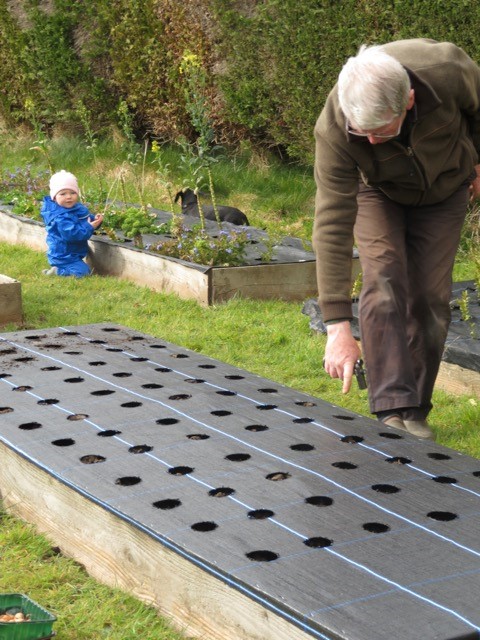 I use a small kitchen blowlamp to create the holes. It has many advantages: it is more accurate, easy to use, seals the holes as they are burned so no fraying, and therefore minimises errors on an otherwise potentially expensive resource, the fabric. By this method, and secure fixing by stapling, the fabric normally lasts 3 years, so also defraying the initial cost.
 But didn’t get anywhere.
  And ended up exhausted and turned to rusting iron.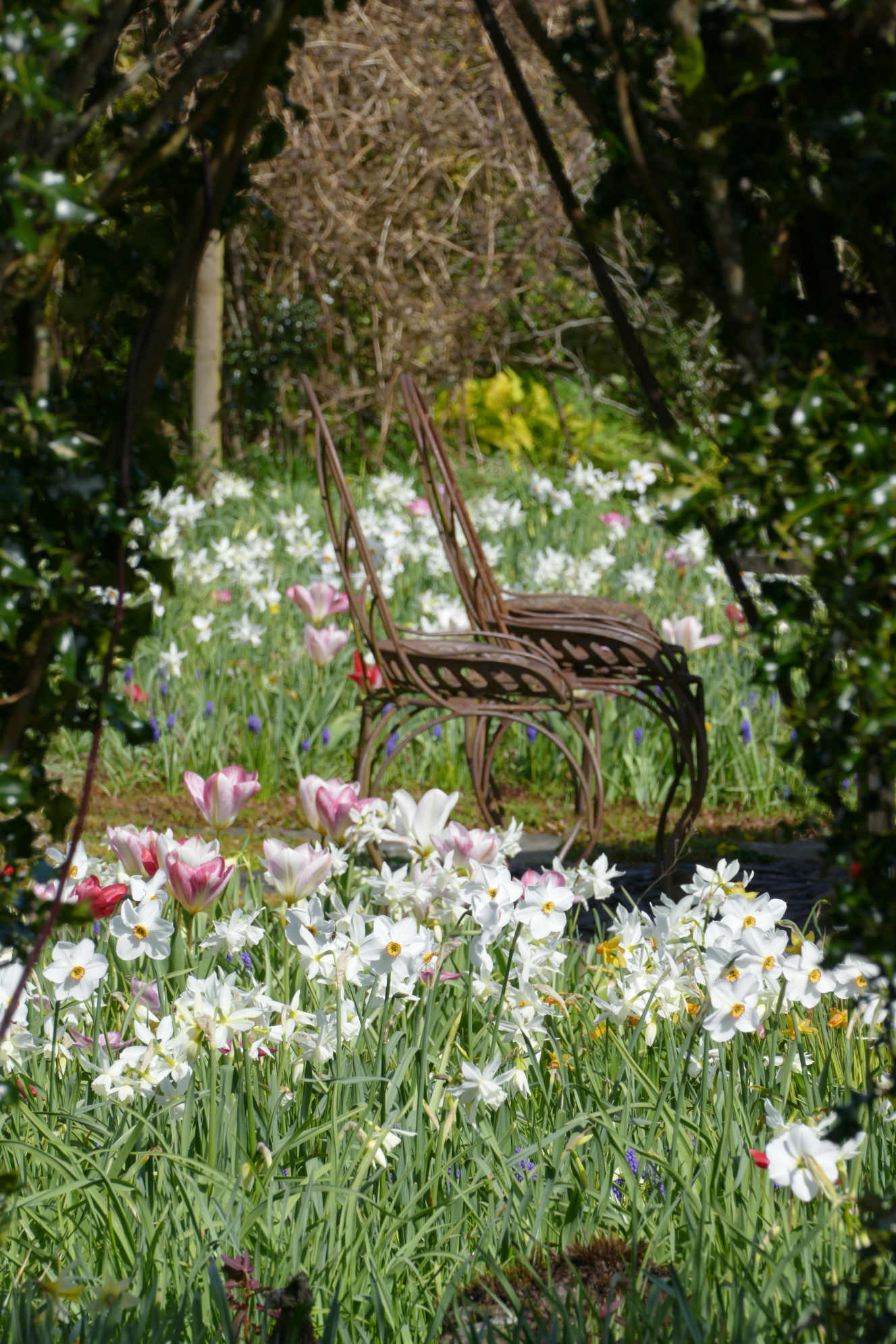

 Cothi Gardeners