Gardeners’ Question Time with Richard Brambly and Mabel of Farmyard Nurseries


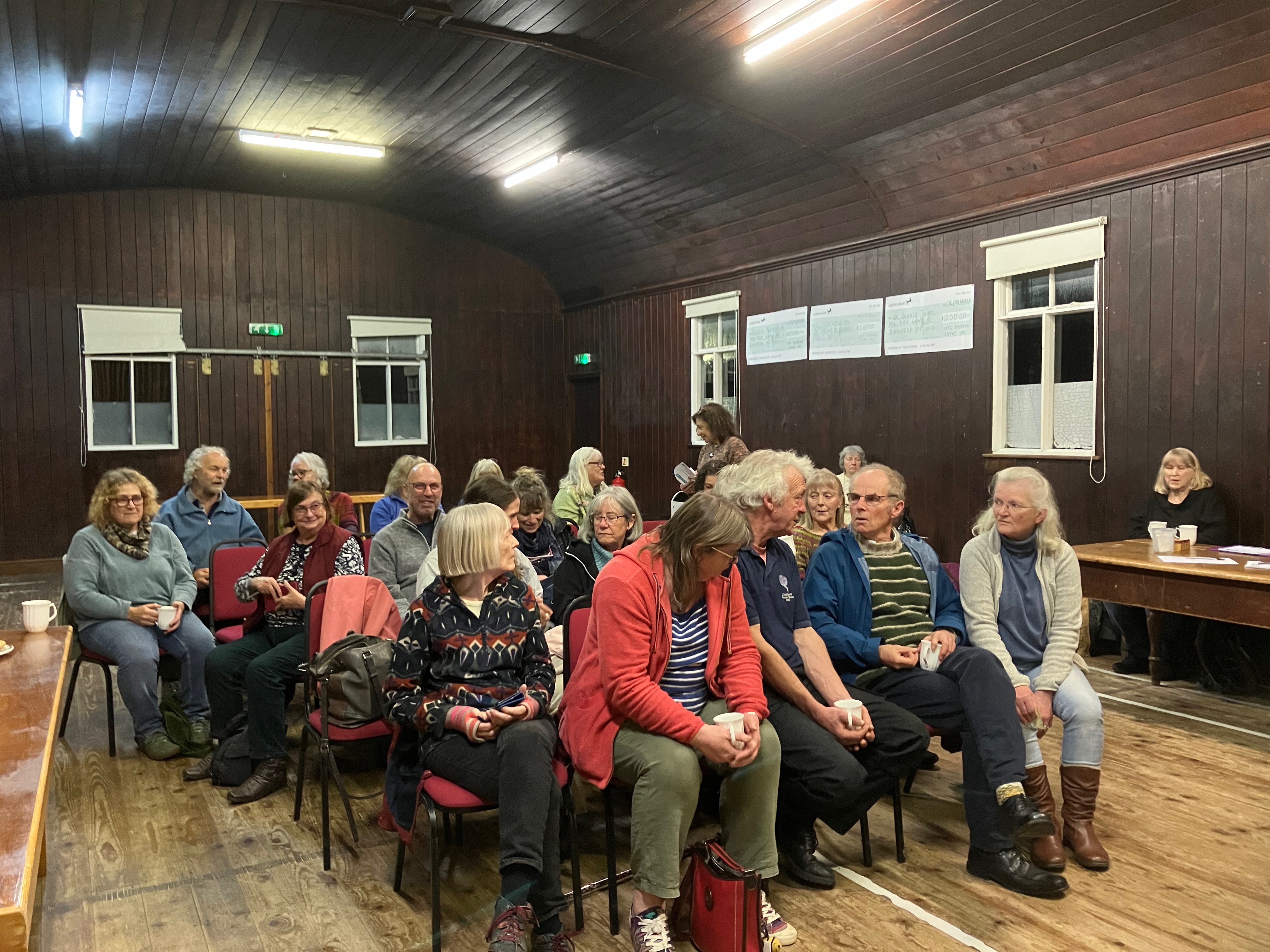
Richard was well-known to many of us from previous entertaining talks at our meetings and from visits to his fabulous nursery in Llandysul. So after words of welcome to members and visitors from Dawn, our Chair, without further ado the audience launched into their questions. 


First up was Sandy, who asked how the changing climate was affecting Farmyard Nurseries, and how his business can help gardeners in that respect. Farmyard Nurseries is moving to peat-free compost, which is challenging. So far they are using peat-reduced compost (30% peat), although one of the issues is lack of government guidance. As much as possible is recycled, and bonfires are now banned. Generally, it would appear that the trend in the UK is for milder winters and wetter summers. Having said that, we all remember the fortnight-long cold spell in December 2022 when the temperatures dipped to -15! Richard lost many plants he wasn’t expecting to lose, including daffodils, snowdrops and Spiraeas. In the end he decided he couldn’t safeguard the Sarracenias, they would have to take their chances, and of all things they survived! So they are monitoring and adapting as they go. Richard is worried about water though. The nursery’s borehole is small; they have recently expanded to four water storage tanks, but that is really a drop in the ocean of what they need.

Talking of Sarracenias, Dawn had recently heard Richard speak on ‘On Your Farm’ on Radio 4 where he had mentioned a special feed for his pitcher plants when there are not enough flies about. Richard noted that there had been fewer flies about this summer than usual. A Sarracenia needs only about 3 flies to be viable but under normal circumstances they can consume many. One thing that some people do is to drop a fish food pellet into the pitchers. Richard uses a Floranid grass fertiliser which is very mild (2 teaspoons diluted in water in a washing-up liquid bottle) and a squirt into each pitcher.

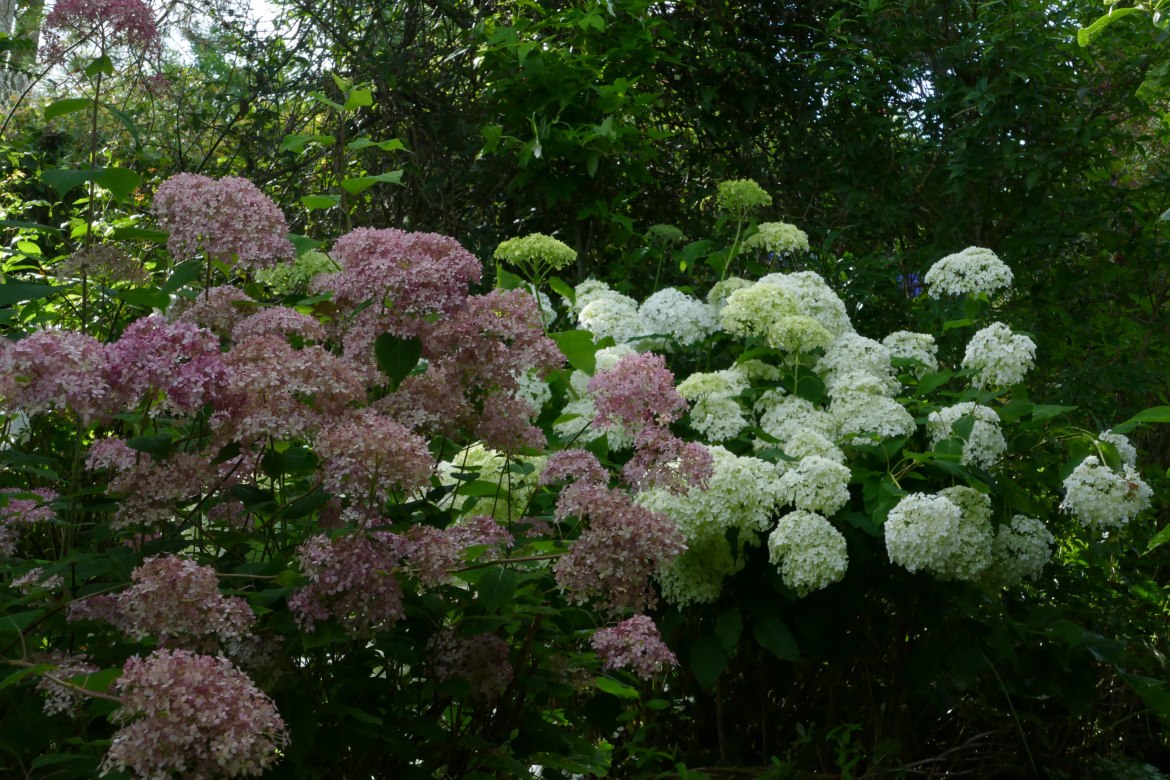
Fiona brought up the subject of ground cover as a means of minimising bare soil and reducing weeding. What would Richard recommend? He agreed that bare soil just encourages weeds. Persicaria is a genus which has many good ground cover varieties. A less well-known form with small leaves is Persicaria vaccinifolium with a mass of pale-pink flower which goes on for months (and is also very effective in pots). For shade Chrysosplenium and also Pachysandra are very useful. Verbena corymbosa ‘Gravetye’ is good in sunny spots. There is also the tiny-leaved Gunnera magellanica for sun or light shade and damp soil. Ground-cover shrubs there are a-plenty: Potentilla, dwarf Hebes, Cotoneasters, Hydrangeas… There are over 200 Hydrangeas in the woodland garden at Farmyard Nurseries, which have really come into their own this year. You can also, depending on your soil,  consider alpines as well as herbs (marjoram and oregano varieties are excellent). Richard uses mint in his wildflower meadow, as it competes with the grasses and the flowers are loved by bees.

Another question related to the depth at which new shrubs should be planted. The general advice is to plant them at the level they were at in the pot. But what about roses? We were all agreed that we no longer knew what the advice is about roses, as it seems to have changed. It always used to be that the graft point or union should be above the ground – now you sometimes see advice to plant it 4” deep. Good advice can generally be found from reputable rose growers such as David Austin and Peter Beales. Received wisdom does change over the years – delicate and very accurate rose pruning is now often replaced by using hedge cutters. A tip from Richard is never to prune your roses hard before March (before that your hard-pruned roses may be affected by winter die-back).

Ruth had grown some Echinacea plants from seed which were now a good size, and she was wondering whether to plant them out now or wait until spring. Richard warned her that generally Echinacea don’t like it in this part of the world, although you can sometimes get away with the standard E. purpurea or alba (which happily Ruth’s are). The essential thing is keep Echinacea dry through the winter as it doesn’t like the combination of wet and cold.

On the subject of seeds – there was a question about hollyhocks and whether the stems should be collected and hung up to dry inside, or whether to leave them on the plants in the garden. On clarifying that the seed was green, and therefore not yet ripe, he recommended both courses of action. It seemed to be generally agreed that for some plants such as hollyhocks and also grasses that it works to cut the stems with the seedpods still attached and lay them down directly on pots or on planting trays/guttering with perlite.

Julian asked Richard to share his two greatest successes and his worst failure during the life of the nursery. Richard replied that the very best thing to have happened was his daughter Ruth, and the worst thing that had happened was the long Covid that Ruth had suffered from, destroying her future as a potential Olympic athlete. The silver lining was that Ruth had turned turned to plants during that difficult time, in particular house plants, and now she runs that part of the nursery. The second best thing to have happened was getting to Chelsea on the first attempt! If he is honest, there had been lots of highs and Richard would do it all over again. One of his favourite things is to wander around the garden and nursery of an evening when everyone has gone home, and to see what has been achieved. Richard’s staff are a loyal and dedicated team, and he recognises that he owes them so much.

Next, a question about a damson – it’s a shrub variety, about 6’ high, from the Midlands. In six years, it has not produced a single damson! Richard said that stone fruits can be slow to get going. He asked whether it flowered well (it doesn’t), and flowers late, after the apples. Richard’s suggestion was to make the damson think that it’s dying, by chopping a circle around its roots. The other alternative is to to ring bark it, the ring being half-an-inch wide. A follow-on question involved two saplings, a wild plum and a sunset cherry, which had been given to a member in pots. Where should they be planted? Somewhere with plenty of sun and not too windy. Still on the subject of damsons, a questioner had a damson which bears very little fruit, but two seedlings have arisen nearby – would they be likely to fruit? Over seedlings you have no control, so theoretically they might. The closer to the species they are, the more reliably they are likely to fruit.

Sheena mentioned her trouble getting Japanese anemones to establish in her garden. Richard replied that it seems to be pot luck with Japanese anemones – they either like you (when they can grow very strongly) or they don’t. Erigeron karvinskianus is another. 

Gordon asked about a 1’-high Eucalyptus with a single stem that he had bought for £3 – how could you resist?! The problem with Eucalyptus, particularly on a single stem, is that they have a tendency to blow over. To keep the juvenile foliage, you should cut it back hard every year, making it less likely to blow over. When cut back like that, Eucalyptus can make a great evergreen screen. Plants that generally do well in the damp soil in Wales, and can be good screens, are willows, Cornus, birch and poplar. 

Carol had a question about her young ‘Bardsey Island’ apple tree, on which the lower leaves are developing brown and blotchy patches. She also has another Welsh apple, ‘Pig aderyn’, which is smaller but is doing better. The ‘Bardsey Island’ is planted close to a soakaway, and Carol wondered whether that might be affecting it. Richard thought not, unless the soakaway was making the soil very damp. He noted that smaller trees will often establish better. ‘Bardsey Island’ is a superb apple though. He added that he had quite a number of them, and they hardly fruited. The damp climate of Wales very often led to canker in apple trees. There was some debate about whether you can, or cannot, grow apples in Wales. The Club’s previous speaker in September had definitely been of the view that you can; Richard’s view is that you can’t – but sometimes you can!

Sandy asked about tall plants for a lined pond which she has recently made deeper.  Options suggested were Iris, Typha minima (a miniature bulrush), plants in the Scirpus family, Pontaderia cordata, and even Equisetum. Apparently dayliles and Schisostylus also do will in water.

The final question came from Ruth, who asked about some young rhododendrons she had planted in a bed where Verbena bonariensis were becoming quite prolific. Richard was of the view that the rhododendrons wouldn’t suffer, as the Verbena are light and airy, and rhododendrons like shade, but that Ruth should just keep an eye on them. He did note that V. bonariensis will seed everywhere. Also, the young rhododendrons may well have come from Holland where they would have been forced into bud, so they may naturally pause flowering for a year or two. In fact, it would be a good thing to debud them next year, to ensure that they grow into good, strong bushes.

Farmyard Nurseries organise a Gardening Weekend every winter in Llandysul. In 2025 it will be organised for the days around 16 February. It’s a fabulous event that certainly brightens up a dreary time of year with talks, a central display and plants for sale. A date for everyone’s diary!

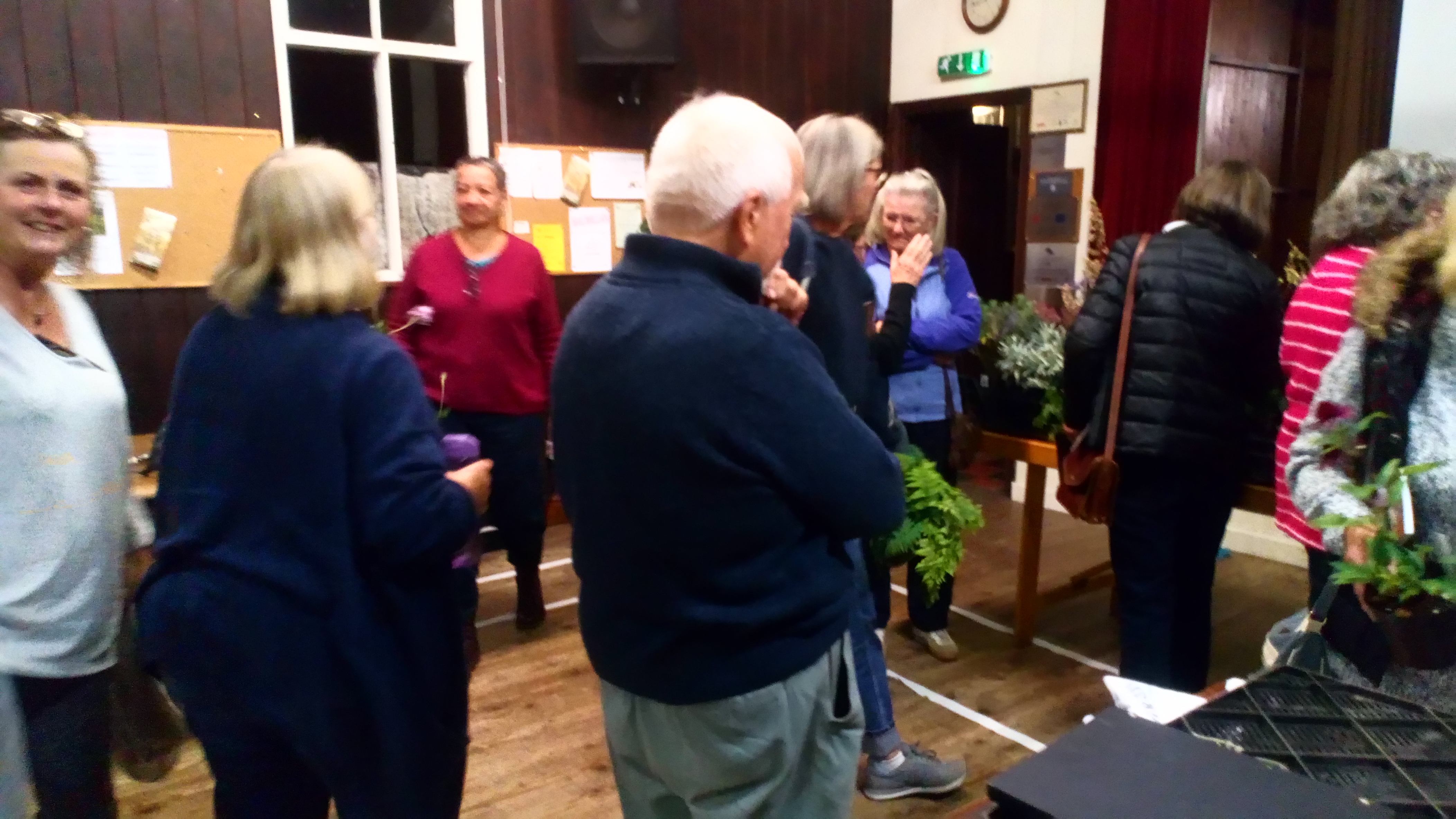
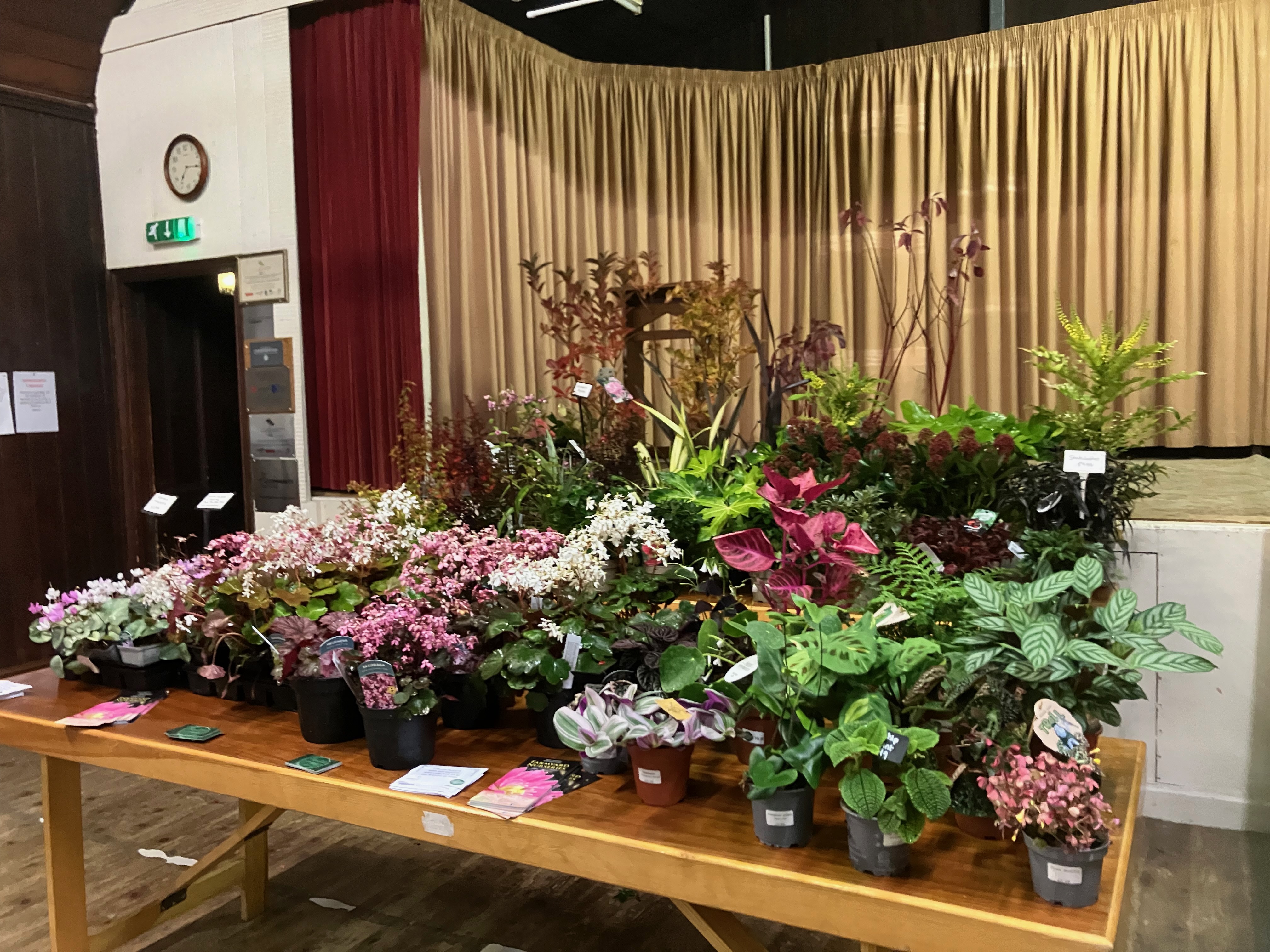
That brought to an end a very entertaining and informative hour, during which Mabel had befriended anyone in the audience she suspected of harbouring food about their person! Richard was thanked by Dawn and by an enthusiastic round of applause from the audience, and everyone made a beeline for the many beautiful plants for sale that Richard had brought to the meeting and arranged in a mouthwatering display.
The Flower Garden by Sara Redman; Upcoming Club Events

Sara grew up on a farm and worked for the council for 30 years but had always been a keen gardener with an award winning allotment, and then she bought her smallholding, where she now lives, in 2015. The house needed renovating, and she spent 2 years preparing the ground for the Flower Meadow, which opened as a business in 2017 when she joined all the local markets to start selling flowers.

There are now 2 polytunnels (with another to come), and a greenhouse (with another on the way). The smallholding is totally organic, with ducks for slug control and she makes all her own compost. She only does any serious weeding twice yearly, uses no plastics and sticks to a permaculture system. She only attempts to grow flowers that are happy in the smallholding and feels it’s a waste of time trying to bring on unhappy plants. She joined the “Flowers from the Farm” organisation in 2018 which is a group of (nationally) like-minded flower growers which you can find near you on their website .

The flowers from Sara are not posted, and can only be bought either from the farm (from £15 per bouquet) or from events she attends; she has done demonstrations at the Royal Welsh show, and the RHS show in Cardiff although there are sadly no more RHS shows in Wales now. She did the Chelsea Flower Show once, but says never again!

There are flower workshops at the smallholding and the premises are also used for other types of craft sessions. Supplies for weddings are a big part of the business (and weddings can be held on the smallholding) but with a caveat that the flowers are returned to the farm afterwards thus reducing waste. When arranging flowers, foam is completely avoided and chicken wire is used. Sometimes she makes whole flower installations for weddings.

There are Christmas wreath making sessions and some sessions for children. There is a wild flower meadow at the farm which is just cut down by hand once yearly, otherwise it needs no attention. She keeps bees (they must think they are in heaven!) and donkeys.

Lots of types of dahlias are grown and planted twice as deep as normal and are unusually generally left in the ground in the winter, although in the last wet winter, about half of them were lost. Dahlia plants are surrounded by sheep’s wool which deters the slugs. Although the farm is on a hill, it does get quite wet.

She uses the greenhouse for growing plants from seed and recommends only using fresh compost for this as it loses its nutrients. She starts growing sweet peas (her favourite flower) in the greenhouse in September but only grows them on in the polytunnel as the site is windy which they can’t handle. She also uses thee flowers from shrubs which are useful for greenery in arrangements – Eucalyptus is really handy and is easy to grow from seed.

Making compost is never-ending and she uses a concrete mixer to combine ingredients with alpaca poo which is brilliant because it can be used straight from the point of delivery.

Dawn thanked Sara for an entertaining and useful talk and encouraged us to make a note of the Open Day at the Flower Meadow which happens on 10th August 2024.


Upcoming Club Events

Members are reminded that our club summer social will be on Wednesday 21st August, probably (by general consensus!) at Dawn’s house – Cae Caradog, Ffarmers SA19 8NQ – see pictures below. Please think of any activities we could do outside and remember to bring food to share.

Our October meeting, on 16th, will be hosted by Richard Bramley of Farmyard Nurseries and he will take questions, following the format of the radio programme “Gardeners’ Question Time”. So please make a note in advance of any problems (garden related!) that you would like a solution for.


Ten Ways to Use Willow in the Garden (and Beyond) by Justine Burgess


Justine began working with willows as a basket weaver ten years ago; she had always been interested in gardening and then eight years ago she and her husband Alan founded West Wales Willows on ten acres of land in Gwernogle (two acres of which are devoted to willow). They hold the National Collection of Salix for Plant Heritage, currently the only one in the country. The nursery was visited by Frances Tophill for  one of the Gardener’s World Winter Special programmes at the end of 2023, and has also featured on ITV’s Coast and Country series.

The nursery will be open for the NGS on 22 June from 10am to 4pm, and will be open as part of the Tywi Valley Open Studios from 27 July to 4 August, running taster willow weaving workshops on 29 July. An Open Weekend 4-6 October, when the winter colours are already starting to show through, will focus on growing willow.

On to the ten ways to use willow:

No. 1 – Plant Willow for Pollinators. Willow is very early flowering, some varieties as early as late January and early February in a ‘normal’ year (this winter it was considerably earlier). Five years ago, the National Botanic Garden of Wales analysed the pollen content of spring honey, and found that it was made up of 80-85% willow pollen, showing just how important it is for bees. This would probably mostly have been the wild growing willow such as the goat willow – Salix caprea – and the crack willow – S. fragilis. Of the more decorative varieties, S. udensis ‘Sekka’ is a magnet for all sorts of insects including bees, wasps and even bluebottles! S. gracilistyla ‘Melanostachys’ has black catkins, and makes a very good-shaped shrub in the garden, reaching only 7ft after a number of years. S. gracilistyla ‘Mount Aso’ has bright pink catkins, and is also not huge.

No. 2 – Plant for Winter Colour. The winter colour of willow stems ranges from pale white through yellow and orange, green and brown, to purple and black. The purple-barked willow is Salix daphnoides, the black-barked willow is S. nigricans, and the orange-barked willow is often a form of S. alba ‘Britzensis’. It is also worth remembering that there are alpine willows, growing no more than 2 ft tall. Frost intensifies the stem colour of all willows.

No. 3 – Plant a Fedge. What’s a fedge? It’s a cross between a fence and a hedge. It is a decorative barrier, rather than a stock-proof one, created by planting willow stems in the shape of a lattice. To keep the fedge at a reasonable size, it is best to cut off all the current year’s growth once the leaves have fallen. S. nigricans, the black-barked willow, is stunning when planted in this way. 

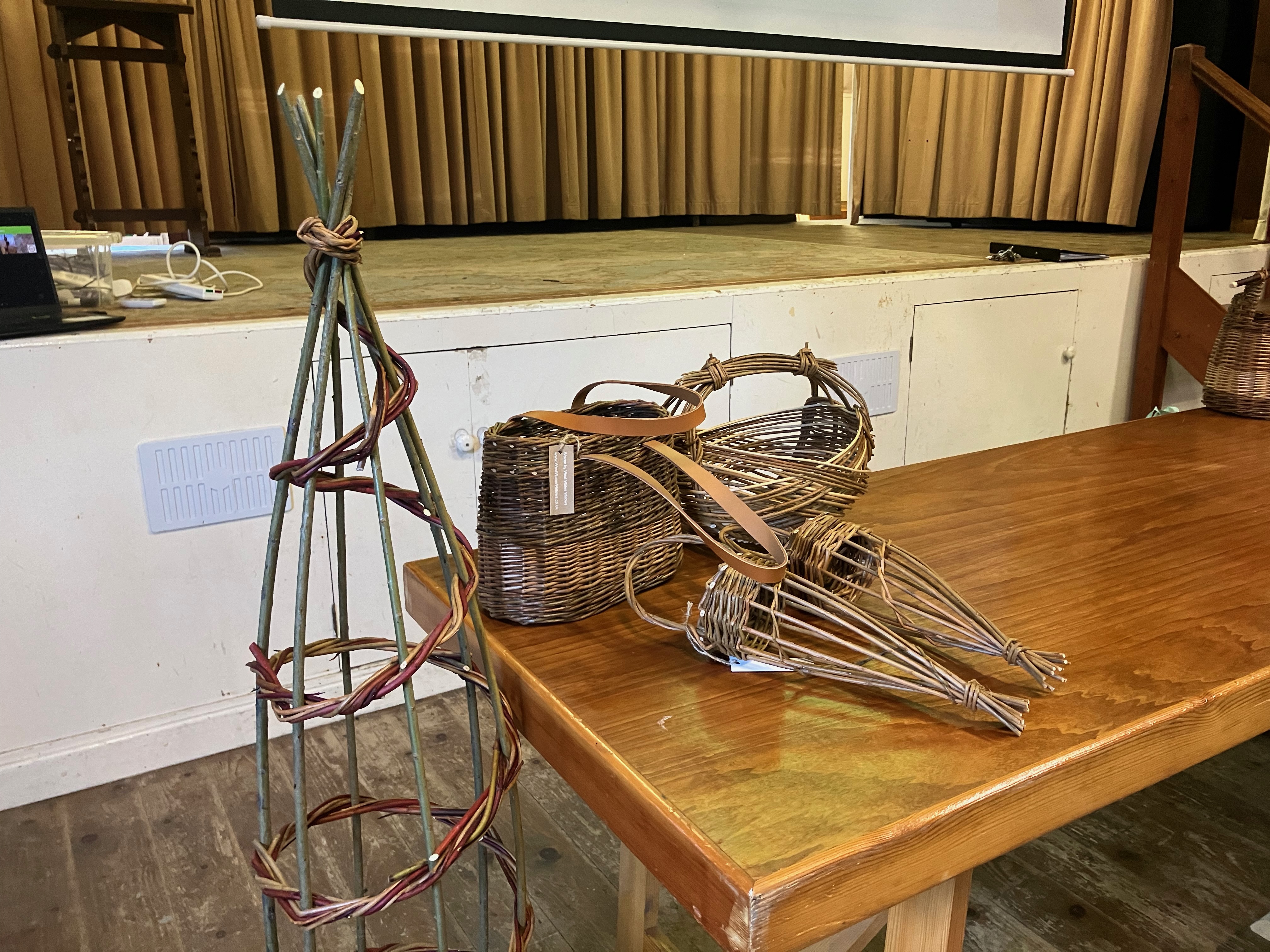
No. 4 – Plant Something Bigger. This could be something like a willow dome, or a willow tunnel. To create stability, you need to plant the willow rods 12 inches into the ground. Willow doesn’t like competition, so in order to get it to grow strongly you need to use membrane; Justine has recently been experimenting with cardboard and wood chip to see how they will perform in place of membrane. Some people have used willow to create mini-domes to provide shelter from the sun in summer for chickens and for dogs. In Germany a willow cathedral has even been created. 

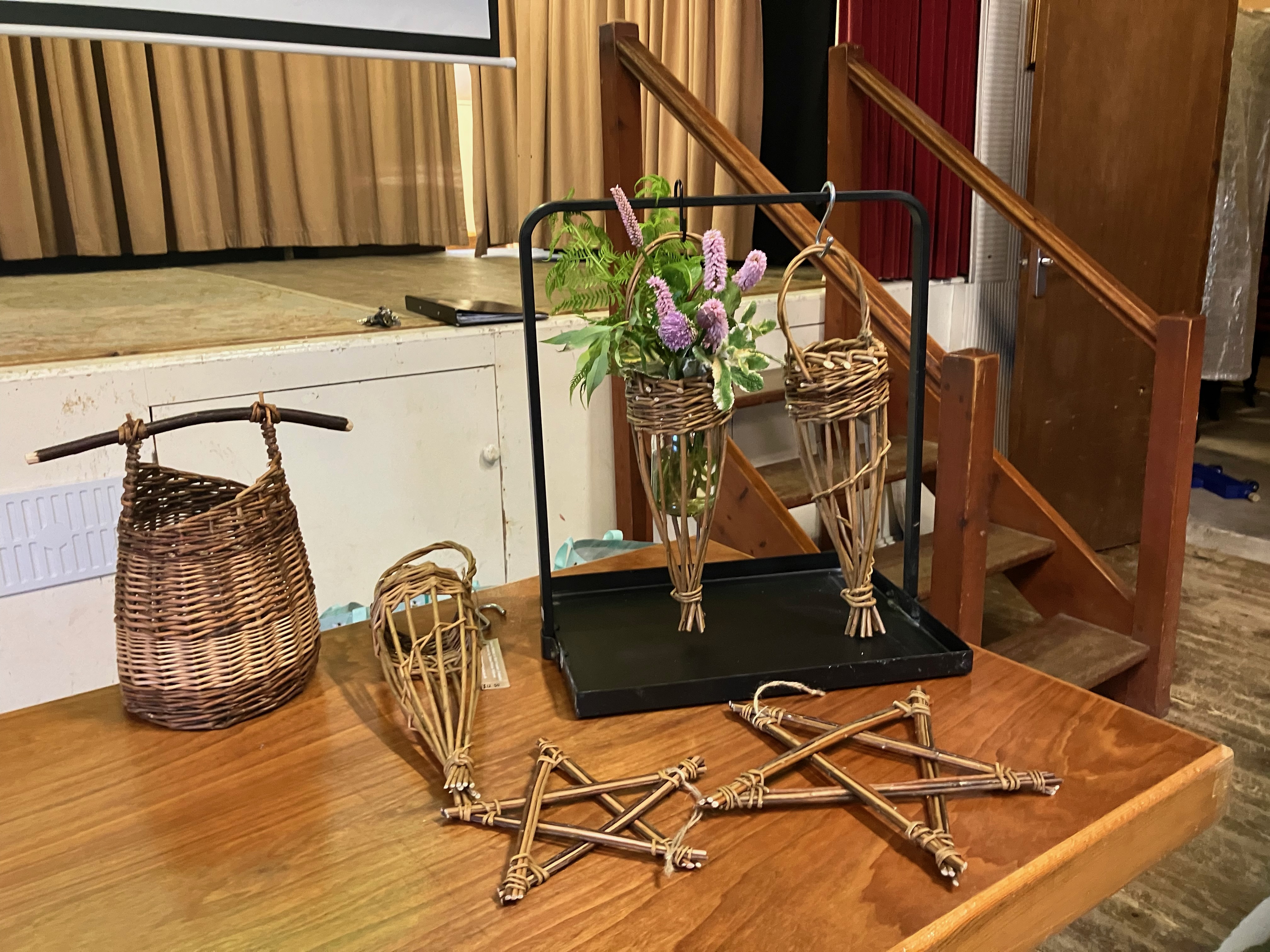
No. 5 – Use Willow Baskets. Willow stems , of course, are perfect for weaving baskets – and what could be better than collecting your own fruit and vegetables in baskets and trugs woven from your own willow!

No. 6 – Incorporate Willow Garden Structures. In the vegetable garden you can use willow to create supports for runner beans and sweet peas as well as mini-pumpkins. Willow also makes a great base for a wedding arch decorated with flowers and greenery. The only thing is that willow structures don’t last forever – four seasons is about the limit.

No. 7 – Make Willow Water. The bark of willow is packed full of growth hormones at the base of the stem when in growth. Take one-year-old willow stems, cut them into 1.5-inch chunks and cover them with water. Use about one-third willow to two-thirds water. The water will only last for one to two weeks before you have to make another batch, but it can be used as a replacement for hormone rooting powder. 

No. 8 – Chop and Drop (Ramial Woodchip). One- or two-year old willow wood, chipped, which breaks down really fast, is amazing for feeding fruit trees. It is also brilliant for making hot beds. You can use wild willow for this. The wood should be cut no later than May, because after that you won’t get much regrowth. The leaves from the wood can be dried, chopped, and then go into the compost bin.

No. 9 – Build a Dead Hedge. Dead hedges are great homes for insects and can serve as good temporary fences.

No. 10 – Make Something Fun! Willow is great for making sculptures – for example, a stag, a hare, even just a big ball.

Justine then took questions from the audience. She recommended Salix nigricans and S. triandra ‘Blacktop’ as the best black-stemmed willows. She confirmed that willows need quite a lot of sun – about 6 to 8 hours in the summer, so you shouldn’t plant them on the north side of a hedge. They also don’t like being next to established trees. They need a lot of water, although they don’t have to be in wet ground. They don’t like chalky ground, and love clay or clay on shale. Willow stems should be cut during the dormant season. As they dry, they lose one-third of their width. They should be allowed to dry for three to four months, then rehydrated. A bundle of 5-foot long willow lengths should be submersed under water for 5 days to fully rehydrate for weaving.

West Wales Willows run a variety of different courses, at Gwernogle, at Myddfai Community Hall, at Abergwili and at Denmark Farm Conservation Centre


Remember to browse the rest of the Cothi Gardeners’ website for other upcoming events, the Surplus to Requirements section and updates to Members’ Gardens. If you have any ideas for new content or would like to contribute a piece about your own garden, please contact cothigardeners@gmail.com.


Christmas Social; NGS Donations for 2023

This year’s Cothi Gardeners Christmas Social was held at Ystrad Nurseries near Llandovery. It was, for a change, a sunny afternoon, the alpacas greeting us as our cars pulled in. We all arrived in time to have a good browse around the nursery before the demonstration 

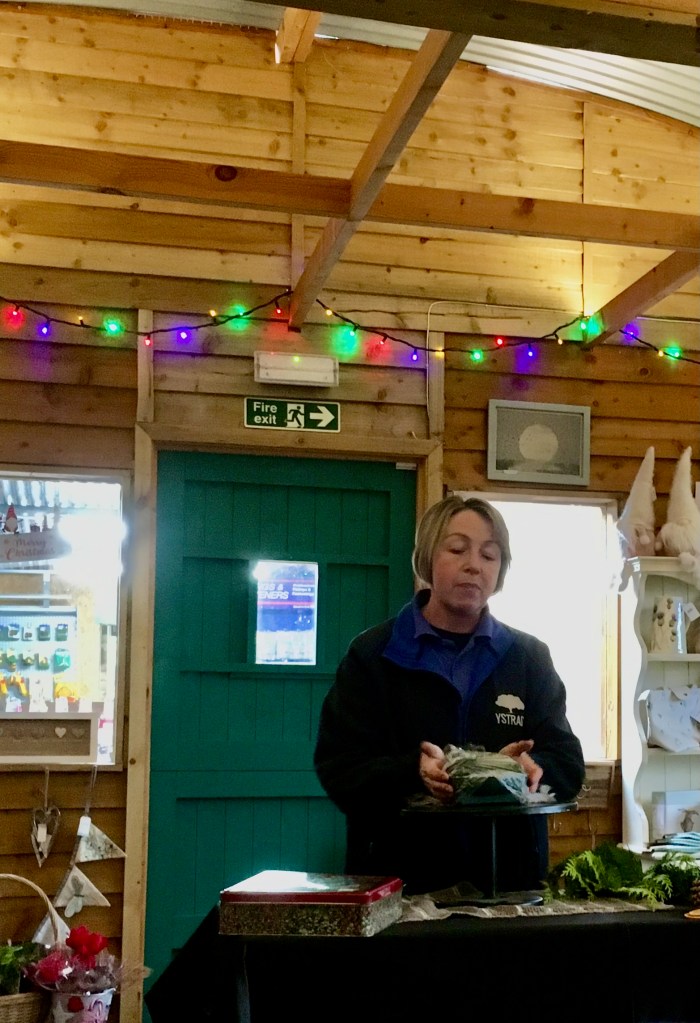
Julie began the demonstration by telling us a bit about the history of the nursery and timber yard, particularly since 2016, when John and Laura Morgan bought Ystrad, having seen the potential to bring together her background in running a nursery and John’s expertise in the timber business. Since then they have grown the business significantly, and from an original staff of three at Ystrad in 2016, there are now over 30. Ystrad Nurseries itself now also has florist Sian on site, and has embarked on phased improvements, beginning with the car park and entrance. Julie herself has worked here since 2020, having previously been a primary school teacher.

First we saw how to build up an arrangement that could be adapted either for the table, or for placing on graves, using a square block of oasis in a circular base,  Starting at the bottom, it is best to avoid prickly holly and to create a base layer with fronds from spruce or cypress. The holly can go in as the next layer. Julie recommends pieris for the centre of the arrangement, which at this time of year has flower buds. To add berries and ensure they show up well, take off any surrounding leaves. When adding skimmia do the same and strip the leaves to highlight the purple flower. For a table arrangement, you can then place a candle-holder with candle in the centre.

Julie then explained how to wire items onto an arrangement, such as dried orange slices, and also demonstrated bow-making.

After that, we turned to wreaths. Nowadays moss is less favoured, and people are choosing straw-based rings for the base as a more sustainable option. The straw rings, once purchased, can be re-used the following year if allowed to dry out and stored safely. The greenery can be fixed in place with either wire or twine, using small clusters of foliage as you go, again starting with spruce, but incorporating a range of foliage such as osmanthus, choisya, skimmia, leucothoe and pieris. From this you can then adapt the decoration depending on whether the wreath is for a grave, a door or table arrangement.

After thanking Julie for her interesting and informative presentation, everyone had an appetite for the delicious and plentiful tea that Ystrad Nurseries had provided. We weren’t going to need supper after that, and a grand time was had by all!


NGS Donations in 2023

Cothi Gardeners Club are fortunate to have among our members John and Helen from Ty’r Maes and Julian and Fiona from Gelli Uchaf who open their gardens for the National Garden Scheme in Carmarthenshire and Pembrokeshire. Across the two counties as a whole there were 3,514 visitors, of which 2,130 were from Open Days and 1,384 from By Appointment visits. That is a return to the visitor numbers seen in 2019 and previously. In 2023 the total raised for charity was £26,638 (up from £20,300 in 2022) – a fantastic increase! 

In total the National Garden Scheme has been able to donate £3,403,960 to beneficiaries in 2023. This record amount is testament to the hard work and dedication of all those who open their gardens to the public and all the volunteers who contribute.


‘Epimediums – Rising Stars of the Shade Border’ – a Talk by Janine Thompson; Fergus Garrett at Llechryd & District Gardening Club; Llandeilo & District Gardening Club 4 May Meeting

Janine runs Heartsease Plant Nursery, based near Cenarth, where she grows herbaceous perennials and bulbs, especially shade tolerant plants, and is a devotee of Galanthus (Snowdrops), Helleborus and Hepatica as well as Epimediums.

Epimediums are valued especially for their ability to thrive in both shady and dry conditions and are particularly useful for ground cover. They are rhizomatous shady perennials which prefer acidic conditions. Many are evergreens with common names such as Bishops Hat, Barrenwort, Horny Goat Weed (the supposed aphrodisiac!) and Fairy Wings and are particularly sought after for ground cover. Epimediums have been cultivated since Roman times.

In 1775, the infamous German physician and botanist Philipp Franz von Siebold was seconded to the Dutch East India company in Japan and was stationed there for 5 years. He did a significant amount of work on Epimediums which were valued for both flowers and foliage and brought them back to Britain, along with the Hosta and Japanese Knotweed.

Two hundred years later, in 1975, the renowned Japanese Plant Hunter and breeder Mikinori Ogisu had a particular interest in Epimediums, as did plantsman gardeners Roy Lancaster and Robin White, which greatly increased awareness about these plants. There is still work continuing on the discovery of new Epimedium varieties in China.

Breeders today are particularly interested in cultivating larger and longer flowering varieties, with even greater tolerance of drought and shade. Many flower colours and shades can now be seen, with ever more diverse habits and appearance, and leaf shapes and colours are more varied than ever. Epimediums can be grown in varied conditions and some will thrive in pots. They are happy planted under trees and shrubs and look excellent under Japanese Maples, Hydrangeas, Cornus sibirica, Rhodedendrums, Magnolias, Azaleas and many more. Whereas in the past they were often thought of as a yellow flowered plant, they can now also be found with cream, pink or red flowers. Many are reliable evergreens such as Epimedium x rubrum, whose pretty heart shaped leaves are bronze when young, darkening to red-brown in autumn and Epimedium ‘Pink Champagne’ which is a hybrid cultivar, with attractive bronze-red, mottled foliage and a profusion of pink-red hanging flowers in spring. Leaf colours now vary from black through the spectrum to red. They are good partners for Spring flowers such as Snowdrops and Hellebores and are extremely low maintenance.

There are very few pests and diseases affecting Epimediums, although they can be prone to vine weevil damage and unfortunately rabbits do like them. Tobacco Rattle Virus causes thickening and malformation of leaves but there are very few perils altogether.

There is a National Collection at Brentwood in Essex run by Roger and Linda Hammond.

Plants can be obtained from Janine at various markets and by email at heartseaseplants@yahoo.com.

Janine answered questions from the audience and Elena thanked her for an interesting evening.


Fergus Garrett at Llechryd & District Gardening Club

To celebrate the 40th anniversary of Llechryd & District Gardening Club, Fergus Garrett of Great Dixter will present a talk on ‘Great Dixter, Past, Present & Future’ on 9 August at 7.30pm in Boncath Village Hall, Boncath SA37 0JL.  This talk on Christopher Lloyd’s iconic English Garden is sure to be popular so entry is by TICKET ONLY.

Cothi Gardeners members are invited to enjoy this wonderful opportunity to hear one of Britain’s foremost gardeners speak on the Great Dixter legacy and his vision for the future of the Great Dixter Charitable Trust.  There will also be a plant sale and refreshments, and Boncath Hall is accessible, has toilets and good seating capacity. Visitors are asked to car share, as parking will be at a premium.

Tickets are limited and can be purchased very easily online at a cost of £5.00 each.  Payment is by BACS after your ticket is confirmed. Tickets will then be delivered by email to your inbox.

Purchase tickets HERE


Llandeilo and District Gardening Club 4 May Meeting

Cothi Gardeners members are invited to attend the meeting on Thursday 4 May, open to all local garden club members, at the Vestry, Capel Newydd, Crescent Road, Llandeilo, SA19 6HN at 7.30pm. Bob Brown, the founder of Cotswold Garden Flowers in Evesham,  will be talking about paeonies, described by the RHS as “slow growing but rewarding aristocratic plants with a brief but keenly anticipated” flowering period.

There are also vacancies for a day trip to Stockton Bury Gardens. The coach will leave Jones International depot, Llandeilo (time to be confirmed) on Thursday May 18th 2023, calling at The Old Railway Line Garden Centre and then on to Stockton Bury Gardens.  The trip which includes the cost of the coach and entry to Stockton Bury Gardens is £33.00 per person.  If you are interested please contact Denise Durham .


Remember to keep checking the Events page on our site, updated regularly, for more events as they are notified to the web editor.

Autumn into Winter with Richard Bramley of Farmyard Nurseries

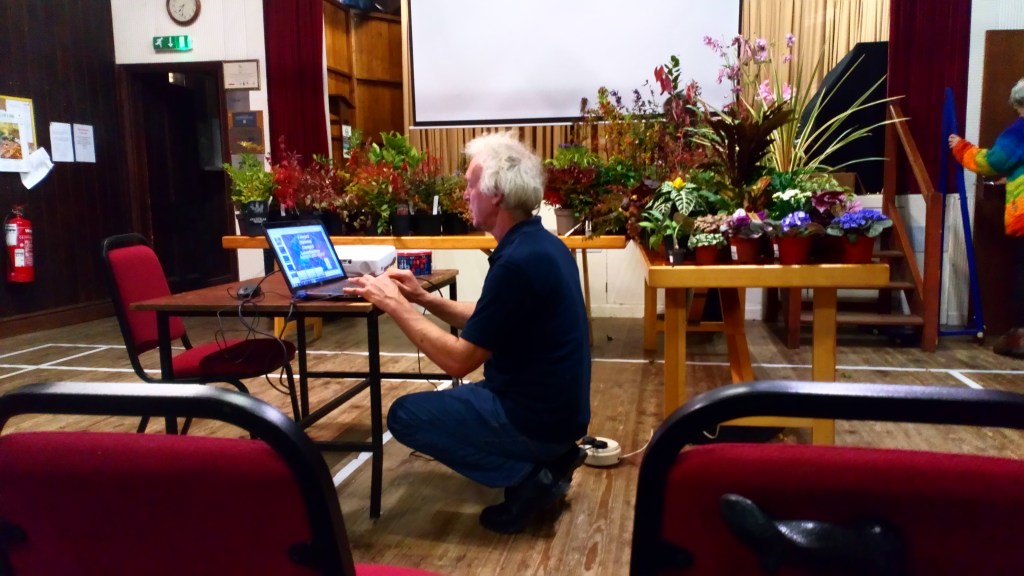
Richard Bramley, here preparing to give his talk, is from Farmyard Nurseries with 3 acres of land and 50 polytunnels near Llandysul, where 90% of the stock for sale is grown outside which helps to produce hardy plants of many varieties.

He is very keen to encourage people to think more about the colour and interest of plants – trees and shrubs can be grown in autumn and into winter.   Starting with Acers, which are not as difficult to grow as is often thought (though they don’t like wind), he showed many of the different colours, shapes and textures that can be provided by planting them. Liquidambar styraciflua, or Sweetgum, is more tolerant of wind though it doesn’t come into leaf until later in the season. Berberis thunbergii, although it is a bit prickly, is particularly worth having because it is so colourful and produces berries and flowers in addition. Also they can be kept at a smaller size if required by hard pruning, without any detriment to the look of the plant.

Winter stems, such as the many different varieties of Cornus, provide different upright shapes with a wide variety of colours and are very hardy. C. alba ‘Baton Rouge’ is one of the very bright red varieties during the winter and again Cornus produce flowers and berries.

There was a lot of discussion about Hydrangeas! The mopheads were described as ‘blocky’, whereas the Lacecap varieties of Hydrangea macrophylla are to be encouraged. Hydrangeas are (generally) enthusiastic growers and do provide colour in the flowering gap, while the H. paniculata varieties can reach up to 18 – 20 ft. Climbing Hydrangeas need to be treated differently at pruning time as they flower from the previous year’s growth but they will tolerate some shade during the flowering season which makes them very useful.

Fuchsia will grow happily into autumn and, although they will tolerate wet,  they do need plenty of light. Chrysanthemum (if cut down in spring) will last into autumn. Lavender, Nepeta, Astrantia and Campanula plus many of the daisy family, if cut down after previous flowering, can do surprisingly well. There are nearly 200 varieties of Aster now which can continue through autumn and the hybrids don’t get mildew, plus they will tolerate some shade.

Rudbeckia ‘Goldsturmwill also last, as will Leucanthemum, Helenium, Persicaria, Autumn Salvia, Kaffir Lillies, Solidago (Golden Rod), Heliopsis and many more varieties of flowers and shrubs, given some care, will reward the grower in spades (see what I did there).

Grasses will give lots of interest in the winter and there are some quite remarkable ones to try. Imperata cylindrica (Japanese Bloodgrass) when planted in a drift looks as if it’s on fire. Panicum virgatum varieties are very varied and do well when established. Grasses are deciduous and demand very little in the way of care, can be easily split, can be grown from seed and some of them flower.  There are endless varieties of grass to choose from now that will provide an addition to the garden in the cooler months.

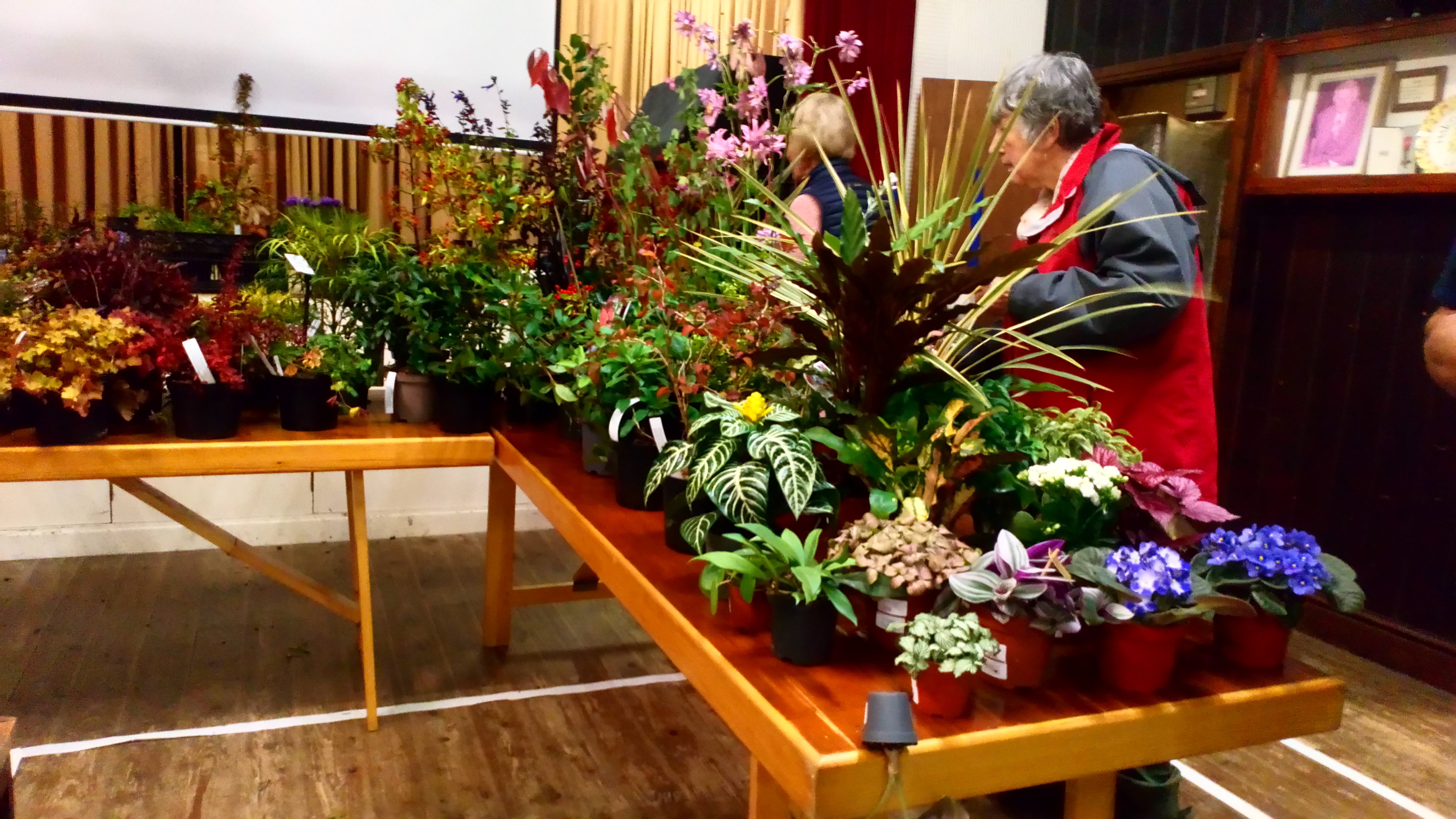
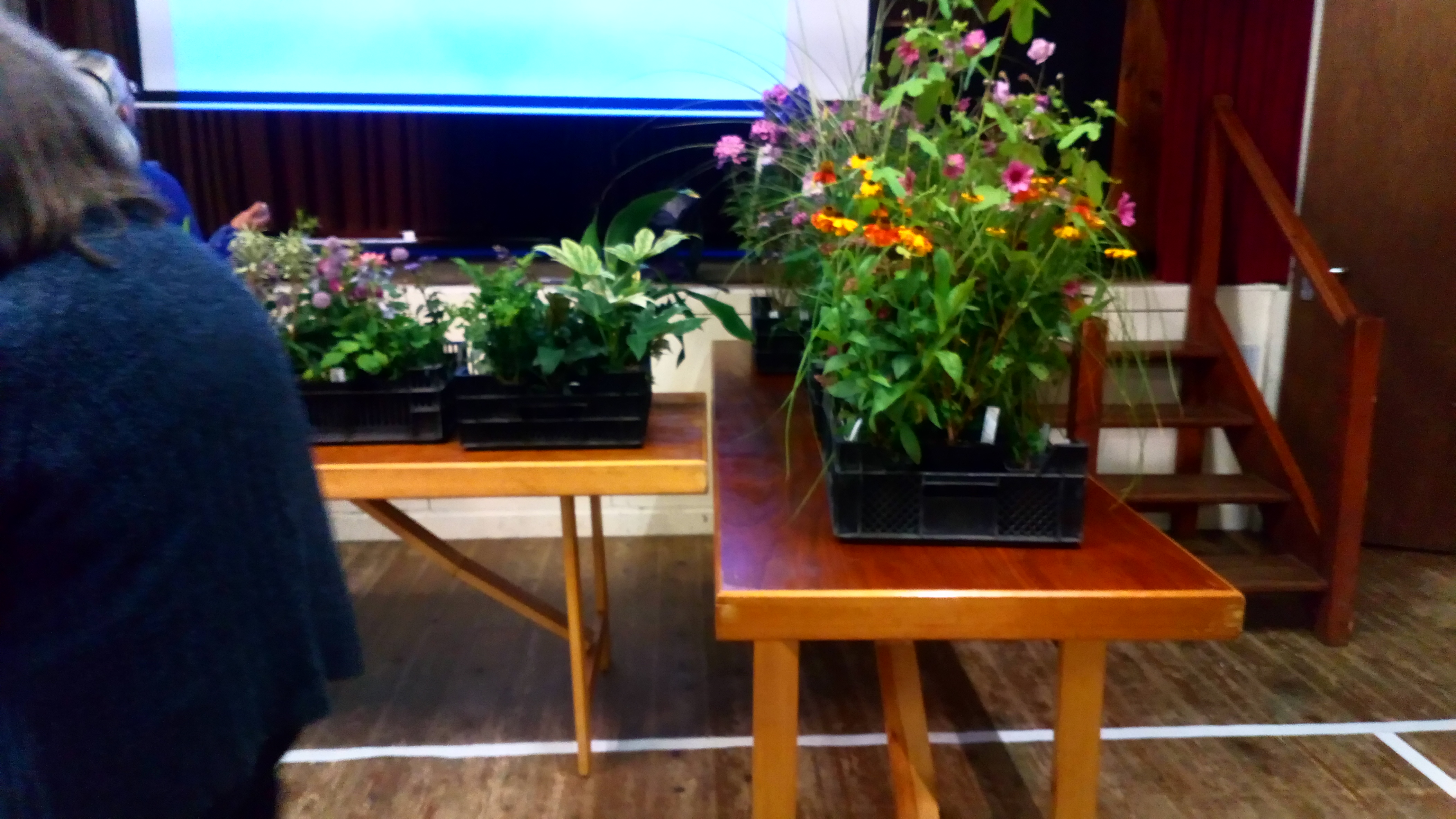
We thanked Richard and his support act Mabel (his dog) for his informative and entertaining presentation and took full advantage of the beautiful plants which he had brought for sale from the nursery.

Native Plants as Garden Flowers; Invitation to Local Gardening Clubs; Plant Swap and Sale

Native Plants as Garden Flowers – Talk by Bob Brown of Cotswold Garden Flowers

We were lucky to once again hear an entertaining talk from Bob Brown, founder of the Cotswold Garden Flowers nursery. He started by encouraging us to put the right plant in the right place – something we all know but need constantly reminding of! 

The initial list of headings was to outline the bullet points of his talk i.e. Acclimatised & Easy, Invasive, Garden Worthy etc. Bob went on to describe the different types of plants within the headings and started with the Welsh poppy (hurrah!) and we had conversations about the habits of the plant. He continued to describe many different types of plants which come into the native plant varieties including Achillea, seakale, viper’s bugloss, Mullein, Veronica spicata and many more.

Woodland plants were described next and include Aquilegia vulgaris, Allium sphaerocephalon, wood anemone amongst many others. 

Woodland Edge plants  & bulbs came next, such as the lawn daisies, hen & chicks, single Campanula, Colchicum autumnale, Pulmonaria, celandine varieties etc.

Grasses were the next category, including woodland grasses and Bob is keen on using plants needing structural support being grown within grasses, using the grasses as the support. Dogwoods, which look good with grasses, (Cornus sanguinea ‘Midwinter Fire’ in particular) are a favourite – he advises to cut them right down in winter.

Ferns of different types were next and his particular favourite, Polypodium vulgare, because it is evergreen in the winter but has died down by June and so makes way for other plants.

Iris types and the different areas in which they flourish came next and we discussed the very smelly Iris foetedissima (roast beef plant) & had a chat then about what the smell actually is like!

Primula varieties, which have been grown here since Eizabethan times, are a good bombproof plant for many areas. 

Roses, particularly varieties of the small Rosa pimpinellifolia ,were discussed, and then many more of the different native plants including the shrubs Salix purpurea (purple willow) and the different varieties of Sambucus nigra (elder), both of which are fast growing and invasive.

We thanked Bob for his informative and entertaining presentation and took full advantage of the beautiful plants which he had brought for sale from the nursery.


Invitation to Local Gardening Clubs

Drefach Felindre Gardening Club and Llechryd and District Gardening Club have each kindly invited all Cothi Gardeners to attend any of their meetings, which are listed below. We hope that their members will also choose to attend our meetings this year and beyond.

Drefach Felindre Gardening Club

All meetings are held at 7.30 pm in the Red Dragon Hall.  Guests simply pay £2 per meeting which includes refreshments.

Open evening October 5th

The speaker is Stuart Akkermans, ‘Cae Hir’: A Welsh Garden with a Dutch History. Light refreshments to follow. This event is free to Cothi Gardeners Club members.

Wednesday, 2nd November 2022 ‘The Gardens at Winchester Cathedral’, Emma Sharpe

Wednesday, 30th November 2022 ‘Biodynamic Gardening’, Louise Cartwright

Llechryd and District Gardening Club

Meetings are held in Boncath Hall, SA37 0JL

Wednesday 12 October at 7.30pm
‘The Treasures of Tadjikistan and Uzbekistan’ with Bob & Rannveig Wallis
Bob and Rannveig Wallis were plant hunting in Central Asia before the pandemic and this illustrated talk starts on the border with Afghanistan and goes via Samarkand and Tashkent to the Chatkai Range. This is the centre of Tulip and bulbous Iris development and also features Fritillaria and Corydalis. Superb photographs and an excellent speaker. Last club plant table of 2022.

Wednesday 9 November at 7.30pm
‘Costa Rica’ with Julian Cremona
Julian Cremona’s brilliant photography brings this small country’s amazing wildlife and flora to life. Dense broadleaf evergreen forest, palm trees, mangroves, mosses, orchids and tropical plants as well as monkeys, sloths, anteaters, snakes and iguanas. Annual Club Seed Swap. 


Plant Swap and Sale for the NGS 9 October 2022

John and Helen of Cothi Gardeners are holding their annual plant swap and sale to raise funds for the NGS on 9 October at 1pm at Ty’r Maes, Ffarmers SA19 8JP.

There will be loads of plants for sale, a lot more than last year, when just about everything went!
There will also be a table of plants that are available for a small donation. These are generally perfectly garden worthy plants that for presentational reasons are not quite up to selling standard.

People are encouraged to bring in plants to swap. Last year some wonderful plants arrived and were seized on immediately.

Tea, coffee, biscuits and cakes will be provided. If you bring extra cakes, that would be great too.
There is no charge for refreshments, but as funds are being raised for NGS charities – donations are always welcome.

A word about parking. We will be using our bottom field, opposite the turn to Ffarmers, for parking and there will be NGS signs up.
The area in front of the house will be available for loading and unloading plants.


August Social; Telegraph Garden and Indoor Plant Centre

August – time for the Cothi Gardeners’ annual social event! This year it was held at the Telegraph Garden and Indoor Plants Centre and adjacent Blossoms Cafe in Llangadog. 

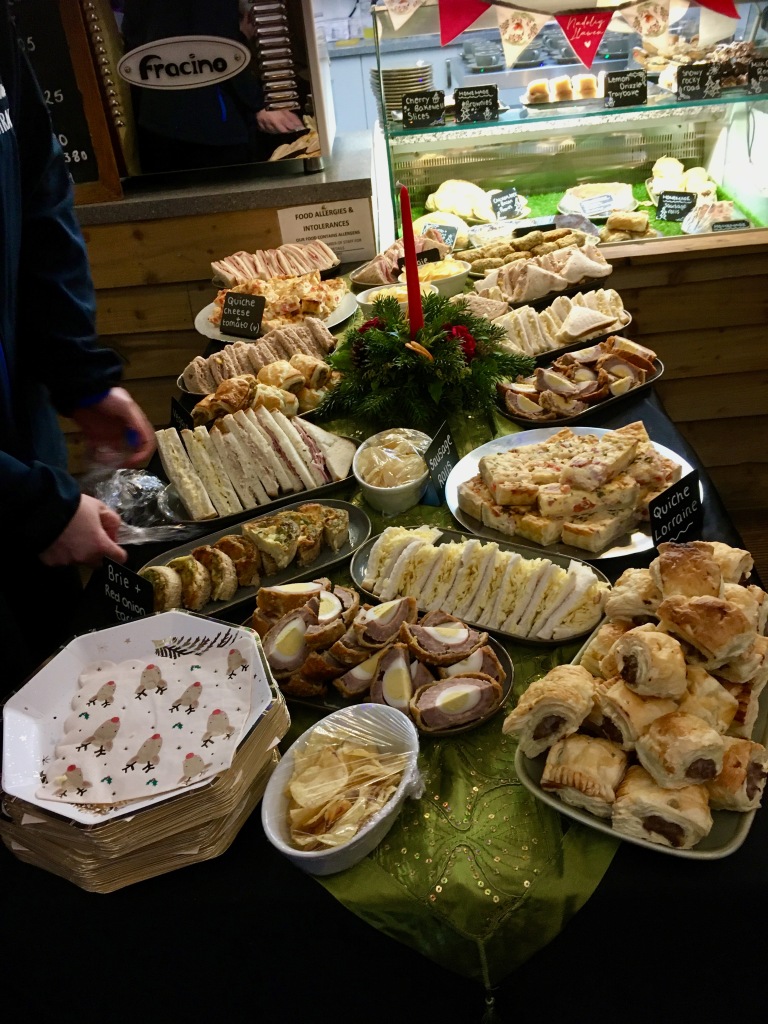
Much anticipated by members, the event proved immensely popular and was extremely well attended. Following a talk by Carol from the Garden Centre, and a chance to wander through the Garden Centre and buy plants, members were able to choose from a very varied menu of savoury dishes, as well as the all-important cake, at the Blossoms Cafe. It was a coolish evening after the heat of the previous week, so the cafe felt warm and welcoming, and it was soon filled with voices and laughter as we all caught up with each other and what we had been doing. The general consensus seemed to be that the food was delicious (I can vouch for my Greek Salad), and the cakes looked mouthwatering!

The social was also an opportunity to celebrate belatedly the tenth anniversary (which was actually in 2021) of the Cothi Gardeners Club, and say thank you to Yvonne who started the club back in 2011, providing us with the pleasure of regular talks on the subject close to our hearts and the opportunity of socialising with like minds. Long-term member Donna would shortly be moving away from the area, so on the occasion of her last meeting we all wished her well for the future and settling in to her new home.

Members of Cothi Gardeners listening to Carol’s talk at the August Social

Telegraph Garden and Indoor Plant Centre

Carol has always enjoyed gardening and been passionate about plants.  Whilst working for the National Trust in Wales as their Grants Manager, she used to break the journey up and down Wales by stopping at different Garden Centres en route.  Sadly the experience tended to be the same at every one, giving a groundhog day feeling.  When Carol retired after working for 31 years for the National Trust, she set up a small Garden Centre on space rented from the Works Antiques Centre in Llandeilo.  However, illness and parking/space problems forced the closure of this Centre.  When Carol and her husband Steve moved to the Telegraph Inn at Llangadog, her daughter Lara saw the opportunity of converting the damp and overgrown area behind the building into a garden centre and The Telegraph Garden and Indoor Plants Centre was born. Although in retirement, Carol enjoys helping out and, in total, the Garden Centre in Llangadog now has 4 members of staff.

Running a garden centre can be more complicated than you might think. One of the skills you need is anticipation – for example, you need to be able to anticipate which plants Monty Don might talk about on Gardeners’ World!  Carol gave the example of Lunaria, or Honesty. Carol had plenty in stock, and they had sat happily on their table without a great deal of interest being shown until Monty Don showed some Honesty in his garden one Friday evening, and all the stock went almost instantly. You need to anticipate what plants people will want when, which means being able to second guess the weather, fashions, television gardening programmes, etc. Obviously the ideal would be for people to want to buy plants year round, and the Garden Centre encourages that, but the winter months can be quite difficult in that respect.

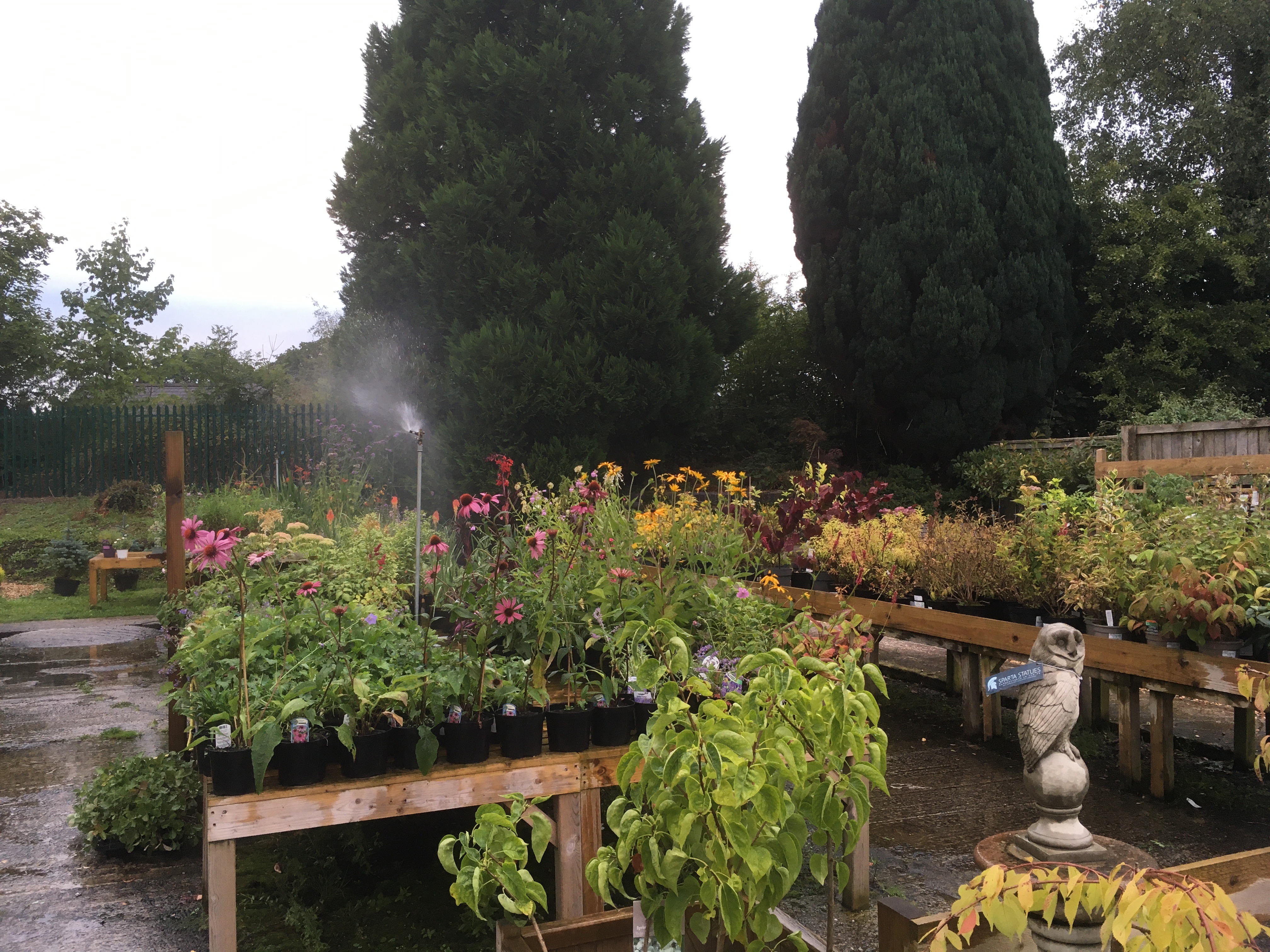
When creating the Telegraph Garden Centre, Carol’s daughter Lara designed the area to look like a garden. The wish was for people to enjoy looking round and to relax there, even if they did not buy anything. Certainly the displays of massed perennials for sale in pots look very much like well-composed garden beds.

At the Garden Centre they are very careful about the sourcing of plants and keen to support other local producers where possible. All the trees, decorative and fruit, are raised in Worcestershire. The bedding plants are sourced in Powys, and all the herbs are grown organically in Ceredigion.

If it is not possible to source some perennials, these are grown from cuttings or seed, and in fact many of the plants in the garden centre are raised there. For example, Nepeta ‘Blue Dragon’ was almost impossible to get hold of, but one plant was sourced and there are now young plants of Blue Dragon available to buy. Here Carol holds one of her favourite plants, Calamintha nepeta, which she grew from seed.

The Indoor Plant Centre is also a great success, with a wide variety of indoor plants always available.  This has proved enormously popular, particularly with the younger generation who really enjoy this form of gardening.

At the Garden Centre, they try to be as environmentally friendly as possible, with peat-free and reduced- peat compost always available.  Pots are recycled at the Centre on behalf of customers and charities for onward use. During the course of the year, as appropriate, plants are  divided, repotted, cut back and tidied up and the whole process started again ready for sale the following year. Customers can have their hanging baskets refilled with no charge for labour, only for the plants and compost used.

One of the downsides of running a garden centre is the paperwork, which is substantial. To counter that, there is the pride in supplying quality plants to customers, and there is the joy of propagating,  creating and nurturing new plants..

Carol finished by giving us all some of her tips. When she’s taking cuttings, she dips them first into liquid seaweed fertiliser and then into rooting powder. Cuttings should always be placed around the edge of the pot, and you need to keep them damper than you would think. Vitax Q4 is really good for plants that are looking a little tired and need perking up. Finally, when dividing plants it helps to take some root off; it might look a little brutal, but it encourages the plant to make more.

On that final note, Carol encouraged the Club members to explore the garden centre and the range of plants available, and we all made the most of the opportunity!

Ornamental Grasses; August Social

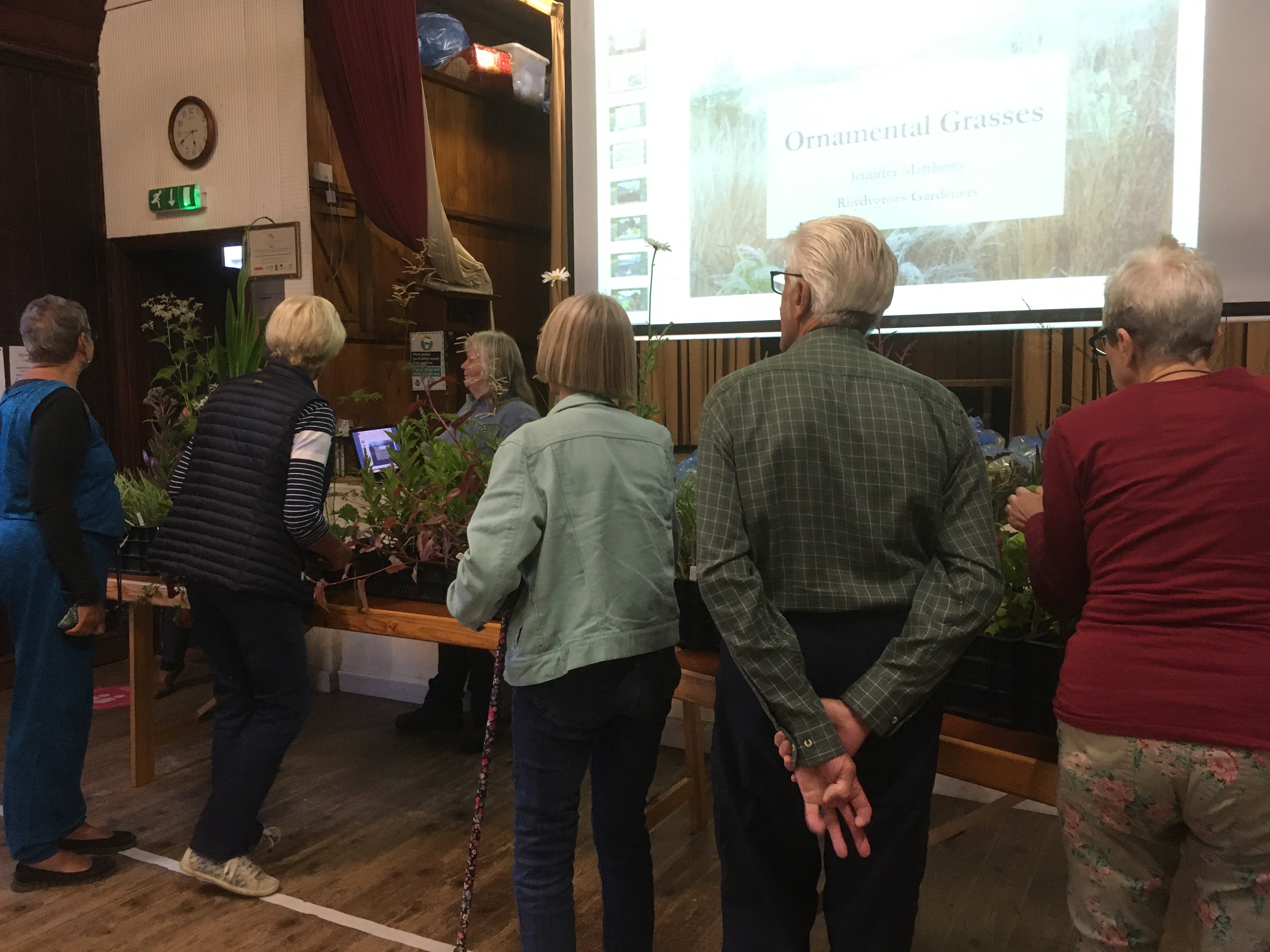
There was a great turn-out of members and guests for the excellent July talk given by Jennifer Matthews, who had travelled from Rhyd-y-Groes Gardens in the Preseli Mountains, where for 20 years until 2017 she ran Moorland Cottage Plants nursery. Now Jenny offers services such as garden design and photography, and has been opening her own garden for the National Garden Scheme for 22 years.

As background, Jenny began by telling us about her garden, which was just an upland field to begin with, explaining that she has always tried to garden with nature. It now contains, among other elements, a herbaceous perennial border, lime lollipops, a wildflower meadow including bluebells in spring, a shrub border including rhododendrons, and an ornamental meadow with cultivated native grasses and big, bold perennials.

Jenny’s introduction to grasses explained their importance as a plant family – from cereals for food and fodder to ground cover and now more and more to another plant group that gardeners are adding to their repertoire of ornamental plants.  Grasses offer elegant linear forms and year-round interest along with low maintenance.

There are three types of grasses – true grasses, sedges and rushes, and bamboos. True grasses have a wide variety of colour and growth habit, with round stems, while ‘sedges have edges’, the stems being almost triangular. Rushes have solid, round stems and need more moisture than sedges. Bamboos in their turn have hard woody stems – they can be specimen plants but also make effective screens and hedges.

Grasses can be variegated – with white, cream or yellow variegation; they can be plain green, yellow (these often do best in shade) or blue (for hot, sunny situations). There are also red, copper and brown grasses.  They do not have vivid, showy flowers, but the flowers do provide attractive structures which last well from summer into autumn.Jenny described all the different situations in which grasses can be used: herbaceous borders, island beds, mixed borders and beds, woodland gardens, architectural garden styles, flowering lawns, meadow and orchard gardens, ornamental meadows, bog gardens and water gardens (largely rushes). There are grasses for dry shade, damp shade, part shade, sunny and open sites, as well as well-drained and very sunny locations.

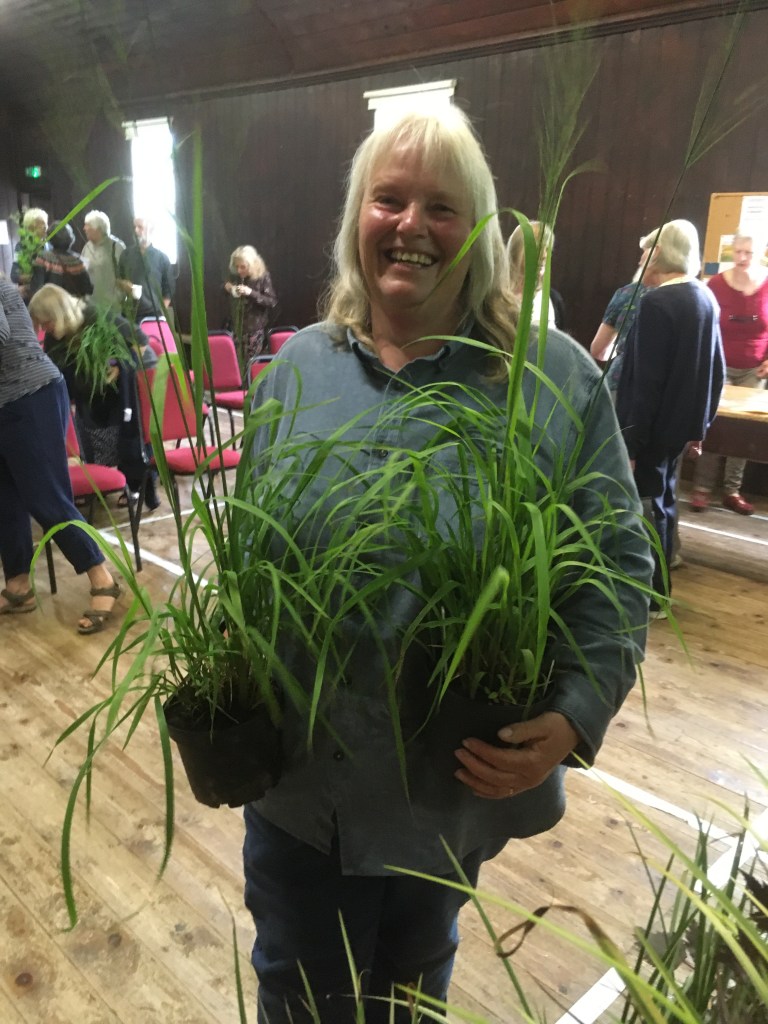
Jenny gave us tips on caring for grasses (they are fairly low maintenance – she described her own regime of weeding and dividing if necessary in spring, and cutting back in winter as the grasses themselves being to collapse), and for propagating them (always wait until you see the first signs of growth in spring or early summer – some grasses will be later than others). She also ran through a list of perennials which make good companion plants for grasses, a good selection of all of which she had brought with her for sale to members. After questions and warm appreciation for a fascinating talk, our appetites suitably whetted, many members made a beeline for the array of beautiful plants for sale.

Cothi Gardeners’ members enthusiastically inspecting the plants for sale

August Social

It was agreed that the August Social would be held at the Telegraph Garden Centre on 17 August in the early evening. The event will include a talk as well as refreshments – more details to follow, so watch this space…


Mid August Update and the Great British Garden Party

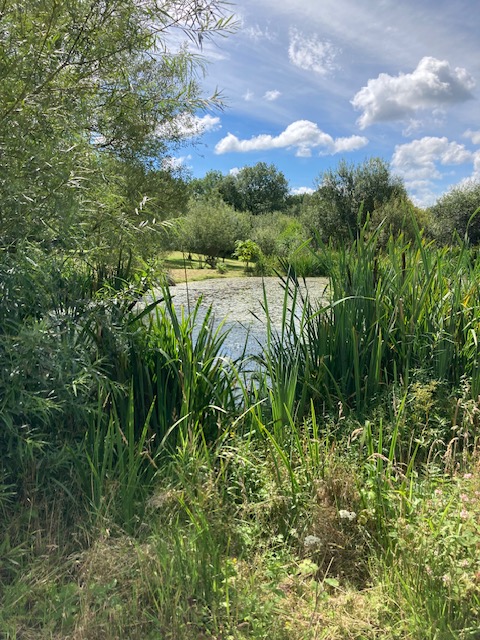
Another month, another update, and hoping all members have enjoyed their gardens over the last few weeks. I know that Tina and Derek have, and have been very busy too, with a major clearing out of their big pond. Thanks very much to Tina for sending me these photos of the work in progress.


I think Tina may even have some spare pieces some of her lovely waterlilies available for interested members. Do get in touch if you’d like more details. Tina says:

I didn’t offer before the dredging of the pond because I couldn’t get any waterlilies out – but now we have floating debris and a boat so if anyone wants some small parts of 3 colours of big flowered lilies and masses of the tiny yellows – see before and after photos – we will be going out on the pond from this Saturday when we get the landing stage repaired.
But the landing stage has been mended today -the rain is filling up the pond and we will get the boat out on Monday for a trial and to take out some of the rushes debris – I am delighted with the regrowth of many of the pond plants and know that the moorhen didn’t leave so who knows what we will see.


Members will already know from Elena’s email, that regrettably the club’s committee has decided to cancel the remaining planned indoor meetings for the rest of 2020 because of ongoing restrictions on indoor gatherings due to the Covid pandemic, and the risk of an autumnal resurgence in case numbers. Membership subscriptions from 2020 will be carried forward to cover the next year, and any ongoing club expenses will be met from club reserves.

As a means of at least allowing some club members to meet up, Julian and Fiona had the idea of using the upcoming NGS initiative of the “Great British Garden Party” as both focal meeting points for club members as well as being a way of raising some much needed funds for the nursing charities which the NGS supports. Click here to read more about it, and you’ll see that it’s open for anyone to host a party – you don’t have to already have a garden opening for the NGS.  Although as Elena outlined, each event should be numbers limited.

I know a lot of members have already got in touch with Elena with offers of either hosting a get together, or expressing an interest in attending one or more of the garden parties. But if you haven’t replied to her yet and would like to come to one of the  parties, or indeed host one, do reply soon, as September will  be here before we know it.  When Elena has all the details she’ll email us again, and I’ll also try to put the details up on the website asap.

Here at Gelli uchaf, we’re hoping to hold our contribution to this event on Saturday September 5th at 2.30 pm, or if the forecast looks really bad for the afternoon,  (on the Friday before, but looks OK for the morning), then we’ll move it to 11.00 am. If all of Saturday looks bad, we’d switch it to Sunday September 6th with the same time options. We’d limit guest numbers to 8 maximum, and hopefully have a few plants for sale as well as providing a range of Fiona’s scrummy cakes and tea/coffee/soft drinks, and a chance to chat and have a look round the garden.  More details closer to the time for our potential visitors!


I’m sure we’ve all enjoyed some pretty variable weather recently.  On the night of the 11th here, we went outside to see if we could watch the Perseid meteor shower, and were treated to the most amazing silent lightning display in the North eastern sky, which we took to be over Ffarmers way. It turned out the storm was much more distant, over the border in Shropshire. For anyone who hasn’t seen them yet there are some wonderful photos of just how amazing the sometimes orange explosion light effects within the clouds were, on Welsh photographer Karl MaCarthy’s site, which he took 75 miles away from the storm in Tredegar. Click here. 
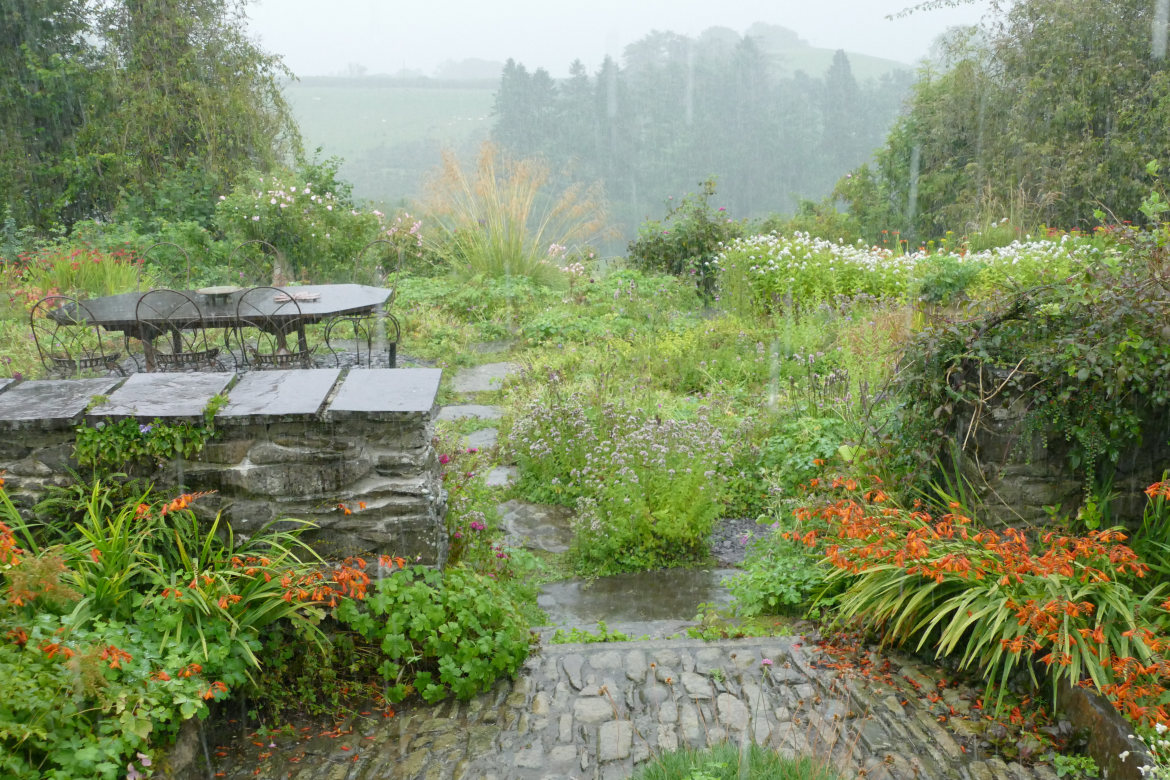
We’ve never experienced anything like it – standing in total silence in a star filled sky, whilst these sort of pyrotechincs lit up the horizon every second or so for over half an hour plus the added bonus of plenty of meteors. And no midges around on a balmy night to distract us!


Yesterday evening I thought I’d scatter the last few Snakeshead Fritillary seed which I’d saved from our top meadow, onto a section we’d cut for hay about 10 days ago, and in advance of today’s heavy rain. Another fortuitous decision, since as I finished, and turned round to head back down the hill, I saw a fantastic full half circle rainbow caught in the evening light with one of the crock of gold points exactly where all the lightning fireworks had been a week earlier.


Don’t we get some amazing weather round here, all in the space of a fortnight …


Two of the native plants, Knapweed and Devil’s bit Scabious, which we’ve introduced into our terrace garden over the last 2 years have begun to flower well this year. Both being chosen for their time of flowering, from August and then into September, as well as both being brilliant nectar plants for a range of bees and butterflies. Even better, one of the Devil’s-bit Scabious plants, collected from seed in a meadow at the bottom of our track has decided to produce really pale pink/lilac flowers as a nice complement to the blue/purple more commonly seen.


In the 25 years or so of owning Gelli Uchaf, swallows have been constant co–residents with us over the summer months, but perhaps on only half a dozen or so moments have I witnessed them playing feather tag, where usually just a pair, but sometimes more, will chase around the buildings and above the garden with the lead bird carrying a feather in its beak. Then losing it, or letting go deliberately (?), the race is on, given the speed they’re flying at, to see which can grab the lost feather first and take up the challenge. Usually a camera isn’t to hand but this time, in mid July, I was close enough to the back door as they whizzed along behind the house, so grabbed the camera, and they were still playing out over the apple trees and then back around the yard. The beauty of a bridge camera is having the ability to quickly switch to zoom, multiple exposure, tracking focus, low aperture (hence shorter exposure time) and swing the camera up, as they swept above me, before diving in through the barn door.

Game over.

So this is it folks! My only photo to date of swallow feather tag,  and you’ll have to look really closely to spy the feather in the lead, upper bird’s beak, but it is there. Honestly!

However, I’m really grateful to Andrea Gabriel, an American artist who’s captured this special moment perfectly in one of her beautiful paintings, and very generously given permission for me to reproduce “Barn Swallow Feather Game” above. Which communicates so much better than my image and the words before it, of the evident delights and flying skills of swallow tag.

Thanks very much Andrea! Do click here for more of Andrea’s wonderful work, which is also available to purchase on line.

Any other Cothigardeners who’ve seen swallows or indeed other birds playing feather tag, I wonder? Do let me know.


Finally one of my posts wouldn’t be complete without something on insects would it? So here goes…

In a previous post, I’d shown the huge waves of male drone bees returning to the butter churn hive after trips made to the mating aerial drone congregation areas in June. The swarm season now having largely ended, hopefully, and with food supplies available to workers beginning to decline, there comes a time when the colony determines that it’s time to get rid of the vast majority of these otherwise non productive male bees, which require food, yet contribute none to the colony, since they don’t collect nectar or pollen.

I’d read that this process can begin quite suddenly so was really pleased to be able to capture this moment on the morning of August 11th, the same day as the storm, when the much smaller female worker bees begin to grapple, drag and force the drones from the hive entrance. The poor drones, in spite of their larger physical size, can’t seem to resist the onslaught. I’m not sure whether the workers are using their jaws to chivy the drones as well.

Though the workers obviously possess a single use sting, they probably won’t want to use this,  since it might result in their own death, but standing beside the hive allowed me to watch a continuous stream of bees involved in this battle of the sexes in which there was only going to ever be one eventual winner. The set up of my hive with a sloping metal sheet beneath the hive entrance allows the determination of the harrying worker bees to be clearly seen.

The evicted drones will quickly starve to death, or suffer from hypothermia outside the warmth of the hive, and many will be approaching the end of their short life anyway. Yet another facet of the life cycle of the honeybee finely honed to optimise survival of the colony and species, over the individual.

And how, typically, it’s the gals who call the shots and exercise real power in this world!


Finally, as always, it would be lovely to keep hearing from members about their favourite plants, or things in their gardens as we go through the next few months. Why not write a few words and send an image or two, preferably resized down to less than 1 MB? I can’t promise to put everything up online immediately, but usually within a fortnight, and it’s a great way of keeping in touch and passing on information.

Or use the Cothigardeners Facebook Page.

You can send things to me at:

Cothigardeners@gmail.com

Thanks again to Tina and Derek for contributing to this post.