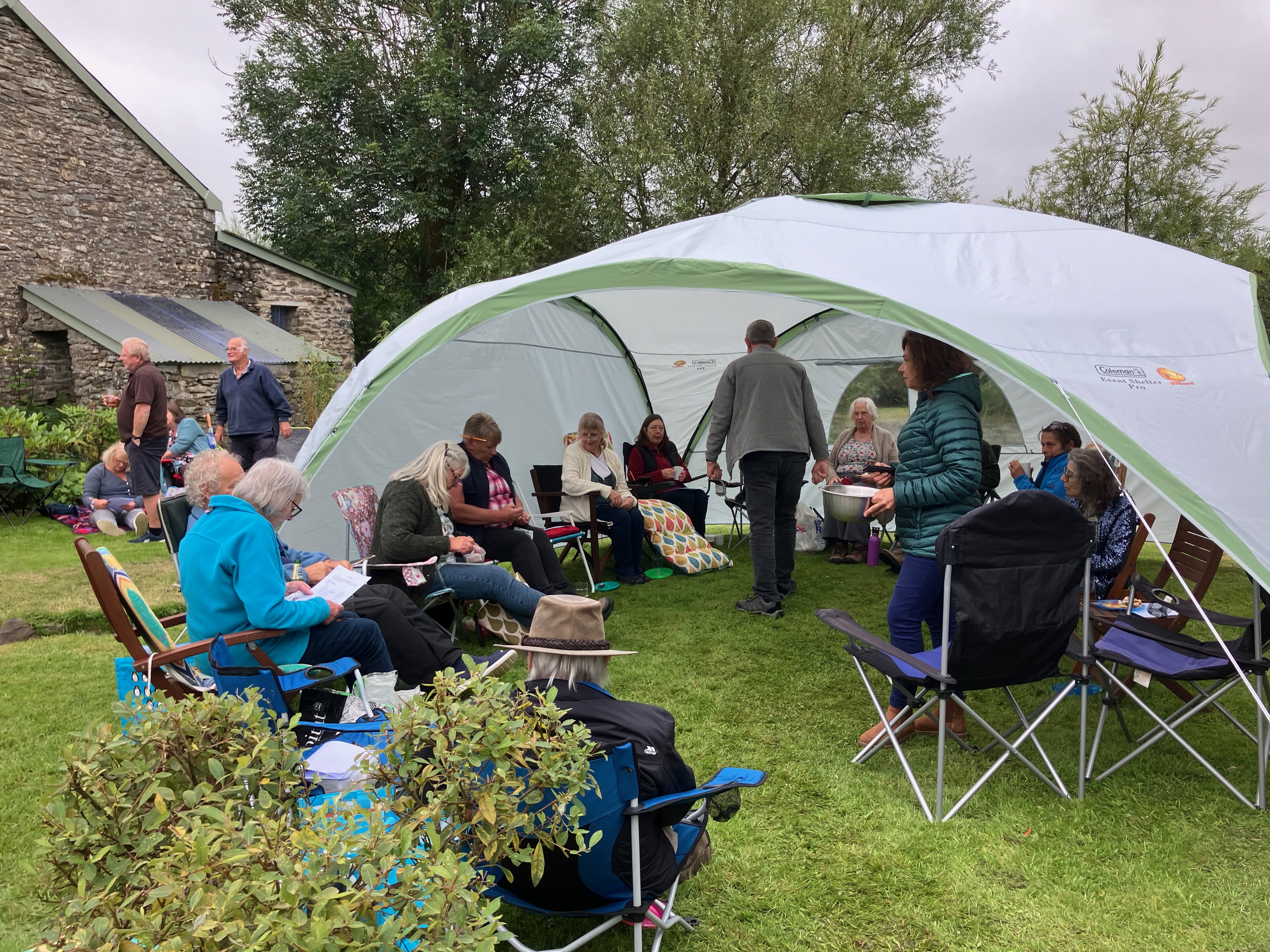
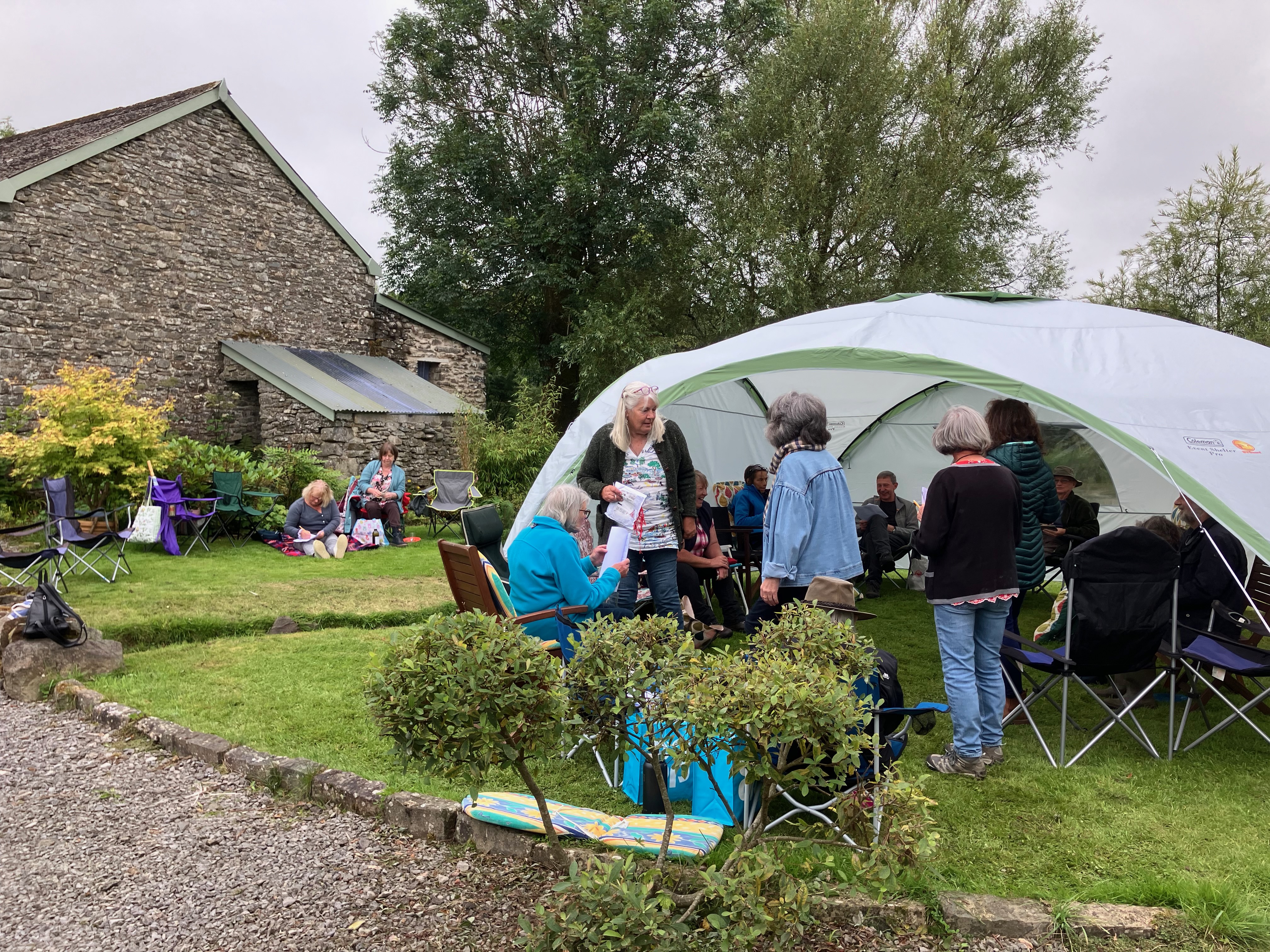
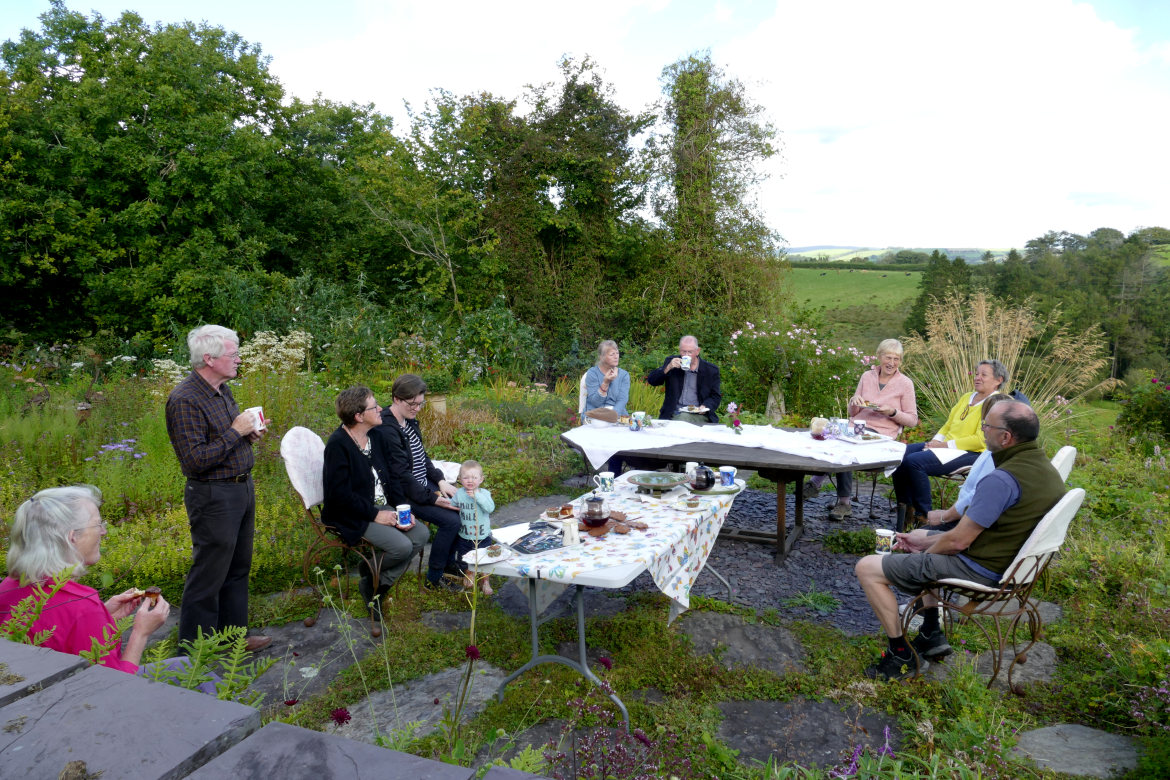
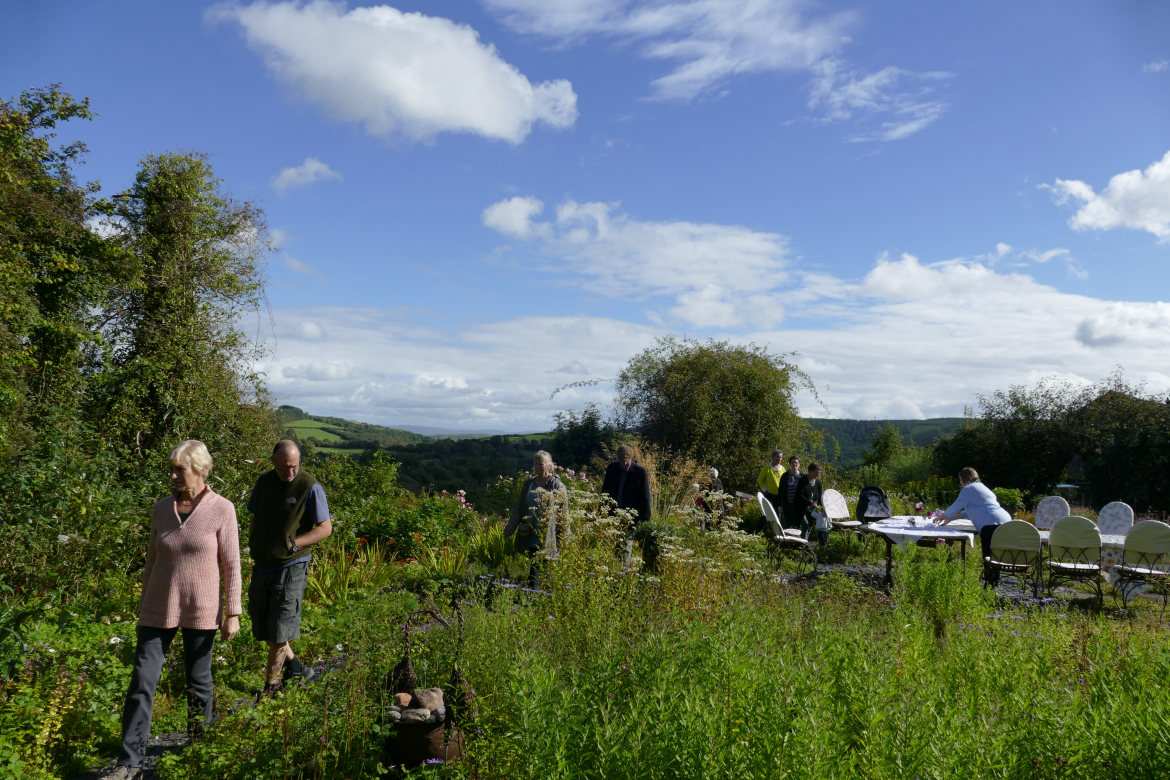
The Cothi Gardeners annual social, hosted by our Chair Dawn, was held on an overcast, but fortunately not rainy (at least not until the end, when the remains of Storm Ernesto arrived!) day, allowing us all to make the most of the wonderful garden in Ffarmers, and the activities arranged. Plenty of members brought along produce or flowers for the various competitions, and the table was laden with savoury delights and delicious cakes for us all to tuck into.
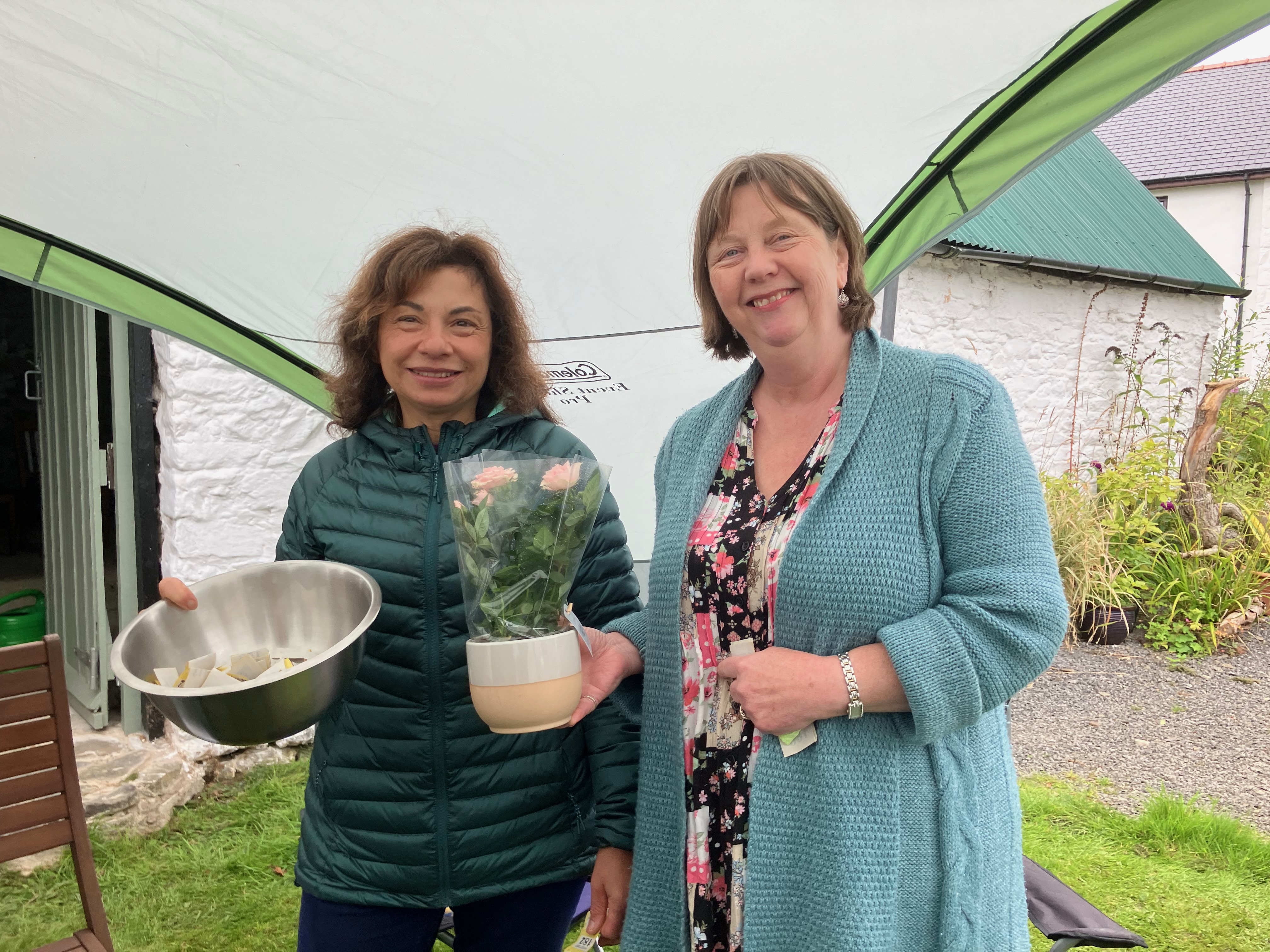
After much conversation over the food, the results of the raffle and the competition prizewinners were announced. There were a total of six prizes for the raffle, which also benefitted the Club’s funds.
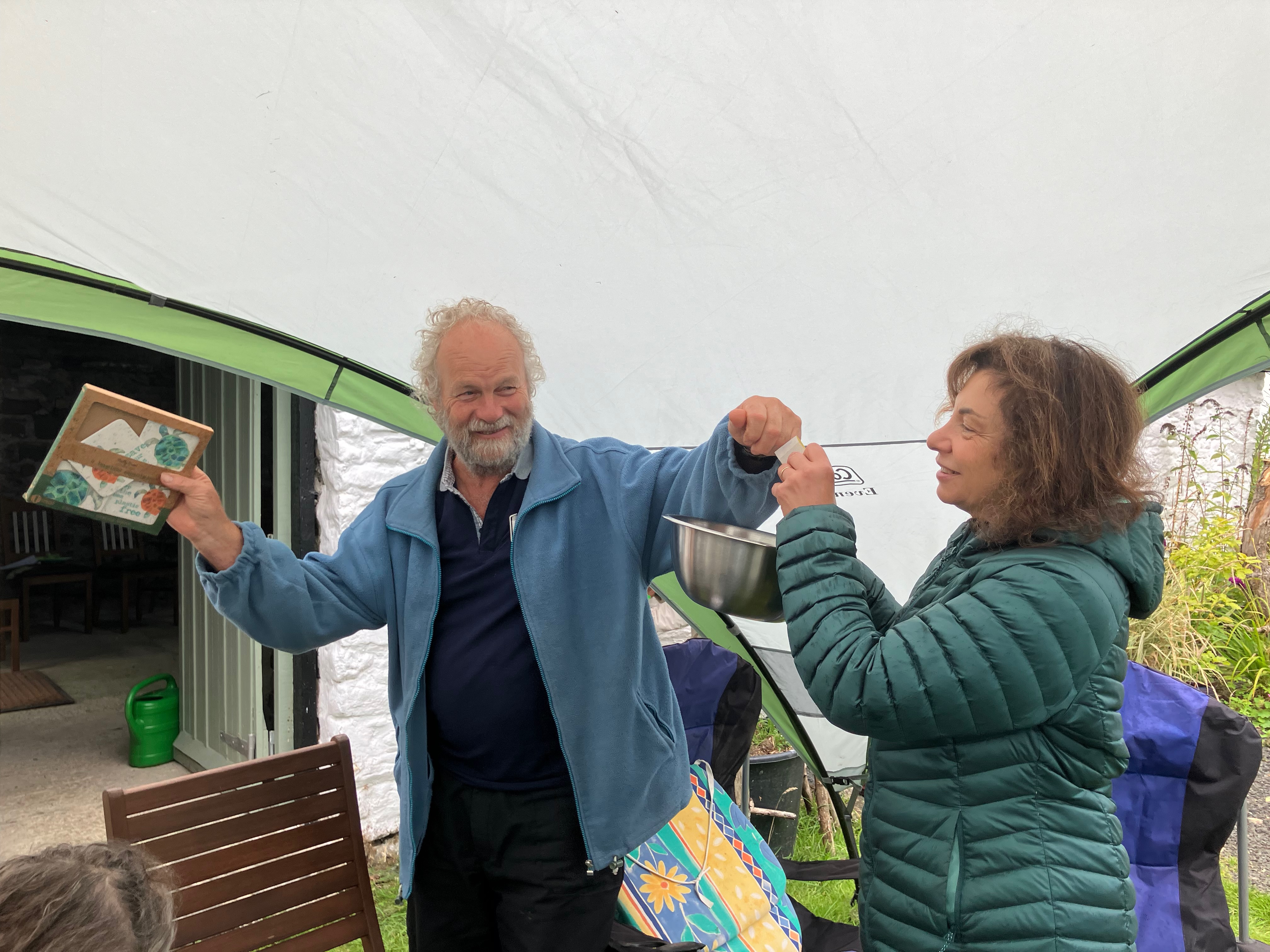
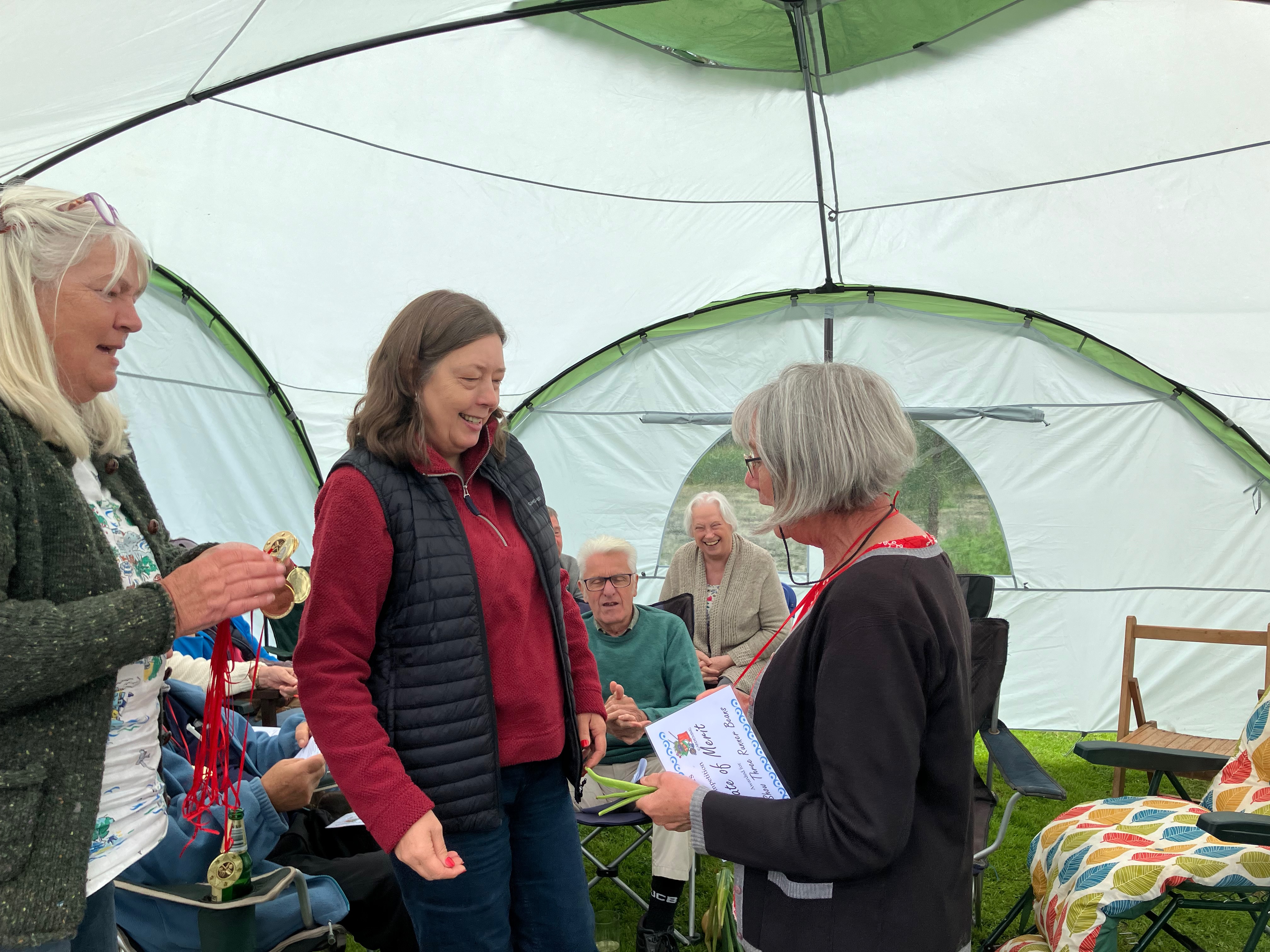
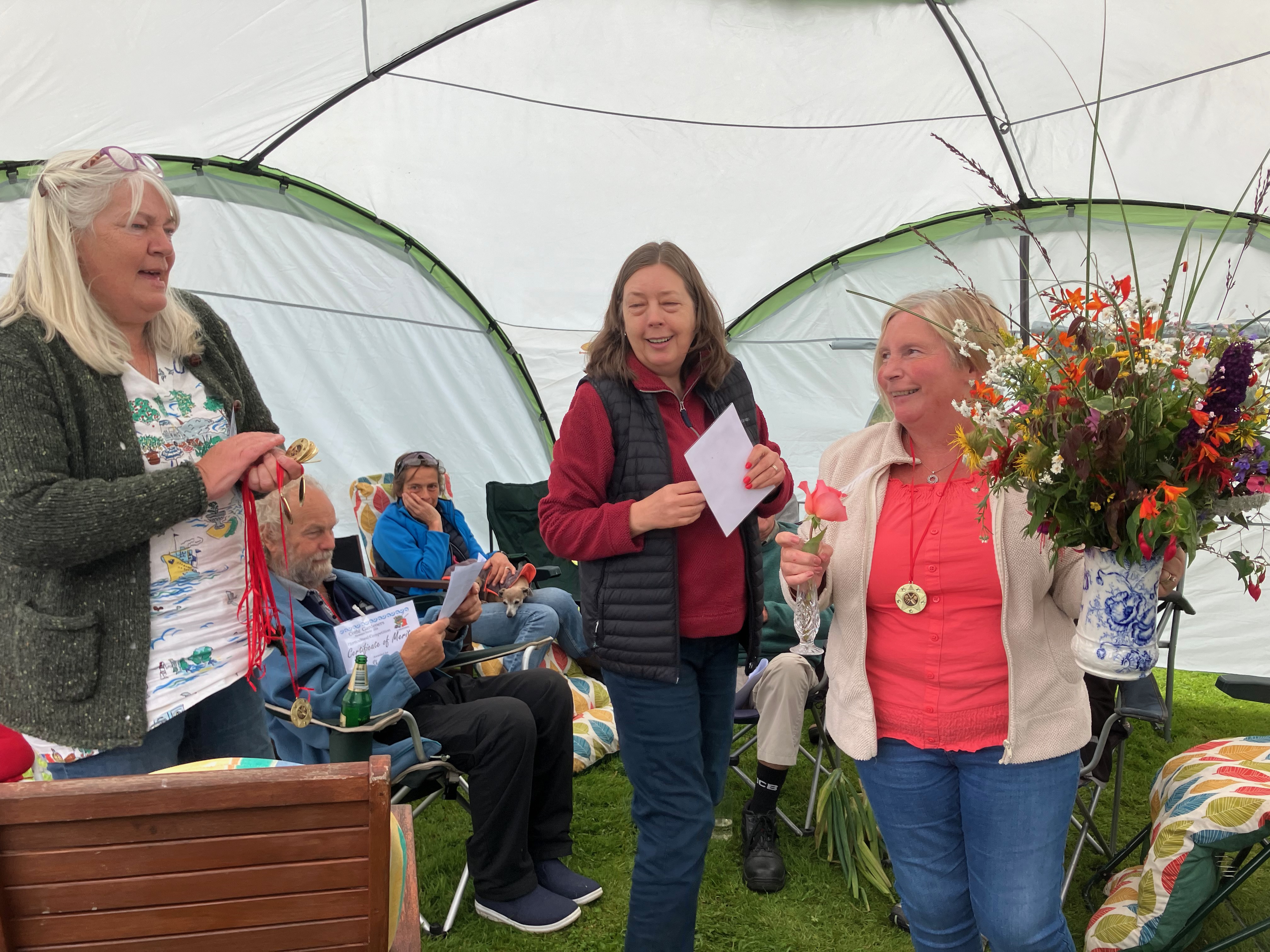
Certificates and medals were awarded for the best exhibit in each category, ably judged by guests Angela and Martin. Rob won the prize for the largest weed (by definition of being a plant in the wrong place, not an undesirable plant). Jenny claimed the prize for the best three runner beans, and Honour for the best flower arrangement and also single rose. Amanda won for best single dahlia, and the best potatoes.
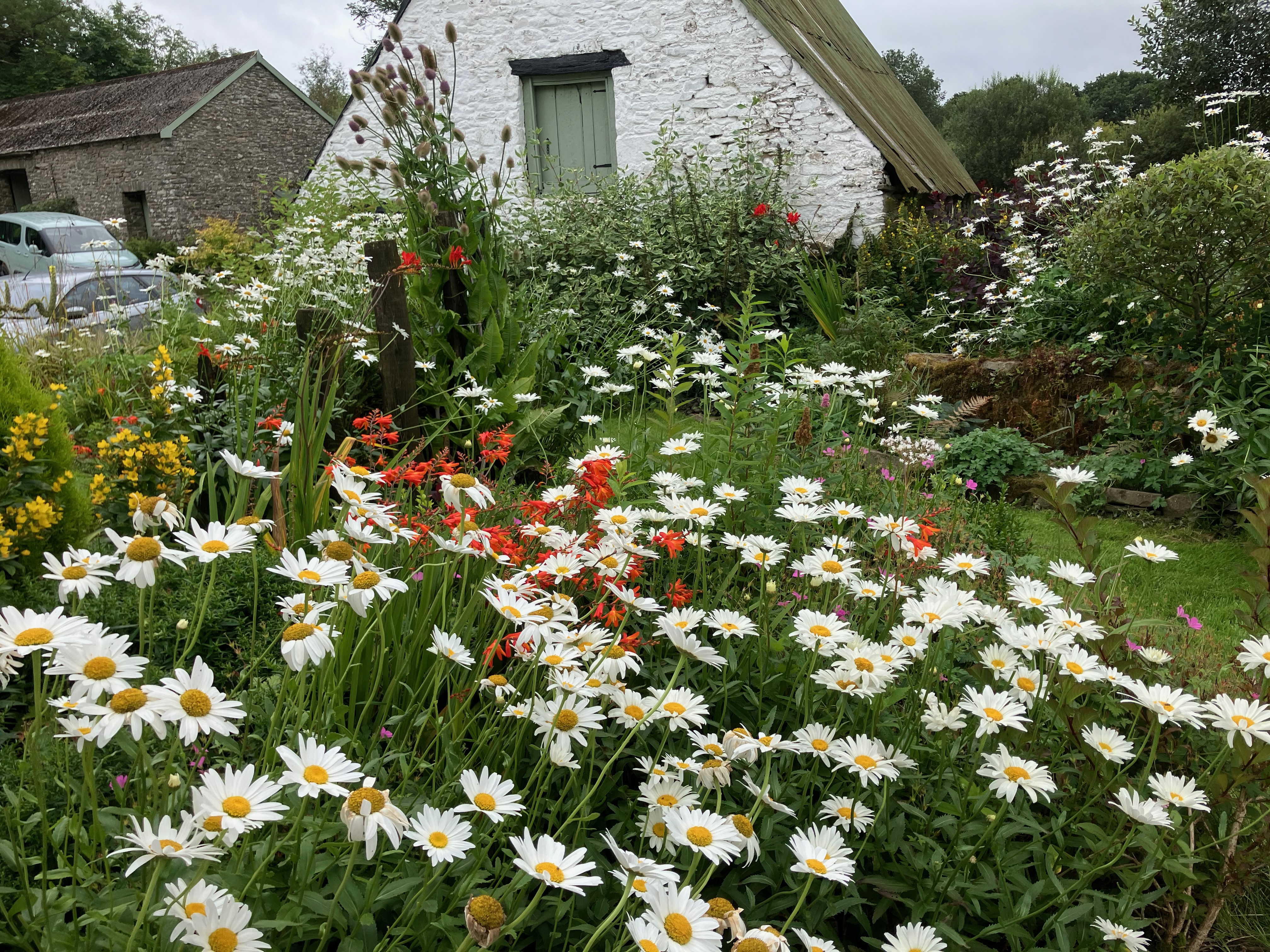
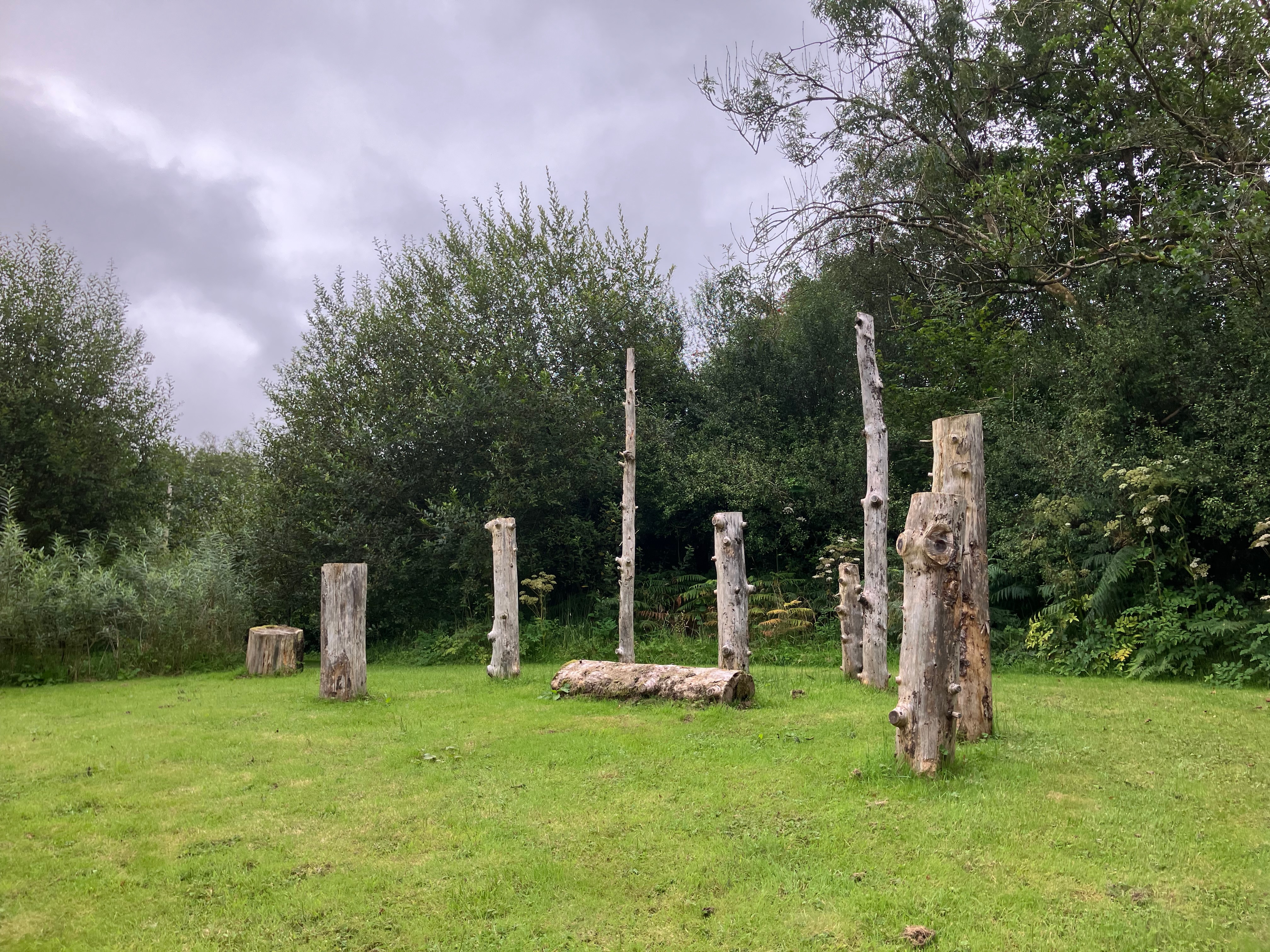
After that Dawn gave us a tour of their garden and land bordering the River Twrch and encompassing SSSI areas including swathes of Devil’s Bit Scabious, the food plant of the Marsh Fritillary butterfly, in perfect flower when we visited. I think that everyone was impressed with the natural beauty of the site and what Dawn and Nick had achieved in removing the overgrown brambles from much of the land, as well as creating a lovely more formal garden around the house and barns.
There was also an opportunity to try our hand at archery, with Nick a very friendly and able instructor. Let’s say that some of us were better than others, but everyone thoroughly enjoyed the experience.
We all enjoyed meeting Dawn and Nick’s lovely dogs, who played a full part in the proceedings and many balls were thrown during our walk. All in all it was a fabulous day out, and the raffle and plant sale (thank you Rhoslwyn Plants) raised welcome funds for the club.
This year’s Cothi Gardeners Christmas Social was held at Ystrad Nurseries near Llandovery. It was, for a change, a sunny afternoon, the alpacas greeting us as our cars pulled in. We all arrived in time to have a good browse around the nursery before the demonstration
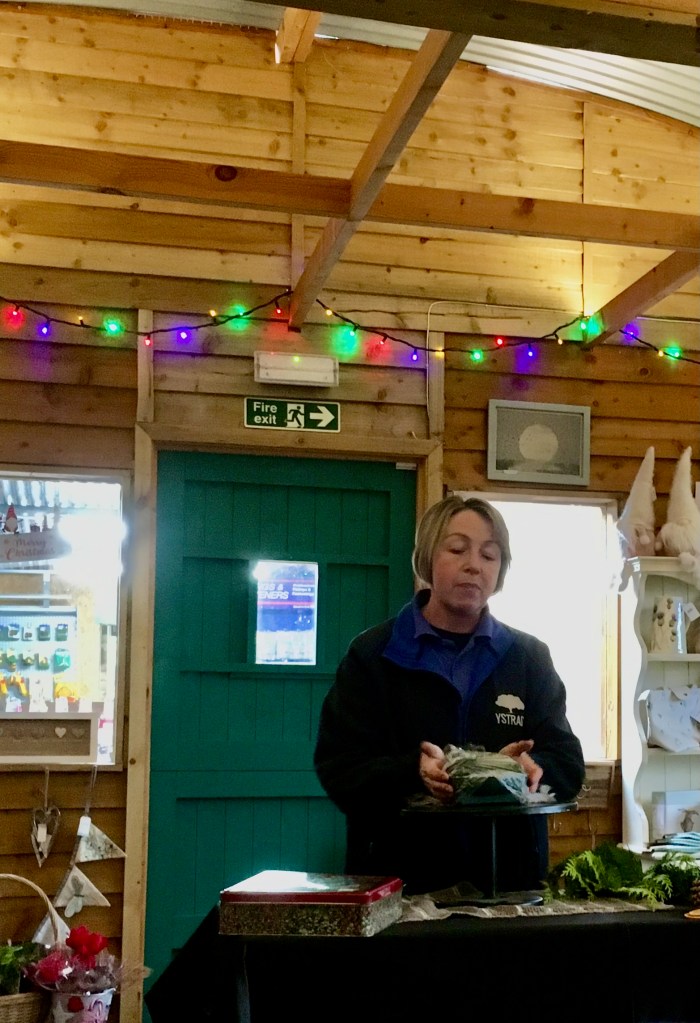
Julie began the demonstration by telling us a bit about the history of the nursery and timber yard, particularly since 2016, when John and Laura Morgan bought Ystrad, having seen the potential to bring together her background in running a nursery and John’s expertise in the timber business. Since then they have grown the business significantly, and from an original staff of three at Ystrad in 2016, there are now over 30. Ystrad Nurseries itself now also has florist Sian on site, and has embarked on phased improvements, beginning with the car park and entrance. Julie herself has worked here since 2020, having previously been a primary school teacher.
First we saw how to build up an arrangement that could be adapted either for the table, or for placing on graves, using a square block of oasis in a circular base, Starting at the bottom, it is best to avoid prickly holly and to create a base layer with fronds from spruce or cypress. The holly can go in as the next layer. Julie recommends pieris for the centre of the arrangement, which at this time of year has flower buds. To add berries and ensure they show up well, take off any surrounding leaves. When adding skimmia do the same and strip the leaves to highlight the purple flower. For a table arrangement, you can then place a candle-holder with candle in the centre.
Julie then explained how to wire items onto an arrangement, such as dried orange slices, and also demonstrated bow-making.
After that, we turned to wreaths. Nowadays moss is less favoured, and people are choosing straw-based rings for the base as a more sustainable option. The straw rings, once purchased, can be re-used the following year if allowed to dry out and stored safely. The greenery can be fixed in place with either wire or twine, using small clusters of foliage as you go, again starting with spruce, but incorporating a range of foliage such as osmanthus, choisya, skimmia, leucothoe and pieris. From this you can then adapt the decoration depending on whether the wreath is for a grave, a door or table arrangement.
Julie with straw base for a wreathFinished wreath for table decoration
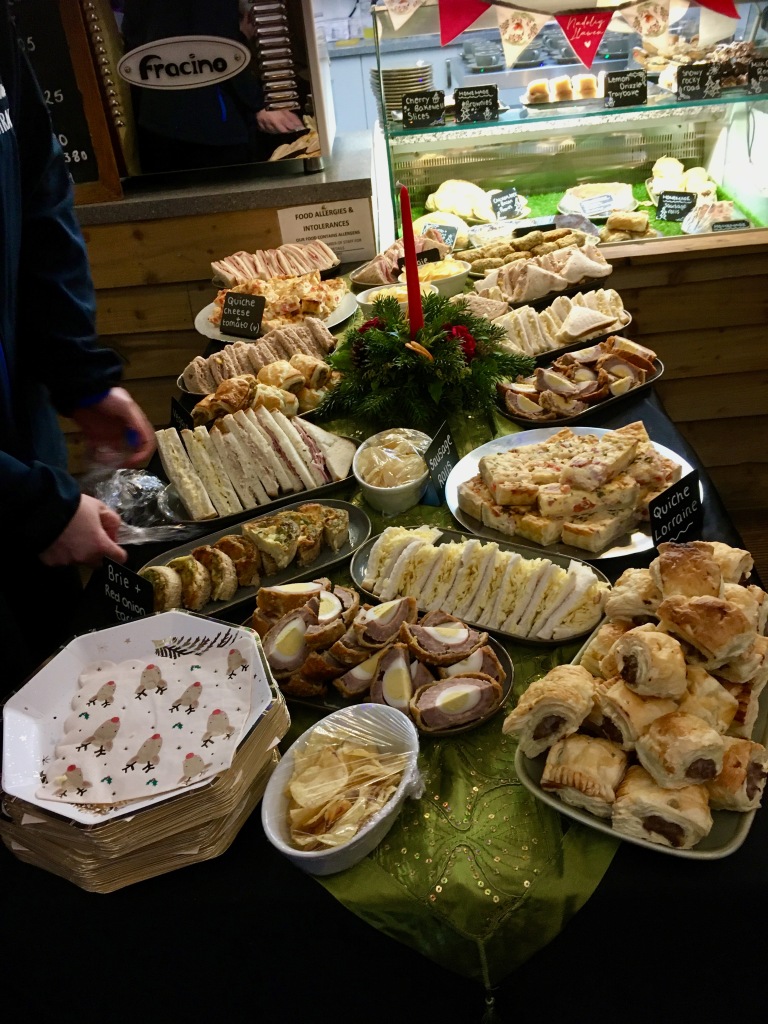
After thanking Julie for her interesting and informative presentation, everyone had an appetite for the delicious and plentiful tea that Ystrad Nurseries had provided. We weren’t going to need supper after that, and a grand time was had by all!
NGS Donations in 2023
Cothi Gardeners Club are fortunate to have among our members John and Helen from Ty’r Maes and Julian and Fiona from Gelli Uchaf who open their gardens for the National Garden Scheme in Carmarthenshire and Pembrokeshire. Across the two counties as a whole there were 3,514 visitors, of which 2,130 were from Open Days and 1,384 from By Appointment visits. That is a return to the visitor numbers seen in 2019 and previously. In 2023 the total raised for charity was £26,638 (up from £20,300 in 2022) – a fantastic increase!
In total the National Garden Scheme has been able to donate £3,403,960 to beneficiaries in 2023. This record amount is testament to the hard work and dedication of all those who open their gardens to the public and all the volunteers who contribute.
Joseph was the Head Gardener at Aberglasney Gardens from 2011 until 2022, when he left to run The Plough in Felingwm, where he grows as much produce as possible for use in the pub, and is keen to obtain sustainable and local produce from nearby.
In gardening, he has always been keen to use and promote succession of planting in order to provide constant, all year round interest and make less work into the bargain. Hurrah!
His first early flower which works so well, particularly valuable if short of space, is the snowdrop. There are so many varieties which will flower at different times and will happily sit around other early bulbs in order to provide early spring succession.
The two types of cyclamen (Cyclamen hederofolium and Cyclamen africanum) are particularly valued because of the length of their flowering period and because the tubers will happily regrow for decades. If they can be planted in mounds or banks, their full effect and beauty can be easily seen.
Following snowdrops, Crocus appear (he’s particularly keen on the variety ‘Vanguard’), so interplanting with these two and also dwarf Dutch Iris will provide lots of interest. Iris lazica are also fairly bombproof, with the advantage that the leaves can be cut after flowering without detriment – they are winter flowering but will last until March/April.
Obviously tulips and narcissi (he particularly recommends Narcissus ‘W. P. Milner’) are good for interplanting and in Aberglasney Gardens it was known for some daffodils still to be flowering into July. Hellebores also always do well, starting in February and continuing into May; they will give very good value, coming up year after year. The different types of Camassia and Allium will provide interest for the Spring gap, and Iris (he recommends the dark Iris chrysographes) are good for the June gap.
Kniphofia (red-hot pokers), (particularly K. rooperi which will flower all through the season) also provide height and texture and they do not need cutting back in autumn. Geranium varieties are long flowering and, if cut back during the season, will flower again. Crocosmia provide fantastic pops of colour and, once established, can be split to provide more plantings. The variety ‘Hellfire’, an extremely vivid red, is recommended.
Shrubs are such good value and, once established, will provide lots of interest with very little attention. There has been a lot of work invested in what is now a huge selection of Hydrangea varieties with many different types and colours of flowers. For a smaller, later flowering Hydrangea, H. paniculatum ‘Brussels Lace’ will flower from July until the first frosts. The evergreen shrub Coronilla ‘Citrina’, which is compact and rounded, will grow in a sheltered position providing lemon yellow flower umbels in late winter and early spring.
Don’t be afraid of dahlias! They are long flowering and the answer is to stick to 5 different types; the tubers are well-suited to filling in gaps in the late summer garden. Joseph particularly likes the smaller ‘Downham Royal’ which is a darker variety and very long flowering.
Calendula and Verbena are both long flowering but do prefer drier conditions. Cerinthe major ‘Purpurascens’ has a silvery leaf, is self-seeding and will virtually grow anywhere, so is very good value.
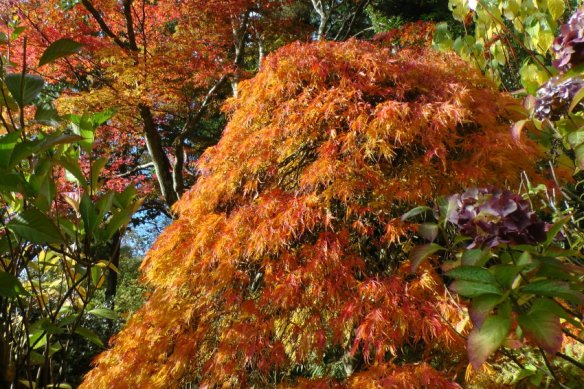
For autumn colour, the trick is to plant trees where they catch the light and they will really shine. Acers of different types are always stunning and worth the expense if planted well. We shouldn’t forget foliage for autumn/winter planting, it will provide lots of variation in colour and texture.
Joseph then answered questions from the audience:
The science of planting – it’s concentrating on what gives pleasure to the eye.
Flowering time of different plants – try not to think too hard. What works best is to plant different types of one plant.
Keep a diary! It’s invaluable.
Problems with creeping buttercup – if it’s a problem in a lawn, scarify with a rake to remove it. Under a hedge – mulch or put down membrane and then plant as soon as possible.
Mound planting of shrubs – don’t dig a hole, just put a dish in the top of the mound, place the shrub into the hollow on the mound and heap up soil around it. Look after it well in the 1st year, half as well in the 2nd year and then leave it alone!
Rhododendron – bear in mind that they have very shallow roots, but they will work well in most conditions. They will grow in a shady border or at the edge of woodland but need watering well, particularly when first planted.
Elena thanked Joseph for an entertaining and useful talk with helpful slides.
John’s End-of-Season Plant Sale – 8 October – in Aid of NGS Charities
Start time 1.00pm Sunday 8 October at Ty’r Maes Ffarmers SA19 8DP
On the A482 look for the yellow NGS sign 7m SE of Lampeter. 8m NW of Llanwrda. 1½m N of Pumsaint opposite the turn to Ffarmers.
There will be loads of plants for sale – at least twice as many as last year. People are also encouraged to bring plants to swap. Donations are welcome, as the aim is to raise money for NGS charities.
FREE entry; tea, coffee and biscuits are provided – if you would like to donate a cake, they are always most welcome!
Parking is on the field opposite the turn to Ffarmers (weather permitting!), although the area near the house will be available for loading and unloading plants .
Committee Vacancies
Early in 2024 two of Cothi Gardeners Club committee members (the Chair and Deputy Chair/Marketing) come to the end of their term on the committee and are retiring from their roles, having served for a number of years including during the very difficult time of Covid. It is a rewarding experience to be part of the committee of such a vibrant and friendly club, so members are asked to give this serious consideration. If you are interested or if you have questions, please contact Elena.
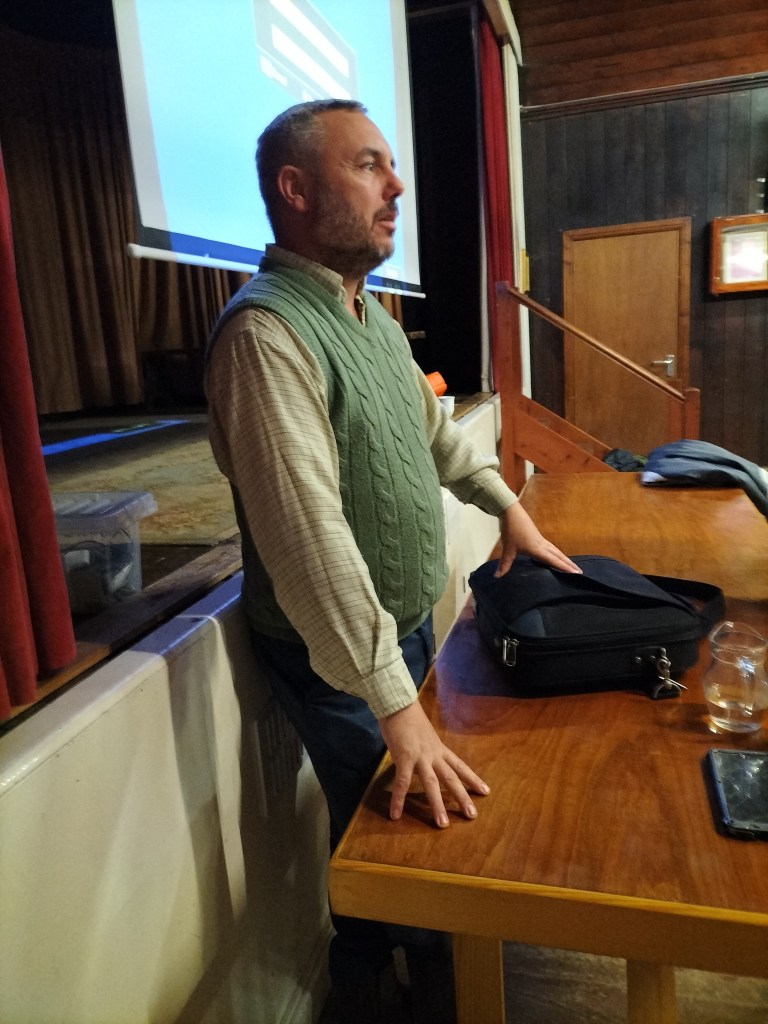
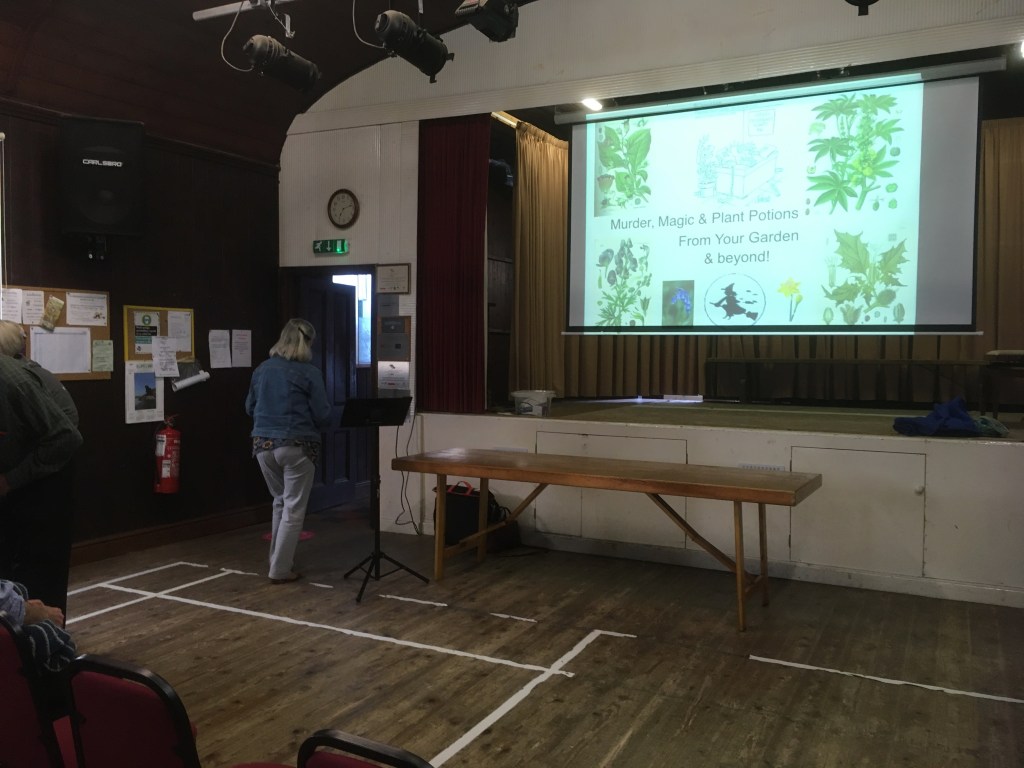
Marion opened by telling us that her talk would be about ornamental and native plants – their history, their less well-known aspects and their ability to both heal and harm. The definition of ‘poisonous’ can range from a nettle sting to causing death. The talk would cover just some of the plants that can be described as poisonous, highlighting those that can be both good and bad.
A good example is the yew tree. All parts of the tree are poisonous, apart from the red flesh of the berries. Symptoms of poisoning can range from stomach upset to heart failure. There are records of yew clippings being thrown into a field where sheep then died after eating them. Traditionally, yew trees have been grown in churchyards and in that environment there are many ancient specimens – in Perthshire there is a tree recorded as being between two and three thousand years old. It was believed that yew trees became poisonous by feeding on the dead bodies buried in the ground in the churchyards, and for that reason they also became associated with witches (another theme in this talk). On the positive side, yew has more recently become known as the source of the anti-cancer chemical taxane, which has had many benefits.
A number of gardens were sources of information for this talk – the Chelsea Physic Garden, the Alnwick Garden Poison Garden and the Welsh National Botanic Garden. The latter contains the Apothecary Hall, a recreation of an apothecary’s shop as it would have been in 1919. Many herbal plants include ‘officinalis’ in their Latin name, indicating that they were used for medicinal purposes, primarily at home. If these domestic remedies failed, people would turn to the apothecary., who would have turned plants into powders, pills and tinctures – the raw materials would be contained in labelled drawers. An example photograph from the Apothecary Hall showed us a drawer labelled with various plants we would consider poisonous, including Aconite. The latter ingredient was included in a prescription (which can be seen there) dated 23 June 1918 – but we don’t know what was wrong with the patient, nor whether they recovered!
Plants are, of course, still used in medicine; now, much more rigorous testing and isolation of the active ingredient is carried out. This ingredient is then made up or synthesised (created artificially). The World Health Organisation estimates that 80% of the world’s population rely on plant-based remedies, while 40% of the industrialised countries use medicines based on plant extracts, and 33% of new medicines developed in the last 25 years have been made from or are synthesised versions of plants. For example, the anti-malarial ingredient artemisinin was isolated in Artemisia annua (sweet wormwood) in the 1970s which was effective, but then resistance developed. However, now an American trial is using the whole plant, which contains 10 different anti-malarial properties, which is proving very effective (as it is harder for the parasite to develop resistance to 10 different components).
The poisonous ingredients found in plants fall into a number of groups:
Alkaloids: this group includes the poppy, which provides morphine.
Glycosides: this group includes foxgloves, whose active ingredient is used to treat heart problems.
Saponins: only some plants containing these are poisonous. The group includes the soapworts, but also the little corncockle, which used to be a problem in hayfields.
Essential oils (terpenes and sesquiterpenes): many of us are familiar with the great variety of essential oils available. One example is lemon balm essential oil which is now being studied for the treatment of agitation and aggression in Alzheimer’s Disease, and also for the treatment of epilepsy. Essential oils are widely available, but as they are very concentrated they can be problematic if they are not correctly diluted.
Peptides and Proteins: peptides (as found in gardenia, for example,) are widely used in skincare preparations.
Pyrethrins and Pyrethroids: deriving from plants from the Chrysanthemum family, pyrethrum is an insecticide (used against ants, for example). Care should be taken to use it in the evening to avoid damaging other insects such as bees.
There are three ways in which a person may be killed by a plant:
they may ingest it accidentally;
they may be given the plant with intent to kill them;
they may self-administer it.
There are a number of plant families which contain poisonous plants (although not all the plants in the family may be poisonous:
Solanaceae: this family contains potatoes (which is why you should cut out any parts of potatoes with green colour for the high concentration of glycoalkaloids) but also deadly nightshade; it contains Nicotiana tabacum (tobacco), as well as the lovely scented N. sylvestnis.
Apiaceae: this is the carrot family, so again it contains a vegetable that we eat as well as hemlock (Socrates was sentenced to die by drinking hemlock). Its similarity to wild carrot means great care should be exercised. Giant hogweed, in the same family, is phytotoxic, and so the juice can cause severe blistering and burns when exposed to sunlight. Dill, parsley and parsnip also have the potential to be skin irritants.
Ranunculaceae: this is the buttercup family, including Aconitum (all parts of which are extremely poisonous), Delphinium and Helleborus (which has irritant sap).
Liliaceae: cat-owners will no doubt be aware of the danger these plants pose to cats. All parts of the plant are toxic to cats, including the leaves, flowers and pollen, even in very small amounts. The autumn crocus (Colchicum autumnal) is also a toxic plant, but is used in the treatment of gout.
Papaveraceae: this is the poppy family, which is the source of the painkillers morphine and codeine with all their adverse and beneficial effects.
Euphorbiaceae: many of the spurges contain irritant sap which is phytotoxic. The castor-oil plant, Ricinus communis, is a member, giving us castor oil (used for many things including the promotion of hair growth in men, but also the deadly poison ricin). It is the coating of the bean that contains the most ricin – one bean contains enough to kill a human, and it would take four beans to kill a horse.
Amaryllidaceae: two plants in this family very familiar to us in Wales are the daffodil and the snowdrop. Both plants contain galantamine, which is used in the treatment of Alzheimer’s Disease in its early stages. Indeed, daffodils are grown commercially for this purpose, including near Talgarth in the Brecon Beacons. Bluebells are another member of this family, everywhere in the hedgerows and woods at this time of year, with a medical history going back to the thirteenth century for the treatment of leprosy. Bluebells are now being investigated as a possible control for mycobacterial infections, including tuberculosis. It is known that badgers eat bluebells, so is it possible that they are self-medicating for tuberculosis? Bluebell bulbs have been shown to contain at least 15 different compounds, some of which are similar to those used in the treatment of HIV and cancer, and others have diuretic and astringent properties. On a more mundane note, the juice from bluebell bulbs was traditionally used in place of starch.
Plantaginaceae: an important plant in this family is the foxglove, which contains digitoxin and digitalin. These are compounds which have a low therapeutic index (where there is only a narrow margin between the amount needed to be medically effective and the amount that would do harm). Despite being so well-known to us today, its use to treat heart disease is relatively recent. In 1598, Gerard in his Herbal declared that the foxglove had no place in medicine; although it would have been used by wise women to treat throat problems based on the doctrine of signatures. It was also later used as a diuretic to treat dropsy (which in retrospect makes sense as fluid build-up can be caused by congestive heart failure).
Marion went on to discuss some of the plants, whether native or introduced, which might serve as starter plants in a witch’s garden. The first four have been referenced in the context of the ‘witches’ flying brew’, supposedly used by witches before mounting their broomsticks!
The first is Aconitum, or wolfsbane. It has the reputation of being one of the most poisonous plants in the garden (although it is also a wild plant). It can be absorbed even through broken skin. It can give rise to severe stomach problems and slow the heart, sometimes fatally. Gloves should always be worn when handling the plant. It was used in warfare to poison arrow tips and to poison the water supplies of besieged castles; it was also used to administer the death penalty in some Greek cities.
Another ingredient in this brew was Atropa belladonna, or deadly nightshade, named after Atropos who in Greek mythology wields the scissors of death. Poisonous as it is, atropine is also an antidote to the nerve agent sarin, and was issued as such to US troops in the Iraq war. The ‘belladonna’ in the name comes from the Italian for ‘beautiful woman’ and refers to its use in dilating pupils to make eyes appear more attractive; atropine is still in use in optometry for specific purposes.
A second member of the nightshade family is henbane, Hyoscyamus niger, containing hyoscine causing hallucinations, as well as vision problems, forgetfulness, weakness and sleepiness. Along with the mandrake root, again of the same family and containing hyoscine, it also makes up part of the flying brew.
Datura, thornapple or jimsonweed, is another plant with a low therapeutic index. The plant has been used as an anaesthetic and asthma treatment, as well as a hallucinogenic. It is worth noting that Brugmansia, often grown in gardens, has the same properties.
Amongst other plants is Sambucus nigra , the elder. In addition to being used to create elderflower cordial and elderberry wine, both flowers and berries have anti-bacterial and anti-viral properties. However, the roots and some parts are very poisonous, so care is needed. Elder trees were often planted in graveyards, and were believed to be protective if planted by a house. In Ireland witches traditionally rode eldersticks rather than broomsticks; the most powerful wand in the Harry Potter books was the Elder Wand.
The box, or Buxus sempervirens, is a native plant commonly used for edging in gardens, but it also contains buxine and is poisonous to us (it can cause a skin rash) and animals. Boxwood extract may boost the immune system, and it was once used in place of quinine to reduce a fever.
Marion was keen to stress that the purpose of her talk had not been to make us concerned, but to bring out the hidden elements behind the history of many plants which she hoped would add to our enjoyment of plants. Members of the audience shared their experiences of contact with some of the plants she had mentioned, and the meeting closed with a big thank you to Marion for a fascinating and enjoyable talk.
Members Only – Mad Hatters Tea Party
Cothi Gardeners’ Club members are invited to a Mad Hatters Tea Party (hats obligatory, the madder the better!) on 14 June at Fiona and Julian’s wonderful garden in Rhydcymerau, when the wild flower meadow should be at its best. If you are a member, and haven’t already let Elena know that you would like to be there, please get in touch with her directly, or email Cothi Gardeners and I will forward your query on. Julian has very kindly prepared a couple of videos to introduce the garden to new members of the club and remind existing members of its delights.
This is a brief post to let you know that our 2022 programme starts next week. We are having the first two meetings by Zoom and then will hopefully be able to have ‘in person’ meetings from March onwards – fingers crossed!
Next weeks’ meeting is on Wednesday 19th January, 7.15pm for a 7.30pm start when Carole Whittaker will be talking to us on “The History, Medicinal Qualities and care of Monarda“
These beautiful perennials from North America have been utilised since 2,500 BC by the Native American peoples for their medicinal qualities. But the history does not stop there! The talk covers all aspects of caring for these unusual, late summer perennials.
Carole and her husband, Pete, have established a beautiful garden, Glyn Bach, in Pembrokeshire which is home to their National Collection of Monarda. The garden is open through the NGS and Plant Heritage. Click here for their website.
If you would like to join the Zoom meeting and have not received the email with the invitation please contact Fiona at cothigardeners@gmail.com so she can send it through to you.
Time flies and a couple of short walking breaks for us in September and early October means I haven’t updated members on the outcome of the garden parties which were held early in September, so here goes!
Elena collated all the information, so many thanks to her for doing this and passing it on, and in the end the four events raised a total of £560, which we all agreed to donate exclusively to Marie Curie since they took such good care of Dave, Avril and family at the end of his life. The sums raised were as follows…
Ros & Mark £65
Fiona & Julian £100
Elena £165
Helen & John £230
Given that the total raised across the UK from this NGS conceived event was a little under £40,000, of which a massive £12, 000 was down to the efforts of the charity’s CEO, George Plumtre ( click here for more feedback), this represents a great achievement by our small club, so many thanks to all who were involved in any way. Andy, our treasurer has arranged to make the payment direct to Marie Curie.
As well as the money raised, the events proved to be a most welcome chance to meet up and chat, as some of the feedback comments from those present illustrate…
Having deprived ourselves of human company for almost six months, we accepted the kind invitation to a garden party with a degree of trepidation. With masks and gloves at the ready, we set off on what seemed like a marathon journey of some 20 miles – the furthest we had ventured since March! We were lucky…. the sun was shining, the roads quiet and the houses, fields and woodlands reassuringly just as we remembered. We were greeted by the sounds of cheerful conversation and laughter from small groups of friends. Seeing your immaculate garden, the teas, and super cakes sampled along with relaxed ‘catch-up’ conversations with friends left us feeling more energized than we have both felt for a long time. Jane and Ivor Stokes
Thank you for the very nice garden visit. It was lovely to see your new pond. What a great little get together with good company, food and drinks. Your efforts were greatly appreciated, especially to those of us who don’t get out much! Jenny Long
We have broken out. Thank you so much, we really enjoyed ourselves so much we didn’t notice the time. All the best. Daisy and John Hufferdine
The company of others can be made so enjoyable outdoors in a garden – the beauty of plants and abundant insects – the chat and the afternoon tea – lovely!! Tina and Derek Marshall
It was great to be able to sit and chat to friends old and new and to know that the funds raised were going to a cause that means a lot to us. Your mulled fruit cup was particularly welcome on a rather damp evening! It also gave us enormous pleasure to be able to host our own garden party. It was lovely to be able to have a long chat with friends we had not seen for months, some of whom had barely been out of the house since lockdown. What a wonderfully enjoyable way to do something to help others. John and Helen Brooks
Attending the Garden Parties and being part of small groups meant that we could talk to people more easily. It was so interesting to hear about other people’s gardens and to learn about their lives and interests. Jane and Stephen Thomley
Thoroughly enjoyed our tea time visit to your garden and grounds with delicious nibbles and warming drinks. Most of all the opportunity at last to see and speak with friends in a safe outdoor environment. Many thanks to you both and a superb effort made by all to raise a significant sum for those who care and nurse us in our hour of need. Ann & Anthony Frost
It was great to be able to host an outside socially distanced garden party, and by doing so raise some useful funds for our nursing charities. It’s difficult to think of a safer environment than an upland Carmarthenshire garden with just a few local guests, and everyone loved the chance to meet up, natter and enjoy a bit of tea and cake out in the sunshine, even if it was unseasonably chilly! The butterflies even put on a great show in spite of this. We must try to repeat this in the months ahead whilst normal and inside social gatherings remain off limits to help retain our sanity, and create further chances to meet up safely with a few friends. Julian and Fiona Wormald
I even have a few photos from our event, included above, to show that in spite of the decidedly iffy weather at the beginning of September, we escaped with no rain, the sun shone, and the butterflies fluttered.
Though not as dramatically as the previous week, when a Small Tortoiseshell landed on my face, a unique experience for me. Any similarities with the image for the cover of “Silence of the Lambs” are entirely coincidental!
We’re well into autumn now, with leaves colouring up nicely here…
Sorbus “Olymic Flame” above, and Acer aconitifolium below, always being reliable and the first to show…
Along with the always early and dramatic red stemmed Cornus sibirica, between the 2 hollies …
I’m very grateful for the following photos sent in by Tina and Derek to show that they’ve all been working hard in the garden recently …
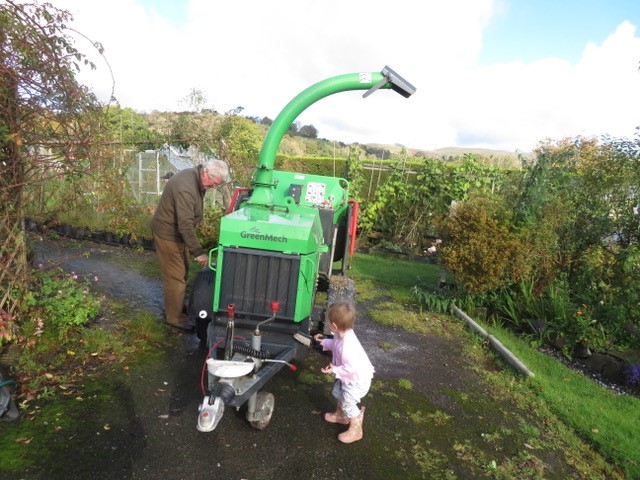
After a day of chipping …
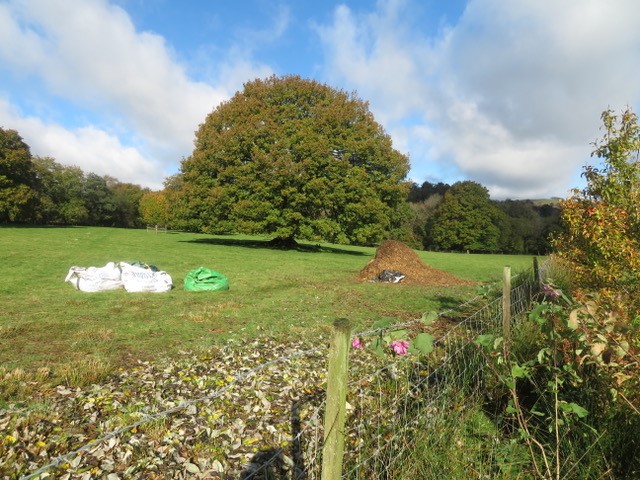
This mountain of clippings still has to be moved and the 4 bags are all half full
All the willows from here planted 10 yrs ago to soak up the water, were cut down and the chippings are being stored here …
I’ve planted a red oak behind the compost – grown from an acorn …
The autumn garden…
Thanks Tina and Derek.
Any ideas what these are, and have you seen them in your garden recently, or indeed ever?
They’re a bit bigger than a honey bee. I’m including them because we hadn’t seen them before, and these were found as part of a large colony just above the beach at Pwllgwaleod, at ankle height on the coastal path walk round Dinas Island in Pembrokeshire last Thursday.
To save the suspense they’re Ivy mining bees, Colletes hederae, a species which only arrived in the UK in 2001 in Dorset and has spread West and North since. If you click here, you can see that it hasn’t really been recorded much up here yet. The name reflects the fact that they emerge very late in the year and feed mainly on Ivy flowers, but the obvious yellow pollen might have come from nearby flowering gorse.
The ones you see here are all mated females taking collected pollen down into the burrows which they’ve just excavated and which house their eggs and then larvae. The pollen will feed the larvae as they mature, pupate and then emerge late next year to begin their new cycle. They aren’t “social” bees so only have a brief annual adult existence. So for anyone with flowering ivy in, or near their gardens, it’s not too late to go and have a look for these recent immigrant bees, if we get a sunny day in the next week or two.
You probably won’t find the males now. They emerge a bit earlier and are ready to mate with the females as soon as these emerge from their own burrows later in September, and then, job done, the males disappear from the scene.
This little bit about bees got me thinking about a photo quiz you can all have a go at.
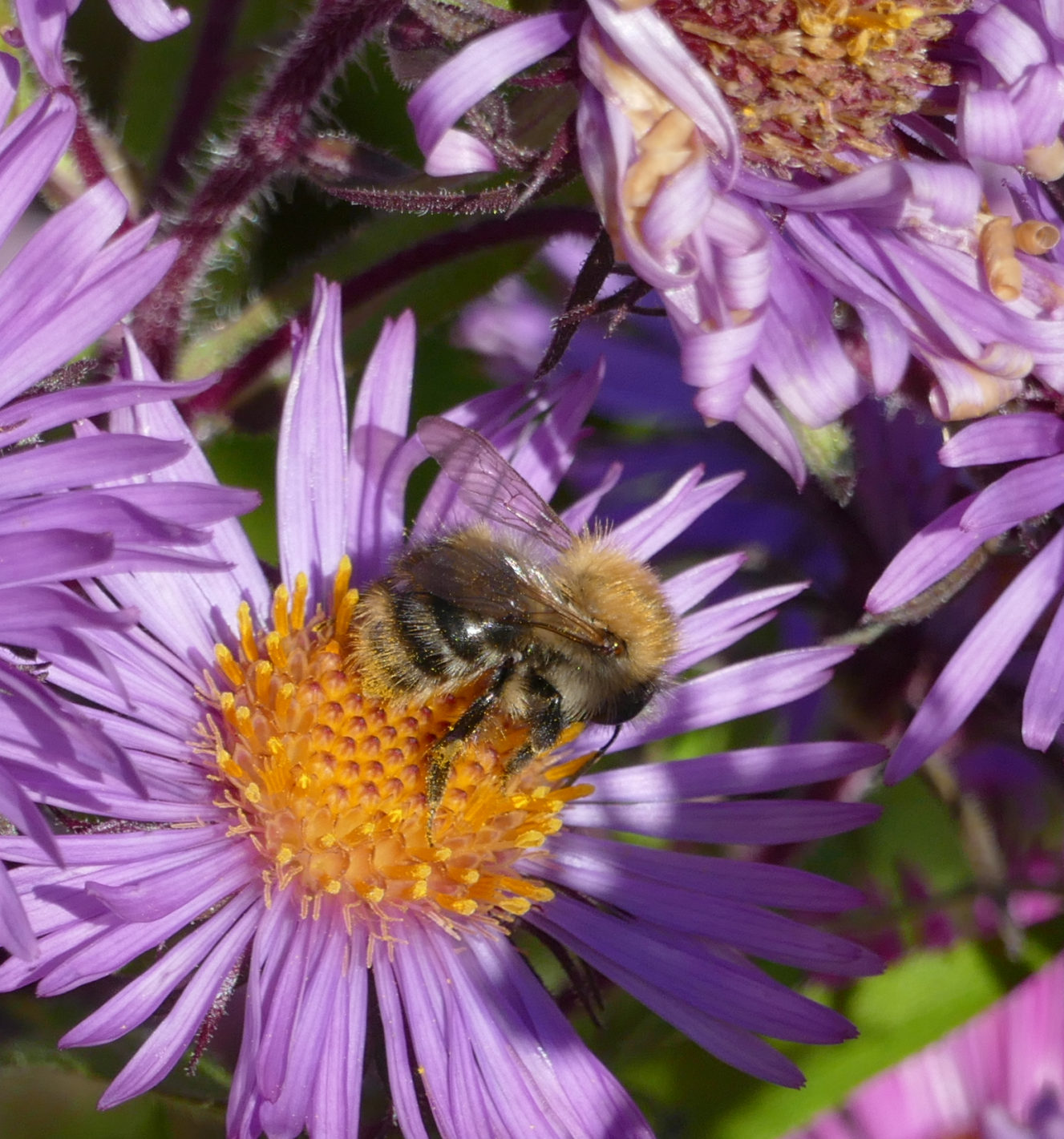
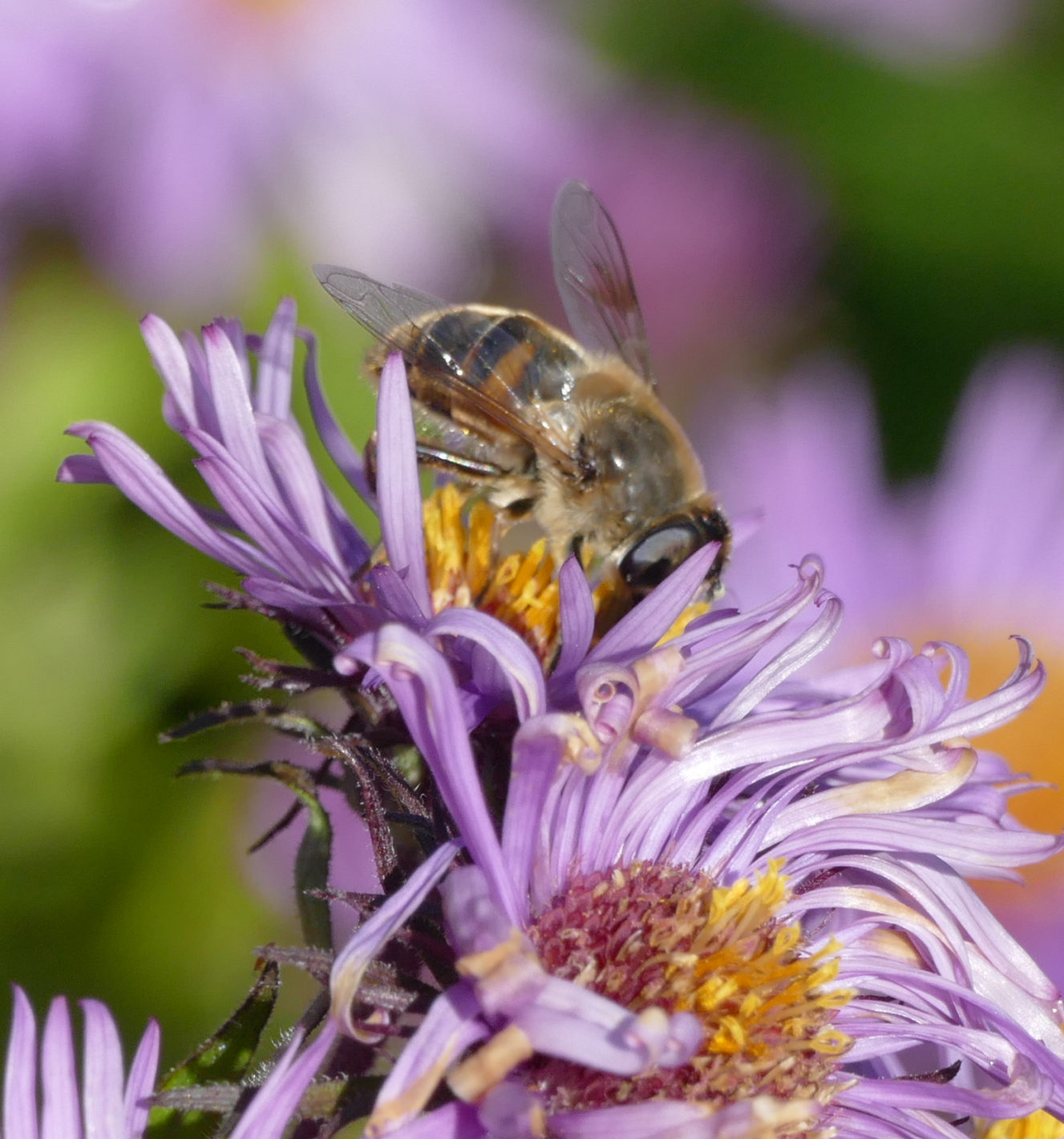
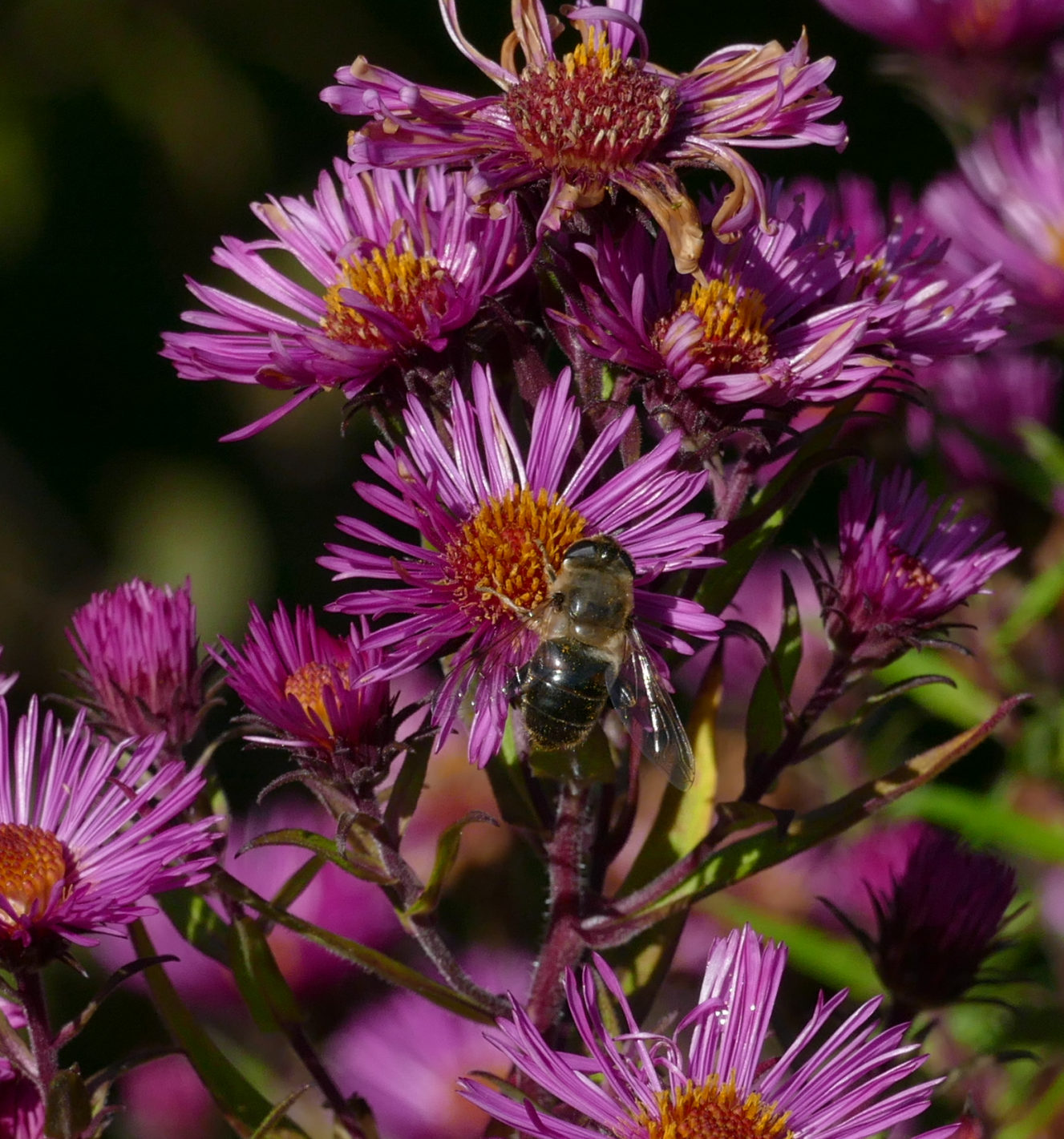
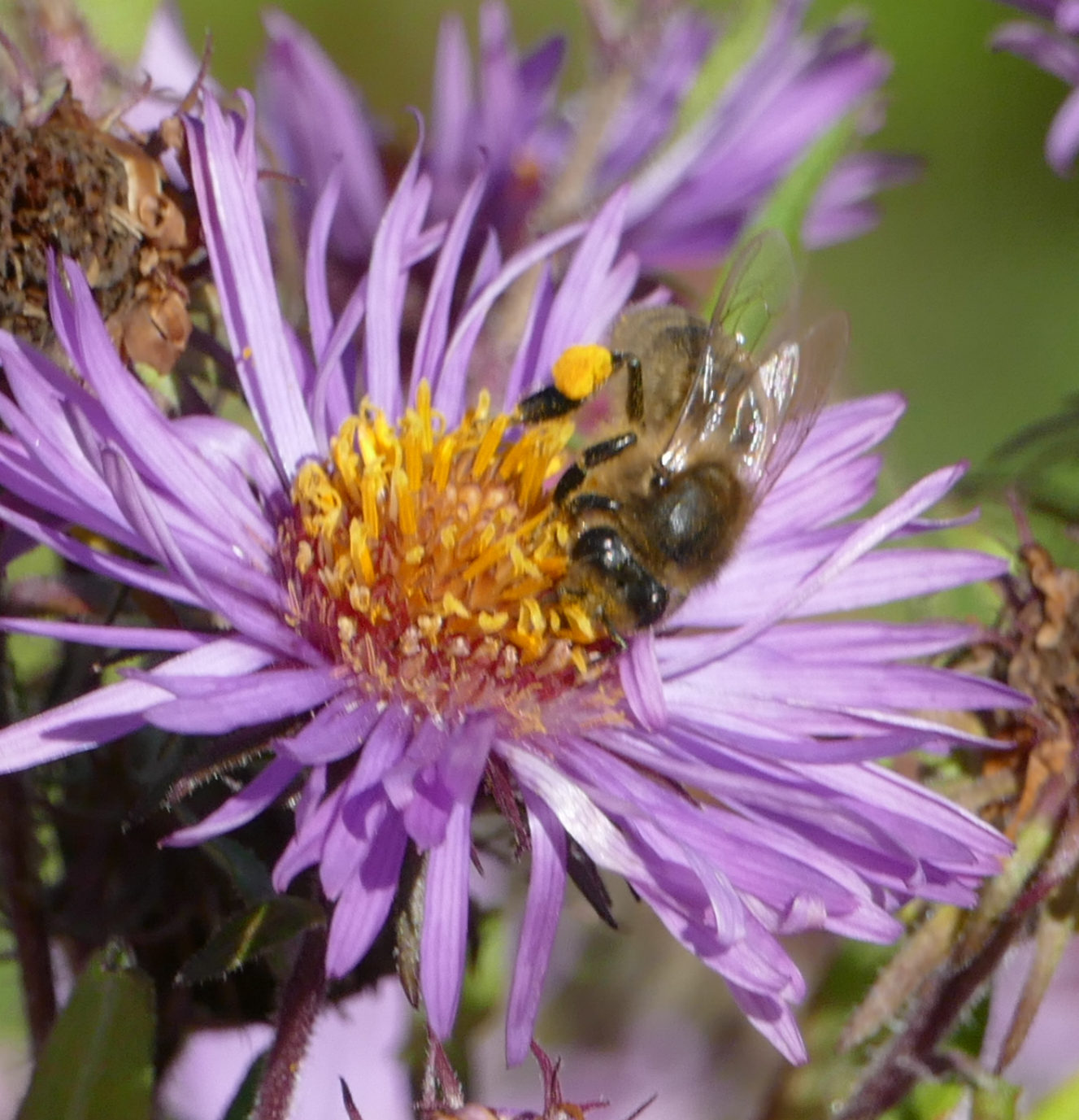
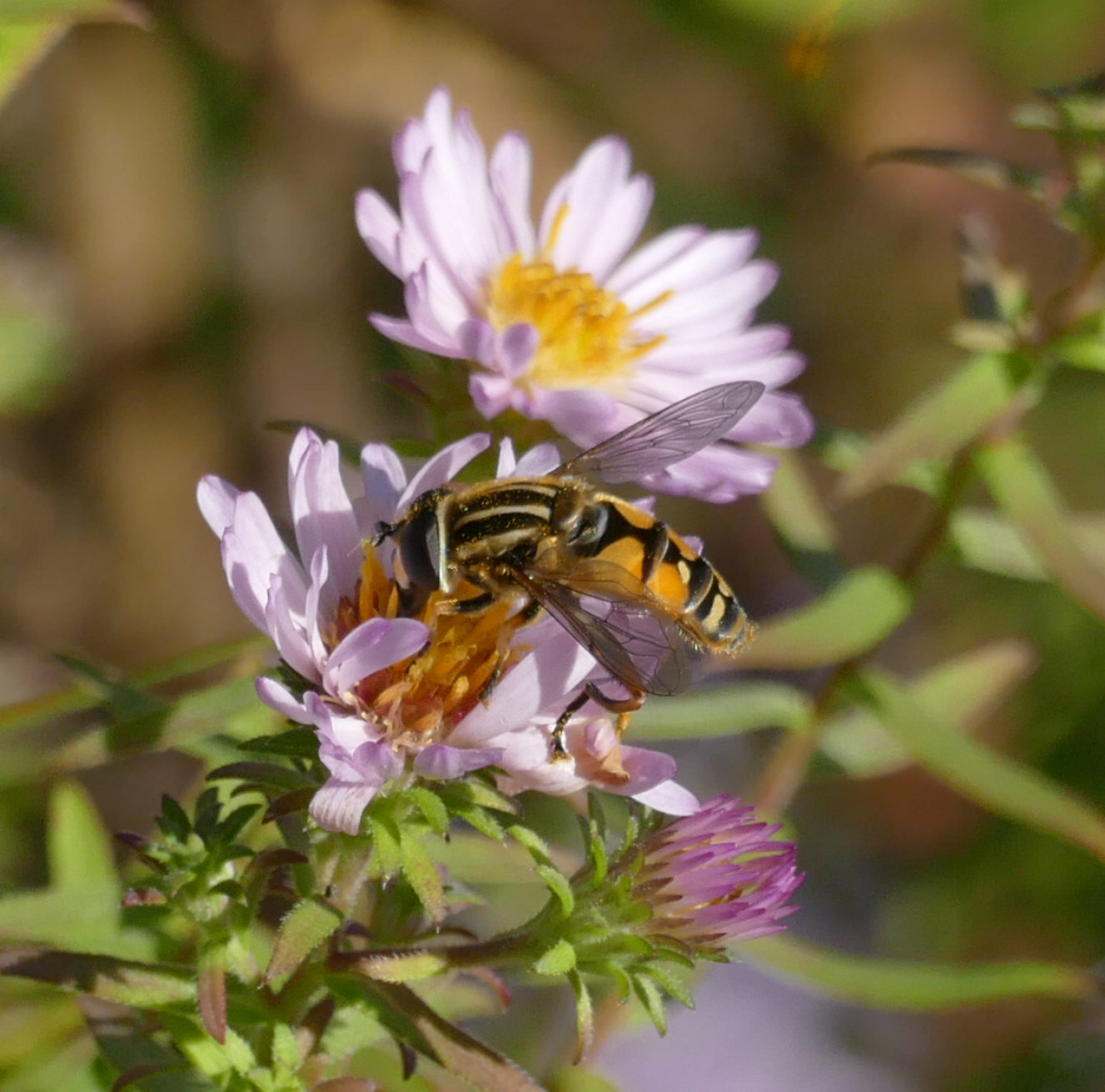
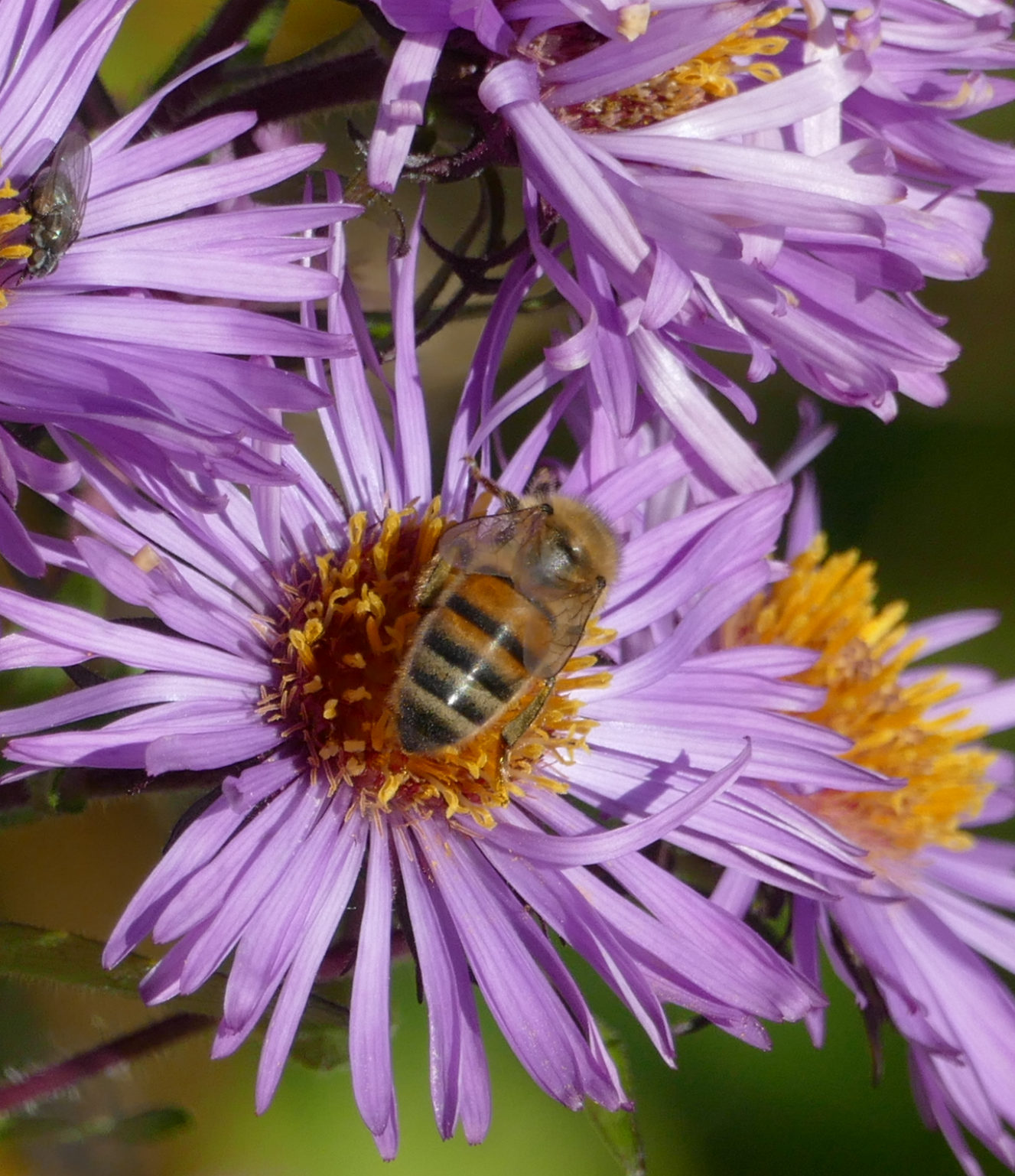
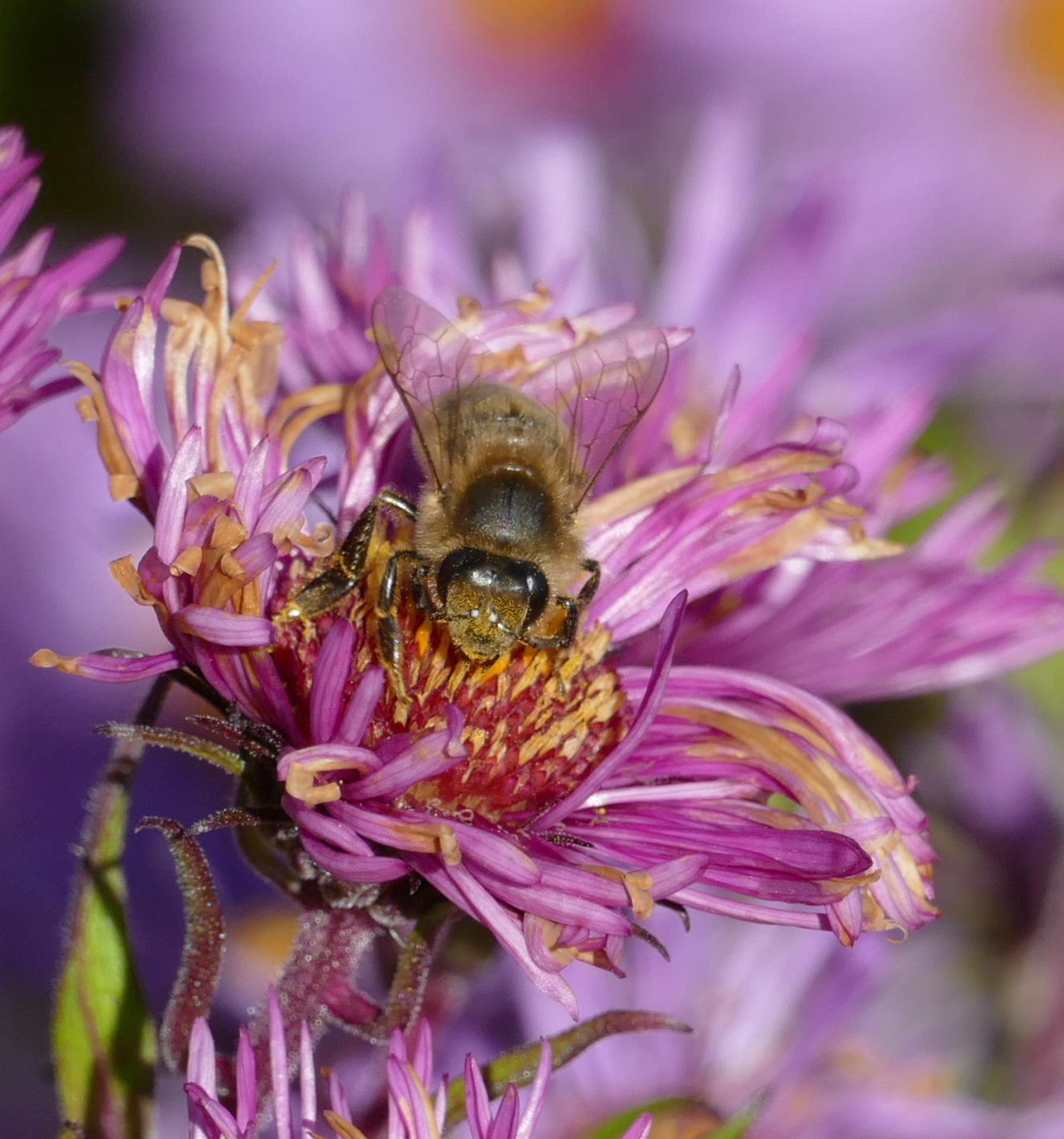
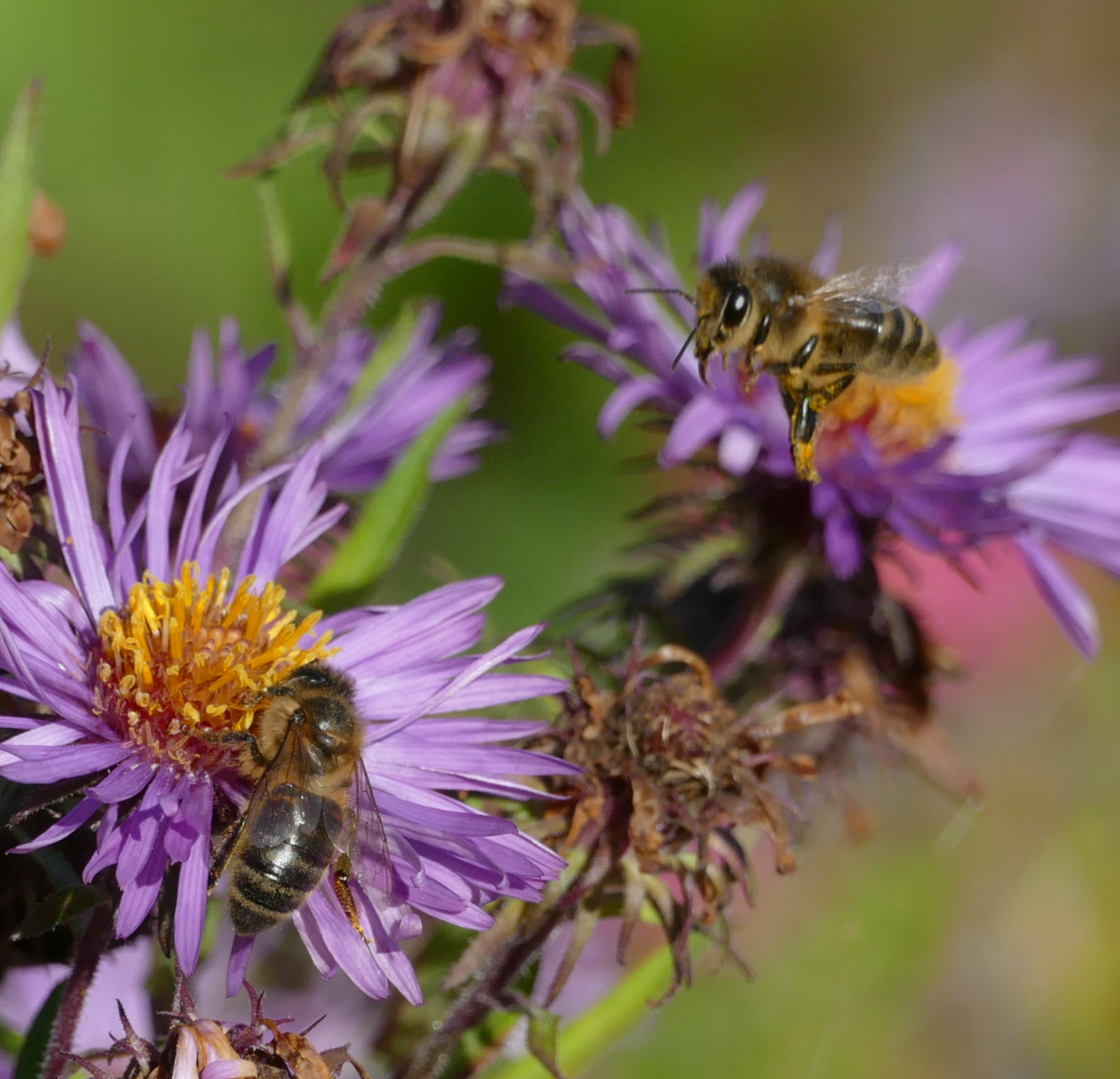
Asters are often mentioned as a great late season nectar source for insects, which they are, but with lots of honeybees around still in our garden, actually very few ever seem to visit the Asters except on a warm sunny day. So for a bit of fun how many honeybees are included in the images below?
The answer is 6, with a single bumblebee. The rest are all bee look alike flies.
And maybe a little easier, on the following 4 images, which has 2 honeybees included, which has 2 flies, and which has one of each?
Easy, eh? Flies, Bees, and one of each in the last 2 pictures.
And if they aren’t on our Asters, then which flowers are they visiting most of the time? Well, mainly the Himalayan Balsam half a mile away in the village, which brings them home with characteristic white dusting on their backs.
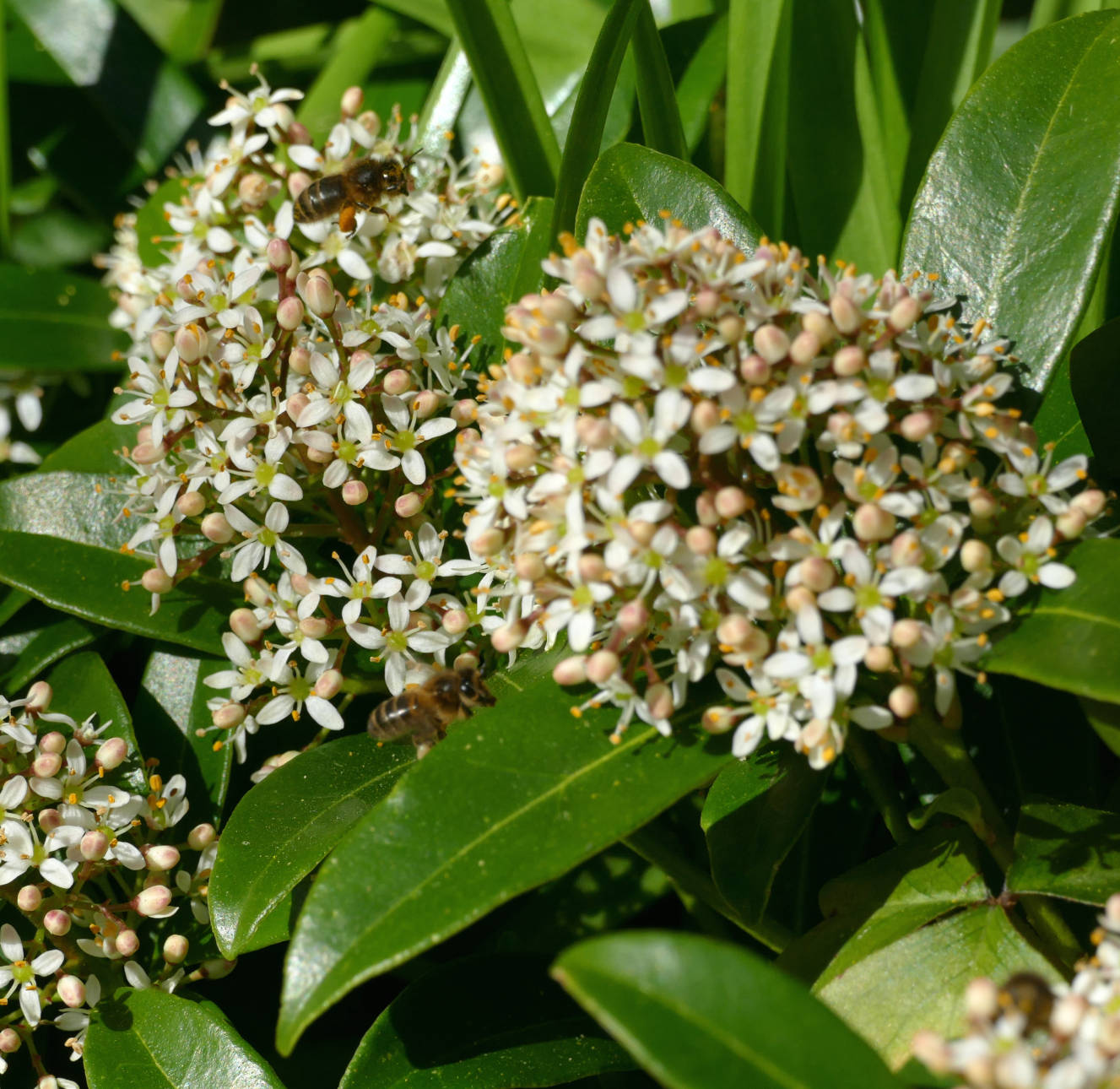
But in a recent light bulb moment, I’ve realised that many of their preferred plants, which they do bother to visit in our garden, throughout the year, originate in the Himalayas or other mountainous Asian areas –
Daphne bholua,
Skimmia
Persicaria amplexicaulis,
Geranium procurrens,
Persciaria vaccinifolia.
Could it be that these all produce a richer or more nutritious nectar, or produce it in greater quantity under our often cool and wet conditions? Who knows, and I can’t seem to find any work which has been done on this. But perhaps it’s more than a coincidence that the largest of the only 8 species of honey bee found across the world, Apis laboriosa, lives most of its life cycle outside in the elements on huge single slab combs, protected only by a cliff overhang high up in the Himalayas.
For a fascinating recent short video of how the locals actually harvest the honey from these large honey bees, (no Health and Safety here, folks), together with some amazing scenery, then do have look below – really wonderful!
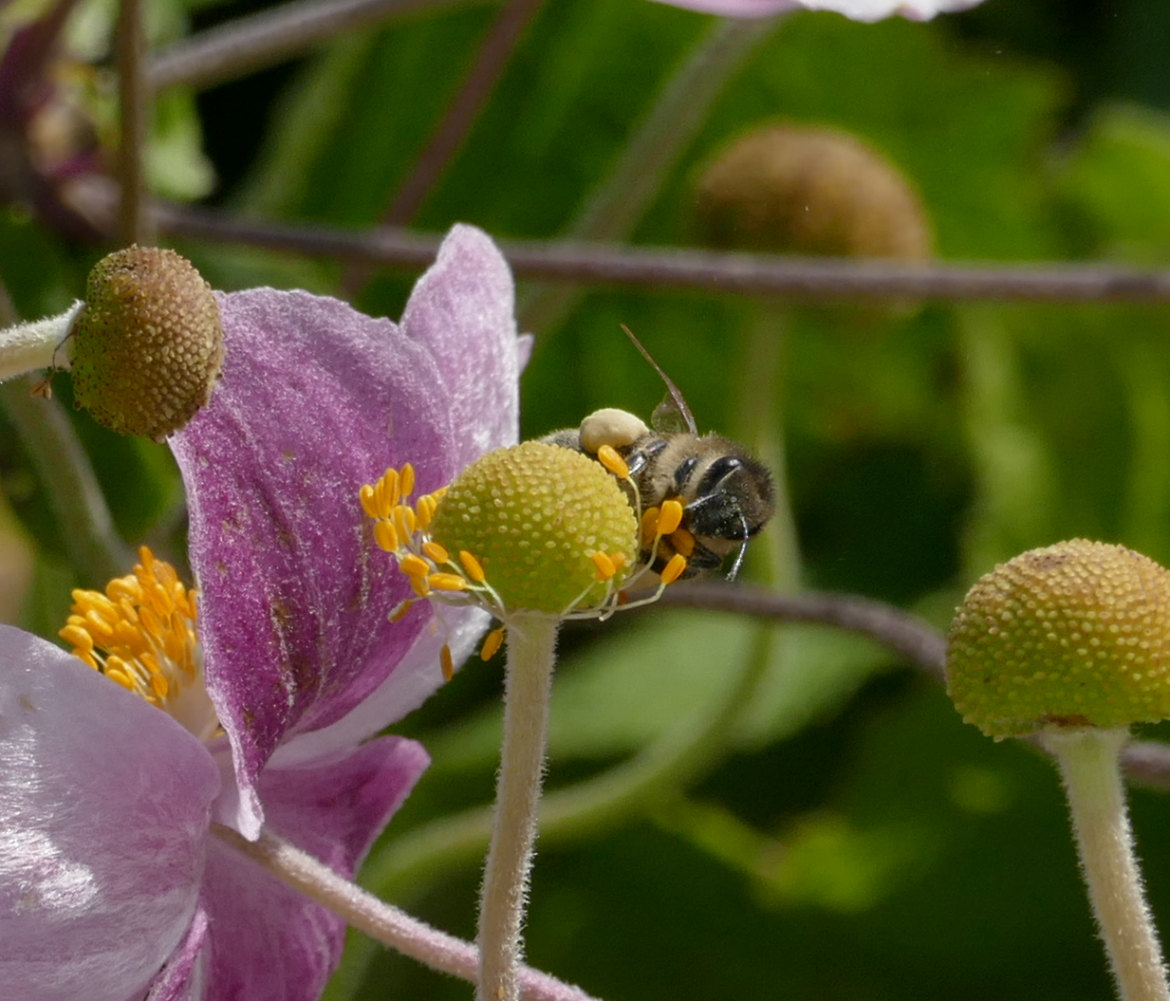
Meanwhile in a change from our normal autumnal tidy up regime, this year I’m leaving alone anything which the bees will visit, like the Japanese Anemones below, until the frosts take the last flowers out, since they can still seemingly get something of value even once the petals have dropped.
Finally, as always, it would be lovely to hear from a few members about their favourite plants, or things in their gardens as we go through the next few leaner months. It doesn’t look like physical meetings will be possible anytime soon, so if you want to read about other member’s gardens, then do send me something!
Why not write even just a few words – it’s a great way to keep the grey cells working, and send an image or two, preferably resized down to less than 1 MB? I can’t promise to put everything up online immediately, but usually within a fortnight, and it’s another way of keeping in touch and passing on information.
Or use the Cothigardeners Facebook Page.
You can send things to me at:
Cothigardeners@gmail.com
Thanks again to Tina and Derek for contributing to this post.
As all members will know there’s still no real hint of when Wales lock down will be lifted for any sort of social gathering, so for now our monthly meetings sadly aren’t possible.
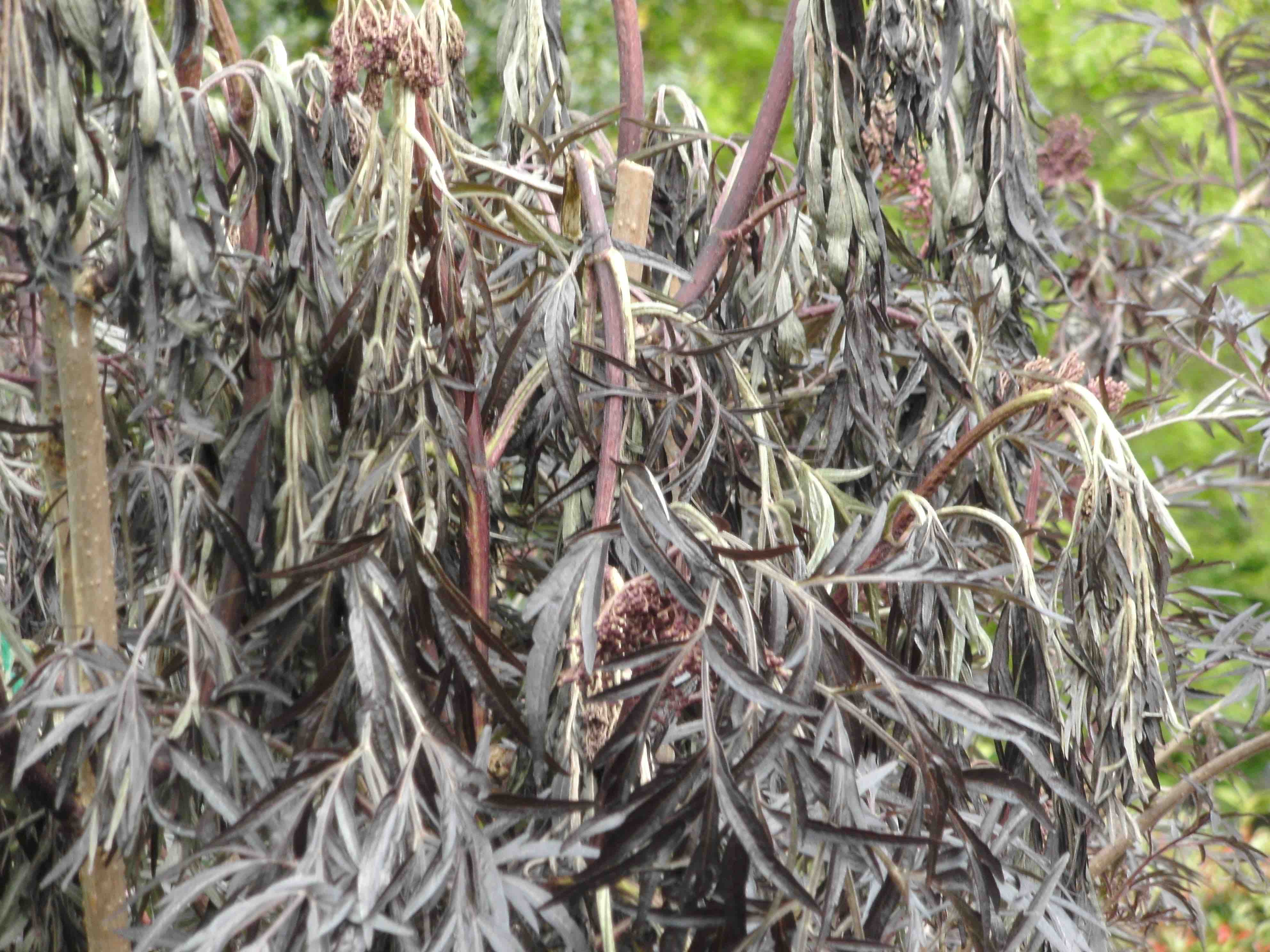
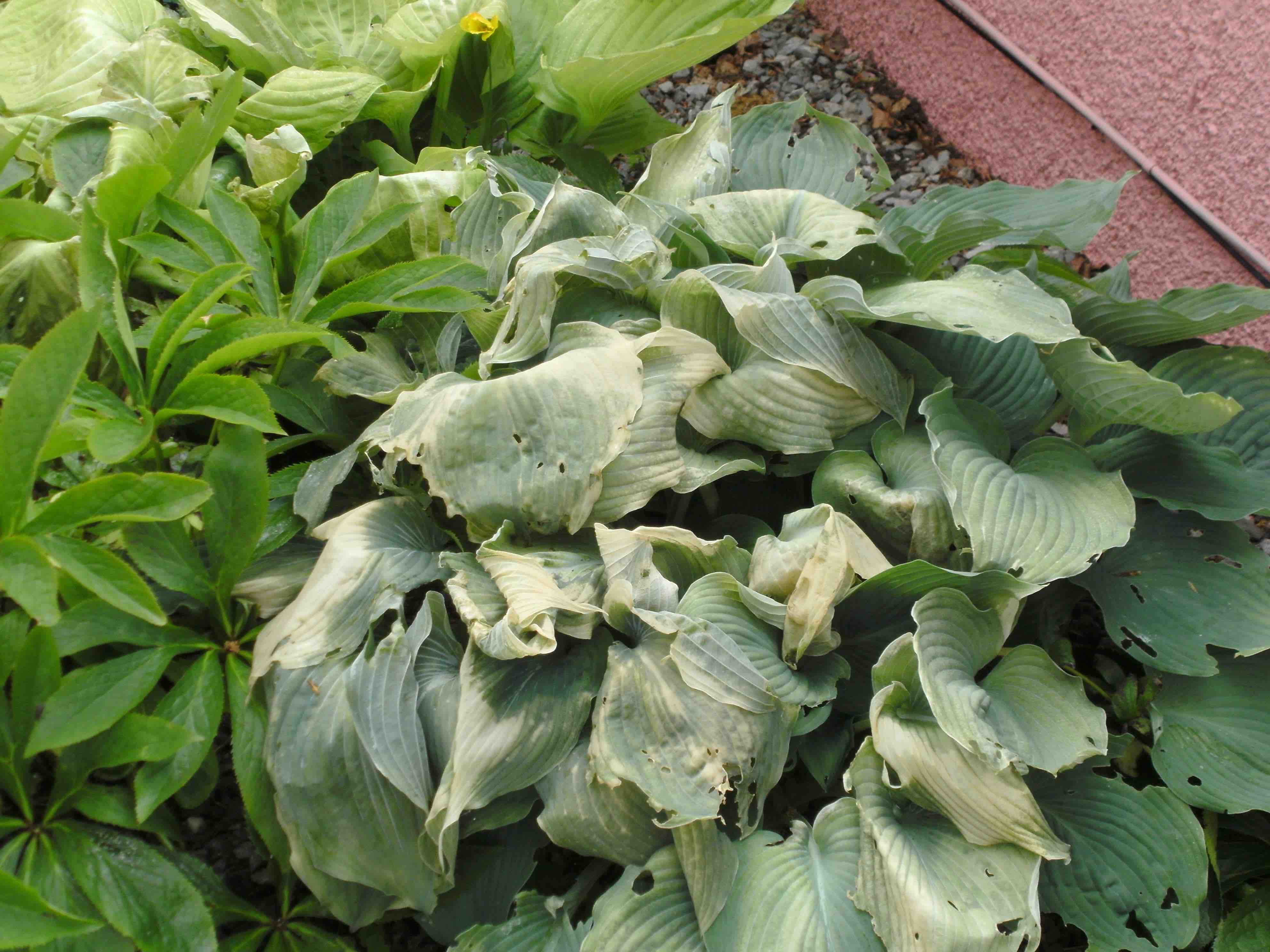
Thanks to those Cothigardener members who’ve sent me some pics of their plots over the last few weeks. At last we have some rain again, and after kicking off a bit of hay making here already, we can all reflect on the irony of lock down coinciding with what has been an amazing and record breaking sunny spring. The Met Office website has some interesting facts and maps to illustrate just how unusual the weather has been this year. It seems a long time ago now, that a run of quite hard frosts spoiled the benign start to our gardening year and caused a bit of damage to many of our gardens…
Here’s some words from Elena to accompany scenes from her garden in mid May …
All the oaks, beech, ash have also been badly nipped. Not a pretty sight, but so it goes in a Welsh garden!
Frosted Black Lace Elder
Frosted Fern
Frosted Hosta
Frosted Persicaria
Frosted Wisteria.
In our own garden Persicarias seem the worst affected plants too, apart from vegetables growing outside – courgettes and squash were badly damaged losing most of their leaves, potatoes got leaf tips nipped …
but enviromesh, water bottles and woolly mats seemed to mitigate the worst of the minus 3 temperatures, and all but 3 squash plants seem to have recovered and are growing away within a fortnight. Will they still fruit though?
In the hay meadow even some early orchids keeled over, probably because the flowers are about two weeks ahead of normal, following the sunny dry spring weather.
________
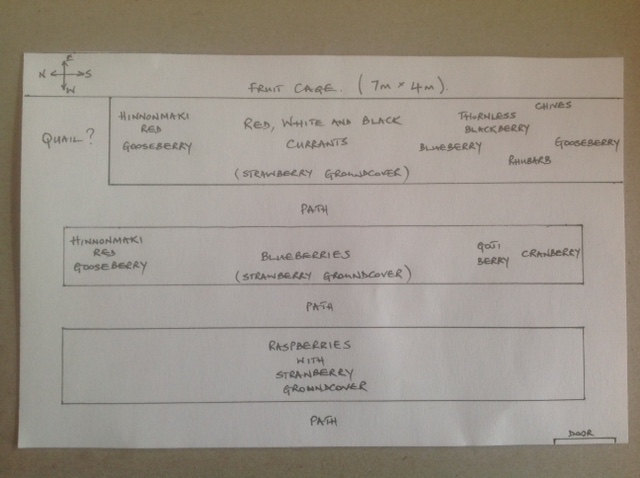
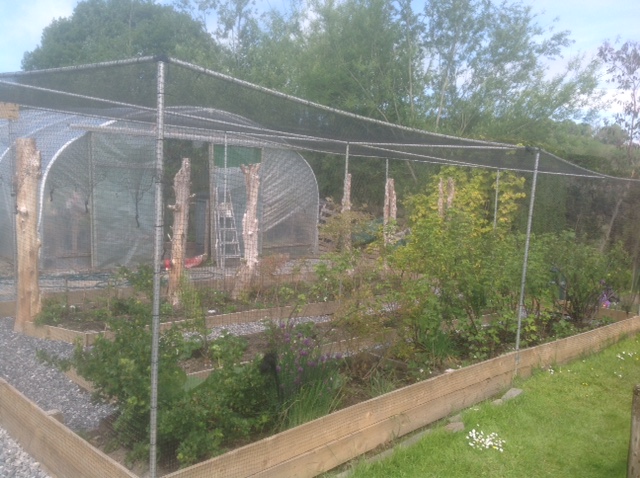
Many thanks to Derek for this insight into how he and Tina have protected some of their fruit from marauding birds in what looks like a highly organised and impressive system …
With the arrival of Bullfinches this has become urgent – we can cope with the interest and demands of Sparrows, Wrens, Blackbirds and Thrushes, but Bullfinches are real experts! Our local wild birds are well catered for with the enormous planting of fruit trees and bushes throughout the garden and grounds, but we are being a bit precious about these within the cage. The fruit is a mixture of old favourites, and some fun varieties, we’ll see how they all get on. The cage was until recently used to house chickens for a friend, but they are all now rehomed. It measures 7 metres by 4 metres, is made of aluminium, and was sourced from Harrod Horticultural some years ago. I have included a planting plan – the Chives and Strawberries are not only welcome in their own right, but of course they encourage pollinators
_______
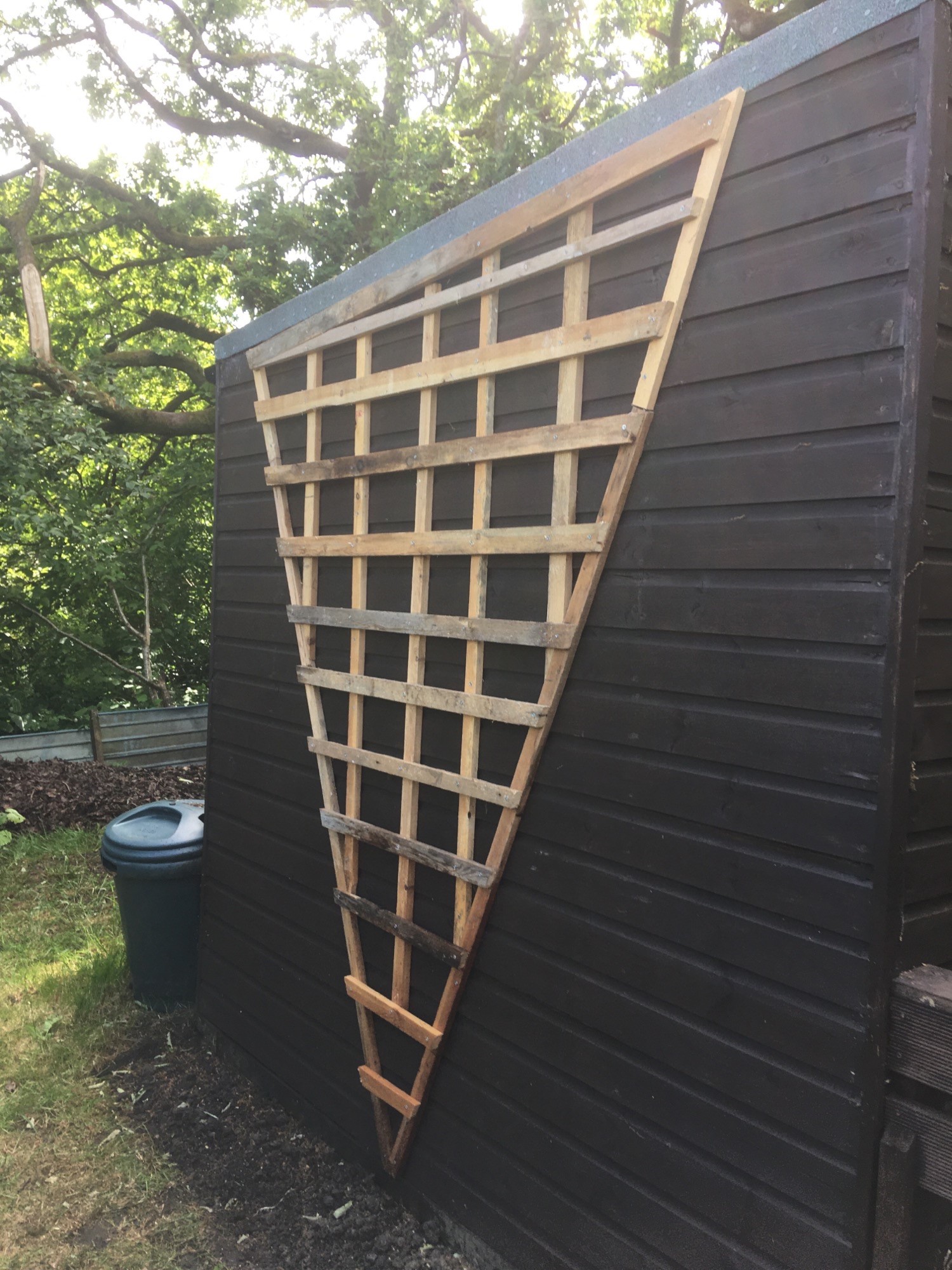
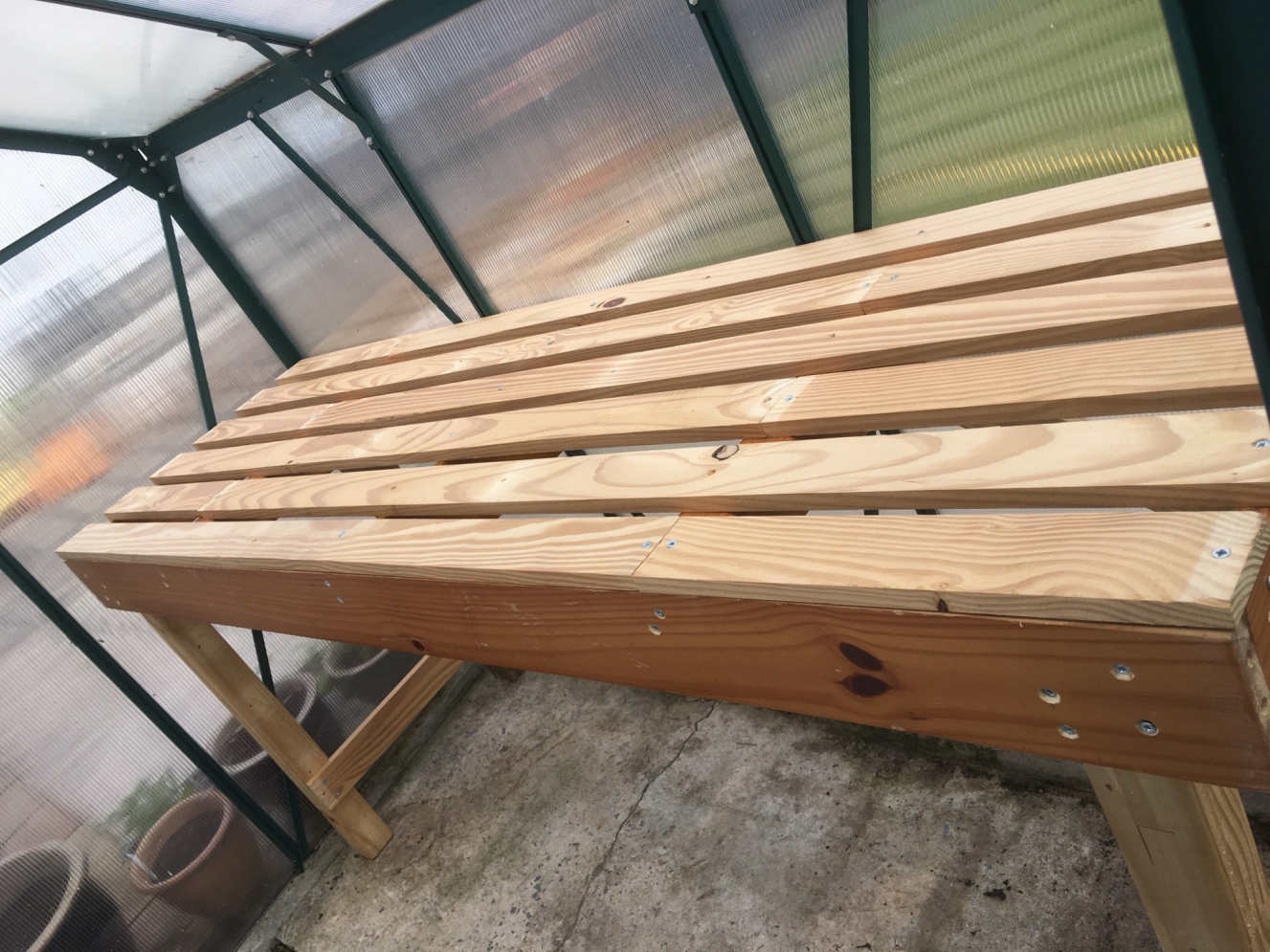
Meanwhile thanks to Alison for these photos, showing how nifty Peter has been at recycling an old bed into both trellis work and new greenhouse staging …
________
Meanwhile Sandy sent me these pictures of her amazing Pyracantha clambering over the side of her cottage and covered in flowers …
____
Finally a plant suggestion for members, and then a discovery I’ve made in our garden both related to honey bees.
Ever since a visit to Sheldon Manor in Wiltshire in June nearly 30 years ago we’ve been great fans of growing vigorous Clematis and Rambling roses into mature trees to add flower interest. Since learning a bit more about honey bees, I realise that hives can often struggle to find good food sources in June – the early spring flowers are over, there aren’t many hay meadows left with wildflowers, and later natives like bramble and willow herbs still haven’t begun to bloom.
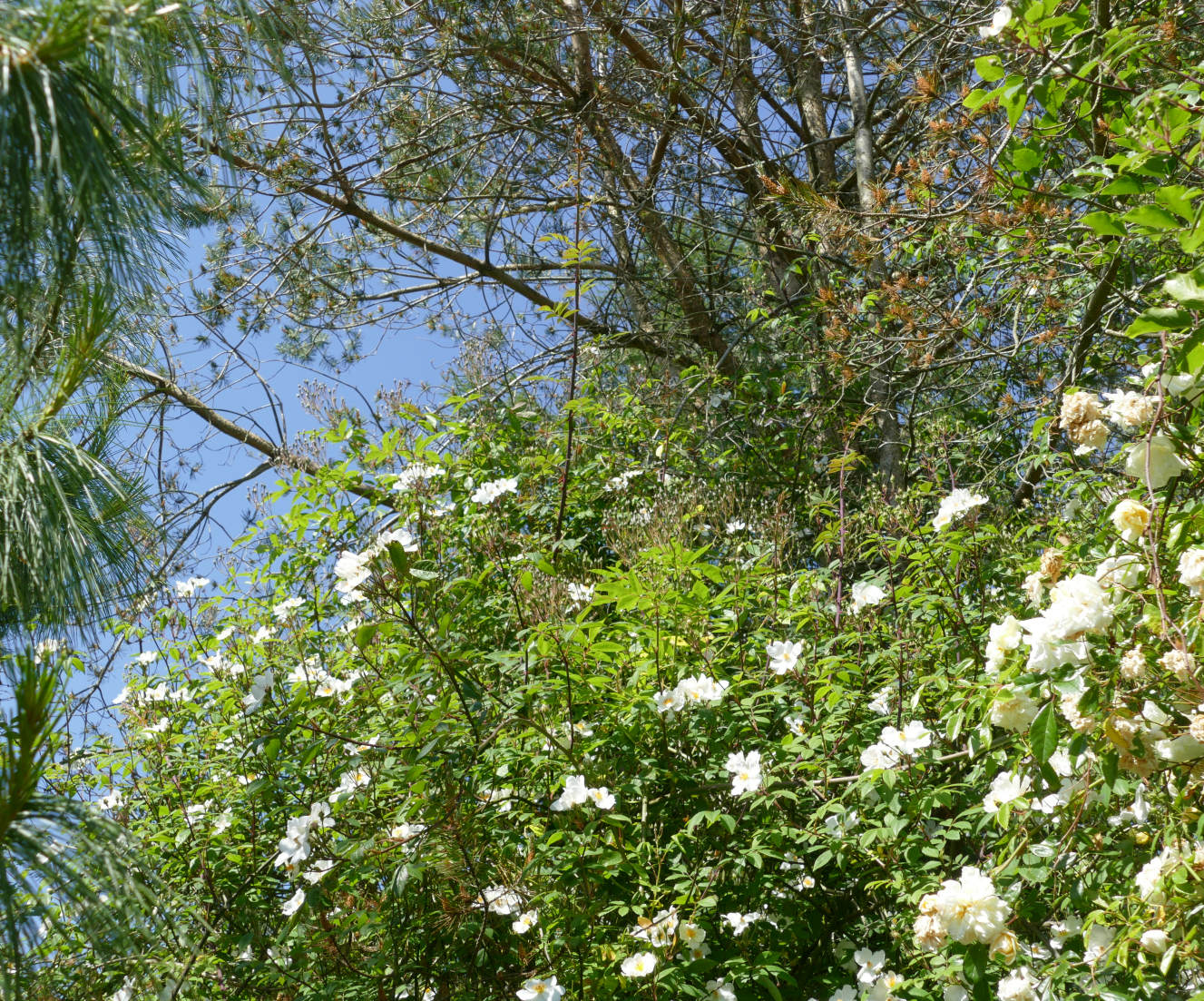
Enter what I now call the “White Dragon” rose. I found this as a seedling growing in the garden back in 2010, probably coming from a hip of the well know vigorous rambling rose “Kiftsgate” which we already had in the garden. But this seedling when it first flowered produced bigger, earlier, and more scented flowers than “Kiftsgate”, which honeybees and bumbles adore. After noting it had grown shoots over 15 feet long in a year, I planted the still young plant into a rotten hollow centred tree stump, filled with compost which was quite close to the base of a youngish oak in 2012.
This rose has incredible bendy stems, and is almost disease free (unlike “Kiftsgate” or “Paul Himalayan Musk”, which we also grow), with young foliage with purple tints, so it’s easy to train around a wire base, or into a tree, even if it is quite thorny. Once it gets going though, it makes its own way ever higher with no need for help. It roots very easily from cuttings, so if anyone fancies a cutting of this local origin rose this autumn, let me know.
The video clip above is of another plant taken as a cutting from the mother seedling which has now made it almost to the top of the still growing Oak. (apologies for the noisy background). This daughter rose is already making good progress going up into a Scots Pine, and probably now only 8 years old, but must already be producing thousands of blooms over about a 4 week period at “June gap” time. You can see at the top of the plant you’re getting up to 50 quite big flowers per cluster.
The bees completely ignore the other creamy named rose “Alberic Barbier”, to the right, and although most roses produce no nectar, the pollen is invaluable, particularly in this time of seasonal shortage.
The second clip I’m including is to pass on an interesting bit of bee behaviour which has been obvious for the previous four warm afternoons. Up until about 2 pm, the worker bees (all female) have been busy entering and leaving the hive on foraging trips for pollen and nectar. They’re early risers and work long hours. They don’t hang around and are almost quiet as they whizz in and out of the hive entrance. Then in early afternoon, the air around the hive suddenly becomes really noisy. Look closely and you’ll see that bigger bees, with much larger eyes, the male drones, suddenly begin to leave the hive. And they’re noisy. It almost sounds like a bee swarm.
But look even more closely and you’ll notice that they all spend a very short time before flying off, cleaning their large eyes/face with their front legs. Why?
Well these chaps are off to complete the still poorly understood part of the bee’s life cycle that involves them flying into specific “drone congregation areas”. An average of 11,000 drones from tens of different colonies fly out to these specific well defined areas which are typically between 15 and 40 metres up in the sky and about 100 by 50 metres wide and may be a kilometre or more from their base hive. And they only fly on suitable warm afternoons up until about 5 pm.
Within these areas they fly around expectantly, waiting and hoping for a virgin queen bee to appear on the scene. The quickest 10 or 20 drones will chase her and if lucky will manage to mate with the queen, who then flies back to her hive after 20 minutes or so with enough sperm on board to enable her to lay hundreds of thousands of eggs over the rest of her lifetime in the hive. If the queen flies past just outside the invisibly bordered congregation area, the drones ignore her and won’t chase her.
The “lucky” drones are mortally injured by the force of the act of mating, and fall to earth dying. Poor things…
The same invisibly bordered congregation areas are used every year – sometimes over centuries. No one really knows how the bees find them.
So maybe the drones are clearing their eyes before take off after a day spent inside in the dark, stoking up on honey for the chase, so that they’ll be better able to spot any queens as soon as possible. I doubt if the queen has any time to select her suitors based on how tidy they look …
Anyway it probably comes as no surprise to readers that with the change to cold damp weather today, the ladies are stillforaging, though clearly not as much as before, but there’s no sight or sound of the drones, who are clearly putting their feet up inside the warmth of the hive.
Feeding.
And maybe having the equivalent of a good bee natter. But who knows?
__
Finally, as always, it would be lovely to keep hearing from members about their favourite plants, or things in their gardens as we go through the next few months. Why not write a few words and send an image or two, preferably resized down to less than 1 MB? I can’t promise to put everything up online immediately, but usually within a fortnight, and it’s a great way of keeping in touch and passing on information.
Or use the Cothigardeners Facebook Page.
You can send things to me at:
Cothigardeners@gmail.com
Thanks again to all who have contributed to this post.
Many thanks to Yvonne for her notes on Richard Bramley’s timely talk “Autumn into Winter” to Cothigardeners in September which we were sadly unable to make, but which was well attended and enjoyed by all.
Richard covered great plants for good autumn colour including Acers, Berberis, Euonymus and Cornus racemosa which has black autumn foliage.
Colourful winter stems from Cornus species and Salix (willow) can add to interest.
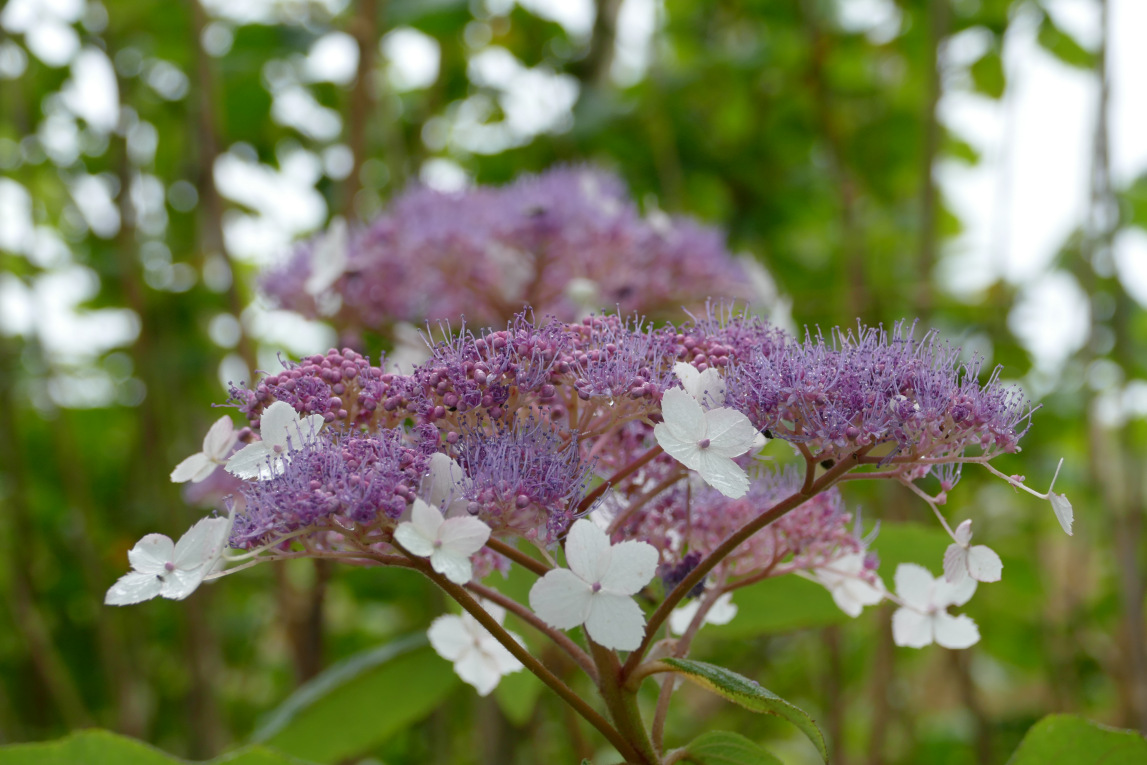
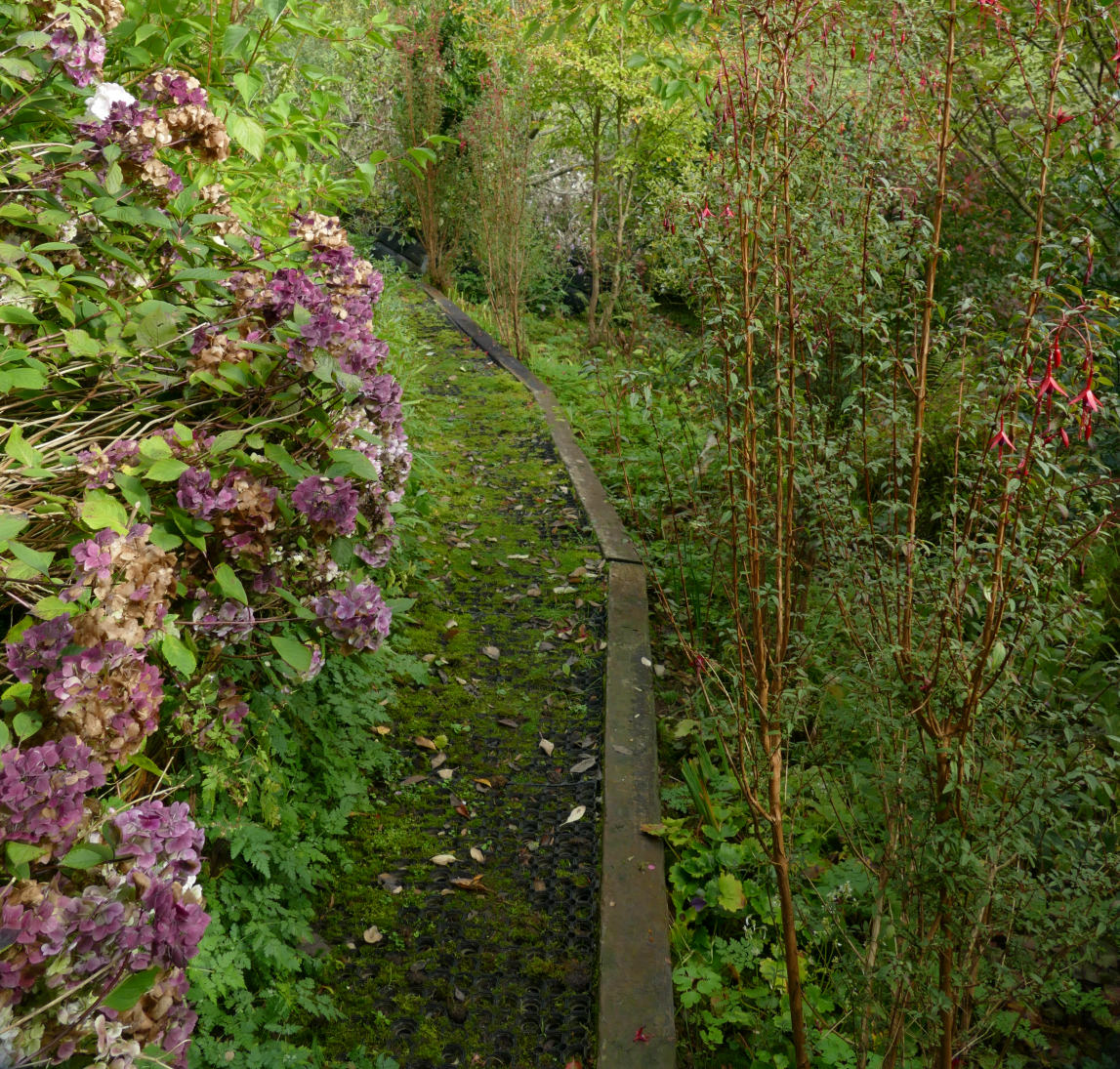
Hydrangea flower heads last well into autumn, even as colours fade. Some forms even flower late like the above form of H. aspera, in bloom in early October. Look out for the Forever series, as they keep on flowering. Cut down Hydrangea Annabelle to the ground in spring as it’s a herbaceous variety so flowers on the current year’s wood, as do H. paniculata varieties.
H. macrophylla flowers on last year’s wood, which may get frosted in spring, so killing the flower buds.
Other good plants for autumn are Lespedezia, Aconitum. Fuchsia magellanica, Astrantia, Campanula – if they are given the Chelsea chop (prune the height by a third in Chelsea Flower Show week), these plants will flower later on shorter stems.
Hardy Chrysanthemums sold in the autumn as domes of flowers, should be treated as bedding. Herbaceous Chrysanthemums should be hardy and are a good addition to the garden.
Some Asters (Michaelmas Daisies) can get mildew due to dry or stress (nova belgii types). Closely allied to Asters are Kalimeris, which are good plants, along with other Asters.
Annual Rudbeckia and perennial Rudbeckia are excellent plants for the autumn, but they can get very tall. Cut them down on the longest day and they will flower a little later on shorter stems. Heliopsis, Leucanthemella will grow in shade. Persicaria amplexicaulis is a pretty thug, and needs to planted somewhere where spread is required.
Viola cornuta, the smaller the flower, the hardier the plant. Salvia species, long flowering but not hardy, can extend flowering up to frosts but take cuttings a.s.a.p. to overwinter ready for the following year. Solidago x aster is another good plant and not at all boring.
Grasses can extend a season of interest right through winter, and can be successfully mixed in with herbaceous plants rather than a bed of grasses. Panicum species have a lovely arching habit. Stipa gigantea, above, is another good grass, and doesn’t self seed. Pennisetum varieties, treat as annuals, though they can be overwintered in a cold greenhouse or polytunnel. Cardoons also have wonderful seed heads in winter. Don’t be too quick to tidy in the autumn, as the frost on grasses, cardoons, etc give a new dimension to the garden. They also protect the roots from frost, and give cover to insects, hedgehogs, etc.
The trip which Fiona had organised with Stephen and Mel Lloyd for Cothi Gardeners to visit the Hergest Croft garden for a combined guided tour and seed/cutting collection was a huge success. We were really fortunate with a benign weather slot in what has been the wettest spell for months, and were thrilled that Steve was so generous with his time and advice, whilst Mel provided us all with bags, and names to record the many seeds, fruit and cuttings we were able to collect in a two and a half hour walk.
Hergest Croft is such a special place with one of the finest collections of trees and shrubs in the British Isles including national collections of hundreds of different Sorbus, Betula and Zelkova, as well as being wonderfully peaceful and beautiful whatever time of year one visits.
Steve demonstrated it’s always worth cutting into a few seeds just to check if they’ve got viable white/green centres. Sometimes a tree will be laden with seeds which look fine, but are in fact empty and will never germinate. Also he pointed out some of the trees where it’s best to save seed from the tree (e.g. Acers and Sorbus) and others (e.g. Magnolias and Davidia) where it’s better to collect from seed or fruit that’s fallen to the floor.
Click here for more about Hergest Croft, and there’s still time to plan a visit for their special autumn plant fair on Sunday October 13 th – Hergest Croft Autumn Fair, Ridgebourne Road, Kington, Herefordshire HR5 3EG with over 40 plant and craft stalls. Open 10-4.30pm. Admission £6.50.
What I didn’t know before Stephen told us, as we walked through the garden’s glades and reached the top of the Sorbus collection, is that the garden rises to over 1,000 feet above sea level, so many of the well labelled trees which are indigenous to China and the Himalayas will be quite comfortable with the conditions here.
Stephen, the Head gardener in a team of 5 who manage the 70 acres, has worked as a gardener at Hergest for 40 years, and has grown many of the now mature and rare trees from seeds sent to Hergest from collectors around the world.So to have him passing on his tips as to how best to choose and propagate material was a rare treat, and all this in a year when many trees were laden with berries and seeds after a bumper year for pollination and fruit production.
Thanks very much to Stephen and Mel for their very warm welcome and generosity and for making it such a very special day. We look forward to letting them know in due course how well we get on with the propagation, once we get all the material prepared for sowing …
A reminder that this month’s meeting on Wednesday October 16th at 7.30 pm is by Neil Barry on “The Plant Hunters and Explorers”. Do arrive in good time for refreshments and a catch up before we start.
Neil is originally from County Cork in Ireland and is now living near Swansea.
He trained at the Royal Botanic Gardens, Kew for three years whilst also studying for his horticulture qualifications at Capel Manor College near London and Berkshire College of Agriculture. After completing training at Kew, he moved in to teaching horticulture and completed a Post Graduate Diploma in Education. He has been a lecturer in Horticulture for 8 years, most of which was at Neath Port Talbot College but has also taught at The National Botanic Garden of Wales and elsewhere.
Finally a date for your diaries – our annual Christmas meal will be on Wednesday December 11th lunchtime at the Forest Arms Brechfa, our very successful venue last year. We should have a final menu available soon, and will need names and deposits shortly and hope that many of you will be able to make it for what’s always an enjoyable event.
Last month’s well attended meeting on Beardless Iris was a really informative gallup through the various species by Alun and Jill Whitehead who put on a great two person presentation, well illustrated with slides from their own garden which holds the National Collection of Iris sibirica.
They showed how they’ve transformed their site from bare grass to a wonderful 3 acre garden, currently open to the NGS and planted in a naturalistic style. Click here for some lovely images to give a flavour of what they’ve achieved with a lot of hard work.
Alun then explained how they became interested in growing Iris, and set up a nursery, concentrating on beardless Iris, which are easier to grow in our local conditions than the slightly fussier bearded group of Iris.
With examples from each group, Alun and Jill featured many of the different species in order of flowering from winter flowering I. Unguicularis, I. reticularis, I. Juno, Pacific Coast Hybrids, I. sibirica, I. ensata and I. foetidissima.
Mentioning some significant Iris breeders of recent times, they were able to show just what a huge range of colours are available in different combinations, and how easy it is to produce your own varieties from seed.
They finished with some ideas of how to divide, plant and sow from seed.
I’m sure many were inspired to have a go and incorporate more of these lovely plants in their gardens.
For anyone wanting more information on this diverse group of plants, Alun and Jill mentioned The Group for Beardless Irises. Click here for more, where you’ll find out how you can join the group, get more information, or even obtain a range of seeds if you’re not a member.
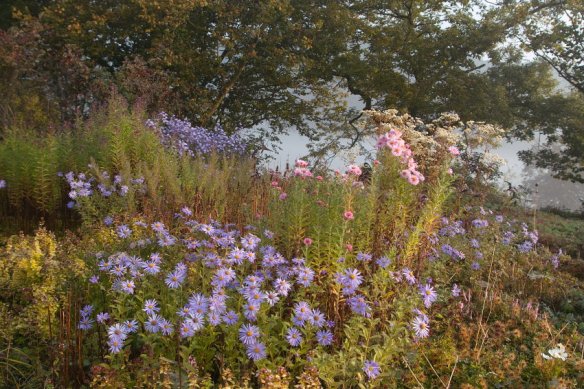
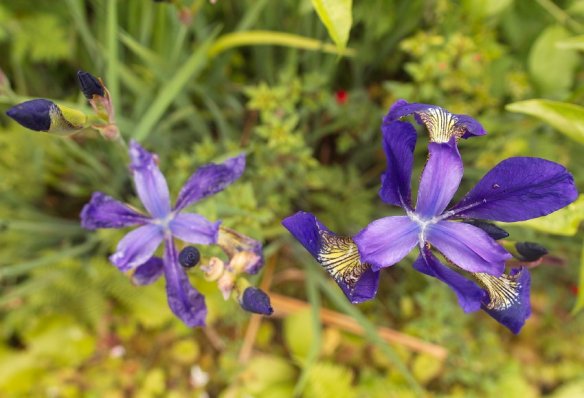
The images give an idea of what a wide range of flower colours is available.
A reminder that on Sunday August 11th, John and Helen’s garden at Ty’r Maes, Ffarmers, Carmarthenshire, SA19 8JP, opens for charity for the National Garden Scheme , from 13.30 to 17.30, admission £4.00.
Our next meeting on Wednesday August 21st in the hall at Pumsaint is our annual member’s medley. As in previous years the format is we’ll all bring along a plate of food to share for supper, and there’ll be a chance this year to feature the results of our annual growing challenge which is to incorporate into the food we bring along some edible flowers.
So if you haven’t already fixed on a dish to cook up, or prepare, now’s the time to get your thinking caps on.
Looking ahead, sadly we’ve just heard from our speaker for the September meeting on Wednesday 18th, that for personal reasons, Brinley Watkins isn’t able to make it. We’ll update with alternative plans for the evening as soon as possible.
The following week on Thursday September 26th is our planned visit, to Hergest Croft gardens in Herefordshire to include some special seed collecting. More details at the August meeting
So lots to look forward to in the next couple of months, and hope everyone is enjoying this year’s lovely summer and that after the last couple of day’s of deluges, everyone on spring water supplies now have them fully restored!
Terry Walton made his long delayed visit to Cothi Gardeners for our November meeting. He was certainly worth the wait and gave us a highly entertaining and informative talk.
The first part of the talk was about how, after retiring from his career as MD of a precision engineering company, he came to be a media allotmenteer appearing on various radio and television programmes. Currently he is a regular Friday afternoon feature on Radio 2’s Jeremy Vine Show and on Radio Wales. Both shows are live broadcasts; for the former he manages to perform his various tasks, often one handed, while communicating via mobile phone with the studio.
He started gardening on an allotment as a child of 4, building up the number of plots he managed to 11 and growing vegetables which he put into veg boxes and then sold to local householders. It being illegal to sell produce from an allotment, he only charged for the box itself and not the veg it contained. By the time he was 17 he was able to buy his first car. He continued to garden his allotment throughout his career, as a hobby.
Terry gardens organically. His allotment is about the size of centre court at Wimbledon, water is collected from a nearby mountain stream and he has an unheated greenhouse on site. He uses a 4 crop rotation which reduces pest problems and maintains fertility, has no paths (they waste growing space!) and is self-sufficient for all his vegetables, freezing summer crops for winter consumption. Seeds that require extra warmth for germination are placed in the airing cupboard at home for 48hrs, moved to a windowsill and from there out to the greenhouse.
Parsnips:
Don’t sow in the ground
Germinate the seeds on damp kitchen towel, wait until the root shows then
Plant into fibre pots with the bases removed, 2 to a pot. This way they can be planted out without disturbance and the root will not be obstructed and so is less likely to fork.
In due course plant out in a drum for long roots, or into the ground under a fleece cloche, thinning to 1 per pot and at a distance of 9” apart.
Leeks:
He grows early, mid and late season varieties.
They are sown into seed trays, 35/tray, so a total of 105 every year.
When approx. 6” high he uses a crowbar to make a hole in the ground into which the leeks are dropped.
A piece of 6” long, 3” diameter plastic pipe is then placed over each leek which will allow them to grow long and straight, and increase the length of blanched stem.
Beans:
To germinate, place in a freezer bag half filled with semi moist compost.
Plant into recycled polystyrene cups (which keeps compost warm and so gives them a head start)
Once planted out in the ground, water twice a week with a watering can of water with a handful of lime dissolved in it. This helps prevent flower drop.
Courgettes:
To help reduce mildew early in the season, mix 1 part milk to 1 part water and water or spray over the leaves – mildew likes acid conditions to germinate.
Peas:
Germinate as for beans
Plant out in a shallow trench.
Lettuce:
To keep continuity and avoid a glut, sow into pots 6 each of Iceberg and Lollo Rosso every 2 weeks, then plant out.
Grow under cloches in March, then in open. Keep going until October
Sow cut and come again in greenhouse for the winter
Onions:
Don’t wait until the end of the season to start using them, use from when they are big enough.
When drying off make sure ventilation is good. If weather is bad dry in the greenhouse on mesh to give greater circulation
Brassicas:
To combat Cabbage White decimation spray with water in which rhubarb leaves have been soaking for 3 weeks. Repeat after rain. This deters the butterflies.
Or grow under netting/enviromesh.
To prevent Cabbage Root Fly place 2 pieces of damp proof membrane, with V shaped cuts, around base of each plant.
Carrots:
Grow in drums for longer, straighter roots
Harvest through the winter.
Sow in February in greenhouse under bubble wrap for an early crop.
Sowing into the ground: dribble in compost, then seeds and then cover with more compost for good germination.
Cover with enviromesh to avoid Carrot Root Fly
Potatoes:
Earlies – Grow in a drum in a cold greenhouse. Place a layer of manure mixed with compost in the bottom
Add the potatoes and then add layers of the manure/compost mix as they grow until the drum is full
In the ground use green manures and well rotted manure in the potato bed for a good crop
Peppers:
Alternate with Coleus carina or French Marigolds to help with White fly.
Spring Onions:
Sow in buckets every 2 weeks
Tomatoes:
Drape bananas over the tomato trusses to help ripening later in the season – the ethylene relased by the banana skins helps ripen the fruit.
Garlic:
Best varieties to grow are UK ones
Strawberries:
Plant up runners and scrap original plants after 3 years
Cover with netting to avoid bird predation
Other tips:
Keep a wormery for excellent, rich compost
Collect sheep droppings, place in a hessian sack in water for 3 weeks, use the water as a plant feed
Use green manures e.g. vetches and ryes
Use nematodes to help reduce slug populations – repeat every year once the soil warms up.
Use a pressure spray to blast aphids off plants then water well to drown them.
To grow giant pumpkins feed them 6 pints of beer a day!!
Book signing
Some topical tips from Julian:
I thought we were doing well this year with being ahead of the game in the garden and struggled to think of any topical tips for late November, but Fiona then reminded me we’ve still got to plant our tulip bulbs, still need to cut back the roses, and still need to raise pots off the ground to stop problems with freezing – so there you go, no time to put your feet up just yet. And a few suggestions for a dry day.
Cothi Gardeners Christmas Lunch at the Forest Arms, Brechfa
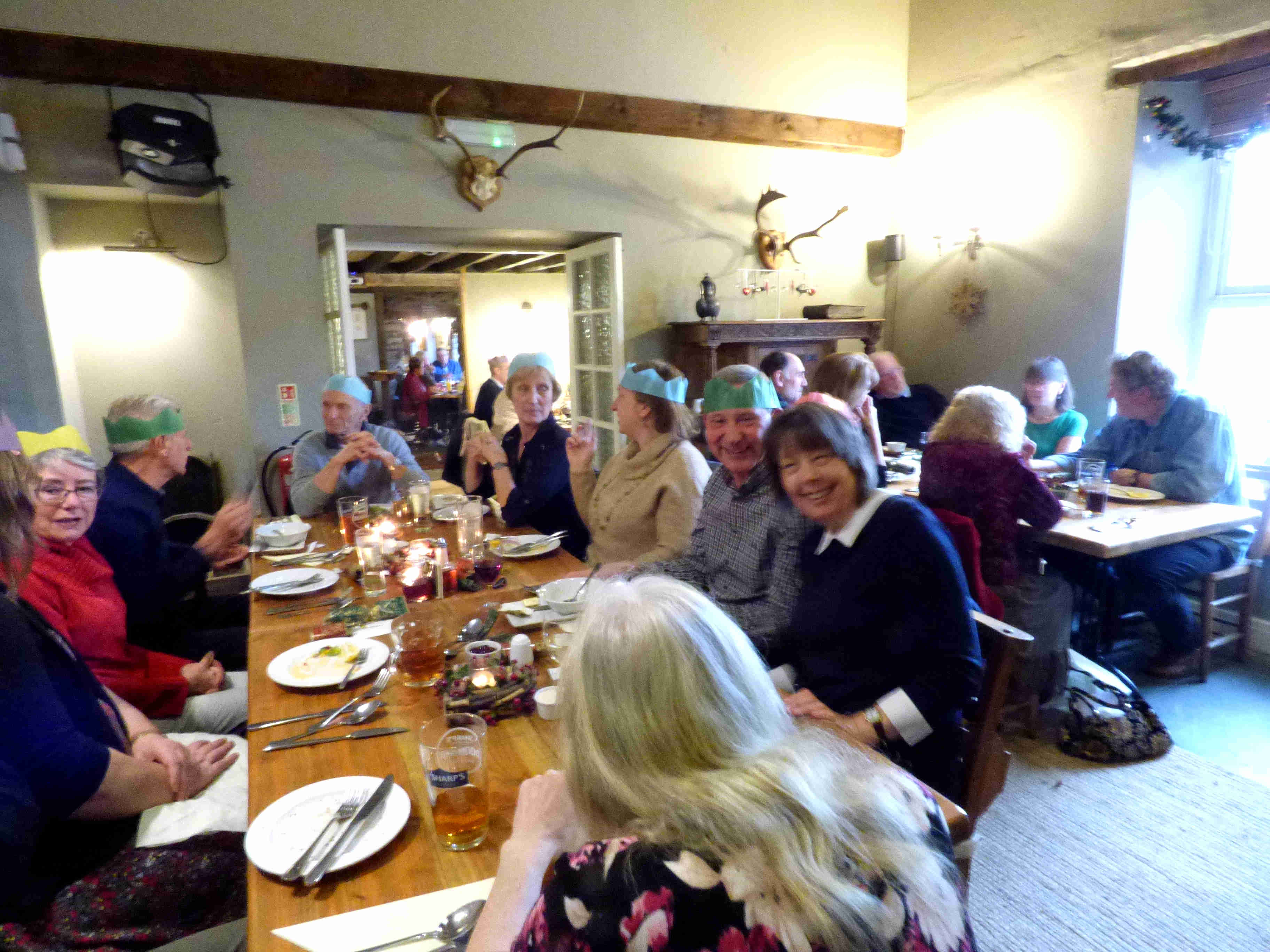
A highly successful end to the Cothi Gardener’s season. A high turnout of members contributed to a thoroughly enjoyable lunch – excellent food, festive atmosphere and great company. A big thank you to George and Louise and their staff and to all who came to make it such a success.
Apologies for the poor quality of the photos but light levels were challenging!
Committee Members Needed
As those who have attended the last few meetings will already know, we have three committee members retiring from their current committee roles in January. A huge thank you to Brenda and Yvonne, our programme secretaries and Julian our Chairman. All members should consider serving on the committee at some point to help the club to continue forward into the future. It isn’t onerous and is often great fun. Obviously it’s very important to find someone prepared to take on the role of chairman. It would be for 1 year with the option of continuing for a maximum of 3. Please give it some serious thought and if you are prepared to join us then please give your name to Julian by 9th January 2019
Finally remember to put the date for the AGM in your diary: Wednesday, January 16th at 7.30pm. Bring a plate of food to share and be prepared for Derek’s Quiz!
Membership renewals:
For existing members who renew their membership before or at the AGM in January the fee will be £10 (normally £14).
In addition, the committee decided that we should introduce a new fee for couples. This would normally be £25 but will be £18 if renewed before or at the AGM in January 2019.
All that remains is to wish you a very Happy Christmas and peaceful, healthy and productive 2019




















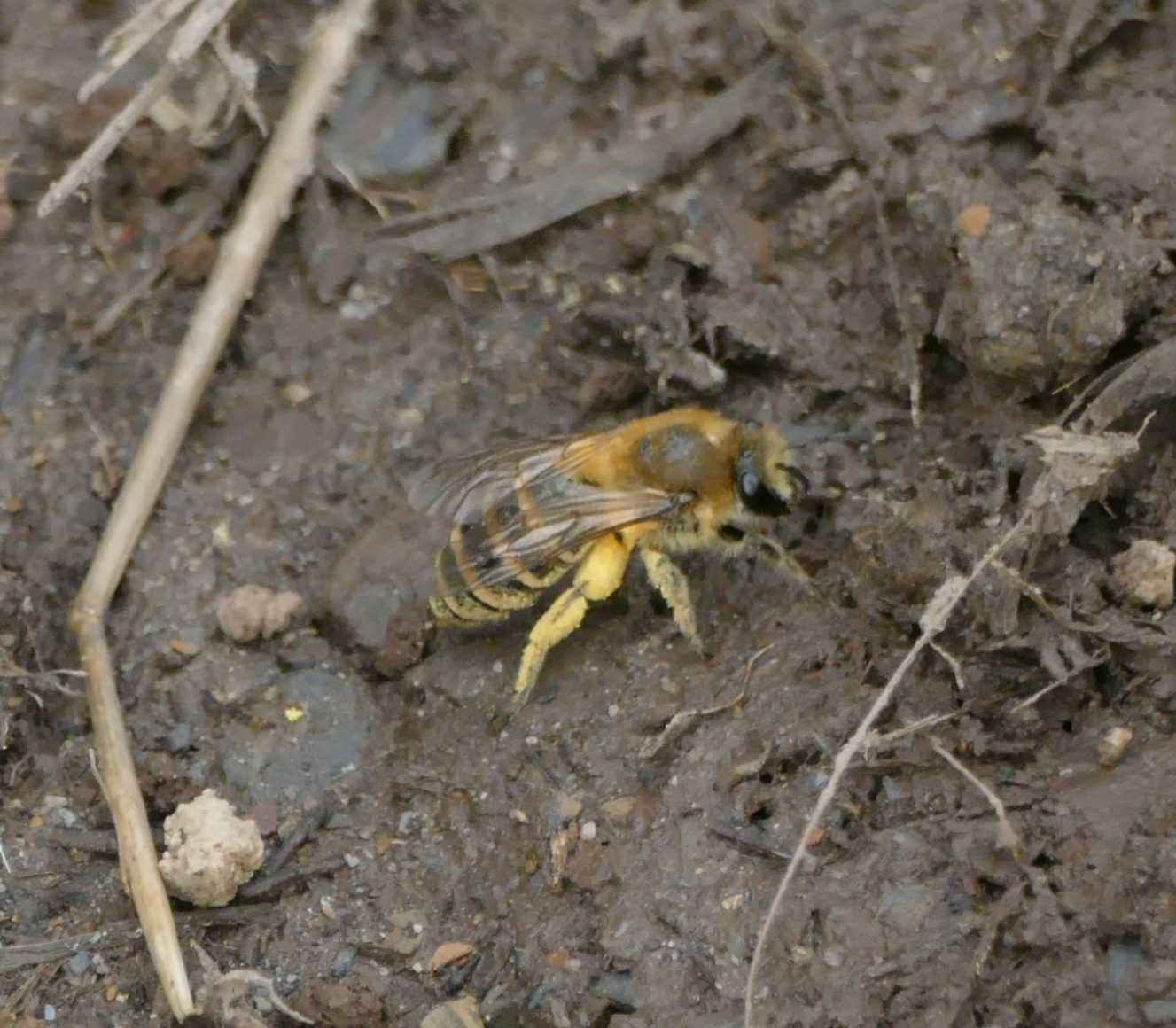 Any ideas what these are, and have you seen them in your garden recently, or indeed ever?
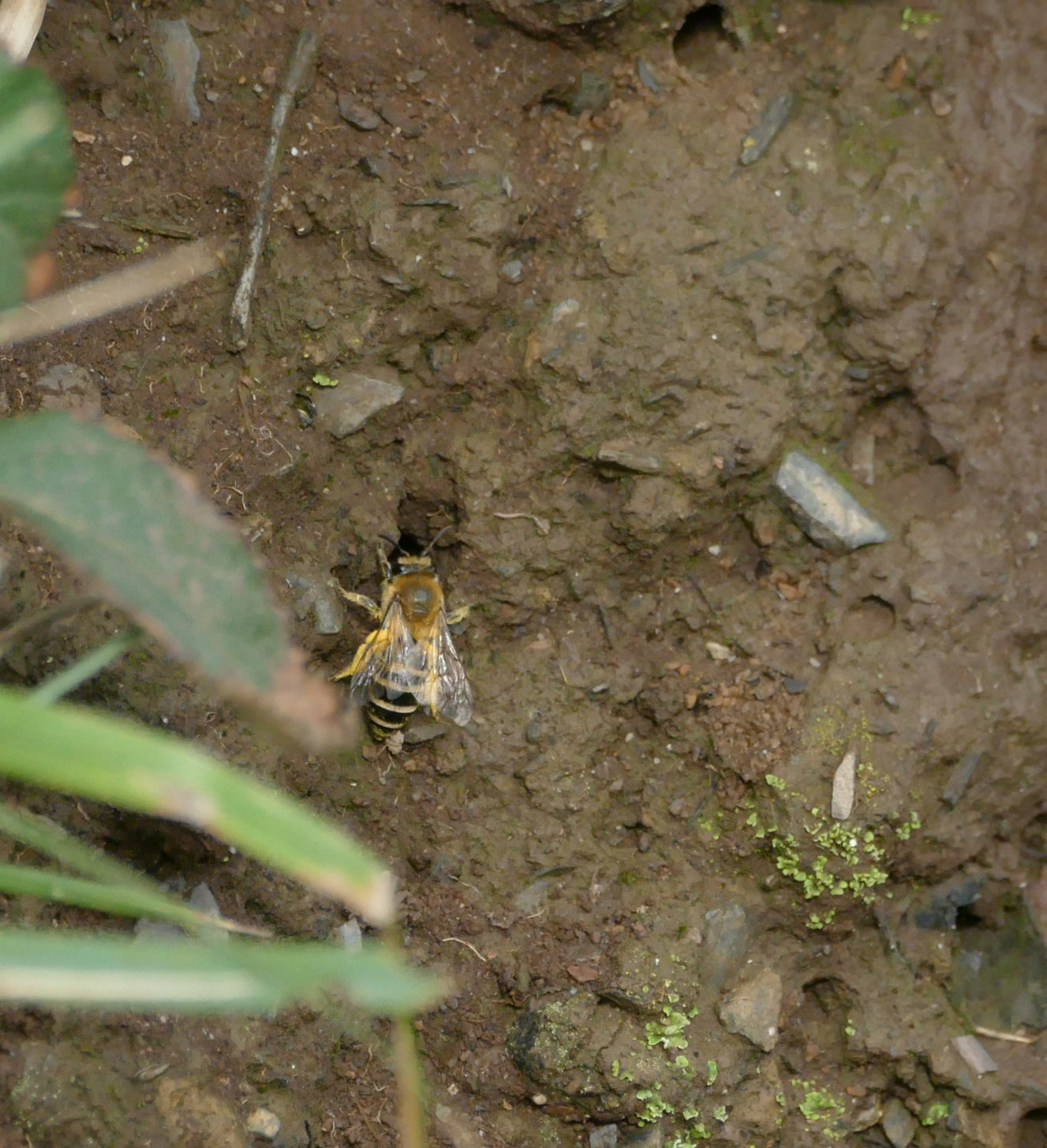 I’m including them because we hadn’t seen them before, and these were found as part of a large colony just above the beach at Pwllgwaleod, at ankle height on the coastal path walk round Dinas Island in Pembrokeshire last Thursday.
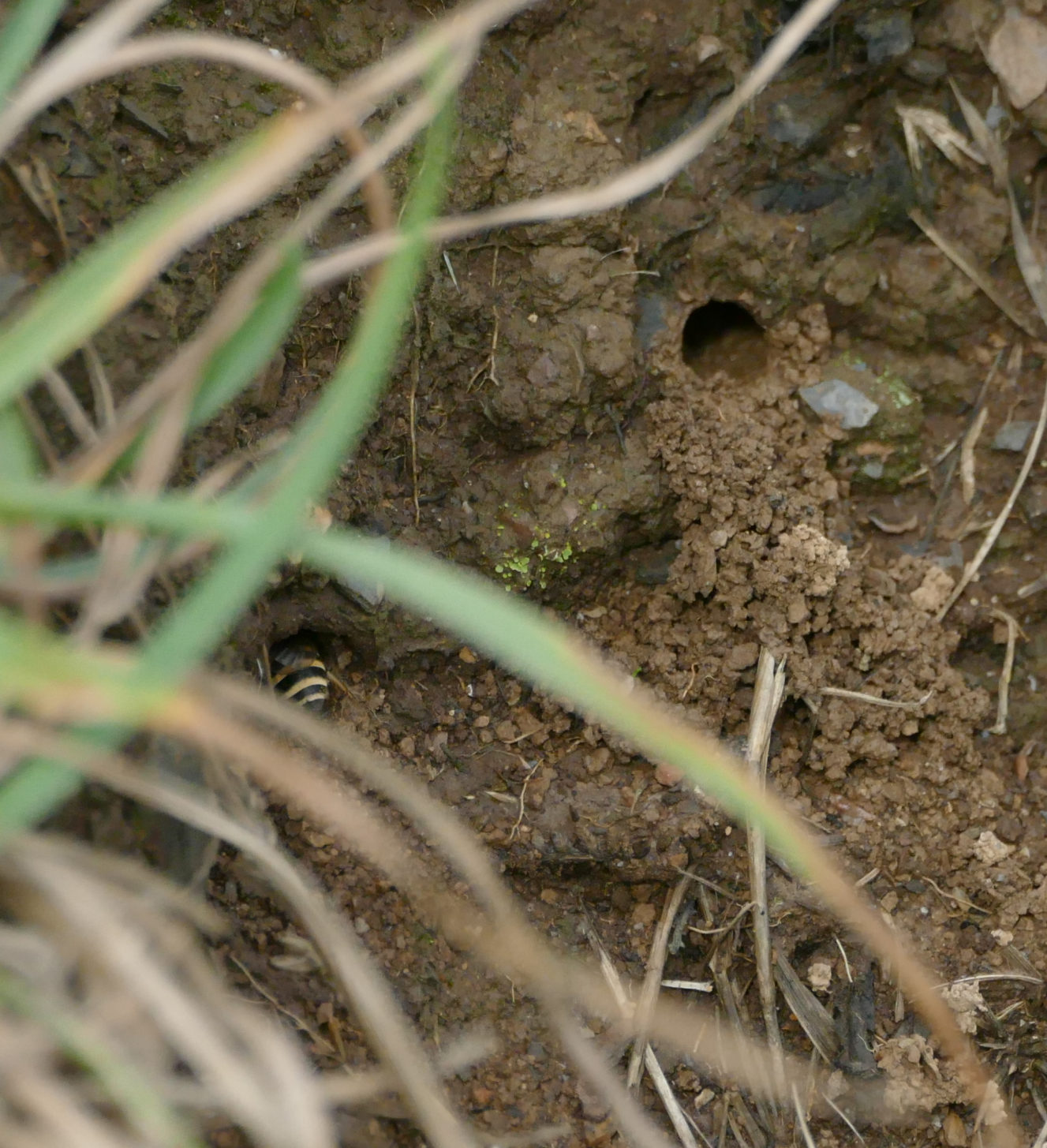
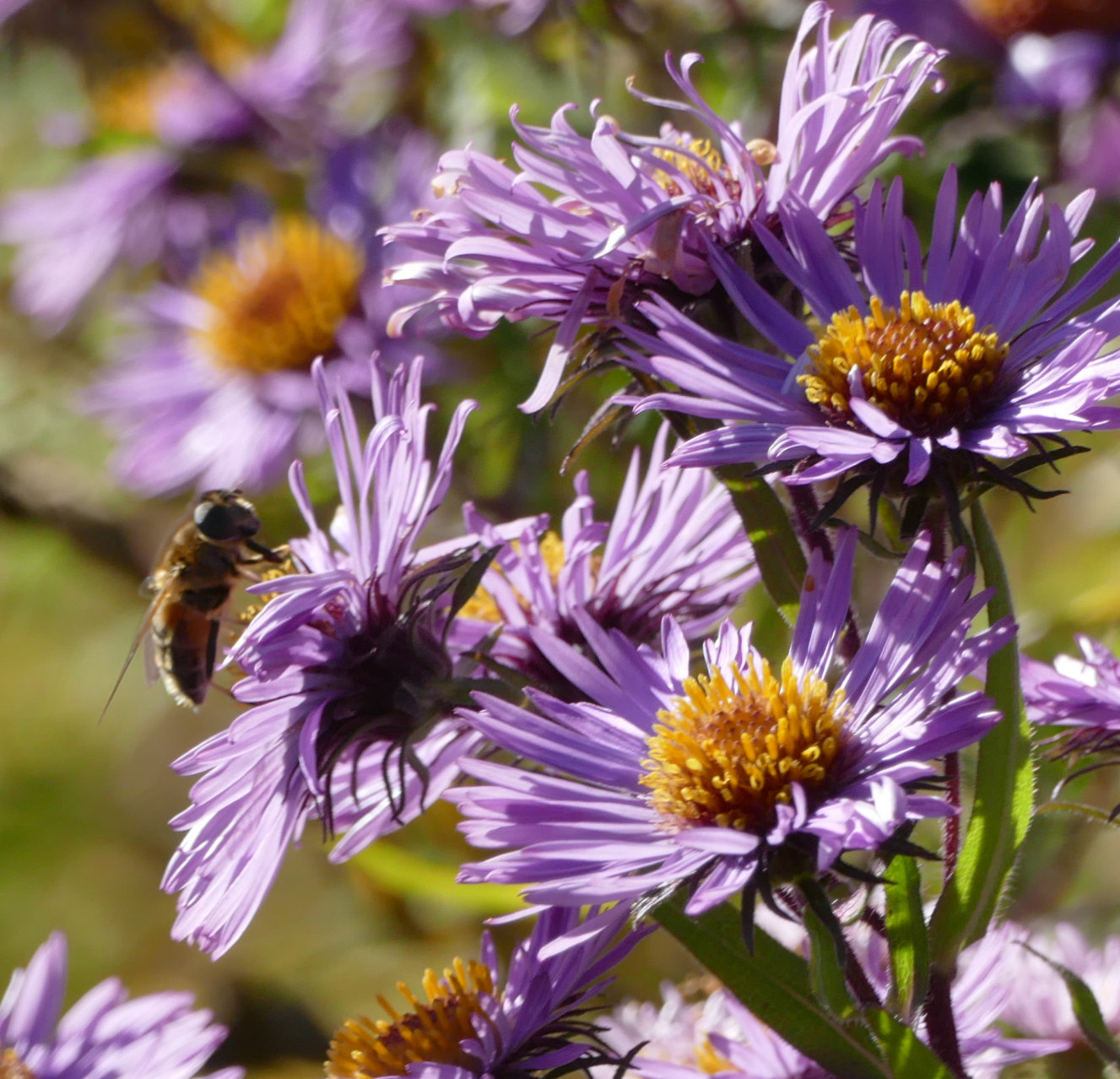








 Well, mainly the Himalayan Balsam half a mile away in the village, which brings them home with characteristic white dusting on their backs.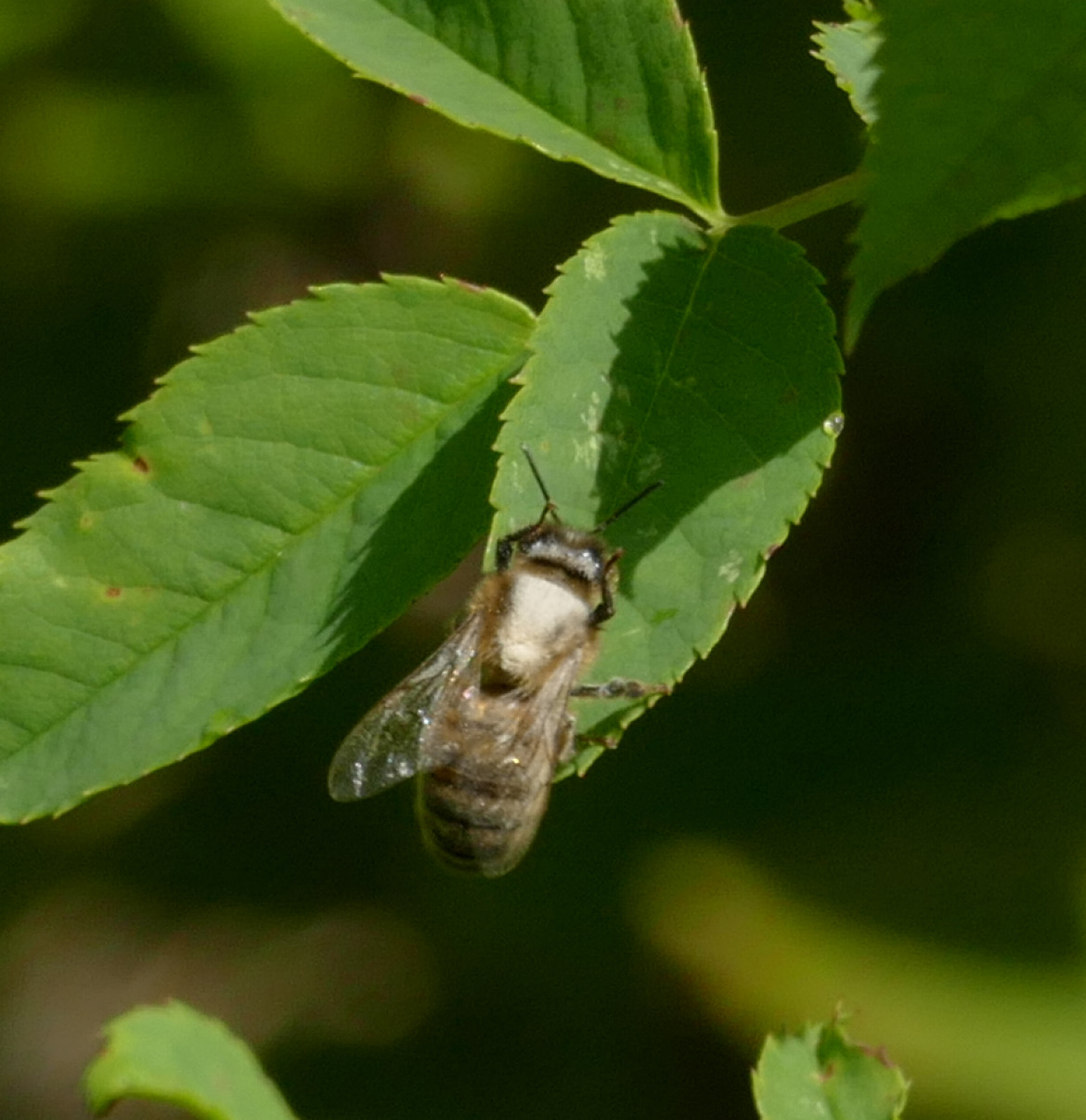







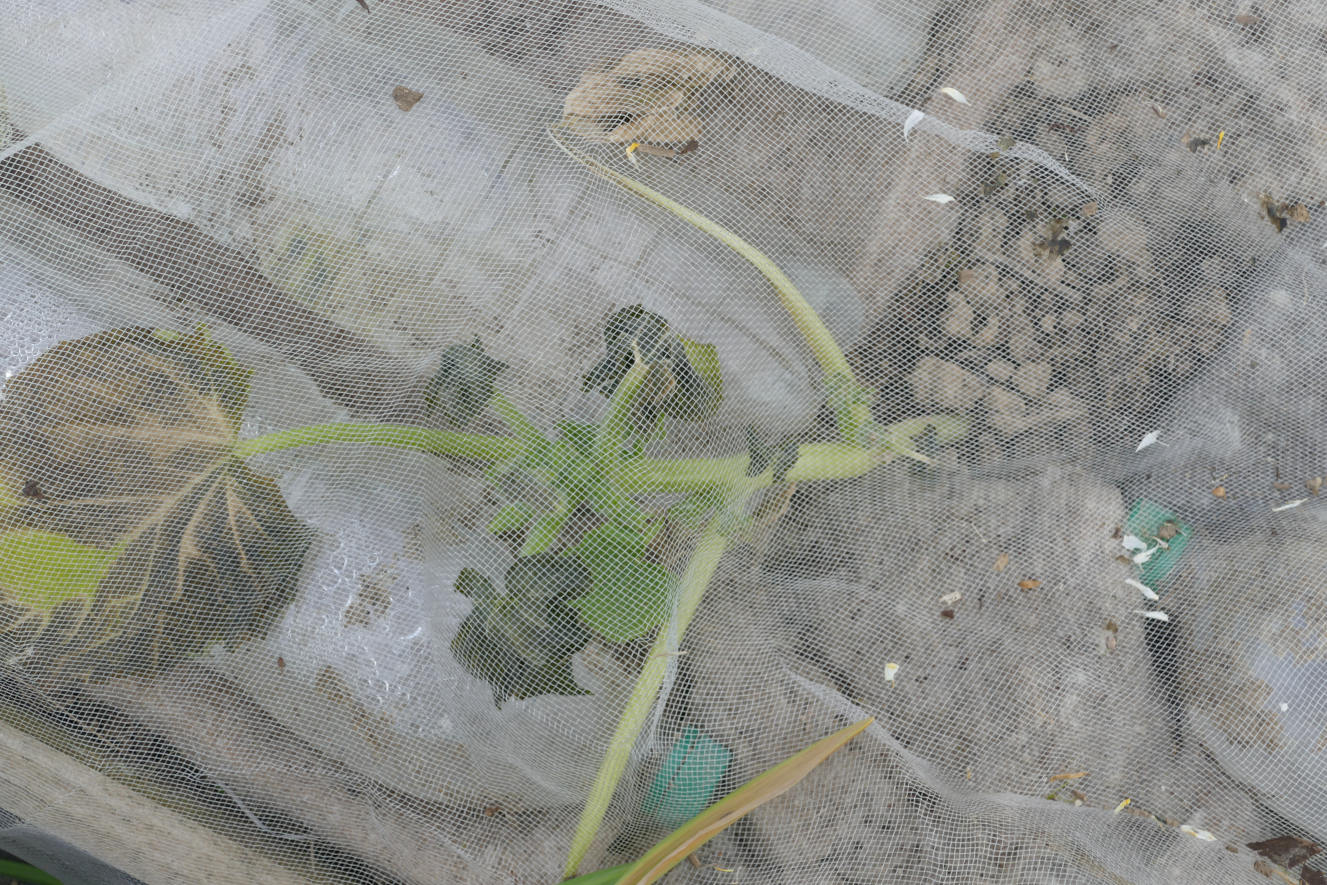
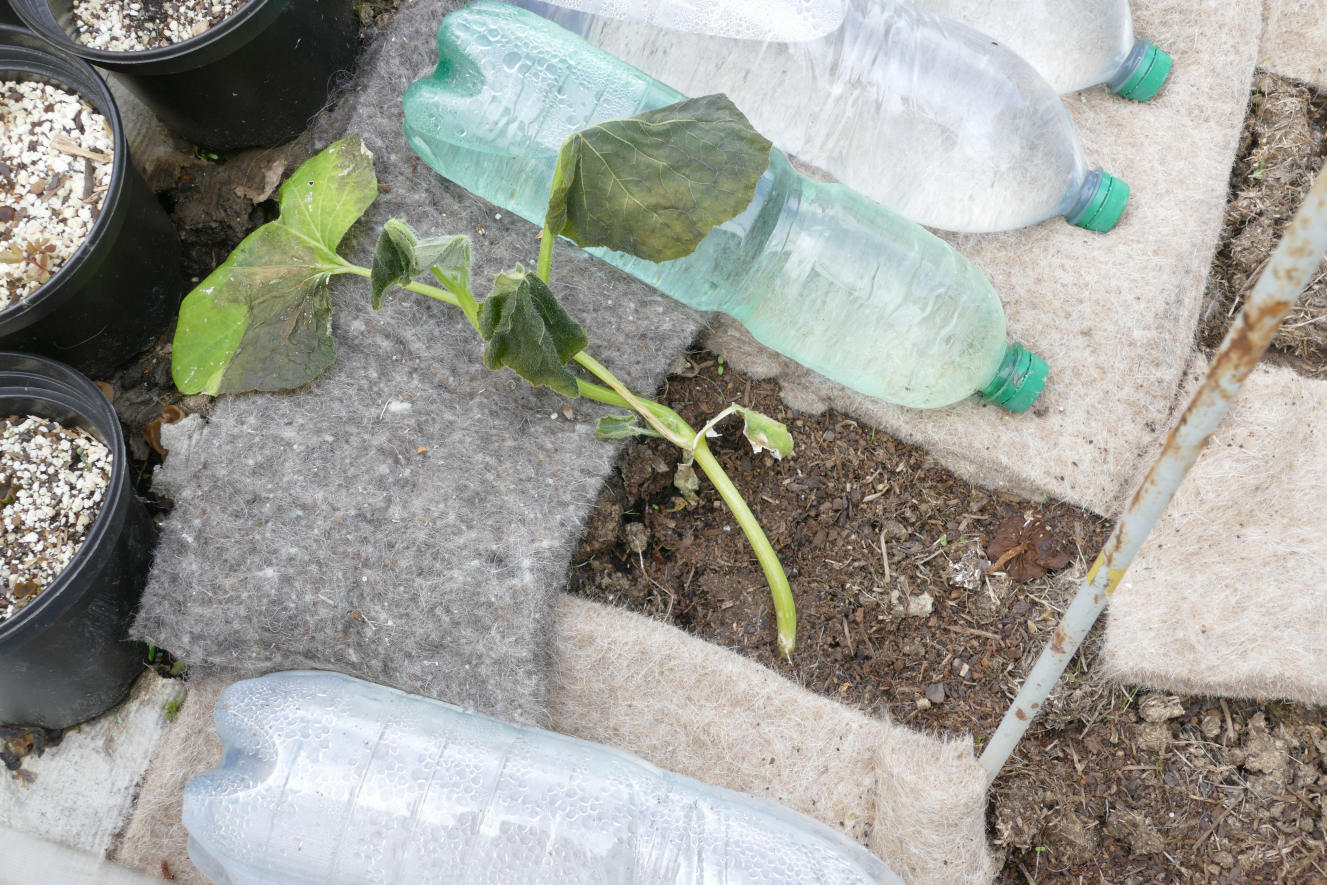 but enviromesh, water bottles and woolly mats seemed to mitigate the worst of the minus 3 temperatures, and all but 3 squash plants seem to have recovered and are growing away within a fortnight. Will they still fruit though?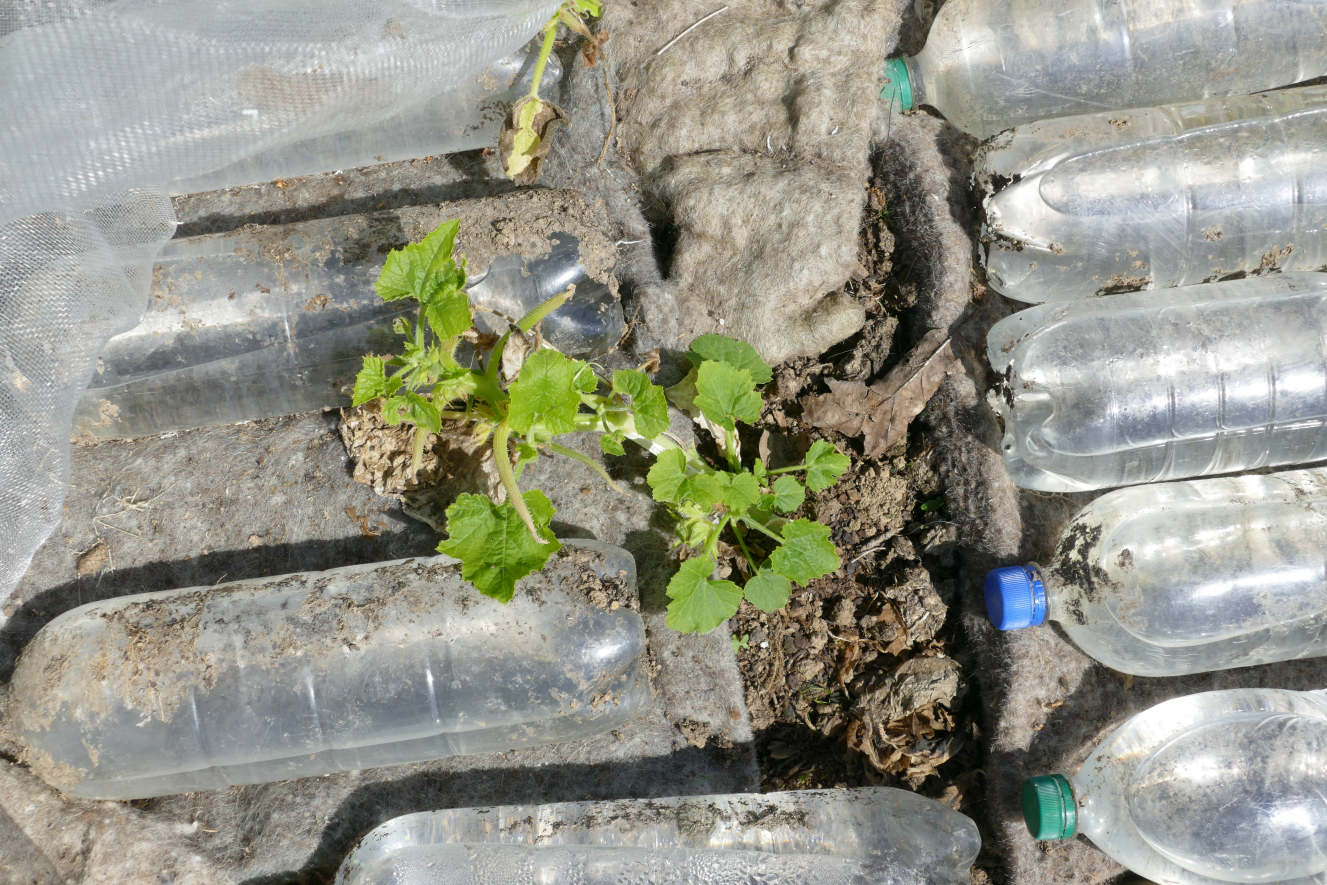

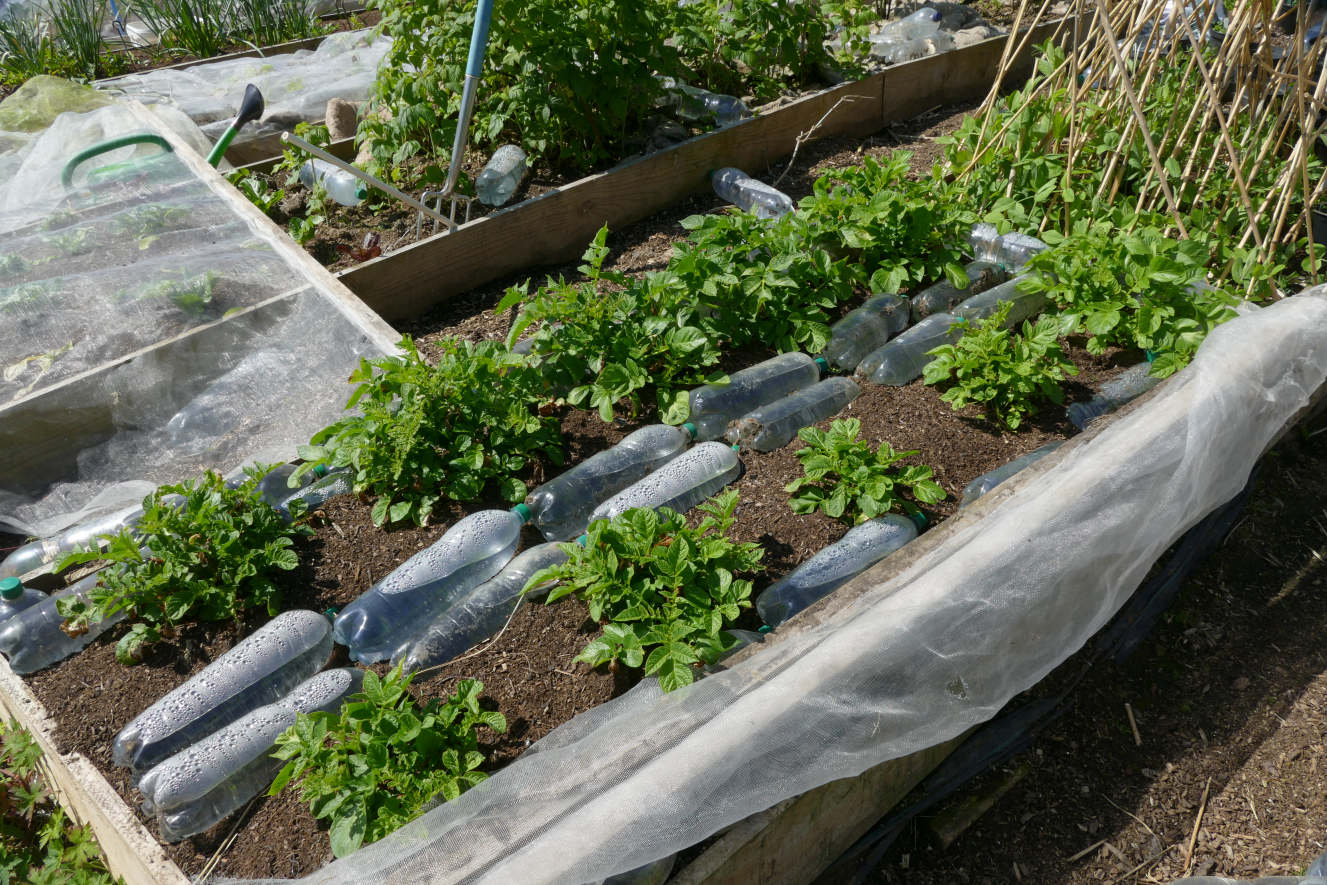 In the hay meadow even some early orchids keeled over, probably because the flowers are about two weeks ahead of normal, following the sunny dry spring weather.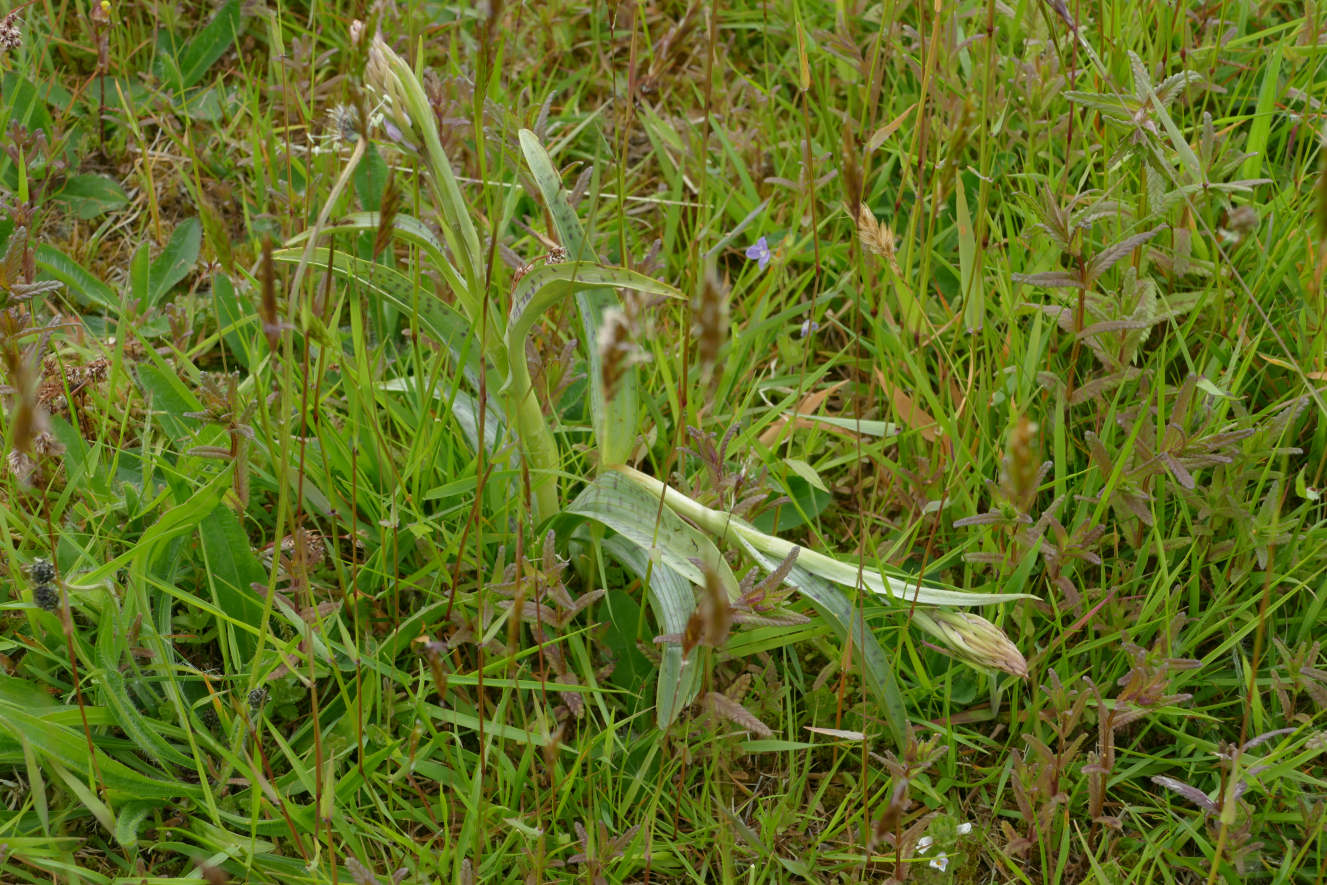



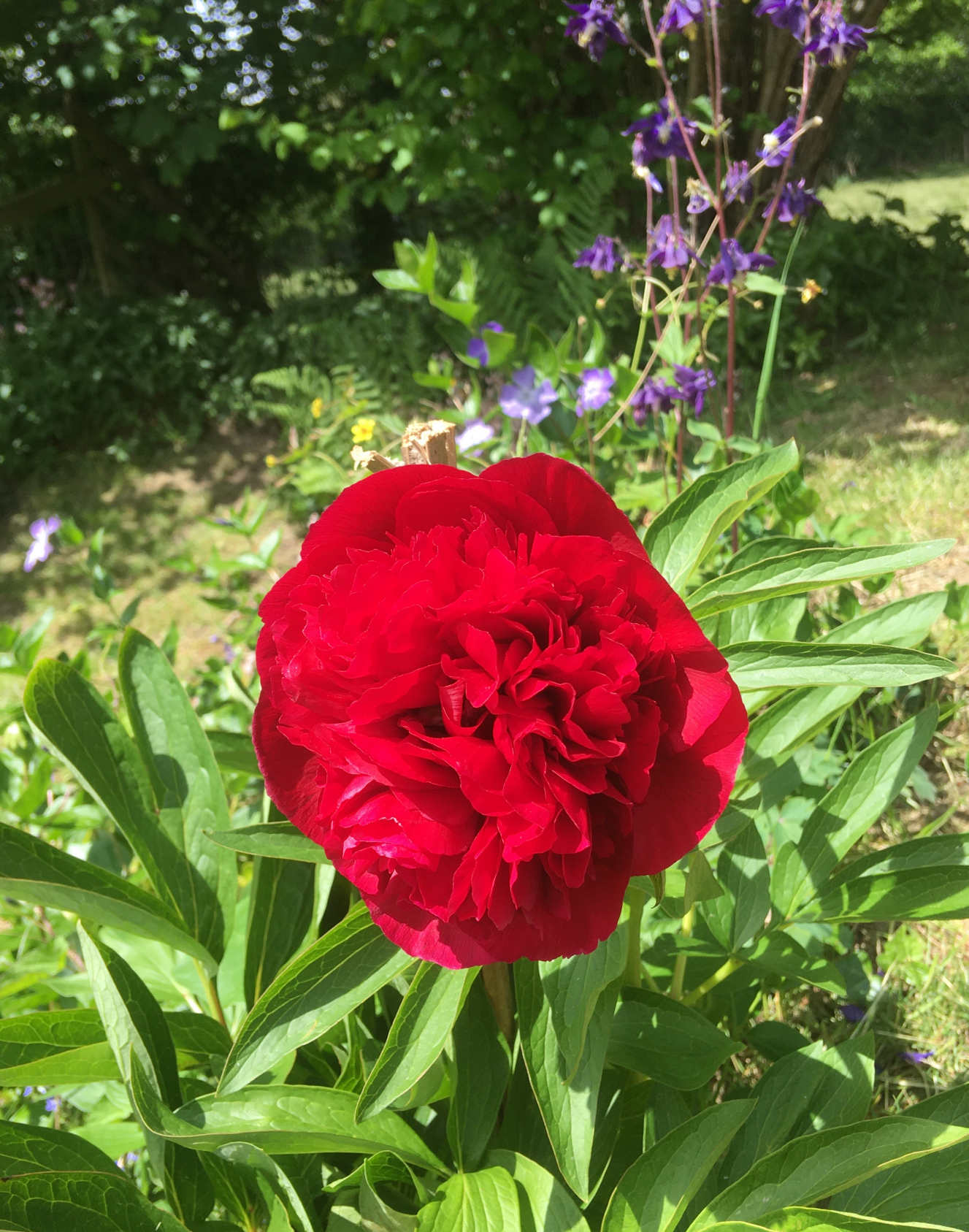
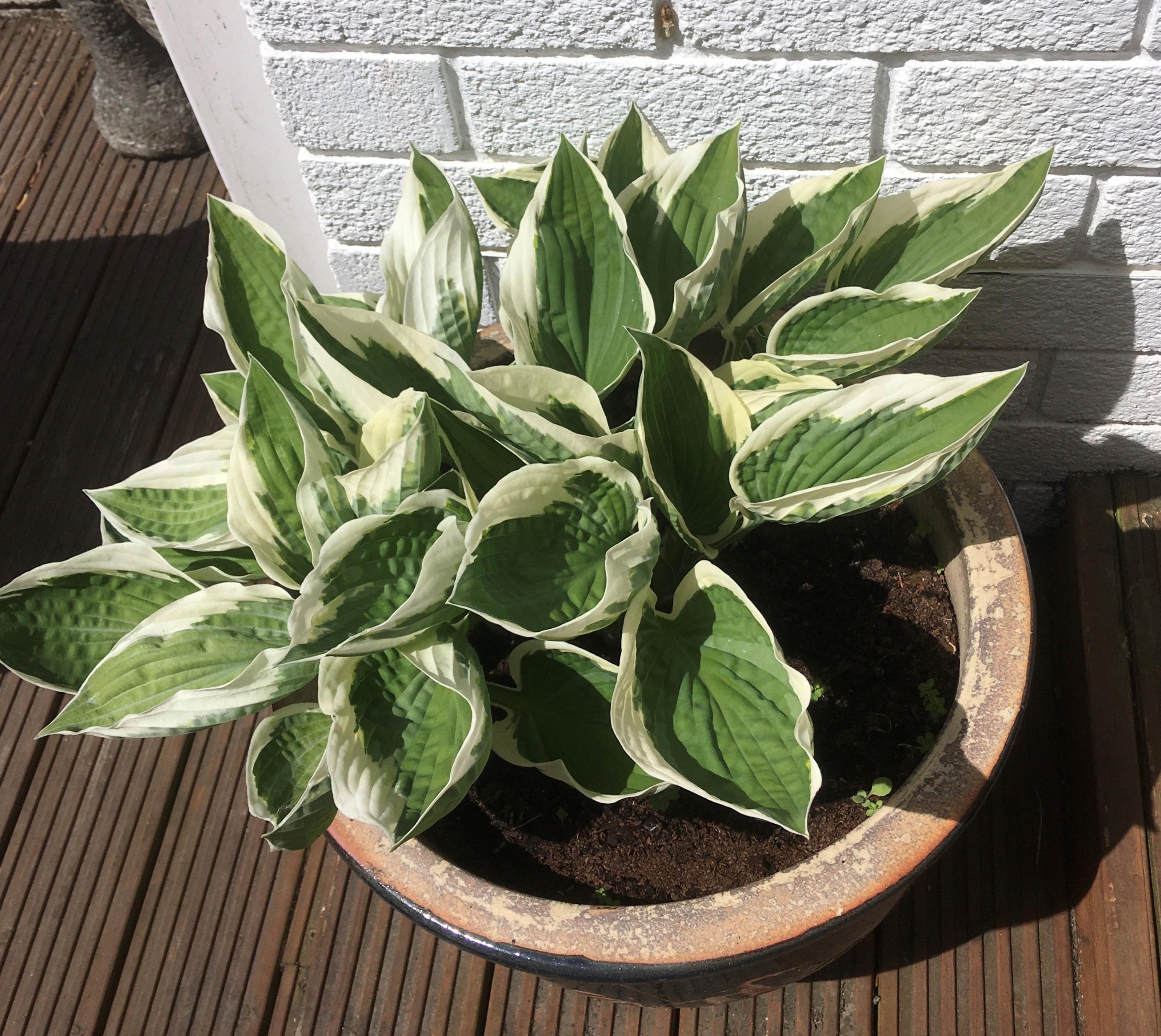


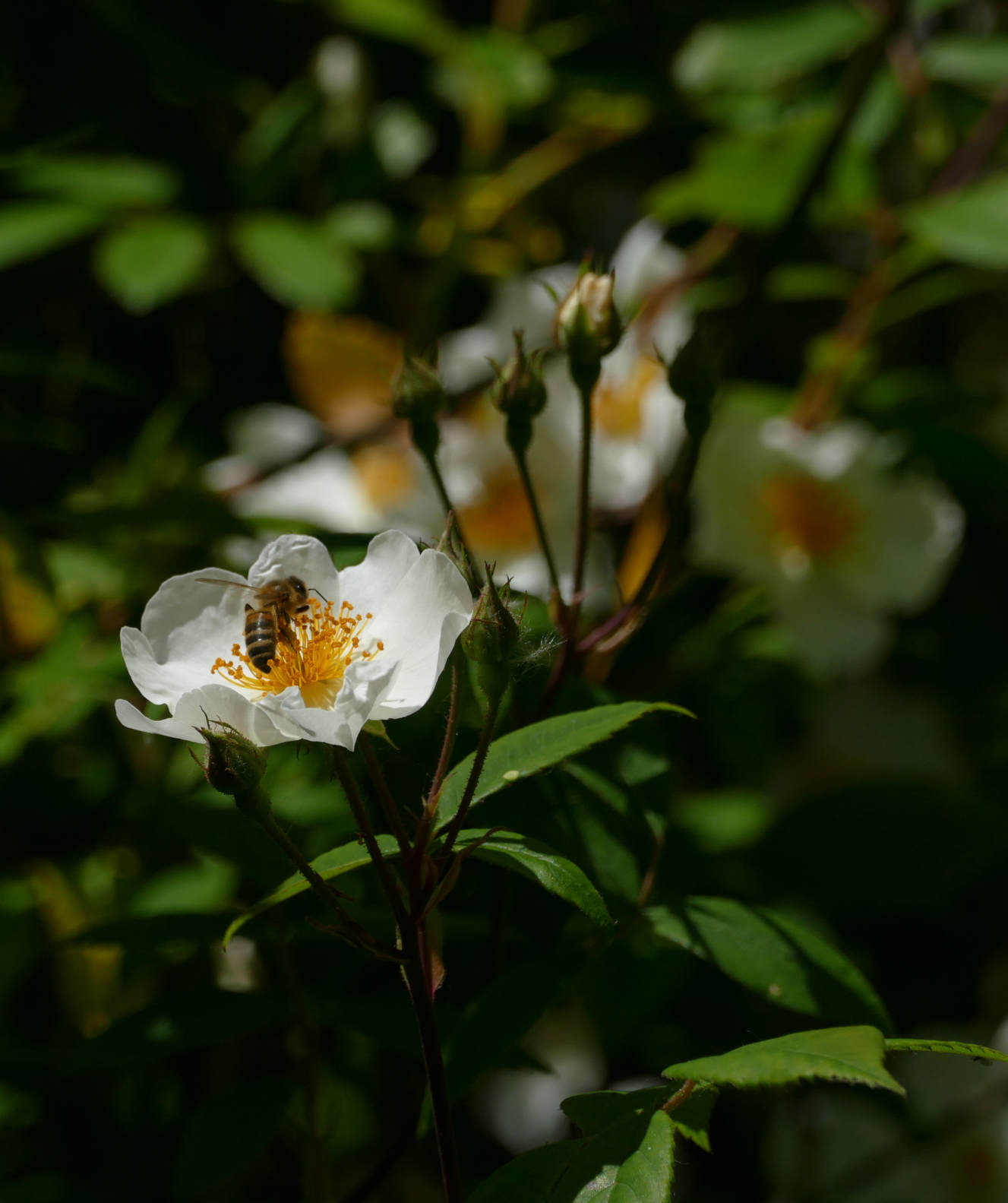 After noting it had grown shoots over 15 feet long in a year, I planted the still young plant into a rotten hollow centred tree stump, filled with compost which was quite close to the base of a youngish oak in 2012.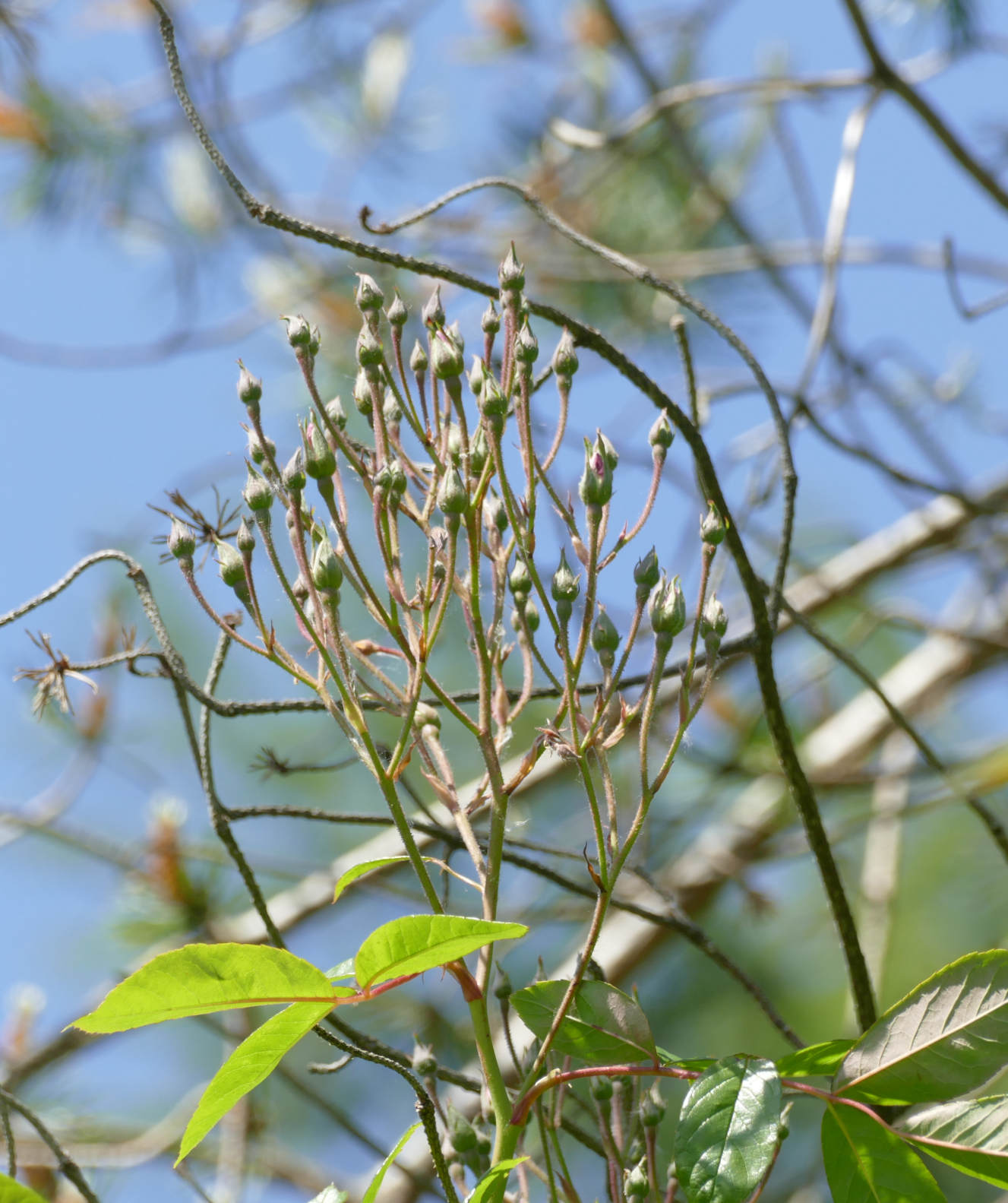





 A reminder that on Sunday August 11th, John and Helen’s garden at Ty’r Maes, Ffarmers, Carmarthenshire, SA19 8JP, opens for charity for the National Garden Scheme , from 13.30 to 17.30, admission £4.00.









 Cothi Gardeners