This year’s Summer Social – Pizzas and Plants – was held at Y Plough in Felingwm, a pub now owned by Joseph Atkin, previously Head Gardener at Aberglasney Gardens and Rachael Garside.

The social was very well attended by members and guests, and judging by the photographs a fine time was had by all! There was an imaginative choice of large and delicious pizzas cooked in an outdoor wood-fired pizza oven.



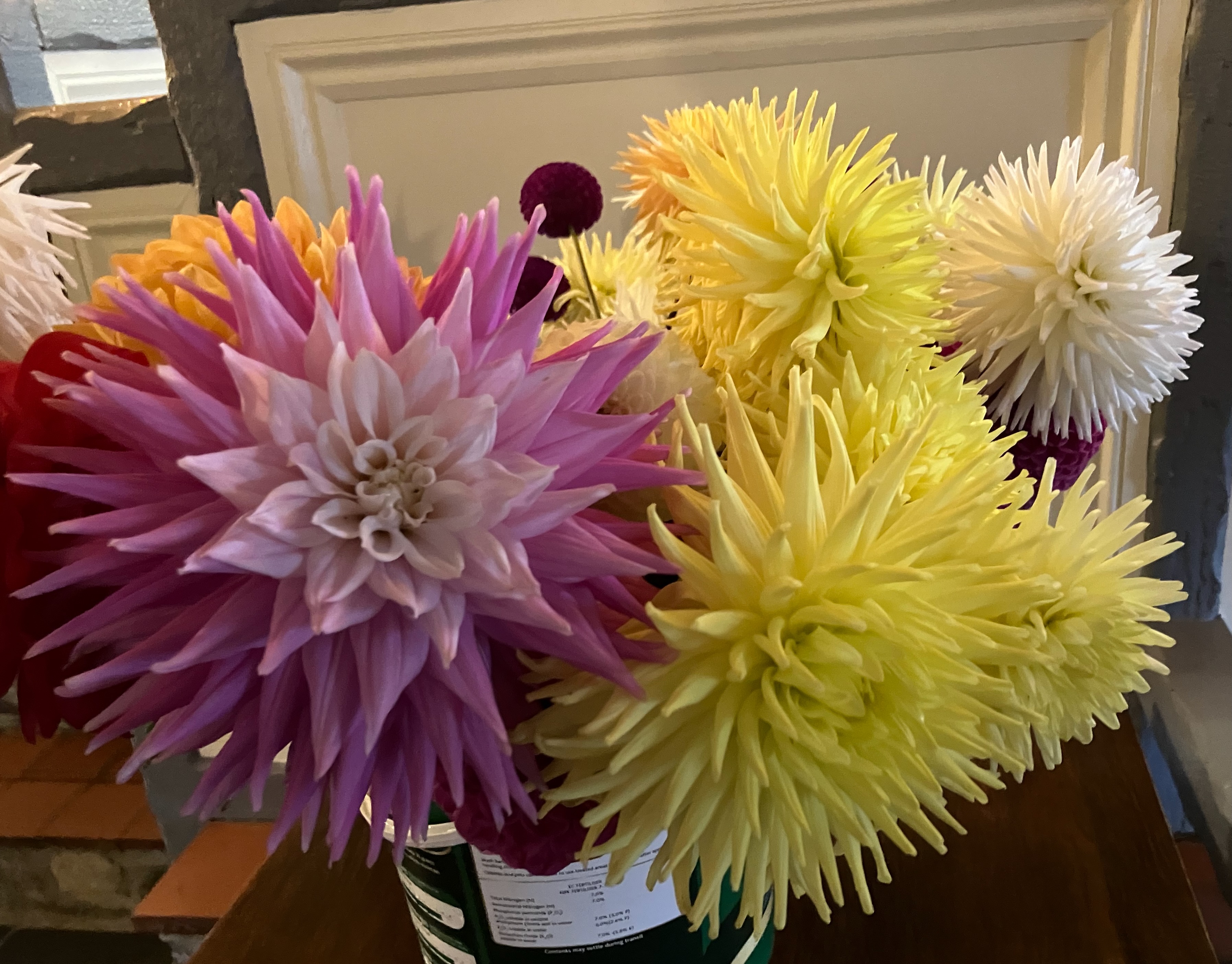

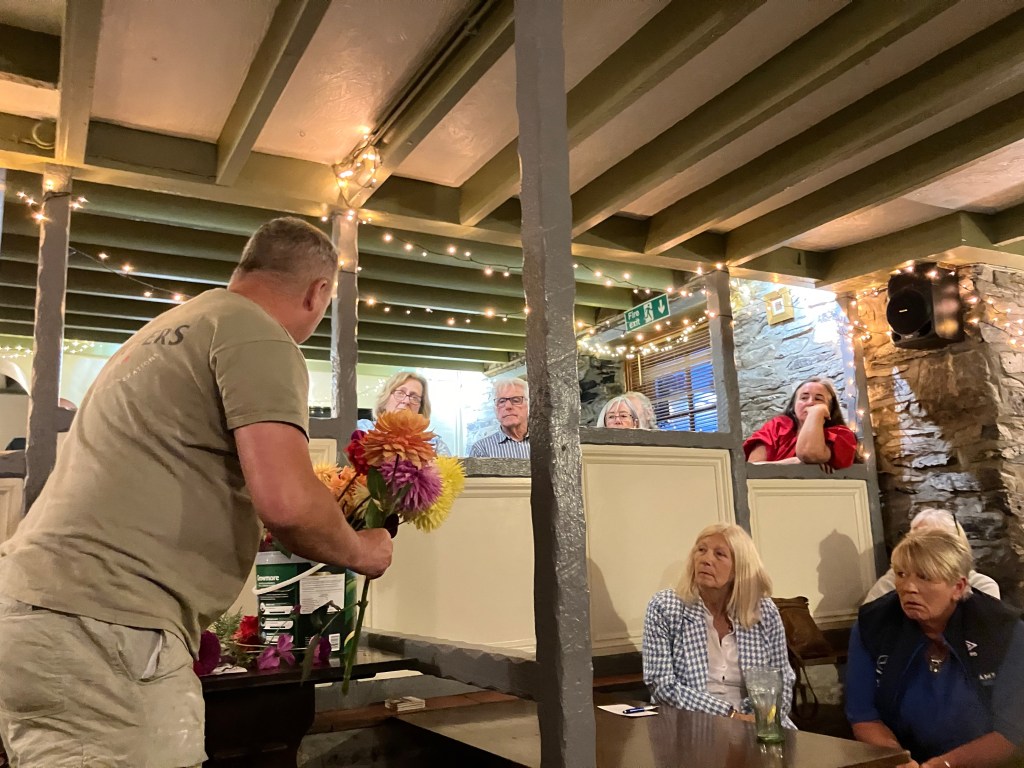
Feeling very full, it was time to listen to Joseph tell us about one of his favourite plants – dahlias, very topical for the time of year. Joseph stressed that he was giving us a gardener’s view of what he thinks is one of the very best plants for the huge selection (4,500 varieties), the range of colours (everything except blue) and their flowering season (from June until the first frosts). The only downside is that they are quite a lot of work! Joseph had two pieces of advice for us – spend some time doing your research to choose ones you really like, and don’t grow too many!
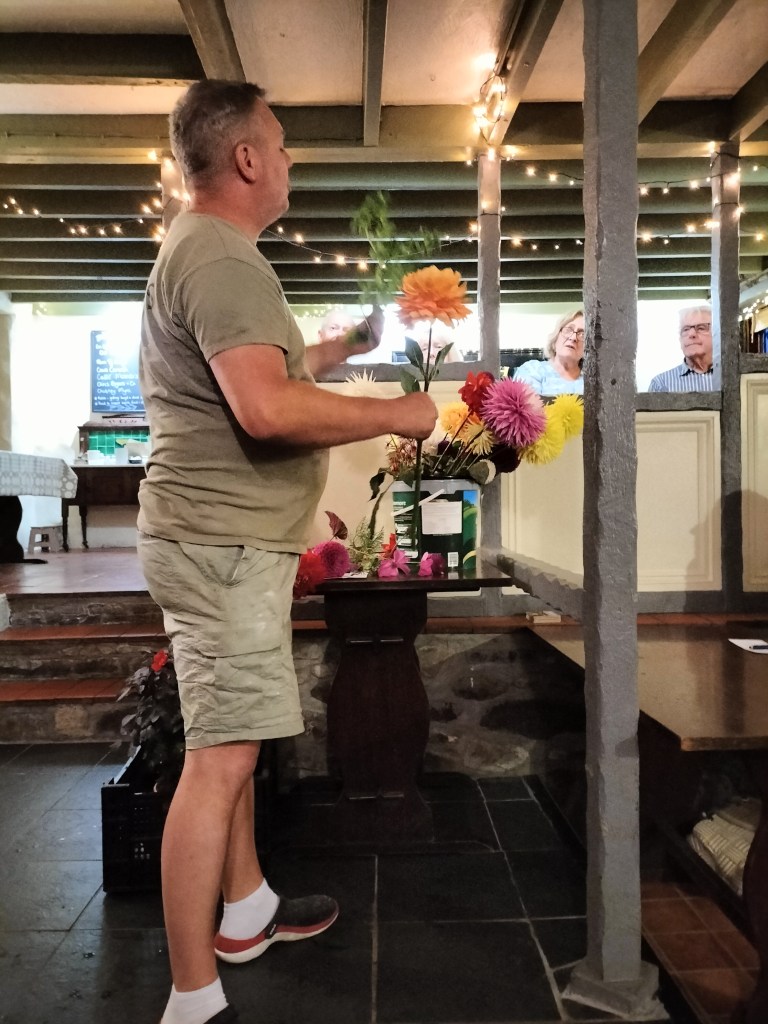
You can grow dahlias in pots, put them in troughs, or grow directly in the ground. They need super-rich, really good soil. Joseph has even grown them in pure manure! A sunny aspect is best, with a bit of shelter. Joseph thinks that the tall types of dahlia are best – as then the flowers are at the right height to be enjoyed – but they will need staking.
Fergus Garrett from Great Dixter plants his dahlias six inches deep, and leaves them in the soil over winter with frost protection. In Wales it is best to either bring the pots in or lift the tubers for the winter, because of the wet we experience and the slugs – although if you want to try leaving them outside then the tubers should be mound-planted.At Aberglasney, they overwinter the tubers inside, and then get them going early in the spring in the greenhouse. In autumn, when you dig up the tubers, cut off the foliage and leave upside down in a dark shed for two weeks. Then shake off the old soil, and plant into compost in crates, pots or hessian sacks (anything with good drainage). Cover with cardboard and they can be left for the whole winter, until late February or early March, but remember to keep the compost slightly moist.
The spring, when they start shooting, is the time to take cuttings. You will find that one shoot, as a cutting, will make a much bigger, better plant than an old tuber. The reason is that there is only so much energy in a tuber, and so that limits the size of the plant; whereas a new cutting will just grow and grow, and only start to make a tuber later. Cuttings are very fast to root (48 hours is the fastest that Joseph has rooted a dahlia cutting!). He uses a fungicidal spray, and puts the cutting into a pot of compost covered with a plastic bag on a window sill (rather than a greenhouse). Once rooted, keep watering the plants steadily in spring until there is a reasonable amount of growth. Cuttings and tubers can be planted out in May, but should be covered if frosty weather is forecast. Add organic matter when planting out, and put three stakes in a triangle around the plant ready to support it later. Slugs are the biggest enemy, so Joseph likes to make sure his plants are as big as possible before planting out, about one to two feet tall. Then just keep them watered, and deadhead them for a fantastic, long-lasting display.
Joseph noted that the popularity of dahlias has grown tremendously since 2008 and that as a consequence dahlia production has become very commercialised, which can lead to inferior plants becoming available, particularly if raised from seed. His strong recommendation is that, as dahlias are so much work, we should only buy really good ones with an Award of Garden Merit from the Royal Horticultural Society. Make sure to buy named varieties; exhibition dahlias will always give you height, but there are also plenty of good garden dahlias as well. In short, choose any AGM dahlia varieties with shapes and colours that you like, and remember that you don’t need many to fill a reasonable-sized bed or border.
Dahlias are great for combining with other plants. The leaves with dark or bronze foliage are particularly useful in colour schemes, and you can have great fun combining the colours and shapes of the flowers with other plants. The pompom or cactus shapes contrast really well with the spire shapes of other plants.
At Aberglasney, dahlias are grown in with the vegetables to really tighten up the look of the kitchen garden. In the autumn Dahlia ‘Downham Royal’ makes a stunning contrast in a border against a fiery background of Boston ivy. Basically, there is a dahlia for every colour scheme! In a border, they need to be in the middle, or further back, not in the front of a border. They also look good in pots – but it should be a really big pot with rich soil/compost. Raised beds are also good.
Asked about dividing tubers, Joseph explained that trying to ensure you get a growing shoot with part of the tuber is a bit of a nightmare. In his view, it is much easier and better to take cuttings in the spring.
Joseph was thanked appreciatively for both the delicious pizzas and his entertaining and informative talk.
Updated Autumn Programme
The Club’s autumn 2025 programme has now been updated on the website. Our next meeting on Wednesday, 17 September at 7.30pm will be an opportunity for members to reflect on our gardening year so far – what’s worked and what hasn’t in our gardens, which garden club talks and activities have we enjoyed the most, and what would we like to see in the Club’s programmes going forward? The usual tea, coffee and biscuits will be provided, along with some extra non-alcoholic drink choices. Please bring nibbles to share as well.
The Events page on the website has also been updated and your attention is drawn to the West Wales Country Gardeners’ Autumn Plant Fair on 13 September.
Ty’r Maes Charity Plant Sale
Our very own John and Helen Brooks are holding their annual plant sale for charity on Sunday, 28 September from 1pm at Ty-r Maes, Ffarmers, Carmarthenshire SA19 8JP (but please use SA19 8DP to locate the property with SatNav). Entry to the plant sale is free, there will be tea and biscuits, as well as loads of plants for sale. All proceeds from the plant sale go to NGS charities.
 Cothi Gardeners