Juliet is a mixed media artist who is fascinated by experimental processes. She is keen to pass on to others her skill and collected information about printing, and the workshop today particularly shows how eco printing (using 100% natural materials such as cotton, linen, wool and silk plus the organic materials which provide the patterns) can result in surprisingly beautiful artworks reflecting the diversity of nature, and can be done at home.
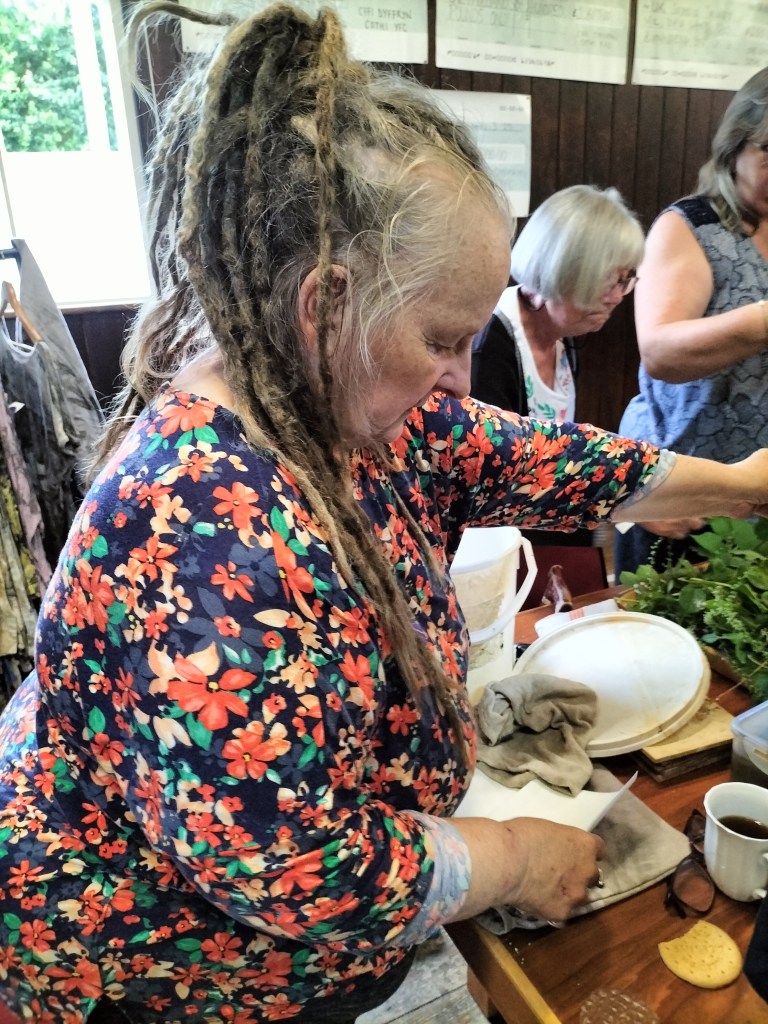
The chemicals normally used in printing on an industrial scale are harmful to the environment and thus to ourselves, both to use and dispose of. The fabric can be washed using a soap solution, without losing the colours or patterns and Juliet brought with her examples of blankets, scarves and items of clothing which she had made using her dyed fabrics, many obtained from charity shops.
Juliet first became involved in eco printing through the work of Nicola Brown who is the author of the book “Eco Printing in the Dirty Pot” which describes in detail the processes and endless possibilities of using this system.
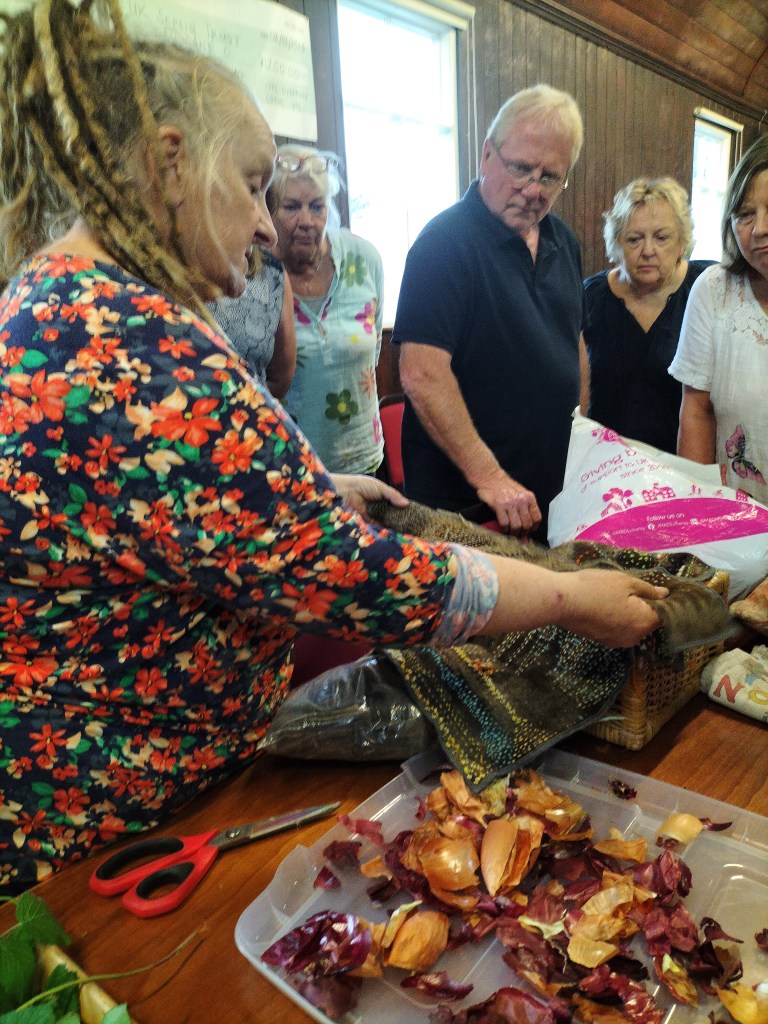
In order to give it a try ourselves, she provided a wide variety of plant material, leaves, moss and onion skins etc. which we could use in our artworks. She provided us with squares of dampened paper about 6” x 6” on which we arranged our chosen bits of plants etc. These were then sandwiched, one on top of the other, in blocks of about 5 and placed between two ceramic tiles. At the end of the process, this meant that impressions would be seen on both sides of the paper.
The tiles were then bound tightly together using strong fabric tape.The plant materials vary dependant on where they have come from and the results will depend on how well you know your area. For instance, an oak leaf from your local area will not give the same result as one from further away – weather, soil type and tannin content all make a difference.
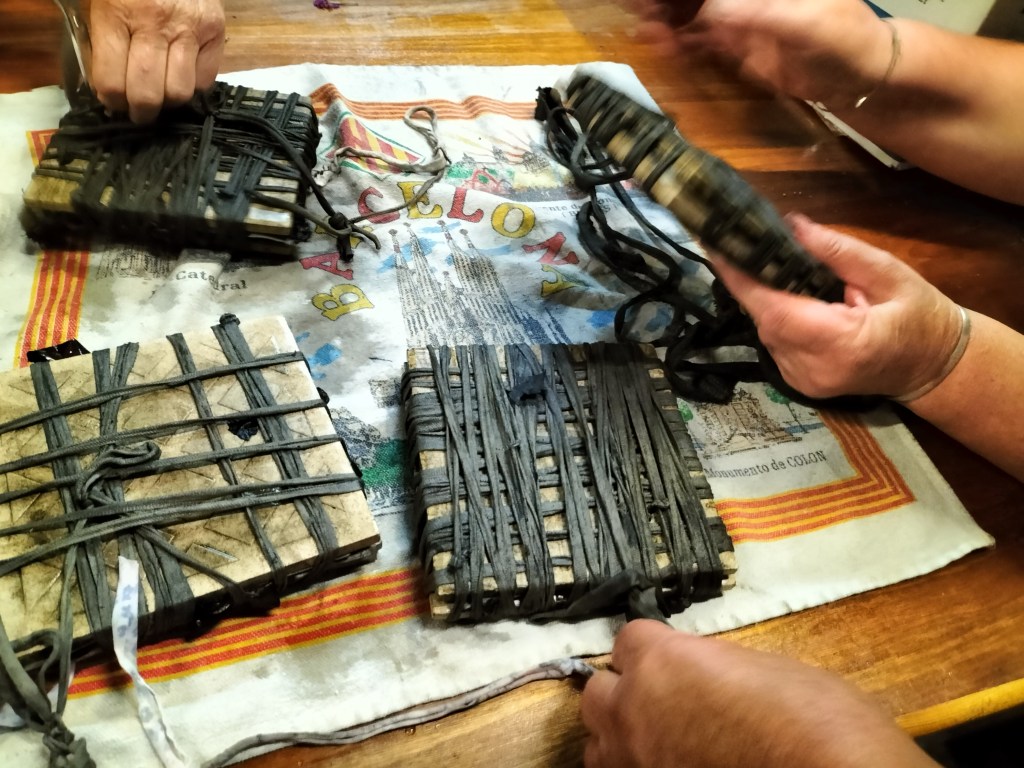
A way of providing a different dimension is to wind cloth around a fairly chunky-sized copper pipe and then securing it with string which results in a tie-dyed effect.

We went outside for the next part. In an aluminium vessel (referred to as the Dirty Pot), the fluid which would fix or cure the images was boiling over a gas stove. This fluid comprised of Eucalyptus leaves and bark, with water and vinegar, plus some onion skins and bits of rusty metal. This was happily boiling away, much like a witch’s cauldron – it was a bit like nursery school on steroids. The artworks, which had been named, were then lowered into the pot, still sandwiched in the tiles, and left for one hour to cure.
Whilst we waited, we did some “slow stitching” – using lengths of different coloured wool to create patterns on pieces of eco dyed wool.


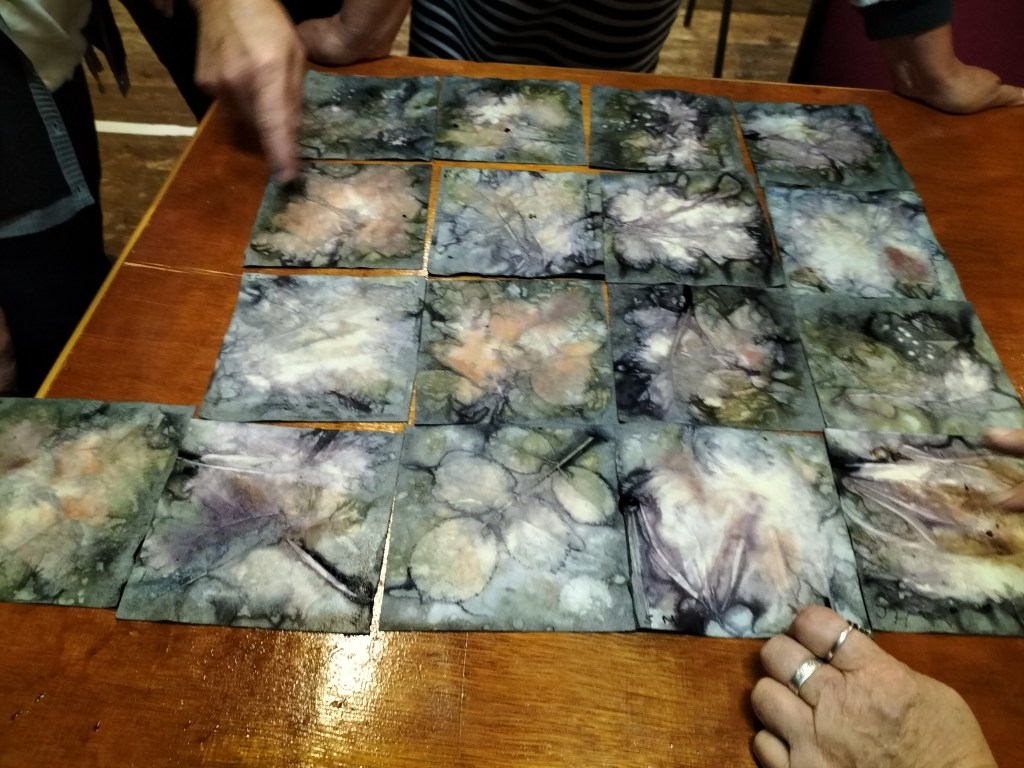
At the big reveal, we were amazed at the variety of the different shapes and the diversity of colours in the images and when this system is applied to natural fabrics. The fact that it can be washed and used as we do with the usual factory-dyed items is excellent and gave us all food for thought.
Juliet was thanked for her very interesting demonstration and talk.
Summer Social
Cothi Gardener members are reminded that our summer social this year will be Pizzas at The Plough at Felingwm, which is now owned by Joseph Atkin, who was the Head Gardener at Aberglasney Gardens. This will be on 20th August at 6pm, and Joseph will be giving us a talk on Dahlias. Car-sharing, where possible, is recommended.
 Cothi Gardeners