Paula Davies (aka Head Gardener) came to Pumsaint, along with her husband Iain (aka Assistant Gardener), to talk to us about the garden she has created in Ferryside, Carmarthensire, on the edge of the river Towy estuary.

In purely factual terms, the garden is a third of an acre in size, eight metres above sea level (when the tide is out!). It faces west, being exposed to south-westerly winds and considerable precipitation. The soil is sandy clay over Old Red Sandstone, neutral to slightly acid (pH 6.5). To Paula, however, the garden is much more about people, places and time; it’s about the past, the present and the future.
Turning first to the past, Paula told us that her maternal grandfather had been a professional gardener, and as a child, along with her three sisters, her weekends were spent helping in her parents’ new garden or being dragged around other gardens or nurseries. Paula’s passion was drawing and painting and, influenced by books such as ‘The Country Diary of an Edwardian Lady’, she wanted to become an illustrator, perhaps of botanical or children’s books.
Once at art college, Paula discovered textiles and surface pattern, and went on to become a very successful international designer first for interior products and then fashion, always focussing on floral design. Thinking about colour, texture, shape and scale, and using these to create rhythm, repetition, focal points and balance, is a similar process to creating a garden – which came later!
The part-time lecturing which Paul did alongside her design work brought her to Carmarthen School of Art. Here, without any career plan but with a lot of hard work, she rose to become Faculty Manager and met Iain her husband, a handsome photography lecturer. Together in 1998 they bought a run-down modernist house in Ferryside, which at that time came with only a tiny plot. Paula had pots of architectural plants she had moved around various rented accommodation until then. The plants were finally put in the ground, which was then covered in 20 tons of gravel. As far as the garden was concerned, job done – or so they thought.

Then along came their son, and as he started to grow, gravel no longer seemed like the best idea. In 2013 it became possible to extend the plot as the neighbouring farm was up for sale, so that it is now one-third of an acre. And this is the land as it was when they bought it – an overgrown pond, goat willow, reeds, flag iris, brambles, nettles, hogweed, dock.
Paula’s inspiration was a book called ‘The Lost Words’ by Robert Macfarlane and illustrated by Jackie Morris, itself a response to words associated with nature being dropped from the Oxford Children’s Dictionary to make room for words from the world of technology. Paula and Iain wanted their son to grow up knowing and experiencing acorns, conkers, dandelions, frogspawn, herons and kingfishers.
The first stage, after Paula’s father had helped clear the land with his chainsaw, was to bring in a digger to excavate the pond which was clogged with couch grass, and then use the spoil to create different topographies and habitats – the pond, damp meadow, wooded shade, dry slopes. There were all the practicalities to consider, such as light, circulation, viewpoints, usage; then where the sun and shade naturally fall, where to put places to sit, paths, steps and so on. Their son got involved as well, creating drawings for what he wanted from the garden – his drawing of a tree-house perhaps the start of his interest in architecture.
This was to be a garden providing food, water and shelter for wildlife. They planted a mixed native hedge (560 plants!) including species such as beech, blackthorn and guelder rose. They left some goat willow and added more trees for height – six oaks, a golden weeping willow and birch – ‘Snow Queen’ and ‘Trinity College’. The rest of the land was sowed to meadow – with different mixes for different areas. Again, job done – or so they thought. The first year, 2014, the annual wildflowers were pretty as a postcard; the next year it was largely perennials – oxeye daisies with some red campion, knapweed, self-heal etc., but a couple of years later it was mostly grass, despite all the yellow rattle seeds sown annually.
By 2017, it was time for a rethink, aiming for dense planting with variety and succession, and value for wildlife. This time the land was cleared slowly by hand (it took weeks!). In the first section under the oaks a liner was used, and the planting (woodland edge/dry shade) was done through that. Now liner is only used for the paths, and other areas , such as the bog garden, have been cleared section by section, using cardboard to cover the ground over winter before planting. Job done – or so they thought.
The pond is a natural clay-lined pond fed by a spring at the rear and rain water from the roof. It was planted up with marginal plants, floaters and oxygenators, but it was not without its problems – nutrient levels, algae and duckweed. Norfolk Reeds were planted to help filter the nutrients – but they are the bamboo of the water world! After they began invading the land, in 2019 work had to begin to dig them out. This work is still on-going – so job not done!
Then along came the pandemic and lockdown. The garden provided wonderful views while working from home, and technology offered online opportunities for connections with other gardeners – for example @myrealgarden with Ann-Marie Powell – and for learning such as garden design courses with Adam Frost. Meanwhile the battle with the Norfolk Reeds continued, now from within the pond, and the bog garden was planned and replanted, and pond marginals chosen for succession. Lockdown was also a time for reflection, and after 32 years working in education, the tables turned and the lecturer became the student.
In autumn 2021 Paula enrolled on an RHS course at Aberglasney Gardens – the RHS Level 2 Certificate in Practical Horticulture. This was harder than any other course she had done at a much higher level, but very rewarding. At the same time more areas in the garden were cleared with the help of a friend, also a student on the course. After the areas had been left over winter, they were planted up for dry shade and woodland edge habitats. The work continued in 2022 with clearing the steepest area, the upper bank, in the autumn and planting up for a sunny well-drained position in the spring with shrubs, perennials (including fruit bushes and other edibles) and bulbs.
Every section of the garden includes wild flowers, which are either a legacy from the meadow seedbank or sown by the birds. These include red campion, ribwort plantain, and ox-eye daisies, with the addition of native ferns (which were always there) and Epimedium x versicolor ‘Sulphureum’. You have to be selective and choose plants which will work well together.
After finishing the RHS exams, Paula enrolled in autumn 2022 on an online Garden Design Course with KLC School of Design, covering how to build a garden design portfolio – storyboards, moodboards, customer profiles, masterplans, elevations and perspective drawings. All this learning was also being applied at a practical level by creating planting plans for a specific situation or purpose – in this case a wetter slope out of sight of the house to be planted colourfully for the birds and the bees. The course also gives access to CPD with the Society of Garden & Landscape Designers covering the latest thinking in design and sustainable gardening. Through this, inspired by visits to Derek Jarman’s Prospect Cottage at Dungeness, and the Walled Garden at Knepp designed by Tom Stuart-Smith and Professor John Hitchmough, as well as Beth Chatto’s Dry Garden, Paula began to rethink the front garden.
This was designed to be drought tolerant, with sand and grit layered above the topsoil, and mulched with local cockle shells. Then, after the summer of 2022, the driest since 1976, came the wettest winter since 1766! Despite this, the drought-tolerant planting survived the floods. Paula realised that we need to learn to garden in a time of climate change with more resilient plants, more species and more natives; we need to think about the soil and the substrates.
So in the following autumn (2023), she began to rethink the areas under the oaks, and the woodland edge plant communities that she wanted to create. The process involves drawing up plant longlists for these areas, taking into consideration growth type, longevity and competitiveness, in order to create successful plant communities that include natives and well-behaved or controllable weeds. The lists are then refined to reach more considered plant combinations which take into account colour, texture, form etc, and which ensure interest throughout the year as well as good ground coverage to retain moisture and avoid weeds or unwanted self-seeders.
Paula and Iain got involved with garden opening through the Ferryside Garden Crawl starting from 2018. From there connections were made with the National Garden Scheme, for whom the garden has opened since 2024 with 186 visitors raising £1100 for NGS charities, and 272 visitors in 2025. Through the NGS Yellow Book, the BBC Gardener’s World programme got in touch, and came to film the garden in May 2024, which was a wonderful experience, and provided great exposure for the garden when aired.
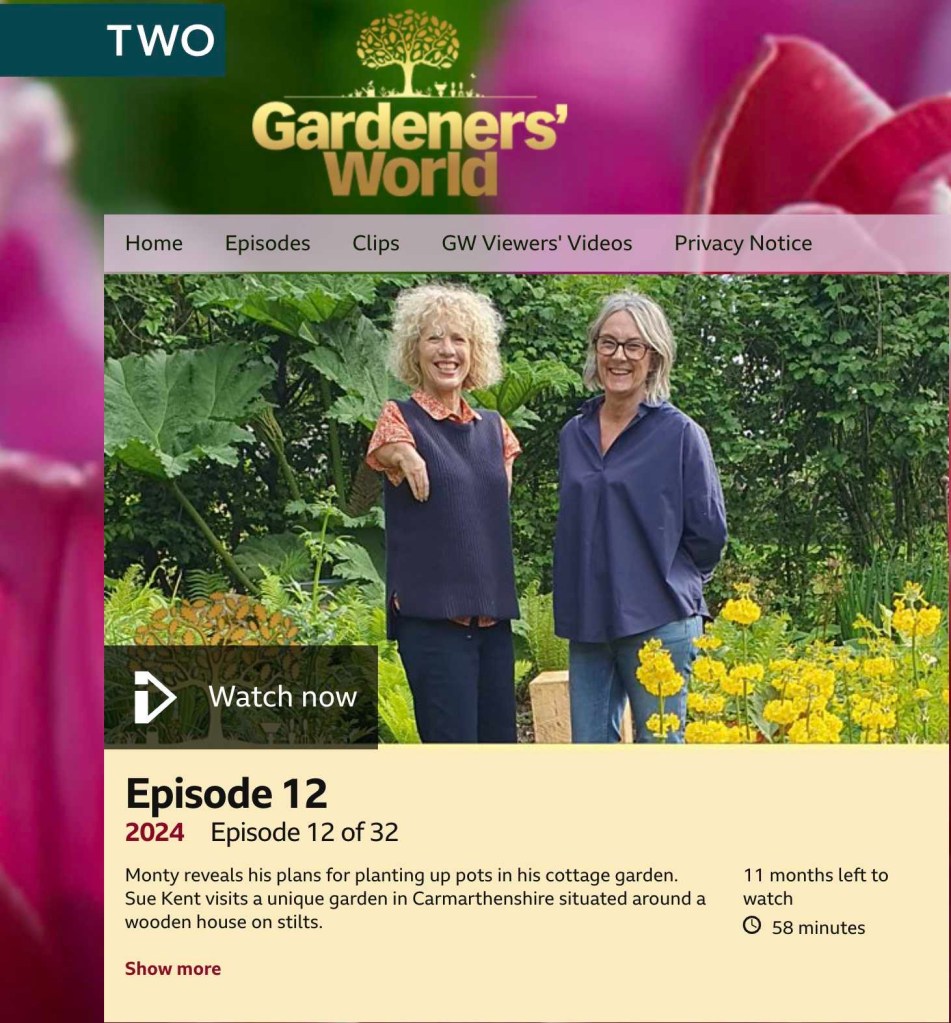
For a number of years Iain had been encouraging Paula to enter the B&Q Gardener of the Year competition, and in 2024 she finally did so in the ‘Most Sustainable Garden’ category – which she won!

In June 2024 photographer Sarah Cuttle had visited the garden to take photographs which were then used by Gardens Illustrated Magazine in an article written by Alys Fowler. That was when Paula realised how much she and Iain had achieved by attracting so much wildlife and creating a magical place for their son to grow up, knowing all the ‘Lost Words’ and having seen them in the garden.
For the future, Paula plans to continue to work with wildlife at the heart of the garden, completing the Garden Design course and implementing the learning. As she now knows, a garden is never finished – and the job is never ‘done’!
Members would be invited to visit ‘The House on Stilts’ on 31 May at 2pm, details to follow by email.
Next Meeting
Cothi Gardeners’ next meeting will be held on Wednesday, 18 June at 7.30 pm. Our very own Mair Evans will be giving a talk on ‘Pelargoniums and Geraniums’, which is bound to be fascinating, and as a bonus she will be bringing along plants for sale!
Summer Social
Members, save the date! On Wednesday, 20 August Cothi Gardeners’ summer social will take place at The Plough Inn, Felingwm. We will be able to order delicious pizzas of our choosing, and hear a talk on dahlias by Joseph Atkin, owner of The Plough Inn and former Head Gardener at Aberglasney Gardens. A real treat in store!
‘A Gardener’s Dream Itinerary’
A recent article in The Guardian newspaper has highlighted how lucky we are to live where we do. It is entitled ‘A Gardener’s Dream Itinerary: a Tour of Carmarthenshire, the Garden of Wales‘ and is a very nice write-up of gardens and a nursery we know and love, and you may just spot a reference to our Summer Social venue!

 Cothi Gardeners