This was a recording of the talk that Nancy originally gave to Cothi Gardeners over Zoom during one of the Covid lockdowns , describing a cornucopia of amazing plants from almost every continent.
Nancy started with Wistaria sinensis, and in case you’re wondering, that is not a ‘typo’. The species was originally named by Thomas Nuttall after Dr Caspar Wistar; but when the name was being transcribed it was spelt as Wisteria, and so it has remained ever since. The particular specimen depicted is Wisteria sinensis ‘Lavender Rain’ in Sierra Madre in California – covering one acre, it is the largest flowering plant in the world. It was planted 100 years ago by a young couple at the time of their wedding, and it grew so large that it actually destroyed their home, and threatened that of their neighbour. Wisteria japonica is not so vigorous, the largest known specimen has covered half an acre over 150 years. Looking down at the plant, W. japonica climbs clockwise, and W. chinensis twines anticlockwise. W. japonica is considered the choicer plant, more delicate, with very scented blooms and strong autumn colour; it requires full sun. W. sinensis is now designated in the US as an invasive species, and people are being encouraged to grow the American W. frutescens instead.
No talk about plants would be complete without a rose – and Nancy chose R. damascena for its magnificent scent. It is the source of Attar of Roses so widely used in perfumery. A lesser known use for it is in the space industry as a greasing agent because of its resistance to temperature change. The Valley of the Roses in Bulgaria has been famous for its rose harvest since the 17th century when it was part of the Ottoman Empire. The peak period of flowering, and thus harvesting, is from mid-May to mid-June. The petals are harvested between 5am and noon every day. It takes 3.5 tonnes of petals to produce 1 kilogram of rose oil, which is worth more than the price of gold. As a consequence for use in the perfume industry it is very heavily diluted.
From here to Japan, for the Japanese Iris – I. laevigata, I. ensata and I. sibirica. These forms of Iris are highly prized in Japan, where they are frequently depicted in works of art. They like their feet to be wet, and one of the best places in the world to see them is the Suigo Itako Aquatic Botanic Garden where there are at least a million iris plants. You can view the iris from boardwalks built around the canal network, but you can also view them at eye level from a boat cruise. People apply from all over the world to get married by boat at flowering time. There are festivals around Japan to celebrate the flowering of the iris, but one of the best is at Itako.
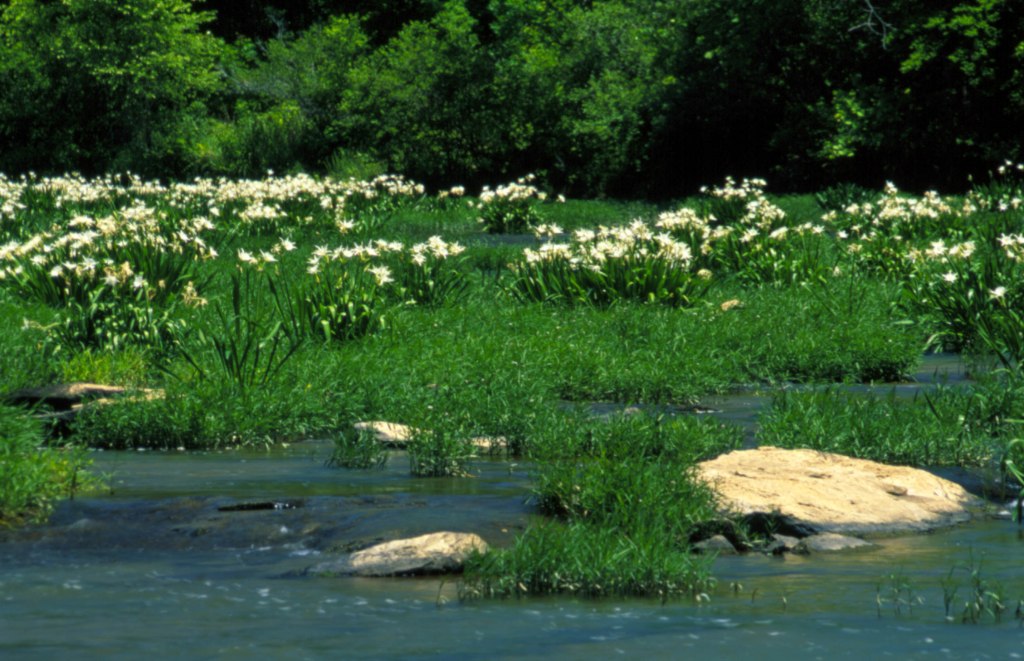
A very different aquatic plant is the Cahaba lily, or aquatic spider lily, hailing from the Cahaba River in Alabama. It flowers in the late afternoon and evening to attract its pollinator, the Trumpet Vine Sphinx Hawkmoth.
It is a member of the Amaryllidaceae, as is another spider lily – Lycoris radiata, the red spider lily, native to East Asia but now naturalised in some southern US states. It is a very poisonous plant and is grown around rice paddies and houses to keep vermin away. It requires heat and rainfall. In Japan where a festival is held in its honour attracting 10,000 visitors a day. It blooms in late summer/early autumn and also goes by the name of the equinox flower.
From the southern USA and tropical South America comes the most dangerous tree in the world, the Manchineel Tree, Hippomane mancinella. Its fruit are known as ‘little apples of death’ or ‘little apples that make horses mad’. It is a member of the Euphorbia family and causes acute allergic dermatitis. People are warned not to stand under the tree when it rains, and the smoke from its burning can cause blindness. On the positive side (!) the roots sterilise soil, and the timber when dry is excellent for furniture. Because of its toxicity, it has become an endangered species in Florida.
Ceroxylon quindiuense is the wax palm from Colombia. It is extremely tall and thin, and its usefulness has been its downfall. The leaves were used as fodder for pigs and cattle, and the stems were stripped for wax. It was on the very verge of extinction when in 1985 it was declared the national tree of Colombia and afforded full protection; its population has since recovered.
Next we turn to the Cook pine, Araucaria columnaris, from New Caledonia. At home they can reach 200ft in height. However, the species missed out on plants’ normal ability to detect gravity, and they lean towards the equator – the further from the equator, the more they lean!
Returning to aquatic plants, the water hyacinth, Eichhornia crassipes, is from tropical and semi-tropical parts of the world. It is one of the fastest growing plants on the planet, spreading by both runners and seeds which remain viable for 28 years. It was originally introduced into the US by a Japanese businessman. Because of its rapid spread and ability to choke waterways, it is banned in Europe and the UK. In the nineteenth century three unlikely men formed the New Food Supply Company with a plan to introduce hippos to eat the plants, and people would then be able to eat the hippos (there was then a meat shortage in the USA). A law was debated in the House of Representatives to allow this, and it fell by just one vote. In Louisiana many millions are spent annually just to control it. However, in the Philippines there is a cottage industry which makes eco-friendly charcoal from the plants. The roots are able to absorb dangerous toxins, including Strontium 90. It is eaten in Thailand; in Malaysia it is being investigated as a potential biochemical control against Mimosa pigra (there an invasive semi-aquatic species).
The Red Lotus Sea is a shallow lake in Thailand renowned for the red water lilies that flower there en masse. Flowering time of day has come up before in this talk, but here you have to go early – the flowers start to close at 10am and by noon there is nothing to see!
Now to plants resembling birds or animals. Harbenaria radiata is the White Egret orchid, a very elegant plant getting its name from its appearance of a white egret in flight. Two plants from SE and southern Asia get their names from their resemblance to bats – Tacca chantrieri, the Bat Flower, and Tacca integrifolia, the Bat Lily, the latter used in Malaysia to create a paste to treat insect bites and minor burns, and to lower blood pressure.
The Flying Duck Orchid from Australia, so named because of its obvious resemblance, has a unique symbiotic relationship with a fungus in the soil in its native habitat, whose destruction, along with a consequent lack of pollinators, has caused it to become endangered.

Kudzu is the Japanese arrowroot, also known as the ‘flower that ate the south’ in the United States. In Japan the plant dies back in the winter, but in the warmth of the southern US it grows up to a foot a day. It was introduced at the Philadelphia Centennial Exhibition in 1876. As a member of the pea family, it fixes nitrogen in the soil. It was seen as a weapon against dust storms, and farmers were paid $8 an acre to plant it – 17 million plants were grown. However, a plant that was seen as a saviour is now a nightmare. Power companies spend $1.5 million per year just on repairing power lines. Goats have been some help in controlling it, and kudzu bugs are now infesting and killing the vines. However, the bug has also developed a taste for the soya bean, a crop which is very valuable to the economy of southern USA.
Superblooms are an extraordinary and beautiful phenomenon. They occur rarely in the Atacama Desert (where some parts have never recorded rain). However, when it is an El Niño year and the right conditions are met (a rainstorm producing half-an-inch or more of rain, and then intermittent rain through the winter and spring), a superbloom does occur. It happens more regularly in the Namaqua National Park in South Africa from mid August to the end of September. Here it is condensing fog that creates the right conditions. There are 8,500 fynbos species here, 5,000 of which are endemic, including Restios and Proteas.
Finally, back to Japan, which has the greatest species diversity of hydrangeas and where their flowering heralds the start of the rainy season. In Okinawa the Yohena Hydrangea Garden attracts 20,000 visitors per year. It was created by Mrs Uto Yohena, who lived to be 100, and planted the garden on the site of a tangerine field.
The talk was a most enjoyable whistlestop tour around the world, taking in a great variety of plants notable in very different ways, and there was a lively discussion afterwards.
 Cothi Gardeners