For our October meeting, three members of the Club volunteered to give short talks about their gardens ranging from borderline hardy shrubs and perennials to ponds.
Sheena’s Borderline Hardy Trees and Shrubs
Sheena’s garden is situated at 700’ with a northwest aspect; it has evolved over the years from a field to a garden where shrubs and trees are the main focus. There have been successes and failures with plants that might be considered to be borderline hardy in this area. The soil in the garden is acidic, and most of the plants featured, with the exception of the first, are ericaceous; they are all more-or-less evergreen.
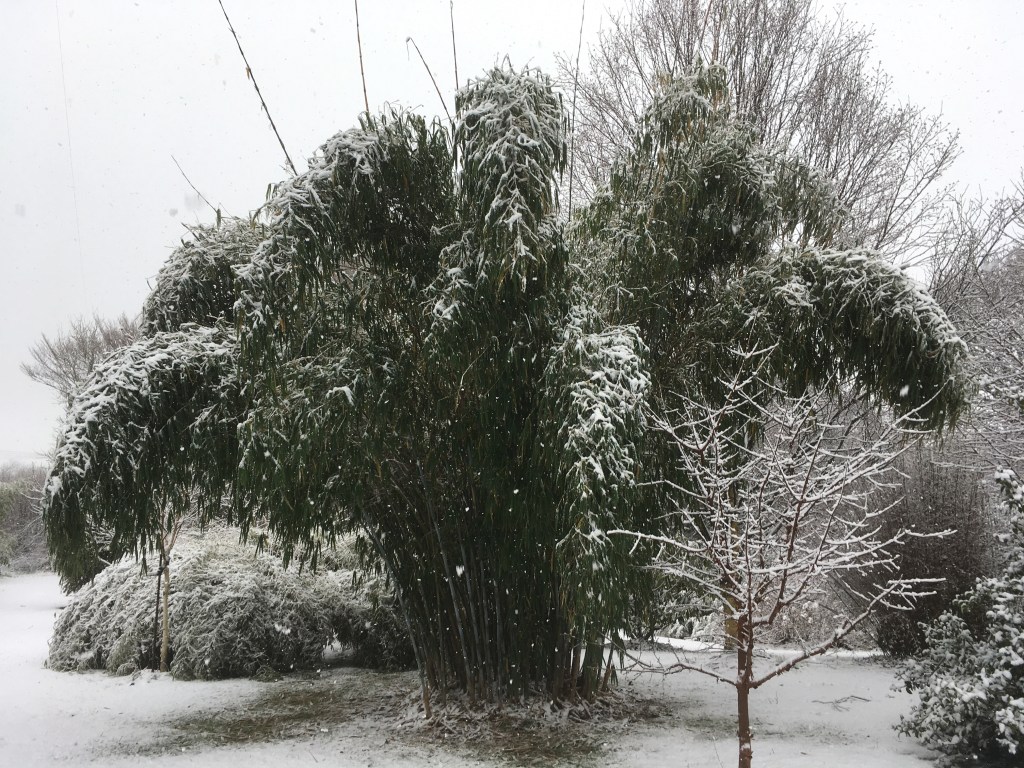
Borinda papyrifera is one of the bamboos from Yunnan that has survived (just!). Borinda lushuianensis (originally known as Yunnan 4, much simpler to pronounce) did not survive any quite mild winters here, but B. papyrifera has proved to be tougher.
Said to be hardy to -14°C to -16°C, as a small plant it did not come through the very hard winter of 2010-11. We decided to give it one more chance, and by 2020 (above) it had made an impressive specimen in the garden.
December 2022 saw some fairly low temperatures in our area, certainly into double figures below freezing. It became clear that B. papyrifera had suffered badly, and initially Sheena wasn’t sure it would survive – but it has, and developed a number of new shoots this year, although it may be a few years before it recovers to the size that it was. The young canes are a powdery blue-grey initially, maturing to olive green, with large silvery-buff sheaths, and develop up to a height of 7m. If you have the space, it is definitely a ‘statement’ plant.

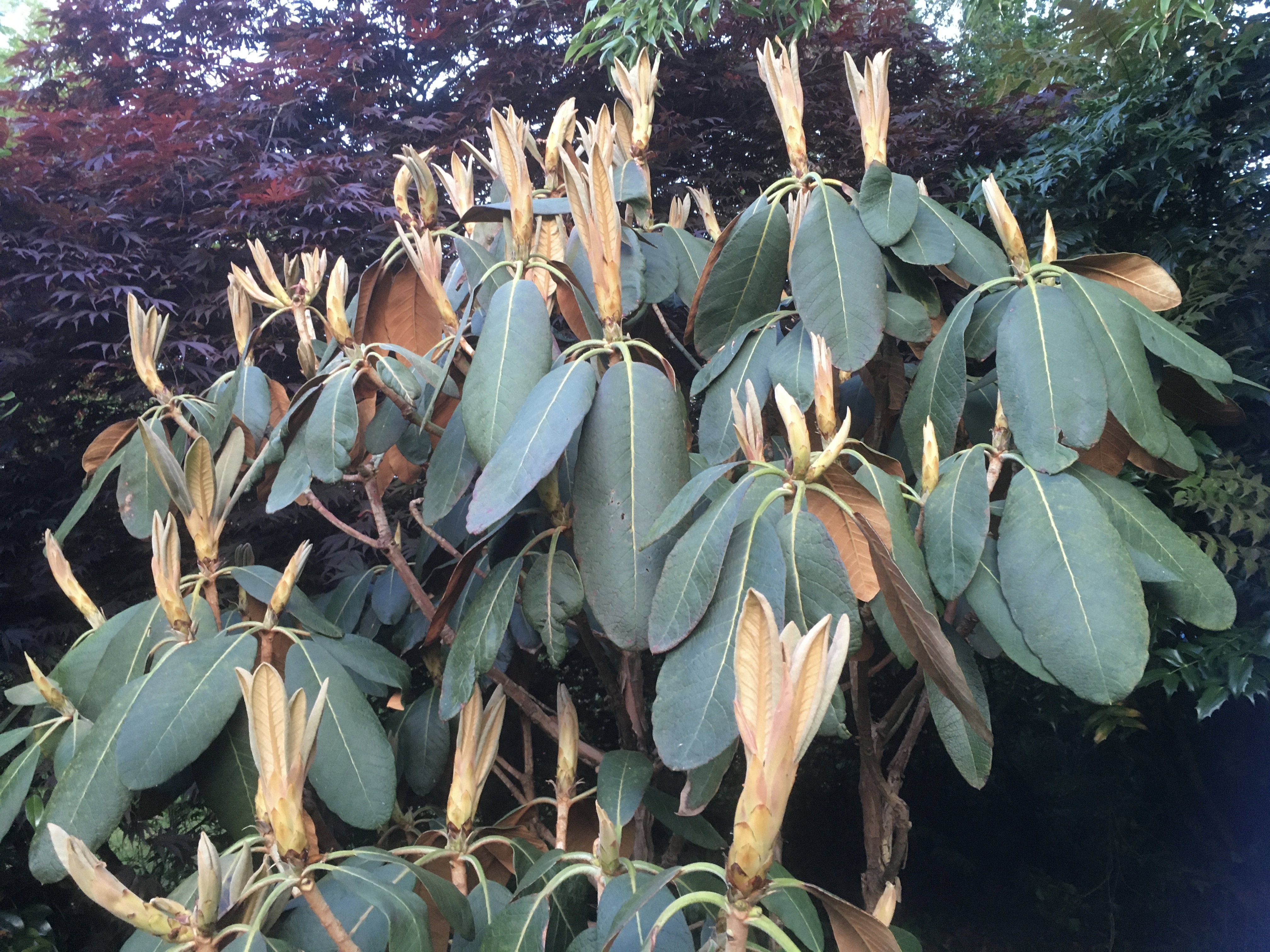
Of the large-leaved rhododendrons, R. falconeri has proved to be the hardiest (it has not suffered in even the coldest temperatures while others, such as R. sinogrande, have). It is a striking plant, with leathery dark green leaves, fawn indumentum when the leaves emerge, deepening to a rusty colour on the underside of the leaves, peeling pinky-brown stems and pale yellow flowers with a maroon blotch. It has not been extremely floriferous here, but the young leaves make up for that as they emerge.


The west wall of the house is the only place where Crinodendron hookerianum has proved happy, and it is now a very large plant. It has elongated dark green leaves and lantern-shaped crimson flowers are suspended from its branches in May, giving the shrub its name of the lantern tree. In our part of the country, it definitely requires a sheltered position.
Another red-flowered plant, this time with bright scarlet flowers, is Embothrium coccineum, which takes over from the Crinodendron flowering in late May and June. It is an evergreen or semi-evergreen small tree with clusters of bright scarlet tubular flowers (hence its name of the Chilean firebush). It has not proved to be very long-lived in the garden (Sheena thinks that late frosts in May were the culprit).

A replacement, a sucker from her parents’ garden, even though still quite small, came through last winter unscathed, even though it is said to be hardy to -5°C to -10°C.
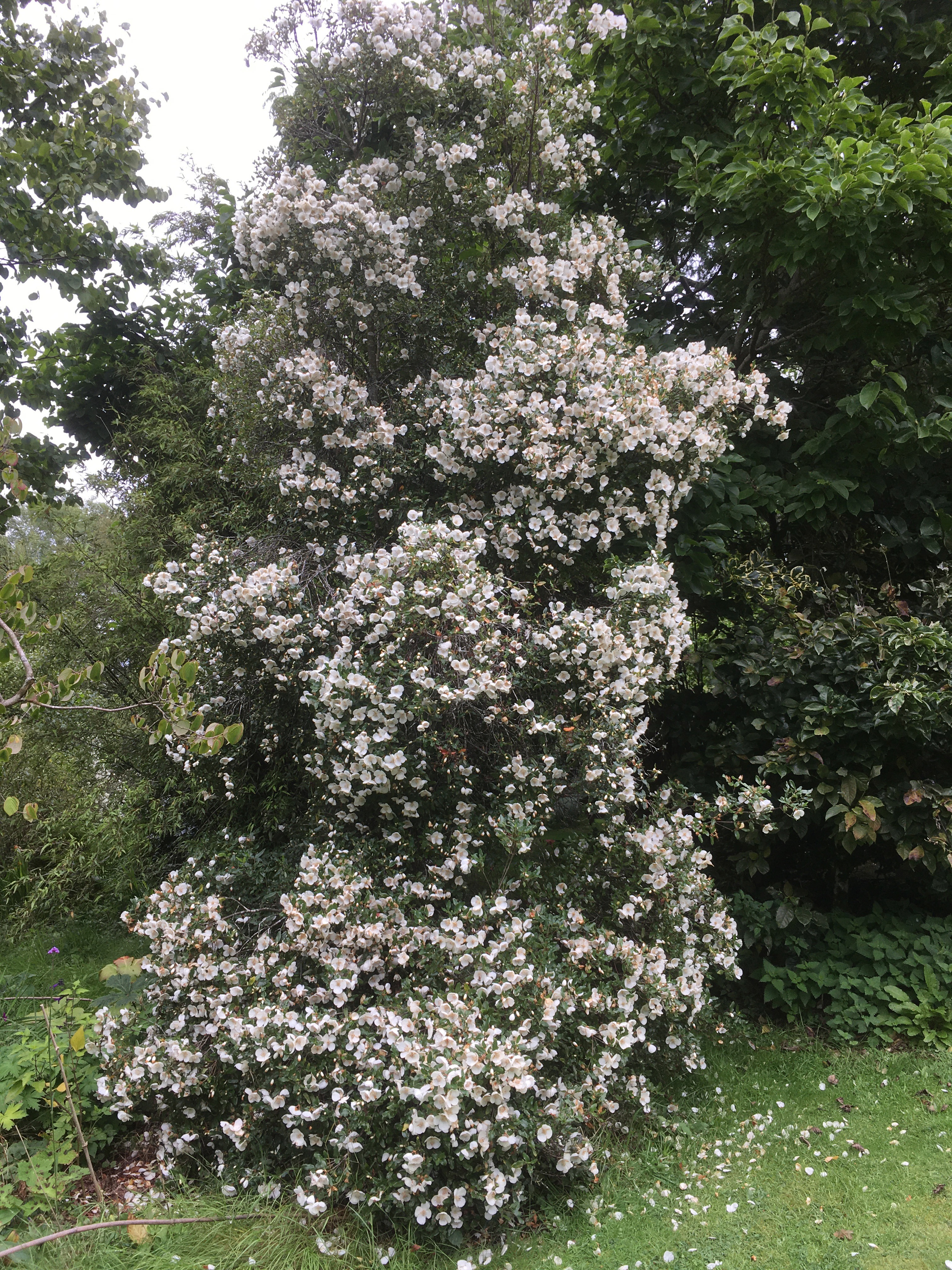
Finally, Eucryphia x intermedia ‘Rostrevor’ is a hybrid between E. glutinosa and E. lucida, which originated in Co. Down. It forms a columnar, evergreen small tree which bearing masses of scented white flowers abuzz with insects; its flowering period of late summer makes it particularly valuable in the garden, and this variety has proved to be very hardy.

Sally’s New Garden with Hardy Perennials and Grasses
After studying painting Sally at college, Sally practised as an artist for 10 years. She was influenced by medieval depictions of the flowery mead in her later work. Gardening became Sally’s main interest after moving to a house with a big garden in Oxfordshire. For ten years she ran a specialist plant nursery, with most of the plants grown from cuttings or seeds, selling out at Rare Plant Fairs, Specialist Plant Fairs and Yellow Book Gardens among others. A few years ago she moved to the Cothi Gardeners area and began to develop her new garden from scratch, focussing on hardy perennials. She has a greenhouse where she propagates perennials from seed and cuttings. To the south of the house is a border 15m long and 5m deep. Huge stumps of C. leylandii had to be removed by a tree surgeon to be able to make best use of this space. The soil is deep and rich, quite a contrast to the heavy clay in Oxfordshire.
The garden to the rear is north-facing and exposed, backing onto set-aside land with plenty of wild flowers. In this area in 2021 Sally decided to try a no-dig flowerbed which she planted up exclusively from seeds and cuttings she had raised herself.

The no-dig bed was created by laying down cardboard, adding compost and cut material on top. It has been a great success and
become a varied tapestry of perennials.
In her gardening style, Sally has been very inspired by Piet Oudolf and his use of perennials and grasses, and plants particularly to attract pollinators. She gardens exclusively organically, and uses only peat-free compost. She doesn’t water plants after two weeks have passed since planting, unless a plant dehydrates completely.
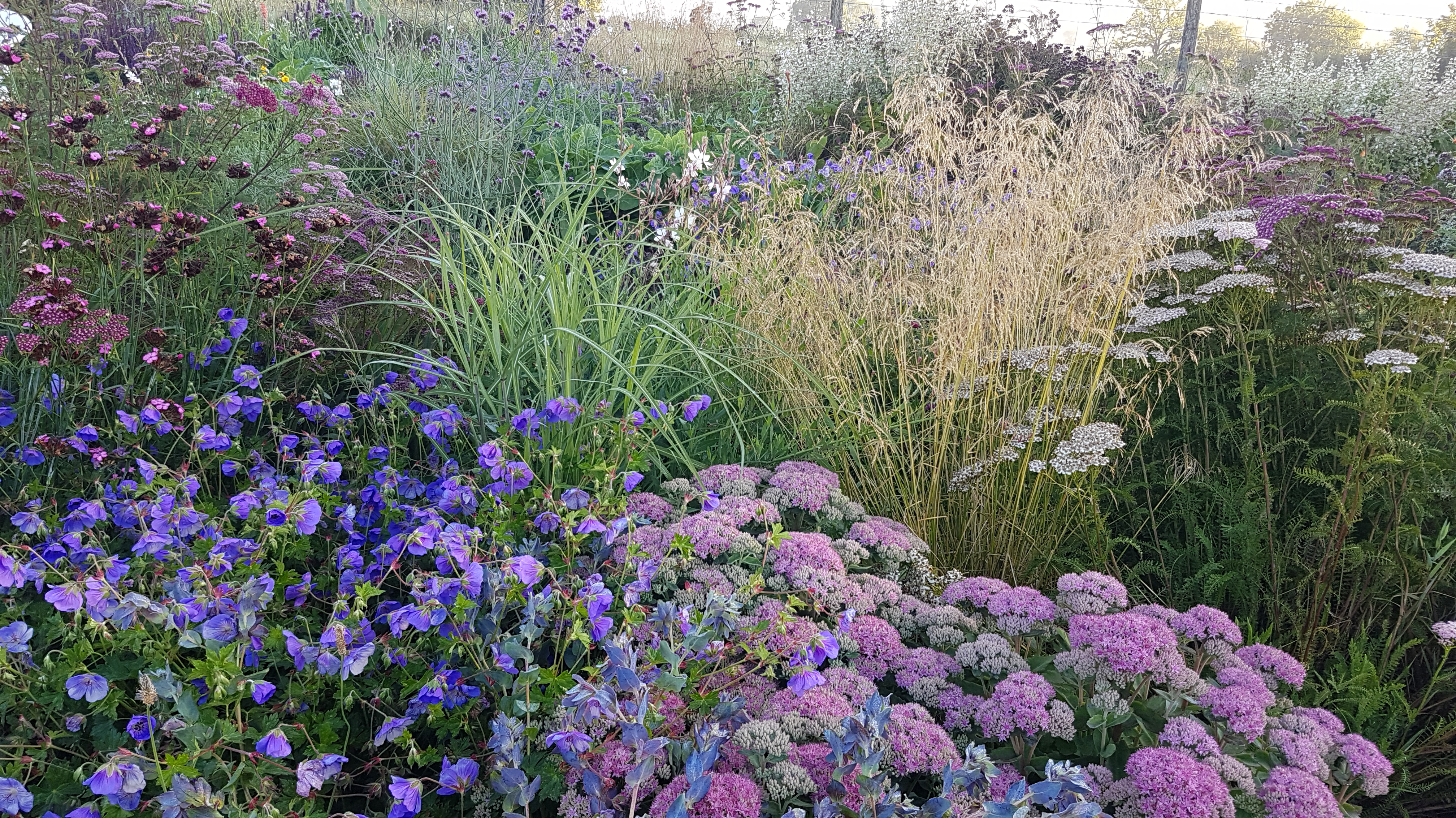
Sally showed us many pictures from her garden of beautiful combinations of hardy perennials and grasses. A group of plants Sally uses widely are the hardy geraniums – including G. ‘Patricia’, G. pratense, G renardii, G. ‘Rozanne’ (which flowers from May to October), and G. ‘Cloud Nine’ raised by Helen Warrington of local Ty Cwm Nursery. The latter is extremely floriferous over a long period, and the bees have an unusual trick to get at the pollen, by making a hole on the underside of the first petal layer.
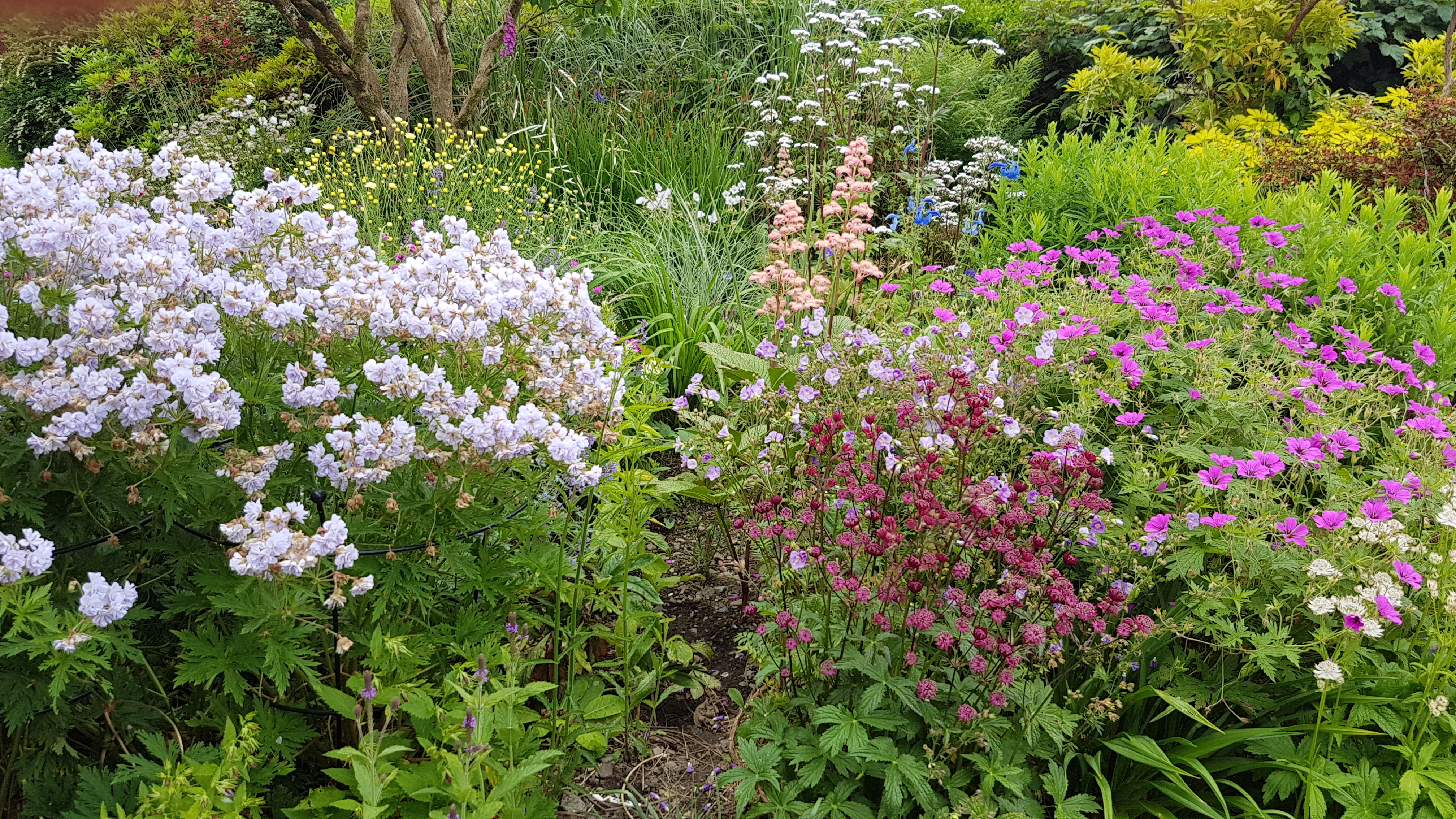
Among the grasses are Miscanthus ‘Morning Light’, which as the name suggests catches the light beautifully, and Miscanthus malepartum, which is extremely tough. Molinia caerulea ‘Transparent’ is another favourite, as it stays small in the border until mid-summer, but then shoots up with stems as much as 8 feet tall, making a real statement without taking up too much space.
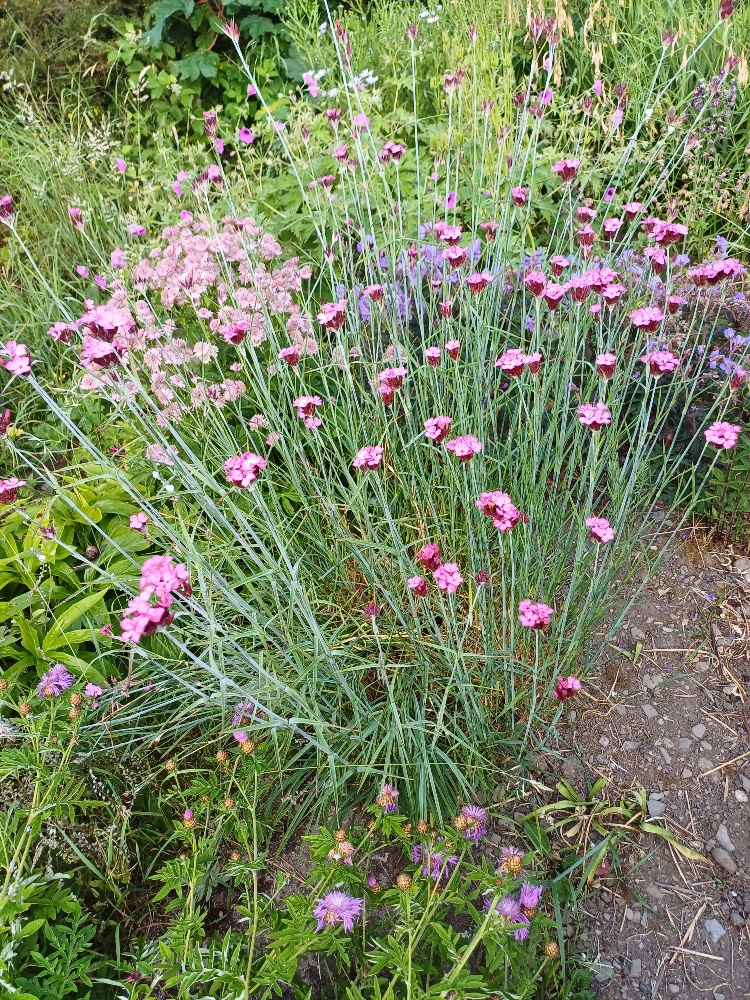
Sally has particular praise for Dianthus carthusianorum, with its single pink flowers held on tall stems above narrow, grassy, grey-green leaves; it flowers all summer long.
Other perennials that Sally uses include Salvia ‘Purple Rain’, Papaver ‘Royal Chocolate Distinction’, Asphodeline luteum, Phlox ‘Hesperis’ (with violet flowers that become almost luminous at night), Salvia uliginosa, Salvia turkestanica, Knautia macedonica, Morina longifolia (hailing from Tibet), Centaurea ‘Pulchra Major’ and Selenium wallichianum.

Elena’s Tropical Pond in Wales
Twelve years ago Elena moved from Trinidad to the Cothi Gardeners area – where the climate and vegetation couldn’t be more different! There was an unused patch of grass in her garden, with just 4 daffodils and half-a-dozen bluebells, which she had been considering turning into a ‘tropical pond’. The site is exposed to the north and the east, and on top of a rubble heap – not promising! Then along came lockdown in 2020, creating an opportunity, and providing a much-needed focus for activity.
The first step was to lay the outline of the pond with twigs on the grass. Then Elena dug up from her garden and divided any plants with tropical-looking foliage. She also scavenged what she could from friends.

But, in lockdown, where to get the materials? James, Elena’s next-door neighbour, came to the rescue. He supplied both the butyl liner, and the soft cushioning layer. He also borrowed a mini-digger to dig the pond.
Even with the mini-digger, the spoil heap proved to be a tough proposition – the pond became shallower, and shallower… Elena collected the stones for the pond, to hide the butyl liner, from the small stream which runs along the boundary of the garden. More of the butyl liner was used to create a bog garden to one side of the pond. Lifting the canopy on the sycamore trees has been effective, giving the stems a tropical appearance.
Then Elena spent hours placing pots in and around the pond, and the next thing the pond needed was a waterfall. Lockdown again turned out to be the provider, as Farmyard Nurseries had been clearing out their sheds and discovered a water fountain – just what was needed!
What of the plants? They include a Banana (which stays out all year, wrapped in the winter), Gunnera, Persicaria (which was gifted as a bunch and distributed about under the stones), watercress (also from a friend), Macleaya and even a carnivorous plant (which also overwinters!). Gingers (Hedychium) also are surprising and beautiful plants in this environment. Houseplants are brought out for a summer holiday, including Hibiscus and Bougainvillea.
Gravel has been put down around the pond, joining to the existing path, which has been lined with trellis screens bought online. At the base are ferns, which have proved to be very hardy. Hostas have been hung in pots from the tree adjoining the path, and stumps have filled with thyme and evergreen ferns.


It is just a tiny pond, but it attracted so much wildlife, almost immediately: birds, snails, dragon- and damsel-flies, frogs, toads, newts and lots of hedgehogs. The frogs come in huge numbers, as Elena and her grandchildren discovered in the spring when they went down to the pond at night to explore!
Around the pond the hedges have really thickened up, and the planting has become lusher and lusher. Many plants have died, but lots have survived. Making the pond has been an enjoyable journey; the tropical feel of the pond reminds Elena of Trinidad and the plants of gardening friends old and new.


John’s October Plant Sale
John and Helen held a very well-attended plant sale for NGS charities in early October, which has so far raised a sum of over £1000 for the charities. This figure will rise as there are plants still to be delivered and collected. John and Helen would like to thank all those who contributed plants, bought plants and helped out on the day. The autumn plant sale has been so successful they may well hold another sale in the spring of next year – so watch this space…
 Cothi Gardeners