December
The first two days of December brought the first real frosts, down to -5 or -6. So winter arrived with a bang; the leaves had by then almost all fallen, with the exception of a few bronze and mahogany leaves on the magnolias.
Taking stock of the year, I am pleased to report that two of the plants that I was concerned about after last December’s frosts have survived and recovered – Borinda papyrifera and Rhododendron sinogrande (although the latter is still fairly weak).
I am grateful that there were only two real casualties from last winter. The Drimys winteri has gone, that was my second attempt, so I probably won’t try again.
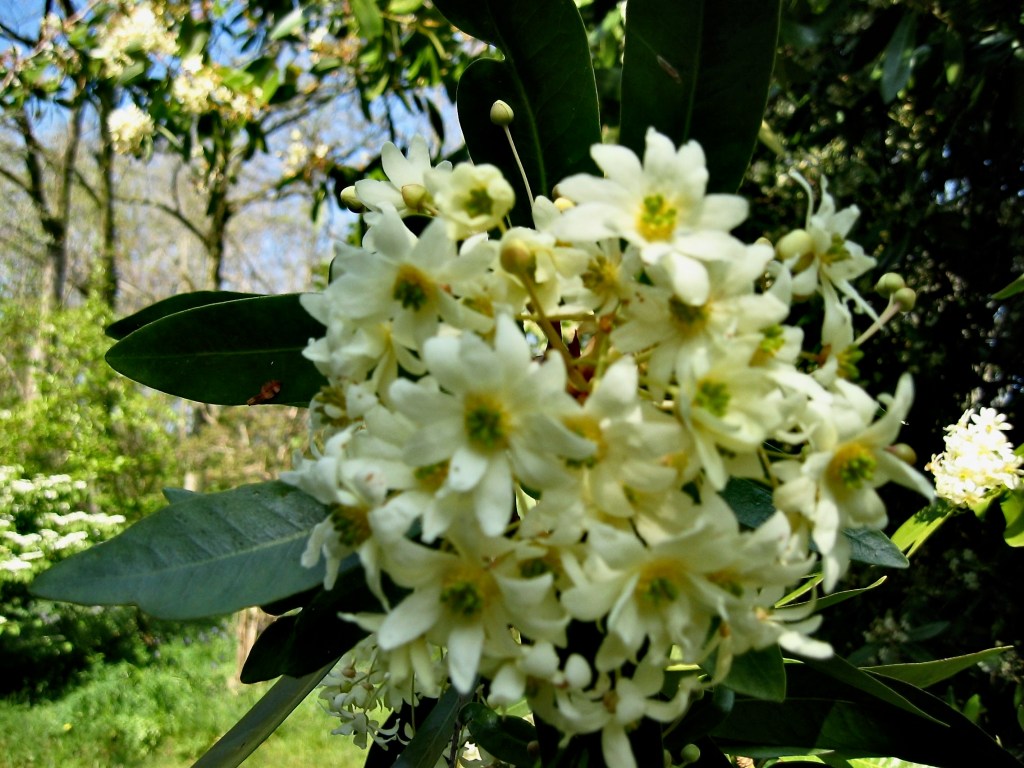
I have seen magnificent specimens in Carwinion Gardens in Cornwall and in the garden at the Royal College of Physicians in London – I think I need to accept that the climate in those two locations is much more favourable than west Wales!
Gone, too, is the Eucalyptus globulus. I had this tree by chance, as my mother and I discovered some seedlings growing in a container at home. They were self-evidently eucalyptus, and we can only assume that seed had been picked up from the ground on a visit to Mount Stewart Gardens not far away (they litter the ground there in the right season). Hence my assumption that the tree was E. globulus, as it is planted widely there. My brother planted most of the seedlings in his garden overlooking Belfast Lough. When I was shipping possessions back from Northern Ireland, he offered me one still in a pot – so it had quite a journey here from Northern Ireland in a wardrobe on a pallet (see right)! I am not altogether surprised to have lost it,as it had been a struggle to get it through previous winters, but I am still very sad after such an adventure.

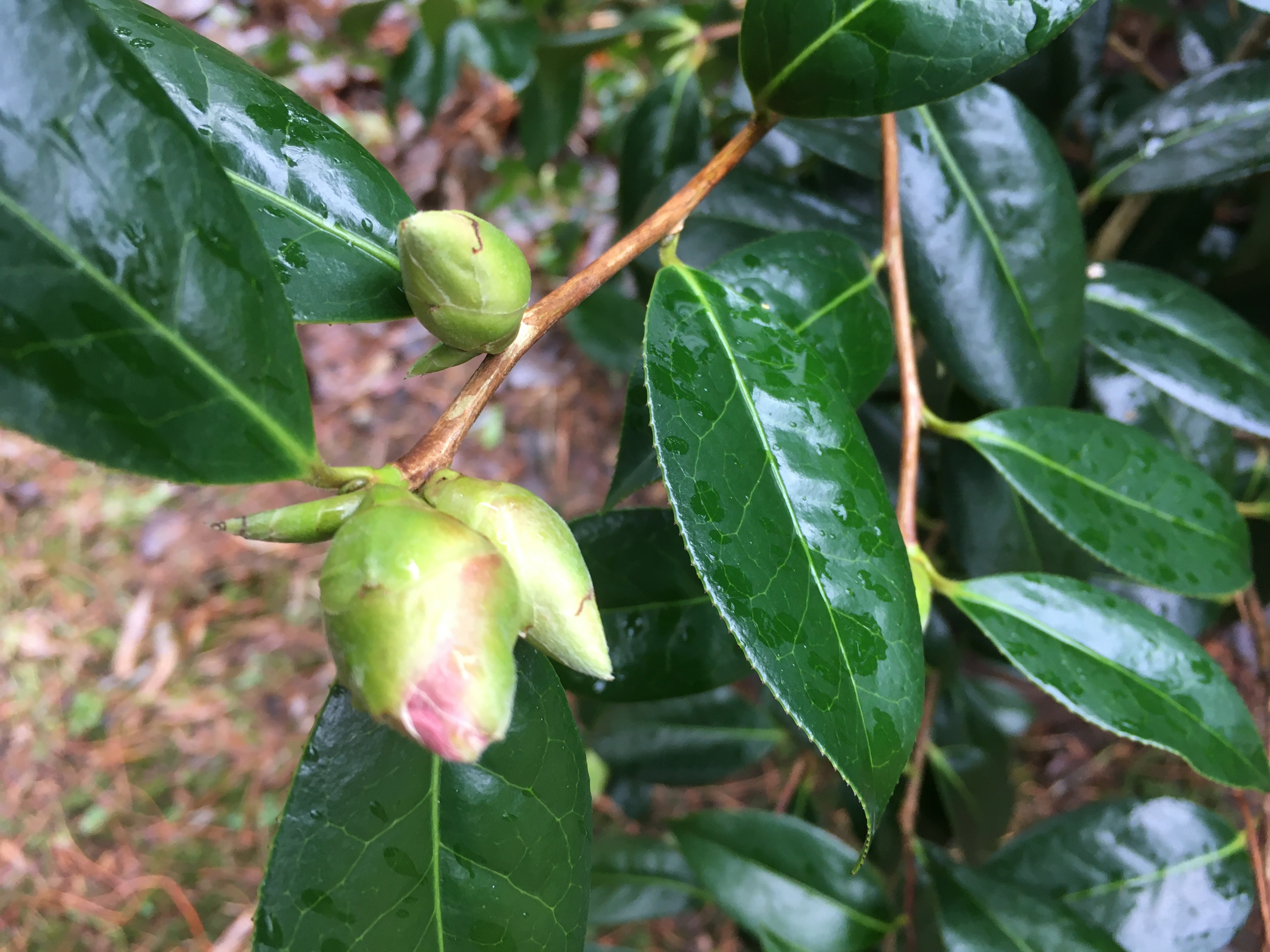
As you look at the bare branches on the trees in the landscape now, it is hard to imagine them ever being green again, but you know deep down that they will be. Now it’s a matter of counting down the days to the solstice, and slowly, oh so slowly, watching the green tips of the snowdrops push through the ground, the silvery buds of the magnolias swell, and the early camellias acquire tints of colour through the outer green of the buds. It is the garden, those tips and buds that keep you going through the dark days, when you can see in your mind’s eye the flowers to come.

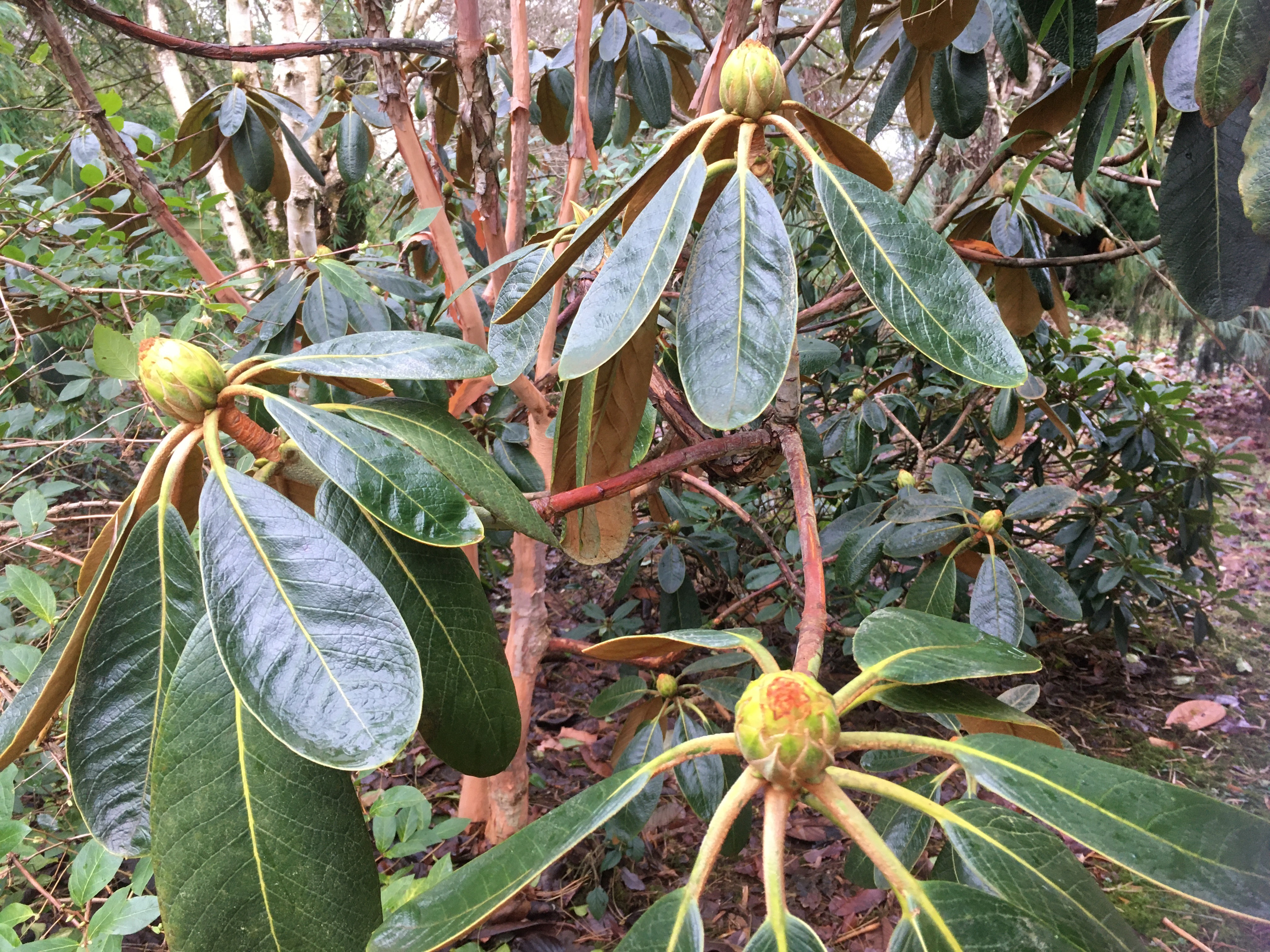
My established Rhododendron falconeri and also Rh. calophytum encouragingly have a mass of fat flower buds (provided I can protect the latter from the ravages of the grey squirrels as it is on the edge of woodland); a R. falconeri planted later has its single first flower bud, and I think the R. grande has buds (for only the second time).

So I’ll close my record of the year in the garden on that hopeful note of the buds and shoots that hold the promise of next year’s spring, and a picture of berries and variegated leaves providing colour currently in the garden.

November
Despite what I thought in October, it has actually been quite a good year for autumn colour – surprisingly given the seemingly endless rain and lack of frost or sunny days. Acers have been ably accompanied by a sorbus, liquidambar, tulip tree and handkerchief tree. The latter two trees are beautiful in their own right, but we are still waiting for either of them to flower a considerable number of years on from planting them! I also enjoy the tapestry of fallen coloured leaves on the ground at this time of year.

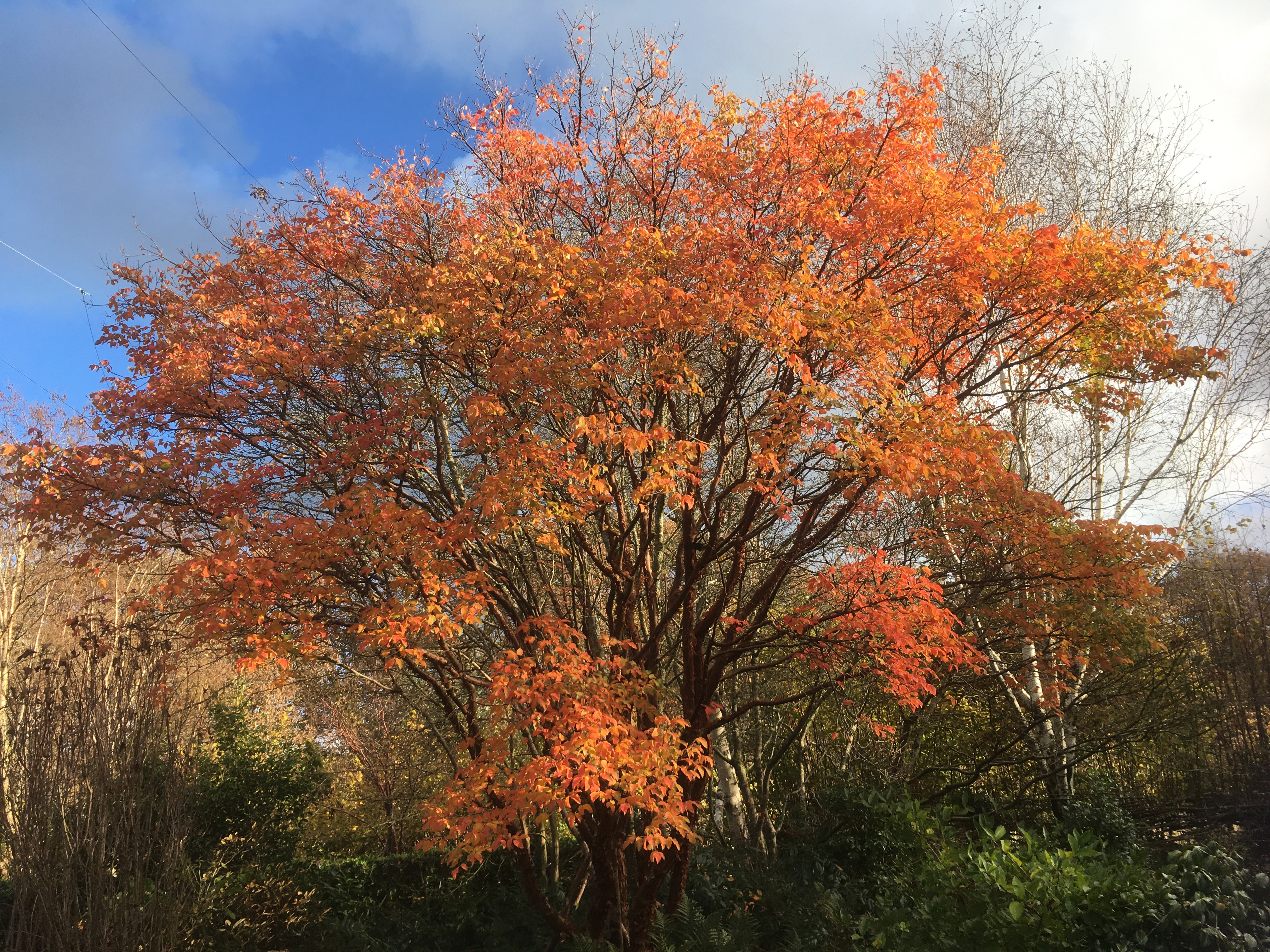


While Magnolias are generally grown for their flowers, their autumn colour is not to be sniffed at. No flaming reds or oranges, but gentle yellows and browns, and most of them seem to turn colour later than other trees, extending the season of autumn colour. As a background to the colour in the garden, there are also the beautiful oaks and beeches around.
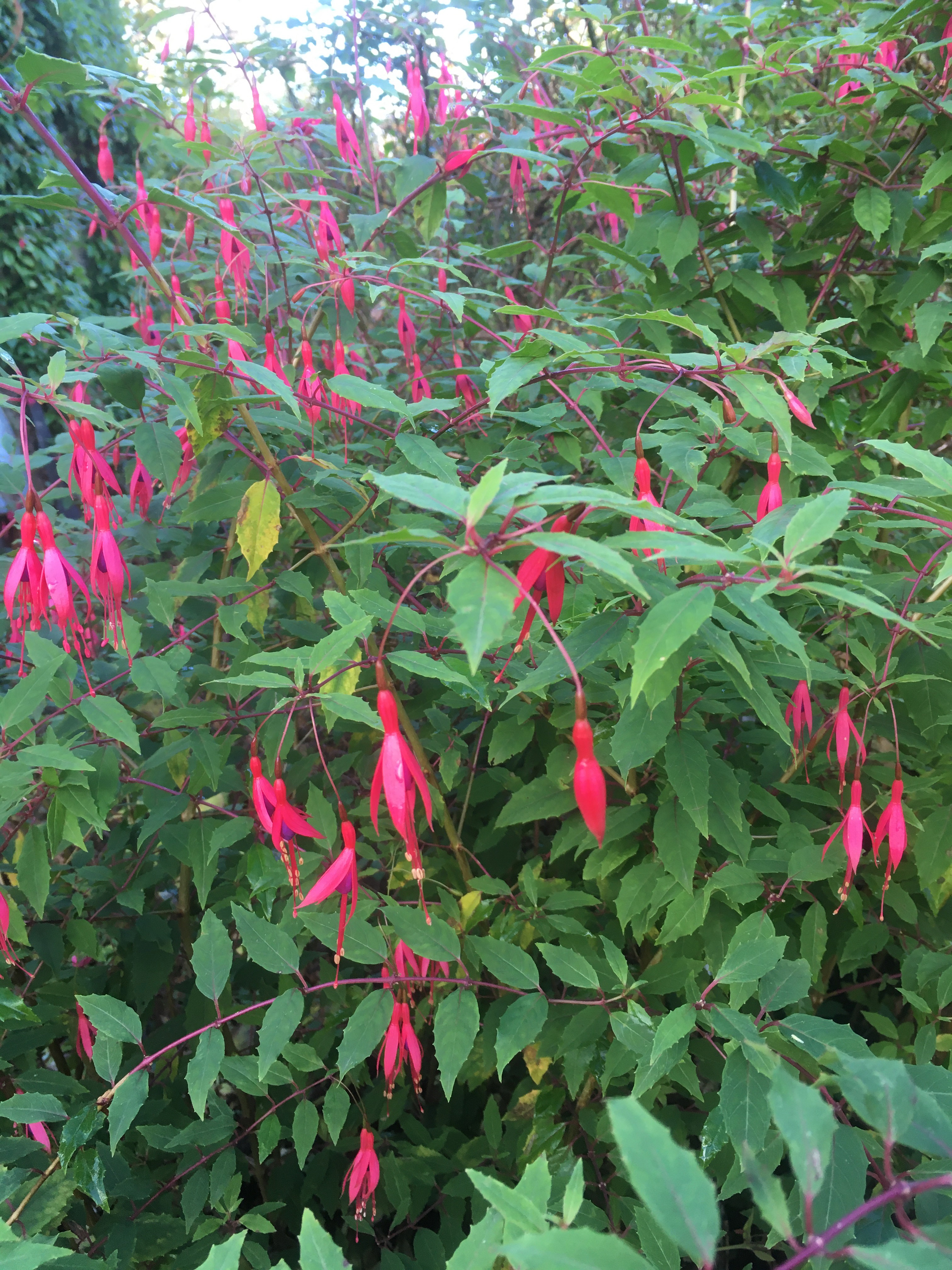
I seem to have mentioned hydrangeas in every entry since July, and they are still contributing – such a good value plant, adding colour when it’s much needed. The hardy fuchsia, Fuchsia magellanica, one of the few plants that was here when we bought the property, also comes into its own at this time of year. Mahonia is now also starting to flower, we have M. ‘Charity’ with its very bold, upright, bright yellow flowers (always the first in flower), and M. bealei, with paler yellow, more fragrant flowers.

September/October
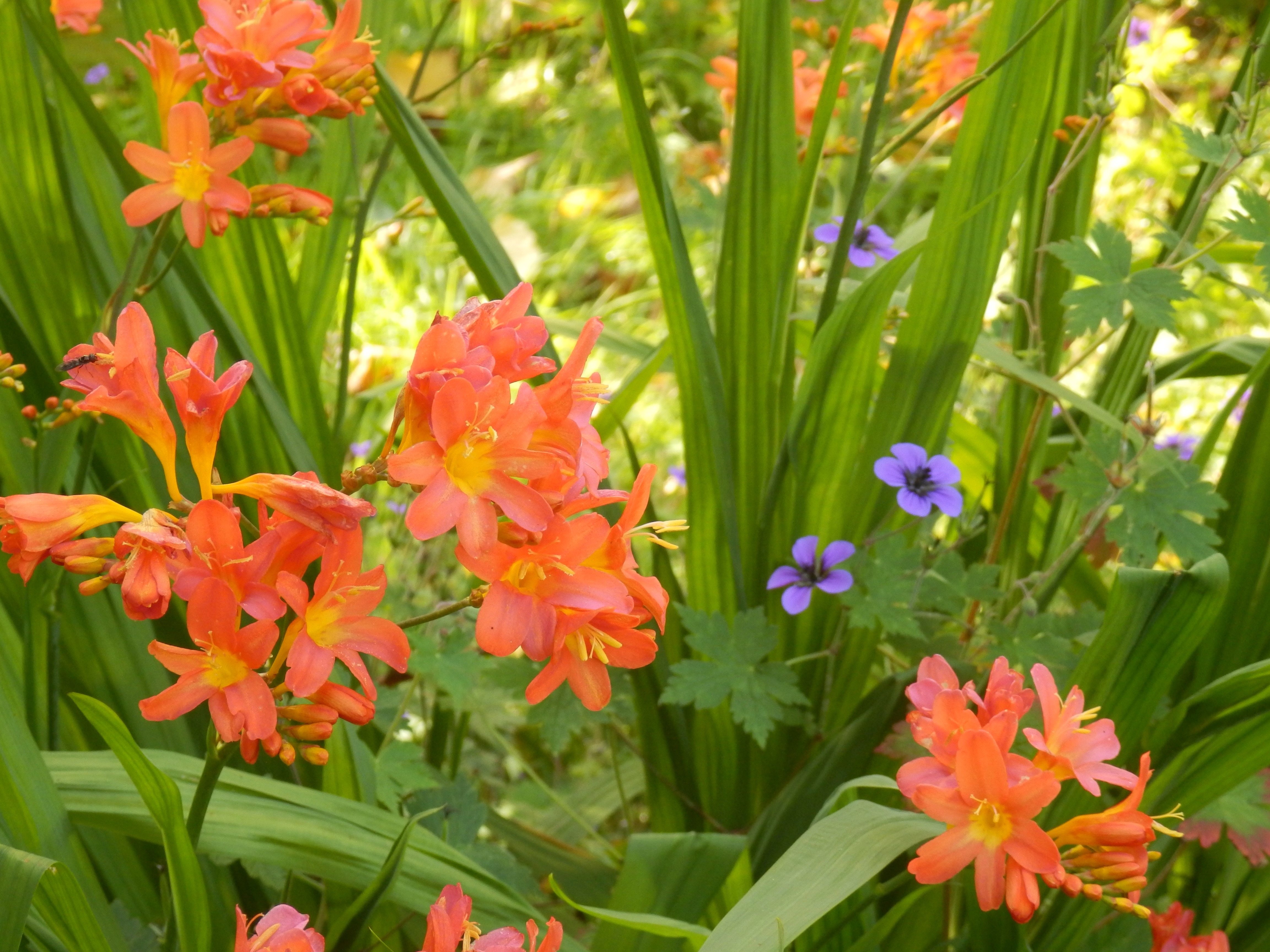
Meteorological autumn ushered in a period of summer-like weather with sunshine and warmth. This encouraged the late-flowering Crocosmia ‘Severn Sunrise’ into flower, its lovely soft orange complementing yellow birch leaves, the blue of the hydrangeas still going strong, and late blue and mauve geraniums.

Apple season! The harvest is (thankfully!) not quite as abundant as last year, but still fairly plentiful. Three trees decided to take a complete break, but the others have done reasonably well. We have had good yields this year from ‘Red Devil’ (a self-fertile eater so always crops well, crisp to start with, but going soft quite quickly), Ashmead’s Kernel (a lovely russety apple, good keeper) and cooker ‘Newton Wonder’, also a good keeper.


The buds of the plums and damsons are a favoured food of the bullfinches which they strip; there were some flowers this year – I hung tinsel on the trees to try to discourage the birds. However, the damp summer weather did nothing for what little fruit there was, which rotted on the trees before it could ripen properly. The pears, which had set a reasonable crop, were similarly affected.
By the end of September, the leaves of Parrotia persica are acquiring red, orange and yellow tints, followed by Betula papyrifera and B. maximowicziana, which both turn a lovely buttery yellow. The red leaves of the Acers add to the scene, but so far the very wet October has not been conducive to great autumn colour.


August
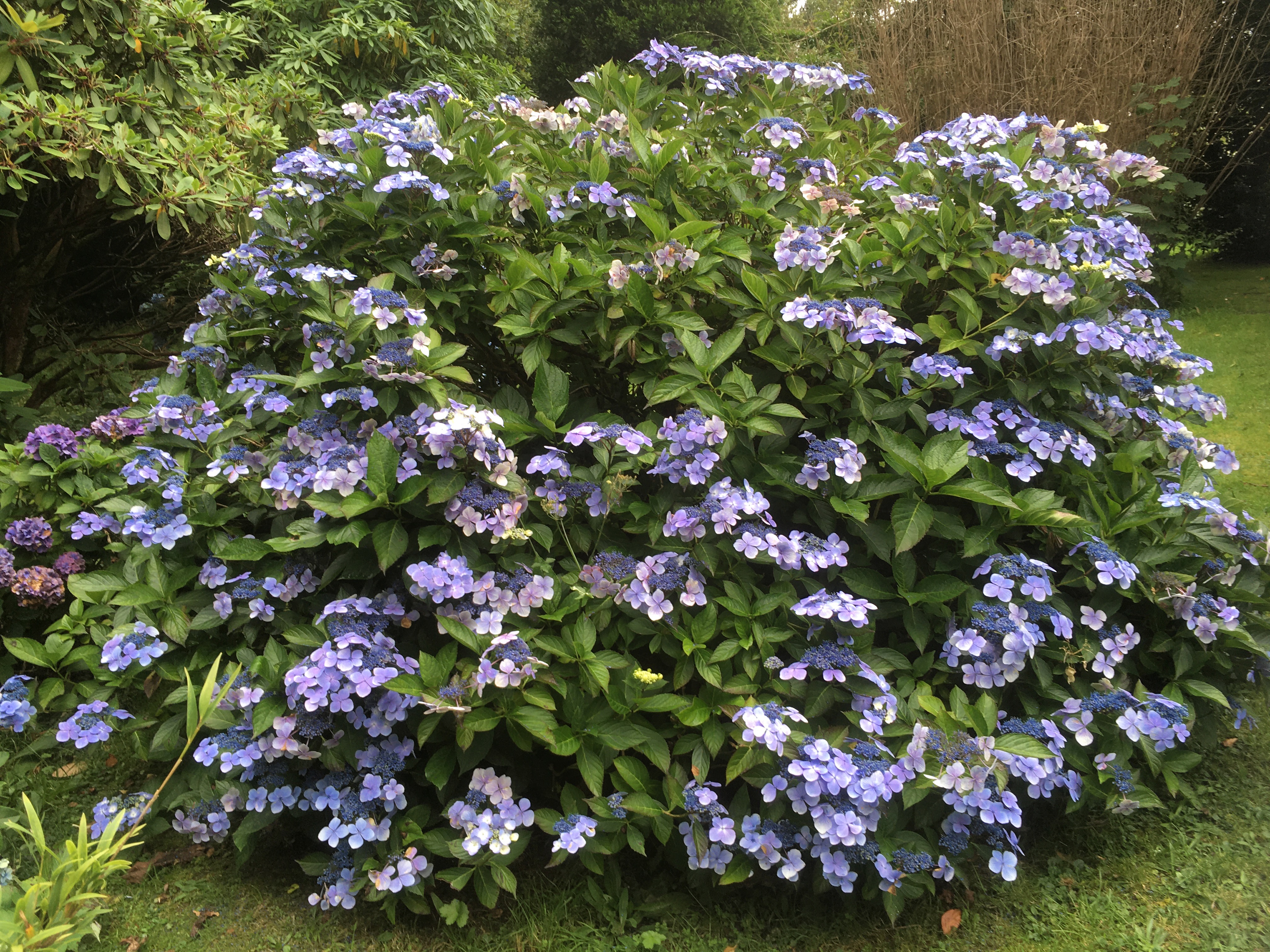
This month the soggy theme continued, with plenty of rain, some very windy days including – unusually for the time of year – a named storm, and lots of cloud cover as well. The hydrangeas enjoyed the weather and they have put on a very good show this year.

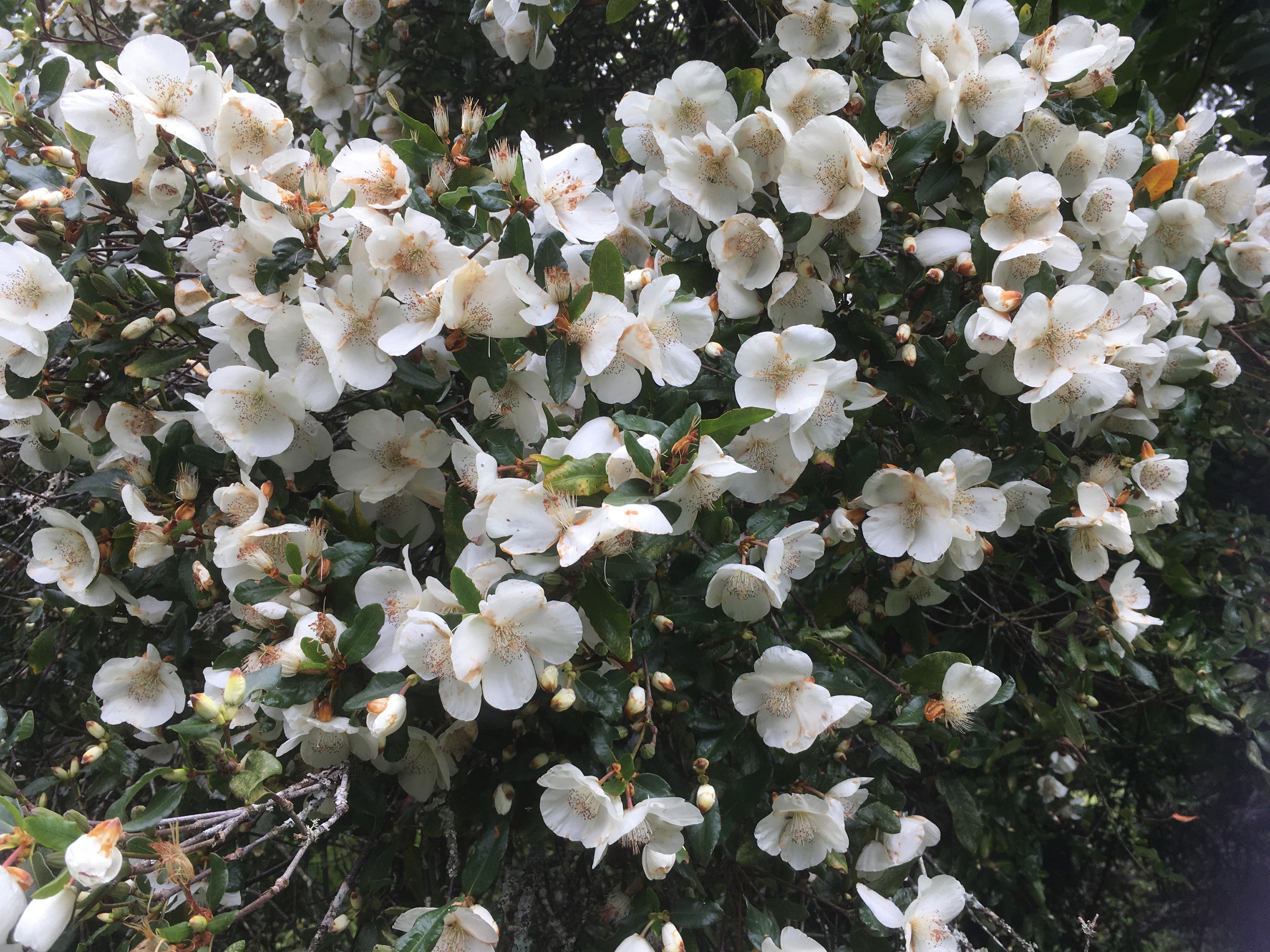
Eucryphias are another star of the show this month. I have found the most reliable in this garden to be Eucryphia x intermedia ‘Rostrevor’; although the flowers are smaller than some other varieties, it can be completely covered.

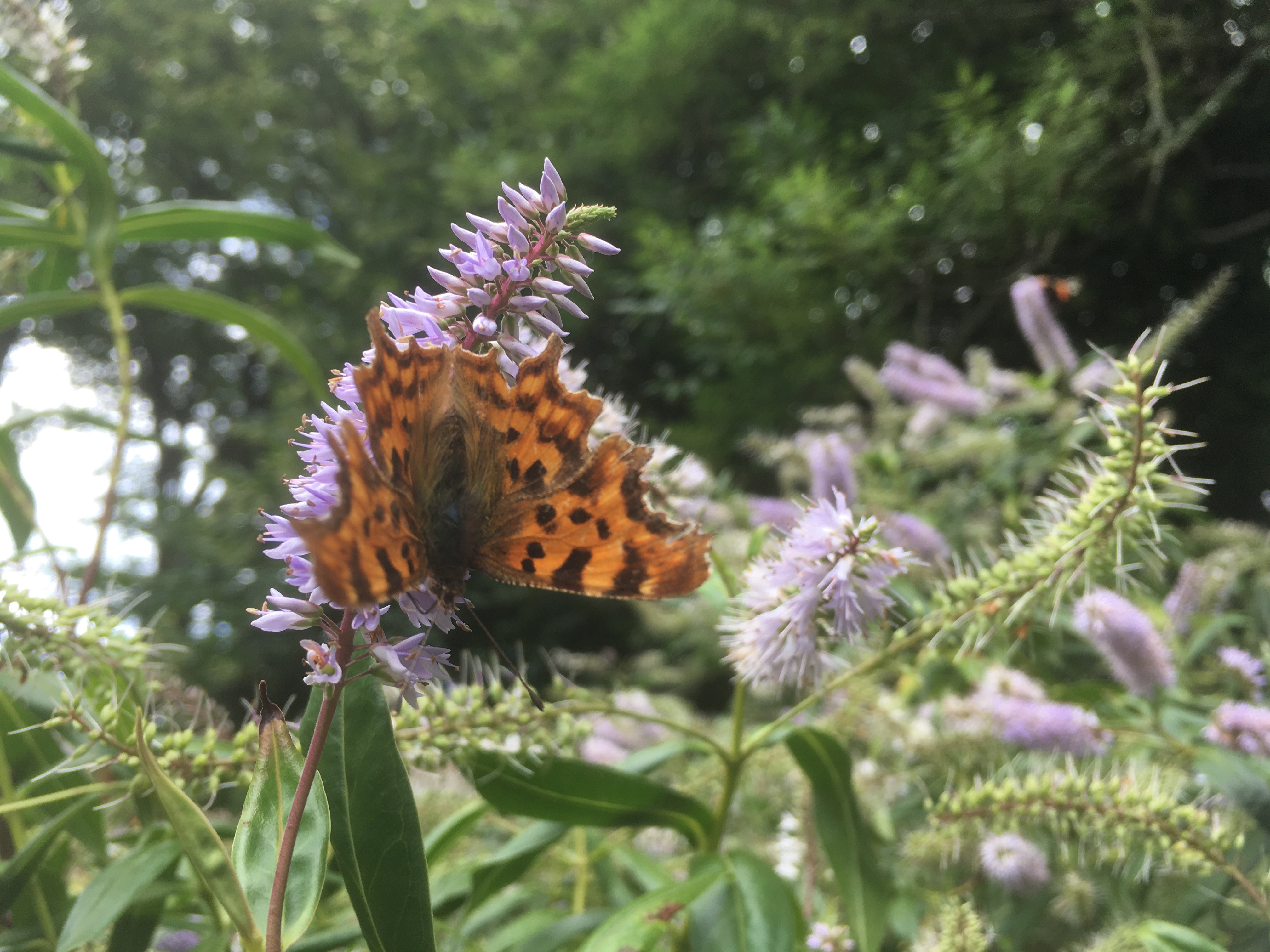
Despite the general weather picture, there were enough sunny periods to lure butterflies out on to the buddleja, when counts seemed to be up on those of the previous few years. There were plenty of Red Admirals and Peacocks, as well as a single Painted Lady and a single Hummingbird Hawk Moth; it was definitely a good year for Meadow Browns.
Even though the month sometimes felt distinctly autumnal, the chiff-chaffs seem to have remained here longer than usual before beginning their migration.


June/July
The first broad-bodied chaser dragonfly emerged from the pond on 1 June to usher in summer, and the first water-lily blooms weren’t far behind.

June is, of course, traditionally the month for roses. Rhododendron means ‘rose tree’ in Greek; and even in early June the later evergreen rhodos are in flower, along with the last of the scented azaleas.


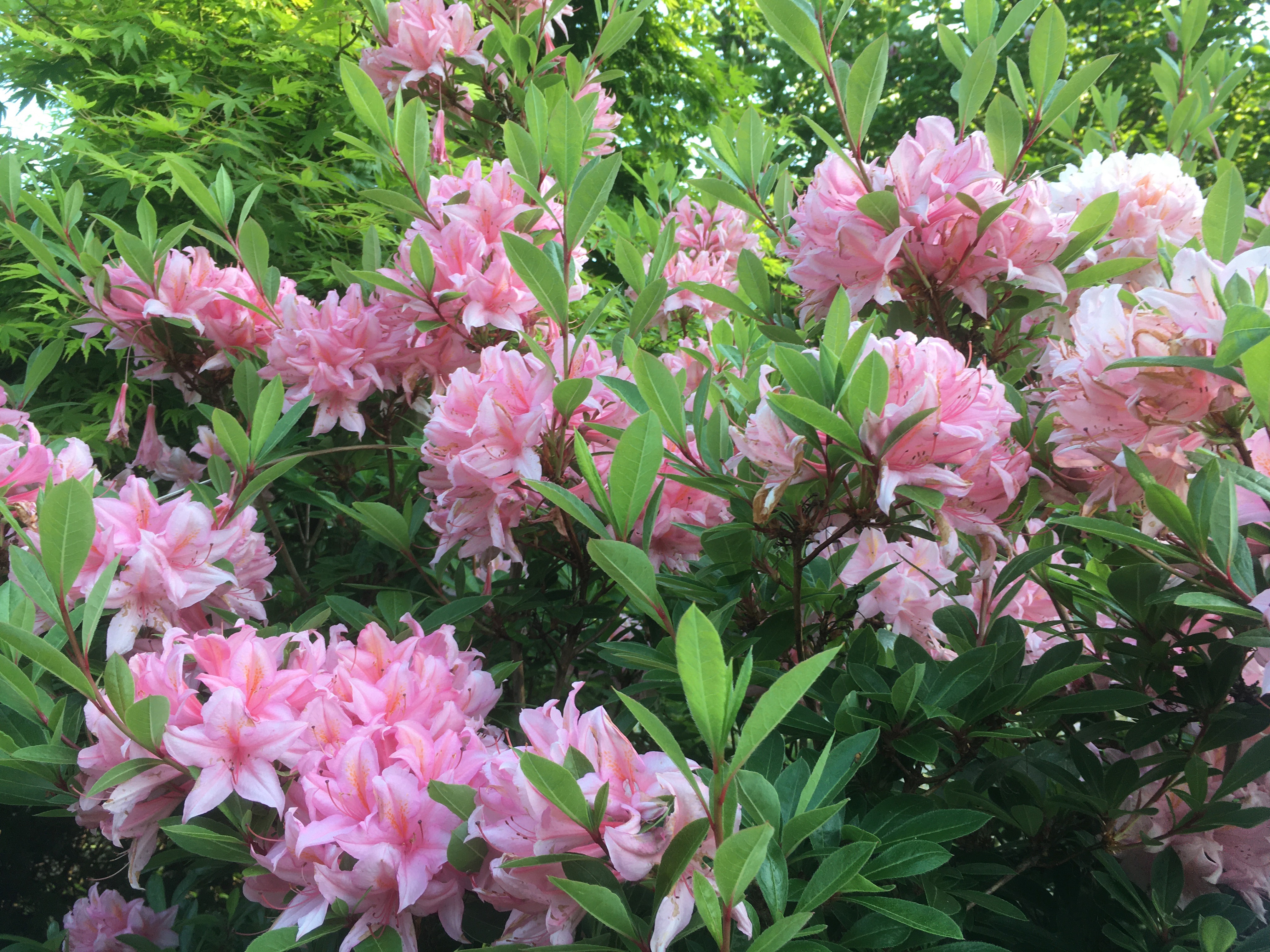

The newly-opened leaves of the larger-leaved rhododendrons, covered in indumentum, are almost as good as flowers (with what I hope is next year’s flower bud already visible).
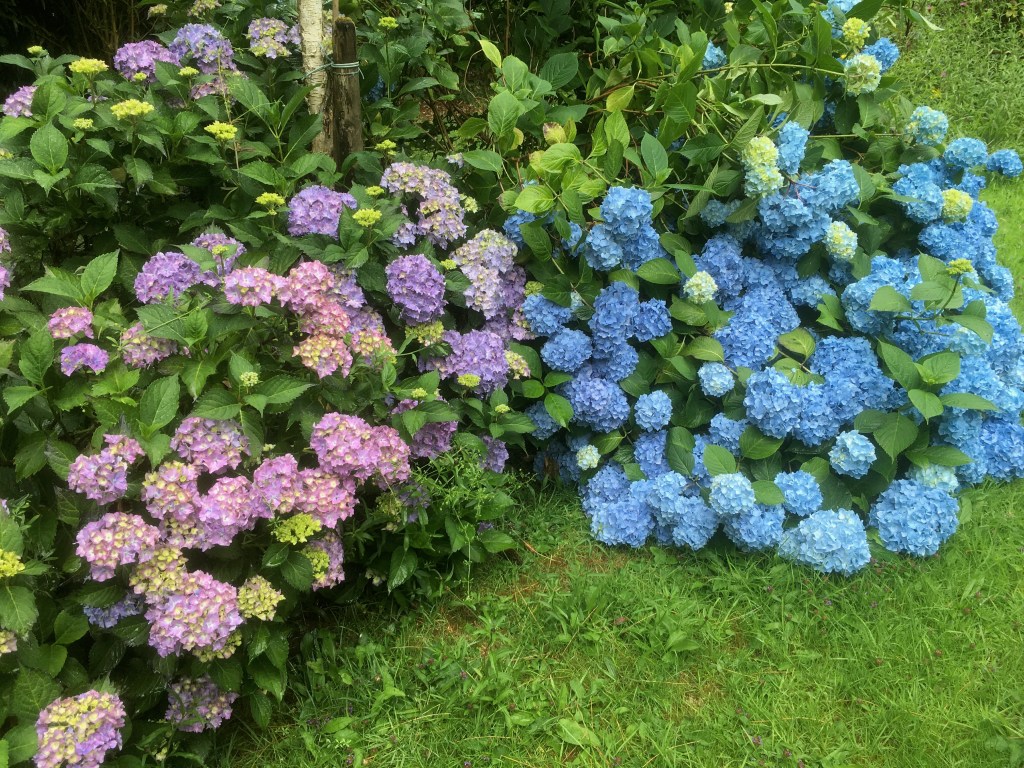
By July the hydrangeas are making themselves felt – and the dry weather broke just in time for their flowering.
June was the hottest ever on record in the UK and the sustained warmth was accompanied by no rain at all until towards the end of the month when thunderstorms broke the spell of dry weather. July has been quite the opposite – cool and rainy so far well into mid-July.
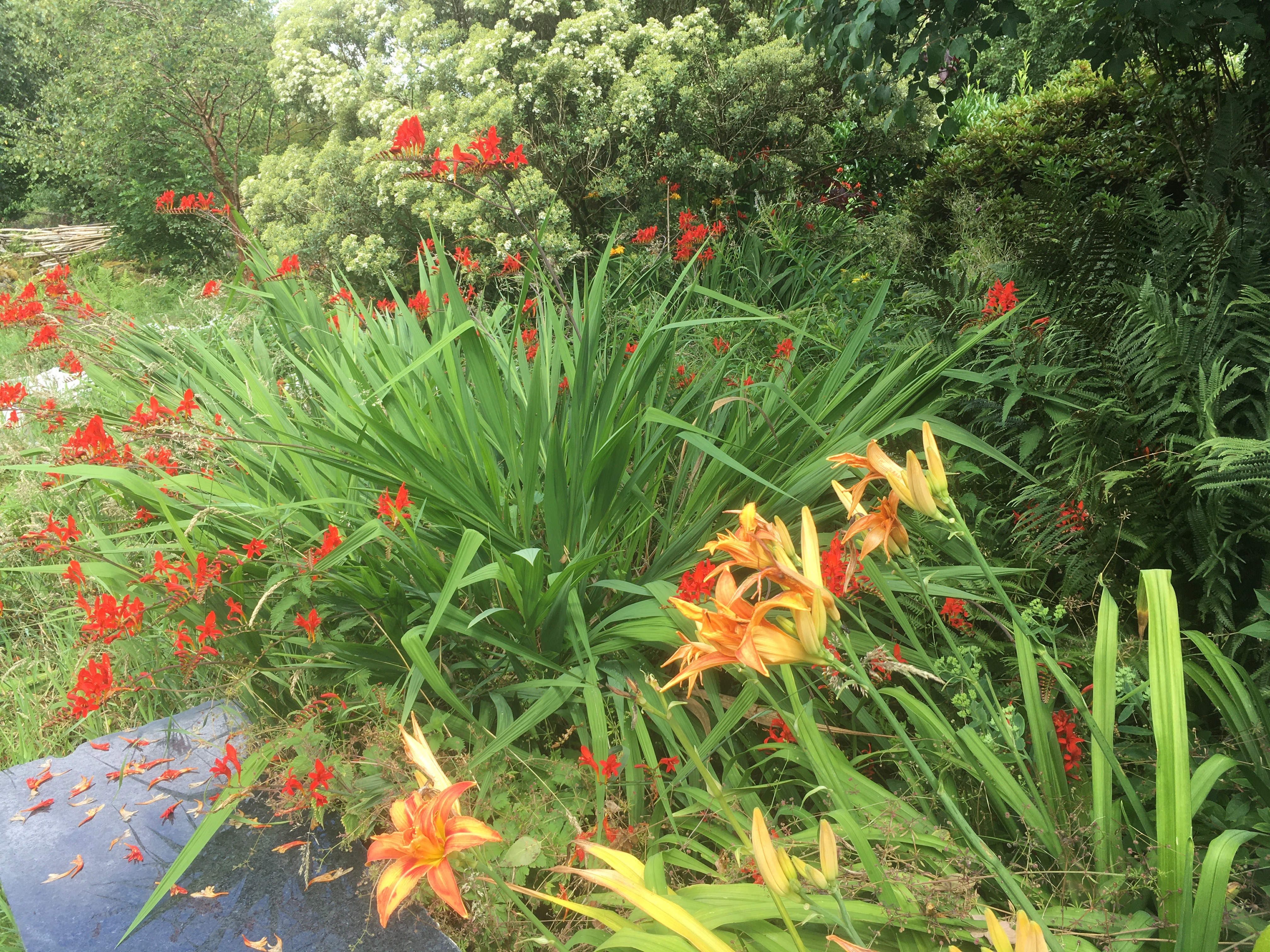
Other plants in bloom at the moment include Crocosmia and Hemerocallis, standing up quite well to their battering by the rain.

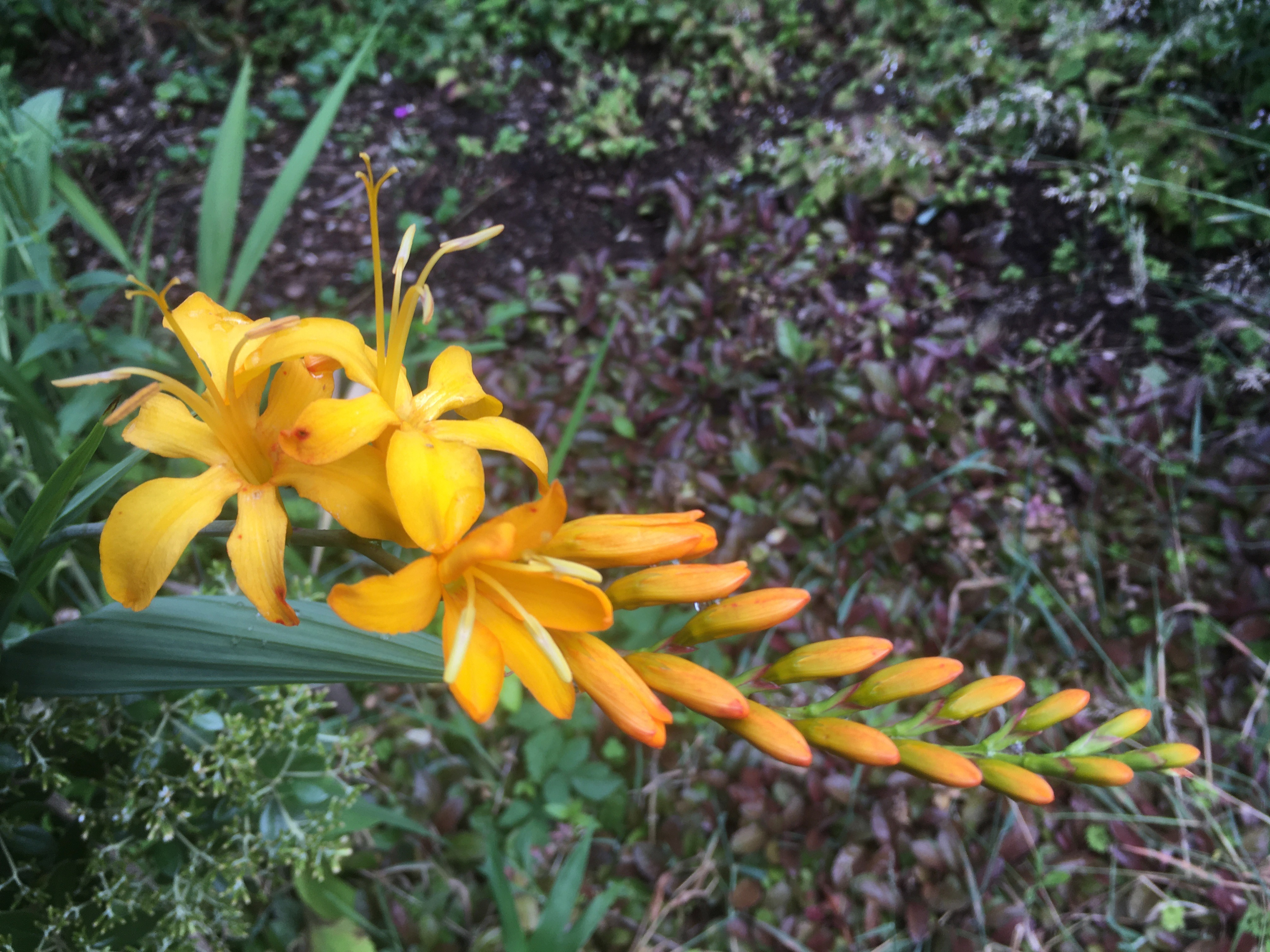
In mid-July a pair of wrens are still actively bringing food to a nest against a wall under a climbing rose. I get the impression the blackbirds had a fairly successful year as far as breeding goes, unlike the song thrushes, whose nests were predated by magpies and jays. Continuing the wildlife theme, I was delighted to see a hedgehog in the garden for the first time in a few years (it was in the same area as my last sighting which was during winter hibernation), so I hope this might mean we have a resident population even though we don’t see them often.


May
The big story of May in the garden are the rhododendrons, whether they be the evergreen, leathery leaved sort, or the deciduous azaleas. The star of the show is Rh. loderi ‘King George’, one of the very first rhododendrons which we planted, which is beautiful in bud, in flower, and at every stage in between. It is beautiful not just visually, but also for its scent, which is a very gentle, delicate one, perfuming the air around.
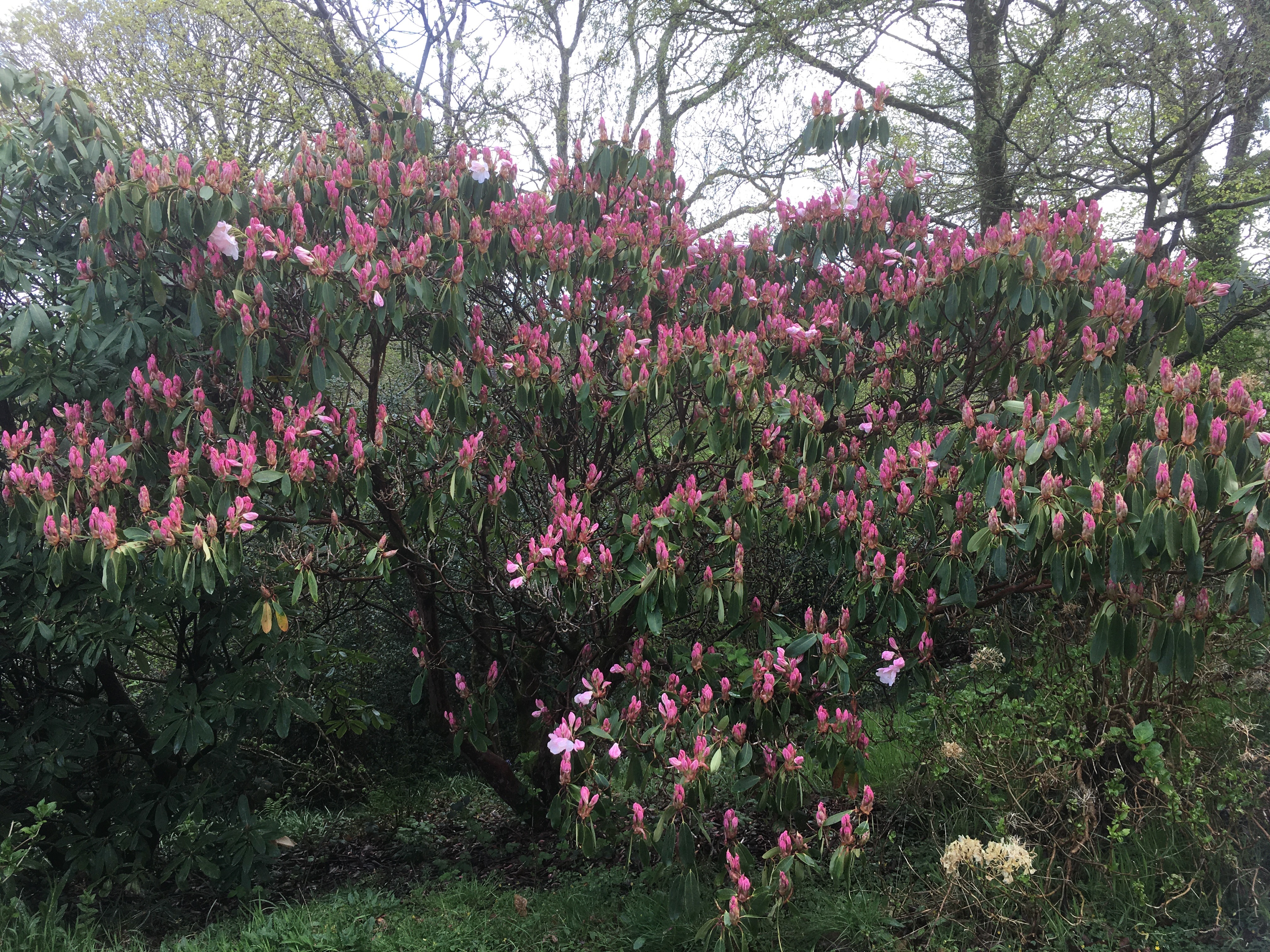
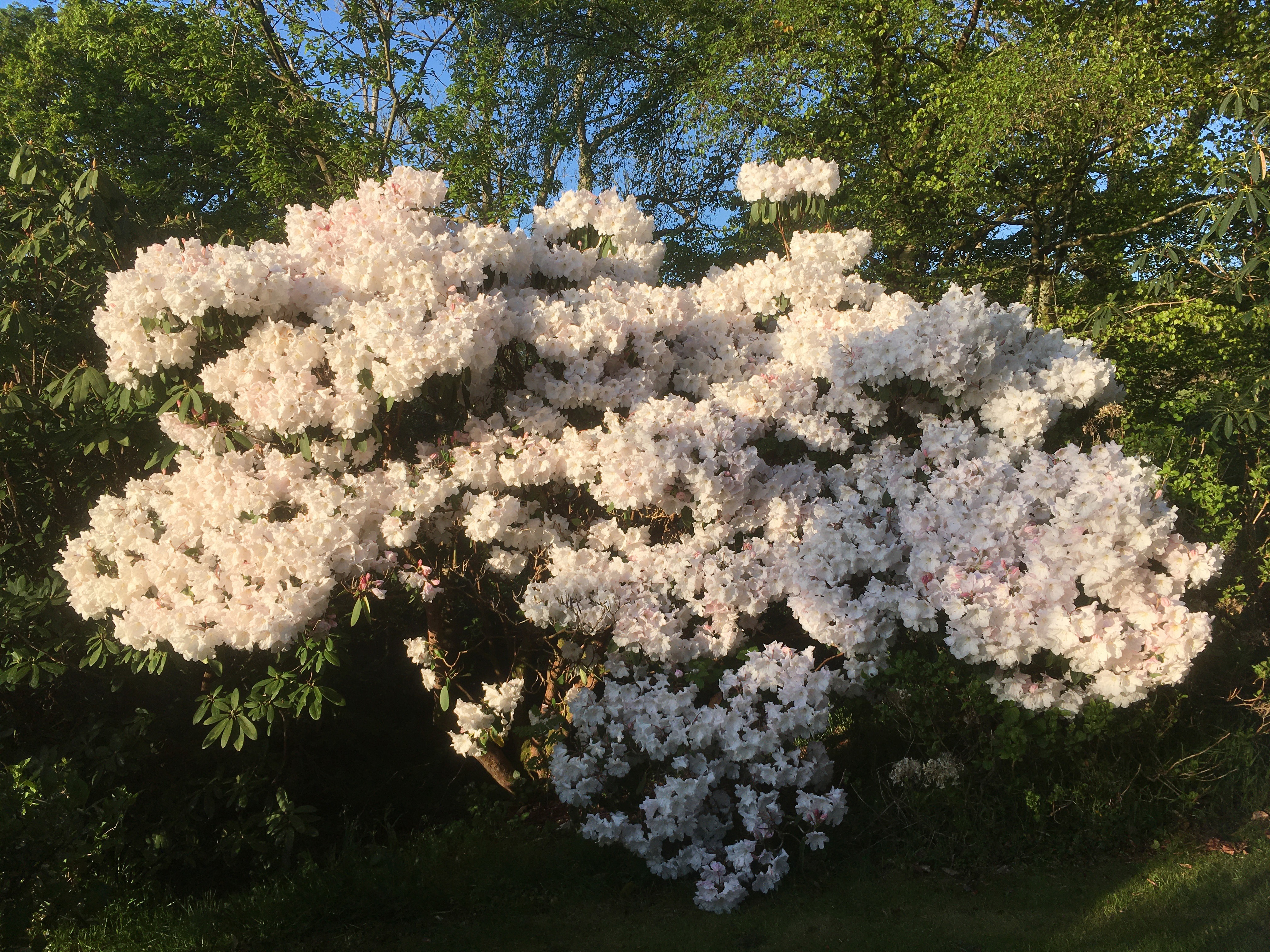
With the azaleas, we have focussed particularly on the scented ones. We have quite a few of Rh. luteum, as well as a number of others, the names of some of which have been lost over time. The scent of each of the varieties is quite different, but adds up to lots of pockets of scent around the garden.

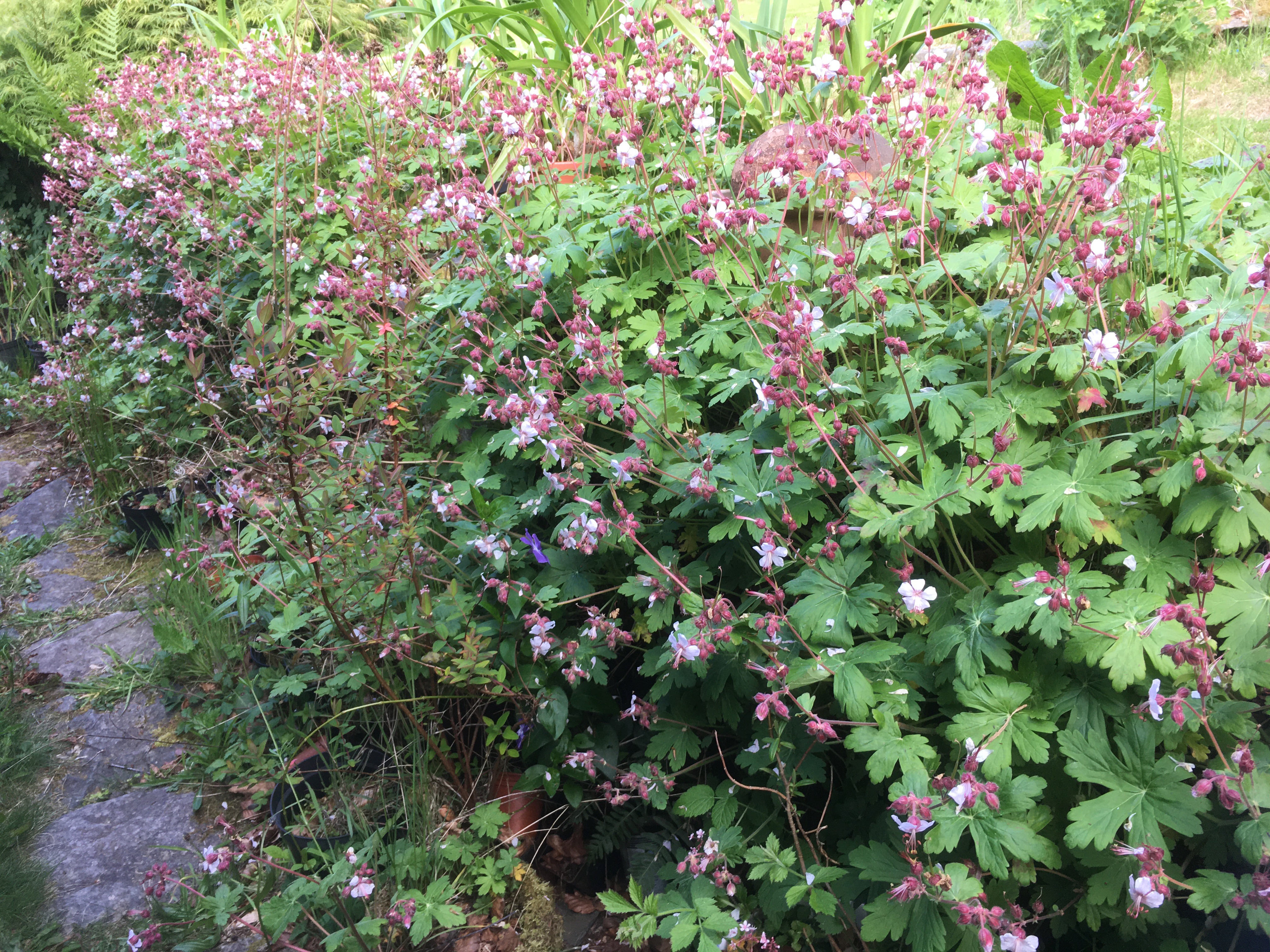
May is absolutely my favourite month of the year in the garden, a feast for the senses whatever the weather, but this year it has been particularly favourable (although I worry now that the blackbirds and song thrushes would benefit from some rain to help feed their young). For many of the month’s delights, including the colour and scent of the bluebells around the edges and the birdsong, I can, of course, take no credit. There is also the gentle hum of the bees – the various bumble bees, particularly in the comfrey and geraniums (Geranium macrorrhizum ‘Ingwersen’s Variety’), and the honey bees in the trees – the hollies and acers.
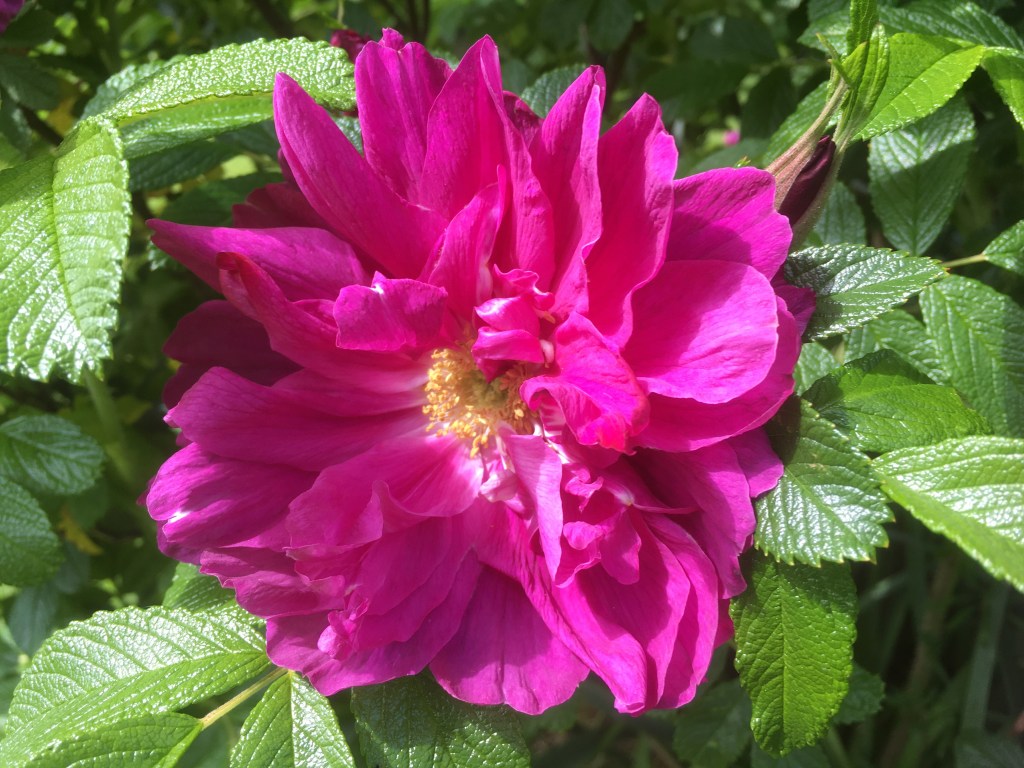
Moving into the second half of the month, the first rose, promising more as spring gives way to summer, appears – always Rosa rugosa ‘Roseraie de la Hay’. We were fortunate enough to be gifted three plants by neighbours who dug up some small bits from the hedge they had made lining their drive – so now we have our very own hedge of it.
It doesn’t have the large orange berries of single rugosa varieties, but it makes up for that in the depth of colour of the flowers and their scent – in this country their petals are frequently used for making rose petal jam.
April
This month is all about the wild garlic, as much in the kitchen as around the edges of the garden. Wild garlic soup is a delight at this time of year, and wild garlic pesto can be eaten now as well as frozen to remind us of spring in the coming months.

You have to make the most of the leaves in the shortish period between them becoming large enough to be useful and the flowers appearing, making a lovely white carpet in damp areas.
The other story of the month is provided by the Magnolias. The larger-leaved Magnolias are the first into flower, although they are more susceptible to bad weather (this year the very heavy rain and wind in early mid-April). I have no names for the two Magnolias below, but they are very beautiful.

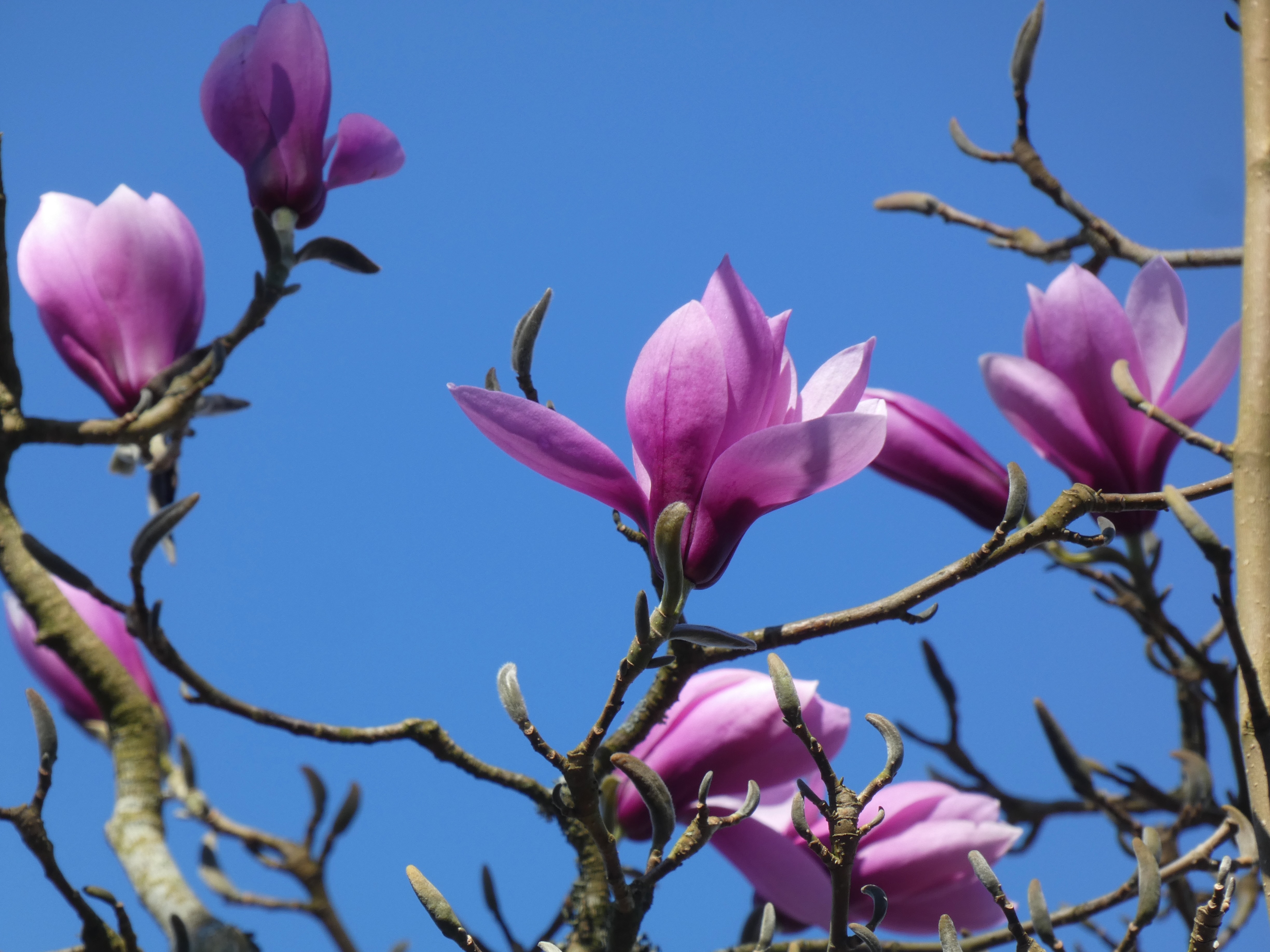
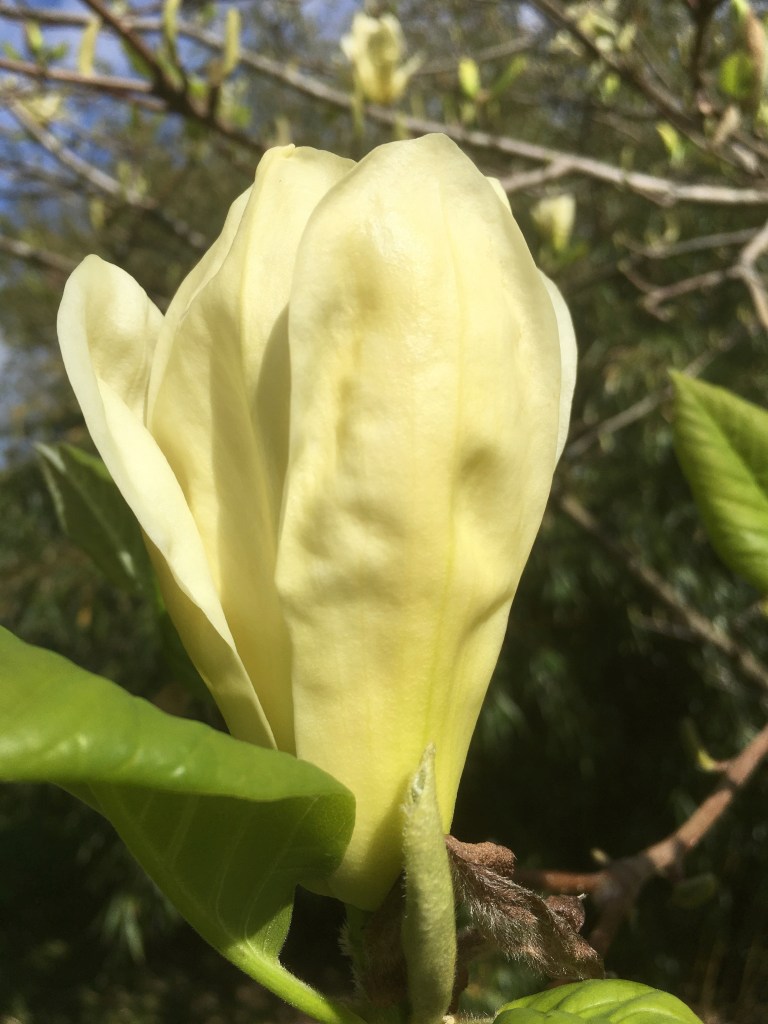
M. salicifolia is also early, followed by M. stellata , M. ‘Leonard Messel’ and M. soulangeana, which are more weather resistant. M. ‘Star Wars’, beautiful and floriferous but scentless, is a bit later, and the latest of all (into May) are M. denudata and M. ‘Yellow River’(left), a lovely pale yellow with a delicious scent.
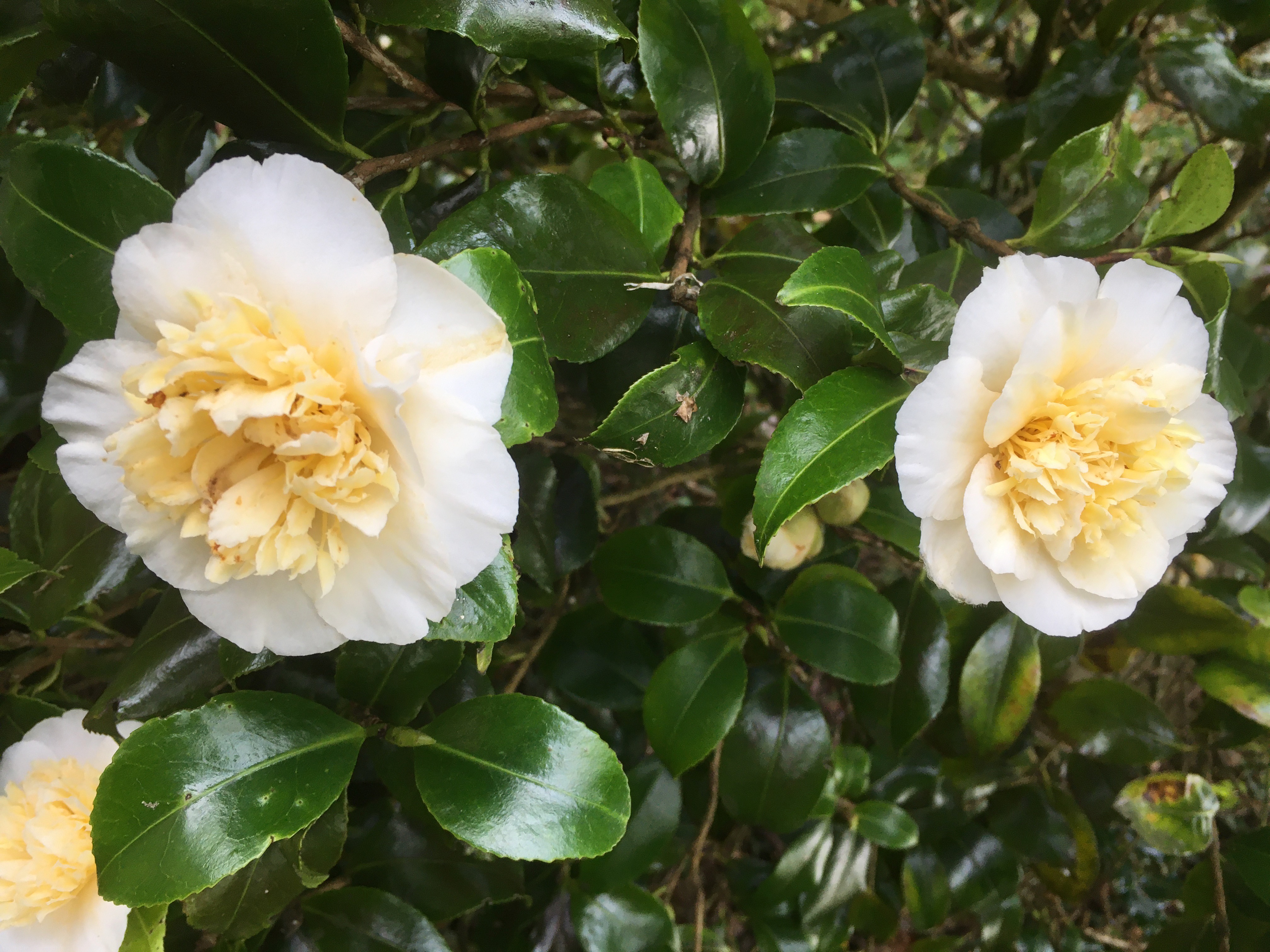
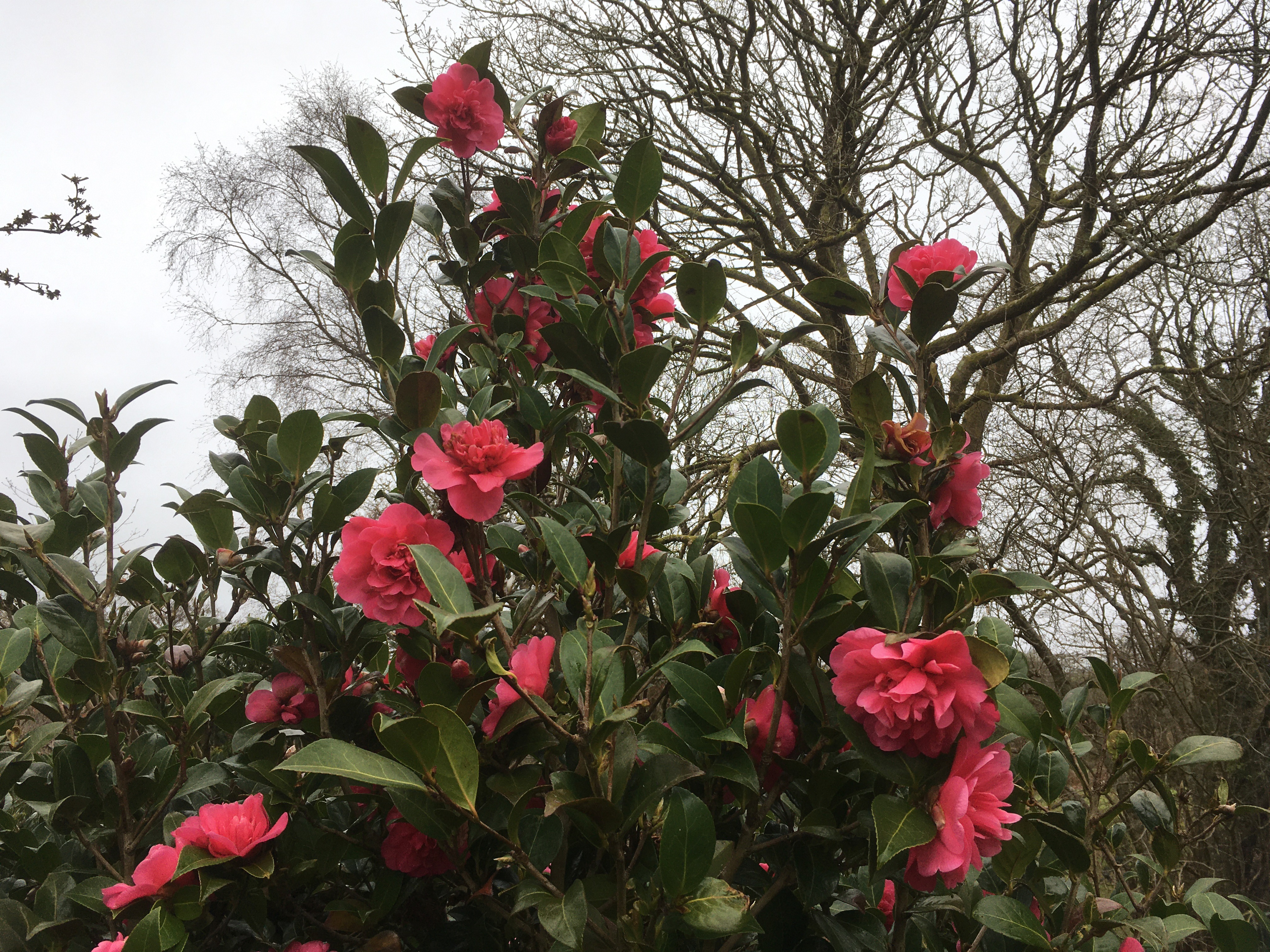
In the end, March was the wettest for forty years, which was not hard to believe. There has been a dry interlude over the Easter weekend, since when the weather has been more autumnal than spring-like. The Camellias like this weather no better than the Magnolias, and in many cases the ground beneath the bushes is carpeted in petals. I managed to take these pictures in early April in the brief interlude between the rains.

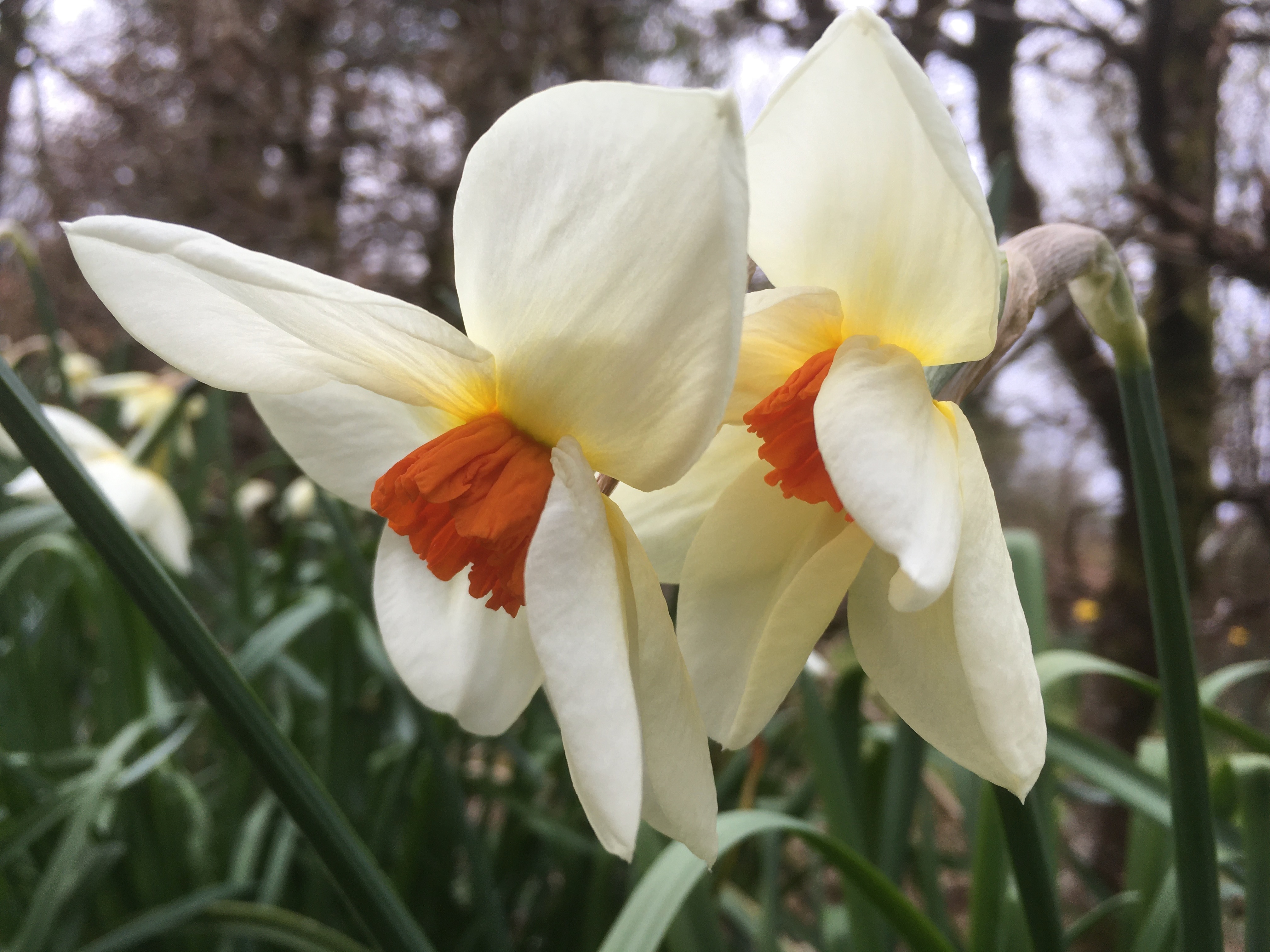
The rain has also been flattening the daffodils – here are some still unbowed…


A particular pleasure this year has been the flowering of Rhododendron ‘Sir Charles Lemon’. This is not the first year it has flowered, but it had taken a break for several years, so I was delighted to see it again.
The lovely ivory flowers are complemented by dark green leaves with a rich rusty-orange indumentum.
March
The weather turned colder at the very end of February, with a hard frost that made the lovely Rhododendron ‘Christmas Cheer’ flowers brown and soggy.

This was followed by falls of snow in the first week of March (the roar of the lion?), although it didn’t lie for long. The cold was followed by the sort of rainfall we hadn’t seen in the previous month, raining solidly, it seemed, through the second week of March.
The weather, however, couldn’t stop the march of spring, with each day a different Camellia opening its first flower. By the middle of the month a number of them were blooming, some strongly so, others with just one or two flowers: ‘St Ewe’, ‘J C Williams’, ‘Roger Hall’, Anticipation’, ‘Freedom Bell’, ‘Cornish Spring’, ‘Elegant Beauty’, ‘Donation, ‘Francie L’ and an unknown japonica with semi-double white flowers. In our climate in West Wales, I find the hybrids (mostly x williamsii) grow more strongly and are more floriferous than the japonica varieties. In all cases, it seems to take a while before they hit their stride and start flowering strongly once planted in the ground.

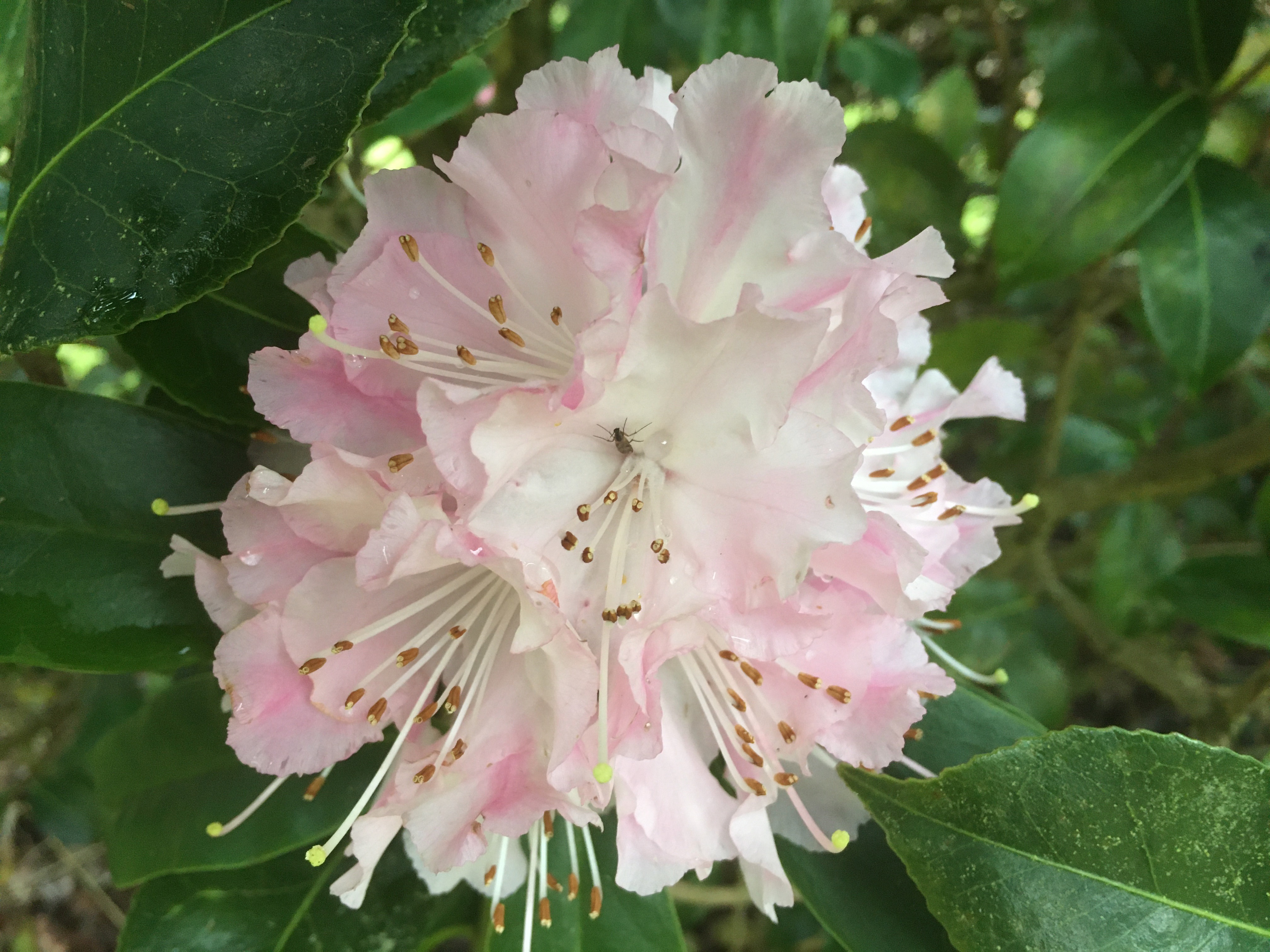
By the third week of the month, the furry casing was starting to fall from some of the Magnolia buds. The first Magnolia into flower is always what I bought as M. sargentiana var. robusta alba – although it patently isn’t ‘alba’, with magenta buds which open to large, floppy flowers of a palish, almost lilac pink; I think from the shape of the tree and flowers that it definitely has M. sargentiana var. robusta in its parentage.
As you can tell, I didn’t buy it in flower, and it must have been a seedling, which I hadn’t thought to check. I am fond of it because it is so early, but because of that it is liable to be frosted, and in any case the flowers only last about 10 days or so. The grey squirrels have a habit of tearing off some of the buds, including this one (as they also do with rhododendrons and camellias), which makes me very cross.

The milder weather in the second half of the month encouraged Rhododendron calophytum into tentatively bursting its buds, and Rh ‘Christmas Cheer’ resumed flowering.

I sometimes think that we went overboard when we planted as many bamboos as we have; however birds definitely seem to appreciate the shelter they provide. The pair of goldcrests which are back in the garden like them, and a song thrush is building a nest in Phyllostachys nigra.
The first chiff-chaff was heard in the garden on 21 March (hurrah!), and lambs are now bleating from the fields around – will the month finish on that note (‘in like a lion, out like a lamb’)?
February
February was a relatively mild month, and it was reported for at least part of the UK as the driest in 30 years. Certainly our unlined pond just had a puddle of water in the bottom and the ground was far drier than usual. By now you can really feel the difference in the amount of daylight, and the bird song is increasing, with song thrushes, blackbirds, great tits and robins particularly audible.

One of the more subtle delights of the month is Parrotia persica ‘Vanessa’, a relative of the witch hazels, and making up to a certain extent for my seeming inability to grow the latter here. I have had a number over the years, but have never managed to keep them more than about five or six years. P. ‘Vanessa’ has a very neat habit, and like all of its family has fabulous autumn colour, although the leaves do fall early.
By the second week of February the frogs were busy in the garden pond, and the first frogspawn appeared on the 10th. The early snowdrops were in full flower, and another sign of spring was the first of the daffodils on the 12th. Early perennial shoots poke through the soil, as do the leaves of the wild garlic.

Every year Betula ermanii is the first tree into leaf towards the end of the month – usually to its own detriment, as the leaves are very often frosted – so fingers crossed for this year. The relative mildness of the second half of the month has encouraged other plants, and some of the camellias in particular now have flower buds on the cusp of opening. It has also brought out honey bees and the odd buff-tailed bumble bee visiting the snowdrops, daphnes and camellias.
January
January this year opened on a decidedly dull and wet note, as indeed December had ended. This lasted until mid-January, when we had a second, for this winter, cold and frosty spell. The first had been in mid-December, when temperatures had dropped overnight to -10oC, and stayed below freezing all day for several consecutive days. The January temperatures were not as low or as extended, but still reached minus -6oC.
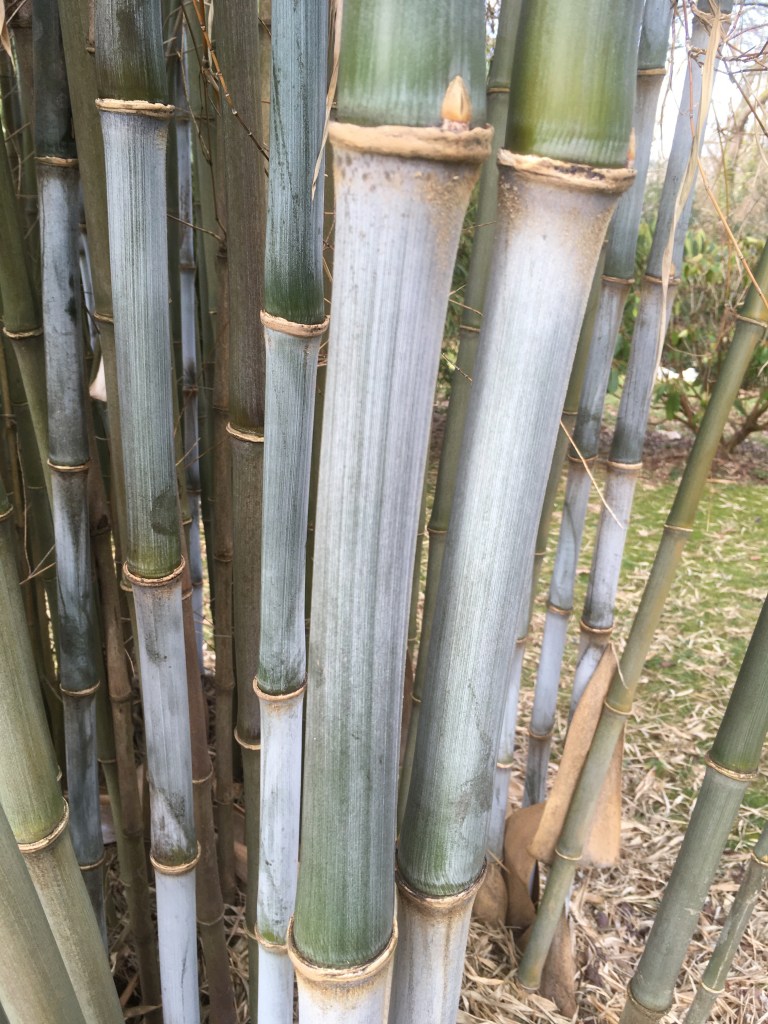
Those low temperatures, particularly in December, have been damaging for some plants. The jury is still out on ultimate survival, but very badly damaged plants include: Borinda papyrifera (pictured on the left, with very fine grey-green stems, the most impressive bamboo in the garden by far); Rhododendron sinogrande, Eucalyptus (probably globulus) and Drimys winteri. I’m keeping my fingers crossed – I would hate to lose any of them. Many of the other evergreens have dropped a lot of leaves – other large-leaves rhododendrons, some camellias, and the Daphne bholua.
Rhododendron ‘Christmas Cheer’ had indeed opened its first bud on 25 December, buds continued opening very slowly through January – but any open flowers were caught by the frosts in the middle of the month.

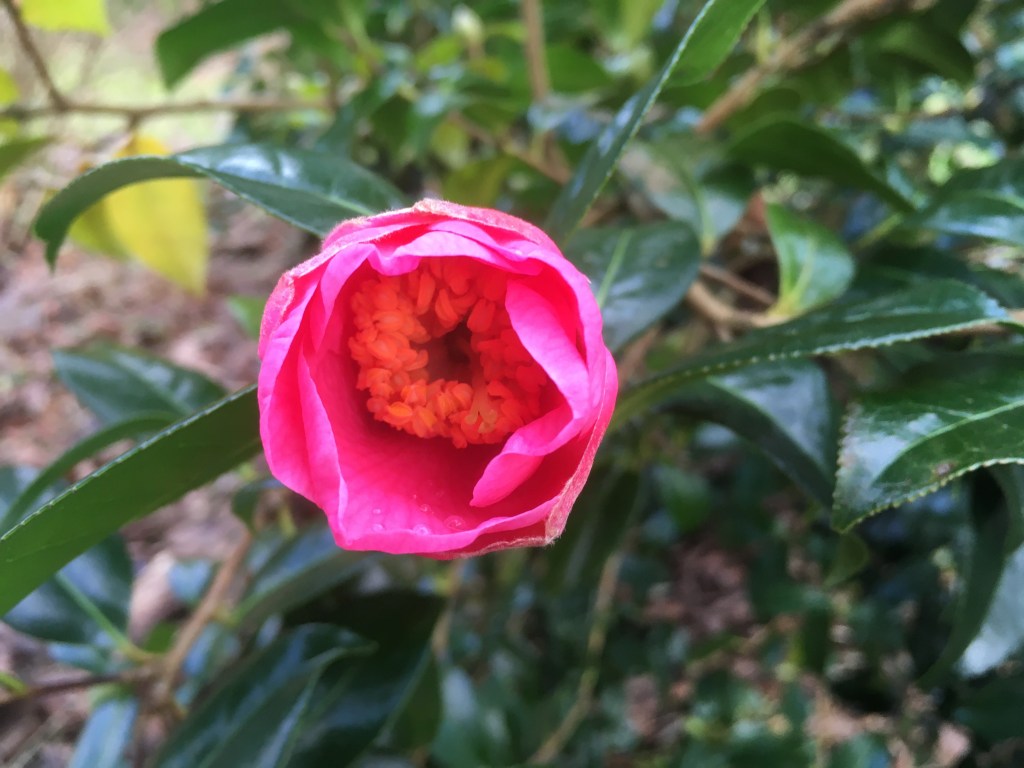
Camellia ‘St Ewe’ is always the first Camellia to have flowers here (this year its first flower opened on 13 January). It is such good value – it will continue flowering right through to April, although its peak is March, and of all the camellias that I have, its flowers are probably the least damaged by frost.
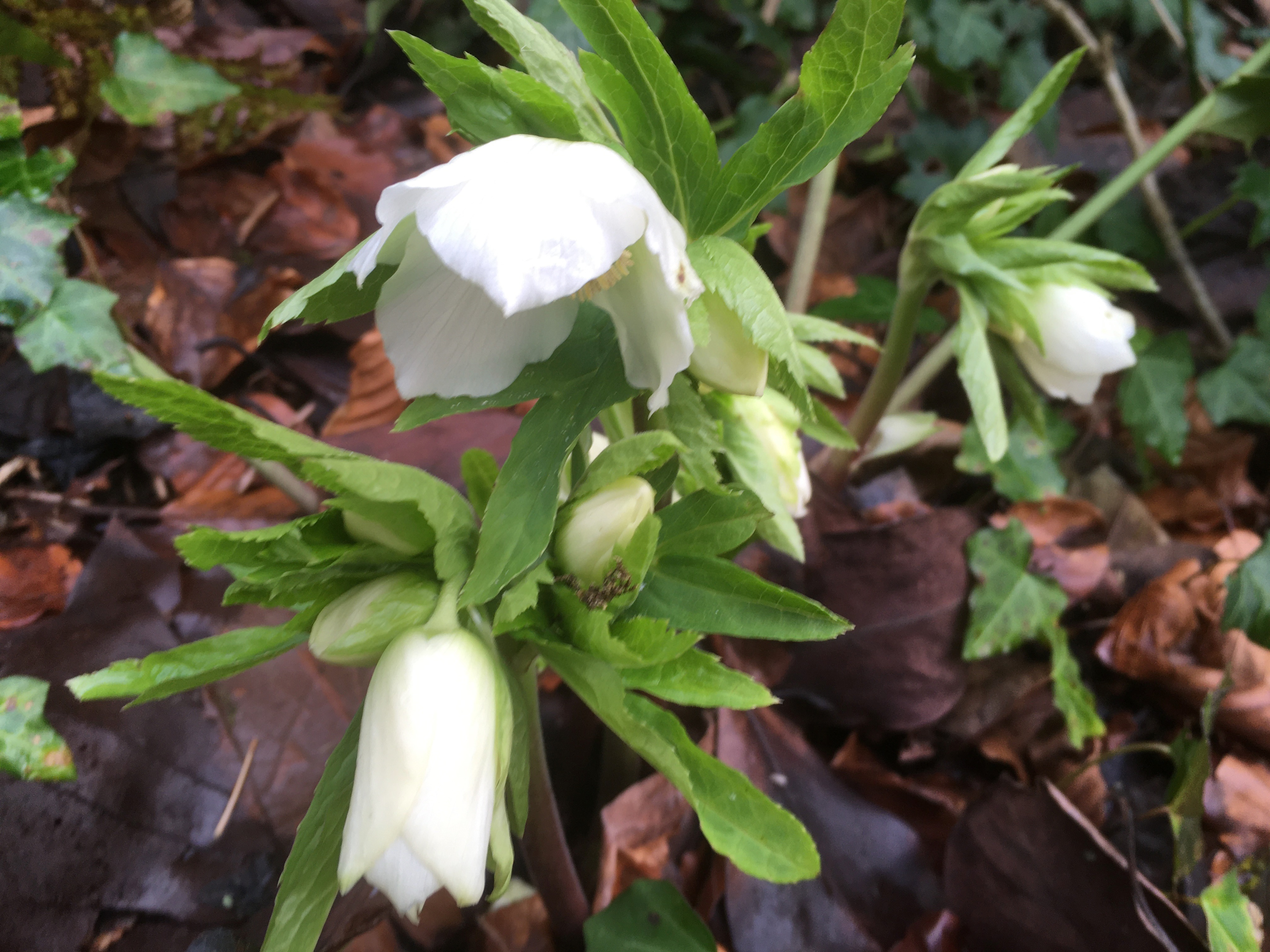
A pair of gold crests frequented the garden throughout January, but I haven’t seen them since. The early snowdrops and hellebores also lifted the spirits in one of the darkest months.

 Cothi Gardeners